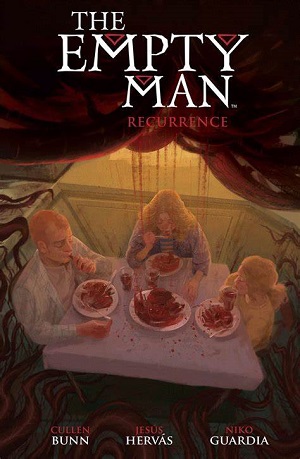
The Empty Man: Recurrence

The Empty Man: Recurrence

In my review of The Empty Man I said I came away from it with mixed feelings. Well, I felt the same way here, though the needle was pointing a little more to the positive.

The Empty Man virus is still in full swing, though no one has figured it out yet. A doctor is shown on TV explaining a bit about its different stages, but at the end of the day (meaning the end of this comic) we’re no clearer as to what’s going on. It seems like humanity is caught in someone’s nightmare, a nightmare that has taken on a life or physical form of its own and is now being projected around the globe. The virus makes its victims act out in spectacularly violent ways, so it doesn’t seem like a very nice thing, though its message is that it only wants to bring people together and create a kind of paradise on earth. There’s a cult of crazies who worship it, but they don’t seem like they’re up to anything good. The “manifestations” or “sacred visitations” of the virus look like a cross between Marvel’s Carnage and a giant shrimp. So that’s all to the bad.

The murkiness that I complained about in the first book is still with us. And things like the peroration here, where it’s said that the virus is a response to humanity taking our free will too far, just added to my confusion. But having said all that, this is a more focused story, with agent Walter Langford having moved off-stage and Monica Jensen (formerly FBI) and Owen Marsh (formerly CDC) being the main protagonists. They’re freelancing now, trying to protect a suburban family home from cultists without and the Empty Man within, as the mother is possessed. Jensen herself has the virus too, but she’s keeping it under control with meds. I don’t know how much longer that’s going to work though.

The art by Jesús Hervás also struck me as a step up from Vanessa R. Del Rey’s, though it shares a very sketchy texture that makes faces seem almost semi-sculpted out of clay, melting or otherwise ill-formed. But at least I could see what was going on.

I don’t know why I liked The Empty Man, but I did. And I had the same response to Recurrence. On the face of it, I shouldn’t have liked it at all. The story is muddled and, from what I could make of it, not very good. The art is rough. And yet it has a vintage X-Files sort of flavour to it and I found myself interested in what was going on. Unfortunately the story, as basic as it is, isn’t resolved, leaving us with a couple of cliffhangers. Oh well. Onward, then.

Graphicalex

Recalled!

For those of you who have been following the saga of my application for reimbursement from the Quaker company after their recall of a few select products, I’m happy to announce that I did finally receive the proverbial cheque in the mail. Not a cheque though but a Rewards Card. Took twice as long as they said it would take to arrive, but I’m not complaining! Indeed, I’m even a little impressed. I was starting to have my doubts it would happen. Well done! And yes, that does mean I’ll be buying more Quaker Harvest Crunch cereal soon.

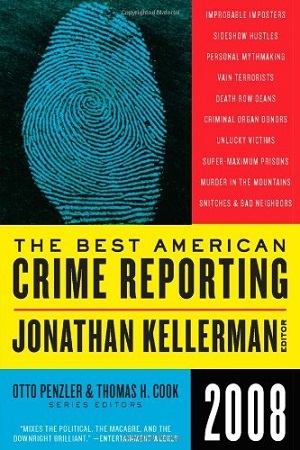
TCF: The Best American Crime Reporting 2008

The Best American Crime Reporting 2008
Ed. by Jonathan Kellerman

The crimes:

“The Story of a Snitch” by Jeremy Kahn: snitches get stitches, or in Baltimore they’re shot multiple times and left for dead.

“A Season in Hell” by Dean LaTourrette: an American finds himself on the wrong side of the criminal justice system in Nicaragua.

“I’m with the Steelers” by Justin Heckert: claiming to be a member of the Steelers (an NFL team) gives a boost to a romance scammer living in Pittsburgh.

“The House Across the Way” by Calvin Trillin: a fight between neighbours on a New Brunswick island gets nasty.

“The Caged Life” by Alan Prendergast: Tommy Silverstein spends a very long time in isolation.

“Badges of Dishonor” by Pamela Colloff: the case of a pair of border guards who shoot an illegal and then try to cover it up becomes a political football.

“Dangerous Minds” by Malcolm Gladwell: the “science” of criminal profiling may only be a parlour trick.

“Dean of Death Row” by Tad Friend: a profile of Vernell Crittendon, who was in charge of executions at San Quentin for thirty years.

“The Tainted Kidney” by Charles Graeber: serial killer Charles Cullen (whose crimes were covered by Graeber in more depths in The Good Nurse) wants to donate a kidney. This turns out to be more difficult than it would be in, say, China.

“The Ploy” by Mark Bowden: army interrogators track down an al-Qaeda leader in Iraq by interviewing people connected to him.

“Day of the Dead” by D. T. Max: author Malcolm Lowry died after drinking heavily and taking a bunch of barbiturates. His wife may have helped him along.

“Just a Random Female” by Nick Schou: the capture of serial killer Andrew Urdiales.

“The Serial Killer’s Disciple” by James Renner: child murderer Robert Buell is executed, protesting up until the end that he was innocent of one of the murders he’d been implicated in. James Renner suggests Buell’s nephew may have had some responsibility for that one.

“Mercenary” by Tom Junod: the security manager at a nuclear power plant in Michigan imagines a fantasy life as a super-soldier.

“Murder at 19,000 Feet” by Jonathan Green: Tibetans looking to escape China by crossing over the Himalayas are shot by border guards, but the incident is viewed, and filmed, by Western mountaineers.
The book:

I’ve talked before about how I’m a big fan of this series, and how disappointed I was that it was cancelled. That said, I found this to be one of the weaker entries. For starters, there were a few stories I don’t think I would have included, for various reasons. One outlier would be acceptable, but even though true crime is a big tent I wouldn’t have included the Malcolm Lowry story here (which is just speculation), or the stories about the security manager who is a fabulist, the army “gators” at work, or the Chinese border incident. That’s not to say they aren’t good reads – I found “Mercenary” to be particularly intriguing – but I just didn’t think they belonged here.

I also didn’t think any of the stories stood out as being particularly memorable, aside from maybe Malcolm Gladwell’s critique of the science of criminal profiling. I even remembered much of that one from when I first read it in the New Yorker almost twenty years ago. I’m no fan of Gladwell, not even a little bit, so you can take it from me that it’s a piece worth checking out. Though his take really isn’t original. Indeed, it draws on a lot of work that had been done in the field, and various other true crime writers and reporters had been saying similar things. By coincidence, in one of the other pieces collected here, “The Serial Killer’s Disciple,” the police go to the FBI to get some help hunting a killer preying on young girls. I’ll let Renner tell the story:

The FBI commissioned a criminal profile of the perpetrator by Special Agent John Douglas, whose pioneering studies of the habits of serial killers inspire the book The Silence of the Lambs. Krista’s killer should be in his early to late 20s, Douglas said. He is a latent homosexual.

“When employed, he seeks menial or unskilled trades,” wrote Douglas. “While he considers himself a ‘macho man,’ he has deep-rooted feelings of personal inadequacies. Your offender has a maximum of high school education. When he is with children, he feels superior, in control, non-threatened. While your offender may not be from the city where the victim was abducted he certainly has been there many times before (i.e., visiting friends, relatives, employment). He turned towards alcohol and/or drugs to escape from the realities of the crime.”

Even without knowing how things turned out, I would have thought this unhelpful. Who doesn’t feel superior, in control, and non-threatened when among children? In any event, the police arrested Robert Buell only after one of his victims escaped.

At the time, Buell was 42 years old. He had a college degree and was employed by the city of Akron, writing loans for the Planning Department. He was dating an attorney. He had a daughter at Kent State. Those who knew him described a neat, clean, orderly man, almost to the point of obsessive-compulsive disorder. He didn’t exactly fit the FBI’s profile of their child killer.

So that’s the second burn of John Douglas in the book, which you’d think would be two too many for someone with his reputation as a legendary mindhunter. As I’ve said before, there are good reasons why the public has stopped trusting experts.

Though it’s hard to characterize an annual anthology like this as having a particular theme, the fact that they have editors with presumably different interests and points of view does mean that each volume has its own character. In the inaugural collection edited by Nicholas Pileggi I noticed a recurring interest in the theme of bad fathers. In 2007 I found a lot of the stories had to do with a betrayal by individuals in a position of trust. If I had to point to a theme for the 2008 edition I might say it’s community.

Before the advent of the digital age, with its romance scammers and crypto frauds, most crime was local. It matters that the first story here is set in Baltimore, the second takes place in Nicaragua, the third in Pittsburgh, and the fourth on an island just off the coast of New Brunswick. In each of these stories the place plays an active part in the events, as do the later stories dealing with border incidents. But community isn’t just about these sorts of locations. It’s also about places like death row, and the community of prison officials and inmates.

In the early twentieth century there was a literary movement known as Naturalism that saw humanity as basically bound by deterministic laws. One’s fate was a combination of heredity (genetics) and environment. This is something a little different than nature and nurture, the terms most often used in explaining criminality, and the question of whether criminals are born or made. Obviously an emphasis on community puts the focus on the environment, but it’s not an equation that’s being argued for here, or even a strict chain of causation. It’s more that place and community do a lot to define what constitutes criminal behaviour in the first place. Is “snitching” worse than witness intimidation? Is taking a shot at a noisy newcomer who’s wrecking the neighbourhood by running a purported drug house a crime? It depends on the neighbourhood and its community values.

Noted in passing:

Over the years I’ve come back many times to an essay by Tennessee Williams called “The Catastrophe of Success,” which was about the impact the success of The Glass Menagerie had on his life. It seemed to me to be the kind of paradox that isn’t often addressed, either by artists themselves or the people who write about them. The point being that it can actually be harder to follow-up a critical or commercial triumph than to break through in the first place, and that success itself can be a crushing creative burden or otherwise be destructive to the conditions that made the breakthrough possible. As Williams put it:

The sort of life that I had had previous to this popular success was one that required endurance, a life of clawing and scratching along a sheer surface and holding on tight with raw fingers to every inch of rock higher than the one caught hold of before, but it was a good life because it was the sort of life for which the human organism is created.

Success, however, brought not only the comfort of “an effete way of life” but a sense of “spiritual dislocation.” “Security,” Williams concluded, “is a kind of death.”

For Malcolm Lowry life never became that cozy, but after Under the Volcano there would be no second act. And he might have recognized something in what Williams said. “Success,” Lowry wrote to his mother-in-law, “may be the worst possible thing to happen to any serious author.”

Takeaways:

Crime is defined by a community, and though not always restricted by place it at the very least always has a specific cultural context. From the Histories of Herodotus:

Just suppose that someone proposed to the entirety of mankind that a selection of the very best practices be made from the sum of human custom: each group of people, after carefully sifting through the customs of other peoples, would surely choose its own. Everyone believes their own customs to be by far and away the best. From this, it follows that only a madman would think to jeer at such matters. Indeed, there is a huge amount of corroborating evidence to support the conclusion that this attitude to one’s own native customs is universal. Take, for example, this story from the reign of Darius. He called together some Greeks who were present and asked them how much money they would wish to be paid to devour the corpses of their fathers – to which the Greeks replied that no amount of money would suffice for that. Next, Darius summoned some Indians called Callantians, who do eat their parents, and asked them in the presence of the Greeks (who were able to follow what was being said by means of an interpreter) how much money it would take to buy their consent to the cremation of their dead fathers – at which the Callantians cried out in horror and told him that his words were a desecration of silence. Such, then, is how custom operates; and how right Pindar is, it seems to me, when he declares in his poetry that “Custom is the King of all.”

True Crime Files
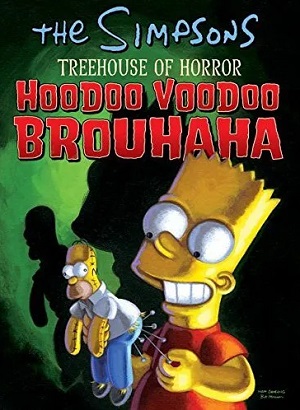
The Simpsons Treehouse of Horror: Hoodoo Voodoo Brouhaha

The Simpsons Treehouse of Horror: Hoodoo Voodoo Brouhaha

This instalment of the popular Simpsons Halloween special is introduced by Comic Book Guy, someone who knows something about a wasted life. He’s prepared a list of things that scare him most – “A slobbering child in the vicinity of a near mint-condition Golden Age comic book,” “What may lurk beneath my beard” – and concludes it with this observation:

But what scares me the most? Poorly executed comic books. Every piece of awful graphic literature that I’ve read cannot be unread. The hours spent cannot be added back to my lifespan. And since much of what I read is awful, said mediocrity has eaten up approximately 17.4 years of my allotted time on Earth. Sooner or later, the days I have left to live will be in deficit to the amount of times I have spent reading paper drive classics like “David Niven Adventures” or “Radioactive Man Vs. The New York Times Crossword Puzzle.” This realization chills me to the bone.

This is the same sort of accounting that I think gives every dedicated reader pause. It may not chill us to the bone, but it does force us to reflect and do a bit of mental accounting. And then we soldier on . . .

I’m a big fan of the Simpsons comics. For all their being a glossy corporate media product, they’ve somehow managed to stay inventive and fun. In particular, the Treehouse of Horrors – a flagship event for the TV show – really lets them go all out with a variety of different stories and art. There are quick pieces like Comic Book Guy’s Best Costumes Ever and Professor Frink’s Hyper-Science Halloween Hi-Jinx and Party Pranks, and parody movie posters (Planet of the Apus, Night of the Living Ned, Teacher from the Black Lagoon). And then there are longer stories, often riffing on established properties like “Krustina” (a haunted clown car that’s a take-off of Christine), “From Hell and Back” (a parody of the Alan Moore comic From Hell and the movie they made out of it), and “The Cask of Amontilla-D’oh” (Poe’s famous tale recast with Moe taking out his frustrations over Homer’s unpaid bar bills). There’s even one story that’s told entirely in the form of limericks, “The Power Plant of Pain.” Though it’s the art that’s the best part of that one.

If I had a knock against this particular book it’s that the stories, while always clever and amusing, weren’t that funny. It’s a handsome production (being a big-media publication has its advantages!), the ideas they came up with were great, and the art is first-rate all the way through, but there were few laughs. It’s not the best Simpsons volume then, or even their best Treehouse of Horrors, but I still enjoyed every bit of it.

Graphicalex

Marple: The Idol House of Astarte

It’s the turn of Dr. Pender, “the elderly clergyman of the parish,” to tell a mystery story to the Tuesday Night Club, and he comes through with a preposterous tale about a house party that goes wrong when a guest, “one of the notorious beauties of the Season,” takes on the persona of the goddess Astarte and strikes the host dead.

There’s a video I remember watching a while ago that had the magician Penn Jillette explaining various magic tricks seen in movies, and when remarking on the transportation booth in The Prestige he says that it’s a bad trick if there’s only one way it could be done. Which is basically the same idea as Holmes’s famous dictum that “When you have eliminated all which is impossible, then whatever remains, however improbable, must be the truth.” Such an approach made solving the mystery here pretty straightforward, as the various attempts at an explanation put forward by the Club members (a javelin, “mass hypnotism,” etc.) are absurd. So pretty much what you think happened at first is in fact what happened. Miss Marple comes to the right conclusion precisely by not indulging her imagination, and cutting everyone else off short by saying “Of course there is only one way poor Sir Richard could have been stabbed.” I think in one of Christie’s novels she would have indulged something a little (or a lot) more improbable, but in a short story there’s no time for that so the obvious solution had to be the correct one as well.

The retired police commissioner also manages to identify the killer’s real identity despite Dr. Pender changing the names in his telling of the story. I thought this an odd note to end on, and it made me wonder if Christie might have had someone specific in mind.

Marple index

The purple stuff

Another pic from my garden. I don’t know the name of any of the stuff in my garden, as careful readers have pointed out on previous occasions. I’m just not a plant person. I don’t know what this purple ground cover is, but for a couple of weeks in the spring it looks nice.

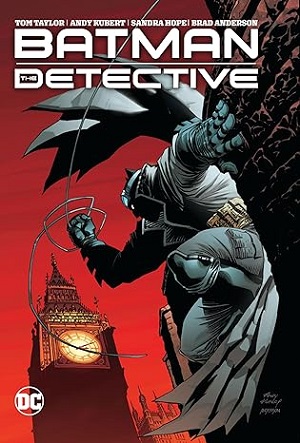
Batman: The Detective

Batman: The Detective

The biggest story in the development of movies in the twenty-first century, at least the first quarter of it, was the domination of comic-book action films. Not just the MCU, but almost any action movie started seeming more and more like a comic book through the heavy use of CGI and generic comic-book tropes.

It wouldn’t be unreasonable though to think that some influence went the other way. That’s certainly the feeling I had reading Batman: The Detective, which plays very much like the graphic-novel version of a Hollywood movie of the period, from the storyboard flavour of the action sequences to the iconic European locations.

Of course one of those comic-book tropes I mentioned as bleeding into film is that of the deathless hero. Despite all the scars on Batman’s tank-like frame (he’s huge in this comic), he just keeps going along. I mean, how does he crack a rib and dislocate his shoulder and keep on fighting when he crashes out of the hospital window and falls to the street? And even more to the point, how do the mooks he falls on keep going? And how does Beryl Hutchinson (Knight) survive falling from a plane and then being shot at point-blank range by Equilibrium? It’s not like Equilibrium wants to spare her, as Hutchinson must have been on the kill list and we know Equilibrium is a homicidal maniac. But the next time we see here she’s sitting up in a hospital bed, and by the time we get to the end of the series she’s ready for action again. I feel like I was missing something there.

Still, this is a really good comic that kept me interested all the way through. The action is great, and the writing moves us along quickly, even though I thought the plot was ridiculous. Equilibrium’s motivation seemed sketchy to me, but she was a strong villain, enforcing some kind of amoral order against Batman as agent of chaos. I thought of her as the anti-Joker in this regard.

I just don’t know why it was called The Detective since Batman doesn’t do much detecting here aside from plugging into his continental network (the European Alliance of the Bat) and getting status updates. I was also wondering when Batman started wearing goggles. I’m not enough of a Batman stan to know that bit of trivia.

One minor point: the use of @#$%$@# for cuss words seems out of place in a contemporary comic. Either don’t use bad language (there’s no need for it here) or spell it out. This isn’t Asterix.

Graphicalex

Little critters

Last year at this time I posted a pic of a neighbour’s back porch that a family of foxes had made their home. I haven’t seen the foxes this year, which means the same location has been taken over by other creatures that have just welcomed some new additions to their families. See if you can find the baby groundhogs and the baby rabbit in this pic! (You can make the picture bigger by clicking on it.)

TCF: Deadly Little Secrets

Deadly Little Secrets: The Minister, his Mistress, and a Heartless Texas Murder
By Kathryn Casey

The crime:

When Kari Baker was found dead by her husband Matt on April 7, 2006 it was judged to be a suicide by drug overdose, mainly because that is what Matt, a Baptist minister, told the authorities had happened. He also showed them a suicide note. Kari’s family, however, didn’t believe she would have killed herself and pursued a wrongful death civil case against Matt. After much prodding the police filed charges and, with Matt’s mistress testifying against him, he was found guilty of murder and sentenced to 65 years in prison.

The book:

There’s a blurb of praise from Ann Rule on the cover of Deadly Little Secrets and I think that’s entirely apt as Kathryn Casey has always struck me as the Texas version of Ann Rule. What I mean is that while both authors cover a fair bit of ground, their real specialty is doing these deep dives into marriages and relationships that hit the rocks in a big, bad way. And I’m not knocking that, since I think there’s a real value in digging into such stories, precisely because they are so commonplace. If you’re going to be murdered, chances are pretty good it will be at the hands of a domestic partner. It’s certainly a lot more likely than being killed by a stranger. So it helps to be familiar with some of the warning signs.

Matt Baker’s murder of his wife Kari was a terrible tragedy but at the same time it was nothing much out of the ordinary. I was even a bit surprised that national news programs like 48 Hours and 20/20 ran segments on it, as I would have thought it was mainly a story of local interest. But I guess the “murdering minister” angle, which is all that sets it apart from countless similar stories of husbands killing their wives, played well in the media.

That a so-called “man of god” could go bad, or be bad in the first place, didn’t strike me as being news. I’m more concerned at how many people there still are who think individuals in positions of trust and authority are deserving of so much respect and deference. Cops, doctors, and clergy, to take just the most obvious examples, are no better or worse than anyone else out there. Given that, and the fact that at over 400 pages this is a book that goes into Matt and Kari’s break-up in granular detail, what lessons can we learn?

I think the red flags with Matt were all the obvious ones. He was overly possessive and controlling. He had no friends. He couldn’t stick with any one job for very long, usually being dismissed for some inappropriate conduct that wherever he was working wanted to keep hushed up. He was a sex addict. None of this meant he was bound to end up killing his wife, but they were bad signs. Only being a minister bought him a lot of trust, and Kari never wanted to believe the worst.

The other thing that stood out to me for it’s not being remarkable was the way the police investigation got off on the wrong foot and then only got worse because people in authority never want to admit making a mistake. By sheer coincidence I read David Wilson’s A Plot to Kill right after Deadly Little Secrets and both books deal with murders involving drug overdoses that were originally considered to be suicides or accidents so that the authorities didn’t have to perform an autopsy. When Wilson tried to get a copy of the coroner’s report on Peter Farquhar he was shut down in a way that he clearly felt miffed by. But I think he also understood why he was getting that treatment, and it’s not because he was a famous author. There are few rules more absolute when it comes to corporate culture than CYA (Cover Your Ass), and the police are nothing if not a corporate bureaucracy.

As with any bureaucracy, the failure of the police in this case wasn’t the result of corruption or incompetence but instead could mainly be put down to simple laziness. In my experience this is the Occam’s Razor of explaining how things go wrong in most organizations. It’s not the fault of bad people so much as people who can’t be bothered doing anything more than the bare minimum to keep their jobs. In this case, the police were offered an easy explanation for Kari’s death so they just took it at face value (a typewritten suicide note?) and called it a day. No need to bother with an investigation.

Because there was so little physical evidence collected the trial itself turned into a very near-run thing. Matt might have even been able to beat it if he’d known enough, or been better advised, to keep his mouth shut. You should always keep your mouth shut in such situations. This was the takeaway I offered in my review of The Count and the Confession: “Innocent or guilty, you have nothing to gain by talking to the police. It won’t do you any good and could get you in a lot trouble.” Talking to the police almost sent Beverly Monroe to prison for life, and she was innocent. It’s what nailed Matt, who otherwise had a good chance of walking out of court  a free man.

Noted in passing:

Guy James Gray, Matt’s defense lawyer, got angry with Matt when he found out that Matt had been lying to him about not having an affair with the younger woman he hooked up with after Kari’s death. Indeed, Gray was so furious that he filed a motion to be taken off the case, citing a “serious breach of confidence.”

That didn’t sit well with Gray, who’d convinced himself early on that he had an innocent client. Suddenly Gray, like the prosecutors, had Baker pegged as a liar. “I think the judge should have let me leave,” he says, with a frown. “From that point on, I never talked to Baker unless I legally had to. I wanted nothing to do with him.”

This isn’t how it works. Or at least it’s not how it’s supposed to work. In the first place, Matt had only confessed at this point to lying about his affair, he hadn’t admitted to killing Kari so was still at least potentially an “innocent client.” But more than that, a defense attorney has a professional duty to present his or her client’s case as best they can, and the question of whether their client is actually guilty or innocent doesn’t come into it. For Gray to suggest he gave up on the case, a sort of “quiet quitting,” when he wasn’t allowed to resign (which would have been very difficult given how late in the day it was) is something I found really surprising.

Takeaways:

One can make any number of stupid mistakes in killing someone and still get away with it. Matt Baker was no criminal genius and should have been caught dead to rights but for the fact that he was a minister. What finally tripped him up though was the fact that his wife had a lot of close family members and friends who weren’t going to let the matter of her death slide and who had the resources to pursue Matt when the police and DA didn’t want to get involved.

There’s a reason so many serial killers manage to keep murdering for years without getting caught. They tend to prey on individuals who are socially isolated or who exist on the fringes of society. Runaways, homeless people, the down-and-out. Killing people with stronger connections to their community is a lot riskier.

True Crime Files