An index to my reviews of the Mike Hammer stories and novels by Mickey Spillane (and others).
The skunks of spring are coming

As I’ve had occasion to say before, it’s hard to take a good picture of a skunk. They’re usually only out during times of day when there isn’t much light, and they don’t like to stand around waiting while you get your phone out and take their picture. Last winter I took some pictures of one trying to climb a snow hill. This may be the same one, as it was near the same place.
The Hound of the Baskervilles
The Hound of the Baskervilles
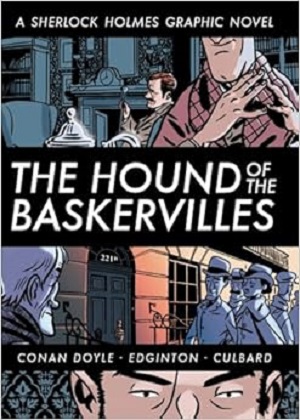 When it comes to graphic novel versions of the classics, artists are in a tough spot. They’re rarely free to go their own way and the text, of which there is usually a lot, can be quite an anchor. Nevertheless, the right combination of an artist’s visual style with a classic author’s sensibility can have magical results.
This adaptation of Conan Doyle’s The Hound of the Baskervilles falls somewhere in the middle range. It’s very faithful to the text, not just incorporating a lot of the original dialogue but even keeping the novel’s chapter breaks and titles. Luckily, Doyle’s story isn’t that long so it’s a manageable job. And the art by I. N. J. Culbard isn’t generic. He does have his own style, as perhaps best seen in his signature way of drawing faces with a curved vertical slash that descends from the middle of the forehead to past the end of the nose. I have to say this really puzzled me as it shows up on every face and I couldn’t figure out what it was supposed to correspond to. A cheekbone? Ritual scarring?
Was Culbard’s style a good fit though? I think so, at least for a version aimed at younger people. The violence is softened, with the bruises and welts on Beryl’s body, for example, turning into the faintest of shadowing. And I’m afraid the hound itself, in its climactic appearance, bears an uncomfortable resemblance to Slimer from Ghostbusters. But then the hound, whether in illustrated versions of the story or appearing on screen, is almost always a disappointment, going on over a century now.
Premonitions of spring
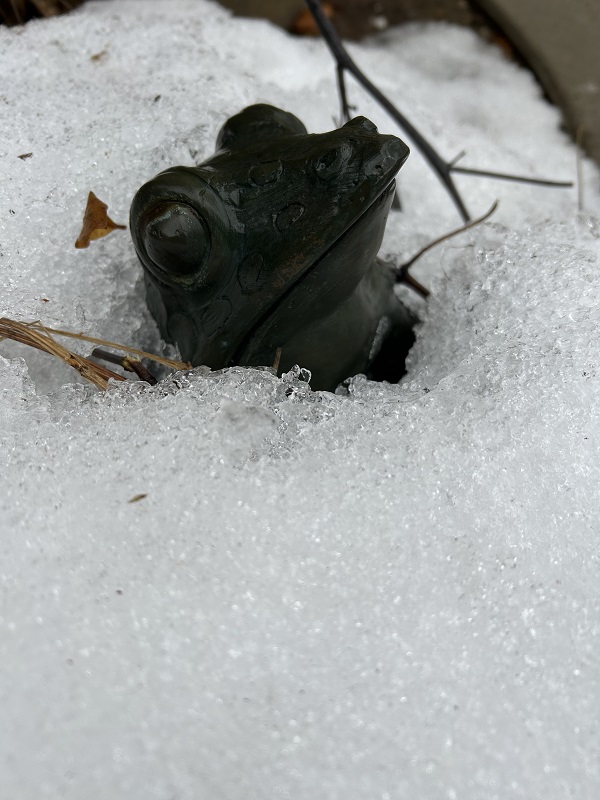
You know the story about the frog in the pot that’s brought to a boil? Not true, apparently. The frog will jump out before it gets too hot. Anyway, as the snow starts to melt around here I noticed the head of this frog statue I have in my front garden peeping out of the snow. He’s sort of the reverse of the frog in a boiling pot. Maybe he was hibernating. Or “brumating” as it’s called with reptiles. Can spring be far away?
Foul Play!
Foul Play! The Art and Artists of the Notorious 1950s E. C. Comics!
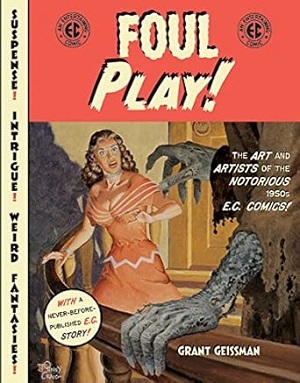 One of the most remarkable things about the immediate cultural impact and subsequent legacy of E. C. Comics is that their glory days only lasted for about five years, from 1950 and the beginning of their “New Trend” in (mostly horror) comics, to 1955 and the implementation of the Comics Code. They weren’t DC or Marvel, comic-book brands that are not only still with us but bigger now than ever. Even MAD, an E. C. spin-off that became an American institution for several decades, is today mostly defunct. Nothing of E. C. lasted in a business sense, even though they were always ahead of the game and the comics and magazines they published are now widely acknowledged to have been among the finest examples of the form ever. Meanwhile, we’re drowning in MCU and DCU slop. There’s a depressing lesson in there about how it doesn’t pay to be too good at what you do.
Foul Play! by Grant Geissman is an oversize coffee-table book taking the form of a gallery of pocket bios of the artists who made E. C.’s New Trend such a comics phenomenon. Presented in this way, it led me to a deeper appreciation of names like Johnny Craig, Jack Davis, Graham Ingels, and Wally Wood. To be sure, E. C. did have a house style, but taking the time for a closer look you become more aware of their individual qualities. Also included for each of the main artists is a full story pulled from their time at E. C. Not reproduced in the remastered format fans will know from the reprint editions recently put out by Dark Horse, but in all their original, faded and yellowed glory.
Along the way a lot of interesting tidbits come up. I liked hearing about the Leroy lettering system (not mechanical, but hand-drawn using a template), which was used by Wroten Lettering to do all the comics here. That outfit must have stayed busy. Having always been curious about the ads to send away for photos of the GhouLunatics – were they actual photos, or illustrations made to look like photos? – I was delighted to see reproductions. And yes, they were actual photos, with Johnny Craig made up to look like the Vault-Keeper, the Crypt-Keeper, and the Old Witch. It was interesting to find out that at a convention in 1972, the story “Horror We? How’s Bayou?” was voted the fan favourite as Best E. C. Horror Story, with Graham Ingels (who did the art) being voted “Favorite E. C. Horror Artist.” That story is included in full here. “Ghastly” stuff indeed, and its popularity tells you something about what readers wanted more of.
I’ve called this a coffee-table book, and I hope it’s clear that I don’t mean the label in a disparaging way. There are great books of this kind, and Foul Play! (a terrible title, by the way) is one of them. If you’re a collector of E. C. comics, or have any interest at all in the comics of the time, it’s well worth a look.
Bookmarked! #132: Bookstores No More XVII: Bryan Prince Bookseller

Bryan Prince Bookseller was an independent bookstore in Hamilton that opened in 1989 and closed doors in 2018. The bookmark I have isn’t in the best of shape, but it’s all that’s left now.
Book: Waste Land: A World in Permanent Crisis by Robert D. Kaplan
Holmes: Holmes and the Dasher
This story was first published in 1925, making it one of the first efforts from A. B. Cox, a prominent golden age mystery writer probably best known today for the books he wrote under the pseudonym Frances Iles.
The fact that it is only two pages long is all I can think of to recommend it. It’s a trivial piece that’s basically just a single gag, and the gag doesn’t land. A “dasher” (I guess a looker, in modern terms) of a young lady named Cissie Crossgarters writes to Holmes complaining that the man who proposed marriage to her while under the influence of the Demon Rum doesn’t want to go through with it the morning after. One would have thought Cissie more likely to consult with a lawyer on a matter such as this, as there is no mystery to resolve, but it’s all just a set up to Holmes himself getting engaged to Cissie at the end.
This doesn’t sound like Holmes, and that’s the main problem I had with the story. For parody to work you have to take elements in the original and distort or exaggerate them in some way, not change them entirely. Cox makes a lot of play here about Holmes ending nearly everything he says to Watson with “what?”, “what, what?” or even “what, what, what?” I don’t know if Holmes ever talked like this in any of the canonical stories. I could be wrong, but the fact that I don’t recall him ever saying “what, what?” at least means it’s not something that ever stood out. So why did Cox want to run with it? I get that it’s a joke, but it’s a joke I don’t get.
Icebox

On days like this you can forget about picking up your mail. Even if you can get your key in the slot the doors are iced shut.
Not that we had any mail delivery anyway!
Archer: The Bearded Lady
This is another proto-Lew Archer story where the detective’s name was changed, by Macdonald himself, from Sam Drake to Lew Archer for publication in the aptly titled collection The Name Is Archer. It’s a long story that feels rushed in not being a novel. And when Macdonald feels rushed you know things are moving quickly. I think all of the action here takes place in under 24 hours, and it involves Archer visiting multiple locations, some several times, one fist fight (which Archer wins because there’s just no time for him to take another whupping and have to recover), and the discovery of two murdered bodies. I’ve mentioned elsewhere how the sheer amount of running around in an Archer novel is enough to make your head spin and “The Bearded Lady” is very much the same way. It’s like Archer needs to keep moving in order to think.
You get a double dose of other what-would-become-standard elements too. There’s not just one big house to visit but two: one the home of the Colonel – or wait, he’s an Admiral this time – and the other the fortress of a shady crime boss who is crippled in some grotesque way. The plot revolves around Archer trying to figure out who killed an old war buddy he’d come to San Marcos to visit, but there’s also a stolen Chardin to find. That would be the painter Jean Siméon Chardin (1699-1779), which is something anyone who could read was presumed to know in 1948. And finally there are the twisted family dynamics. The way it works is all here in embryo: the no-good trophy mother-in-law (oversexed, alcoholic, “raddled with passion”) and the dangerously sexy daughter who is pretty poison to all the men she meets. At least I think she’s supposed to be sexy. How would you take a description of a girl who “filled her tailored suit like sand in a sack”? Is that a compliment?
It all goes by in a rush and I enjoyed every page of it. Though I did have to go back and re-read parts to understand what was actually going on. When Archer visits the crime boss’s mansion he’s taken to a library where “the walls were lined with books from floor to ceiling – the kind of books that are bought by the set and never read.” The boss is only a collector, you see. Is he ever going to take that Chardin out of his wall safe? Probably not. But some of us do read books by the set, so my notes on the Archer files will continue.
Mountain melt II
A bit of a warm snap for a couple of days here so the snow mountains in the parking lots are starting to melt a bit. I’ll keep with the updates. I’ve reposted the original pic with today’s update below.


 Alex Good