This is the Guelph train station. Most train stations in Ontario have the same sort of look. I find it very peaceful. You almost expect a steam engine to pull up on the tracks outside. But given how little train service there is the building itself is always empty. There isn’t even anyone working there, and for some reason all the bathrooms are kept locked.
Chapter Two
Over at Good Reports I just posted a quick review of the final part of Jonathan Karl’s trilogy on the (first) Trump presidency: Tired of Winning. (The two previous instalments were Front Row at the Trump Show and Betrayal.)
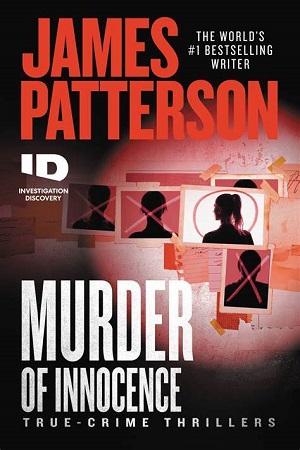
As I mentioned in my wrap-up post on the 2024 presidential election a few days ago, I read and reviewed a lot of books about American politics in the previous eight years. I don’t have an index to just these reviews, but for a couple of lengthy omnibus essays you can read about the long and short road to Trump here and Trump and the religious right here. I’ve recently been moving these books onto the shelves in my new library and even after tossing out a lot of them out (or donating them to book sales), what’s left still takes up a lot of space. Here’s a couple of shelves.
As I also said in that wrap-up post, I wasn’t sure if I was up to reading about Trump this much again. I really don’t think there’s much new to say. Everyone has known who Trump is for a while now, and what he’s all about. All that’s left is to see how the dance of corruption and appeasement plays out, at least for the next couple of years. And that’s depressing stuff.
I think the best thing to do would be to unplug entirely, but I’m not (quite) ready to do that yet. So I’ve got another shelf set aside for the next chapter in America’s long national nightmare. It’s right next to the fireplace.
Asterix and the Golden Sickle
Outside of the central characters and the basic formulas, I only recall bits and pieces of the Asterix comics from when I read them as a kid. But I do remember thinking that Asterix and the Golden Sickle was one of the best. It’s actually a nice little mystery story, with Asterix and Obelix traveling to Lutetia to find Metallurgix, Obelix’s cousin who is also a manufacturer of the golden sickles that druids like Panoramix need to harvest mistletoe. Unfortunately, when they get to Lutetia they find that someone has kidnapped Metallurgix as a way of cornering the market on golden sickles just before the big druid festival.
It’s eventful, fast-moving, and the plot holds interest throughout. The secondary characters are also interesting, from the little guy in the drunk tank who gets a shot of magic potion to the Roman prefect Surplus Dairyprodus, whose appearance was based on that of the actor Charles Laughton. Dairyprodus is one of the most original villains ever, taking up a life of crime and hanging out with lowlifes just because he’s bored of enjoying all the good things in life. He’s even looking forward to rowing in a galley at the end, just for a change of pace.
The only false note came by way of the new “North American” translation, which even has Obelix saying “Cool!” at one point. Not cool!
U.S. election 2024
Over the last eight years I’ve spent a lot of time reviewing books about Donald Trump, so with his re-election I thought I’d post a few preliminary thoughts and provisional observations that I will no doubt be returning to for modification and expansion as we move forward. That is, if I don’t decide to unplug from the discussion entirely, which is something I’m starting to consider.
Exercising my nearly perfect record of failure when it comes to political prognostication, I thought Kamala Harris was going to win the 2024 election. Both because she performed very well (and much better than expected) and ran what I thought was a solid campaign, but also because I thought there was a lot more Trump fatigue out there. Leading up the election there was a refrain I heard among many of my American friends (and not a few Canadians as well) that they were just “so sick of the guy.” And I’d add that these were by no means just lefties saying this. It was George Will who prophesied that Trump’s demise would be the result of his becoming boring, which he assuredly was, but on election day a majority of Americans signed up for another four years of the Trump Show. I didn’t think there was that much appetite out there for such programming. I thought people were fed up. I was wrong.
I also thought Trump ran a very bad campaign, by the end of which he appeared so tired and sounded so incoherent that more than one observer thought he was actually trying to lose. He seemed cooked to me, and I don’t think that was a false impression. Just since 2020 he has clearly taken a significant step down in his mental functioning and I would put his chances of serving out his entire term to be only 50/50 at best. Despite his usual bluster about being a perfect mental and physical specimen, he is old and not in good health. But I guess as long as doctors can keep him upright he’ll do for the establishment. As the anti-government crusader Grover Norquist once described his ideal president: “We don’t need someone who can think. We need someone with enough digits to hold a pen.”
There have already been many Democratic post mortems. I don’t know how convincing or even useful they are. There are still some hardcore Bernie Sanders supporters out there who see him as representing a populist turn the party should have taken in 2016. I don’t think Sanders could have won in 2016 and I still don’t see him as a viable national candidate, as popular as he is personally and how well some of his policies play. The non-partisan establishment would crush him. That same establishment despises Trump, but they know he can be bought. A point I’ll return to.
The most common explanation for Harris’s failure is that inflation was the deciding factor in the election. Perhaps. But America has experienced higher inflation and it had anyway come down to the point where it was lower than when Biden took office. Not to mention that inflation is largely out of the control of a president. During the campaign Trump not only gave no explanation of what he would try to do about it, one of his few absolute declarations on economic policy – the imposition of staggering tariffs – would be inflationary by definition. If it was the “economy, stupid,” then the U.S. had one that, as even The Economist declared weeks before the election, was “the envy of the world,” and was the strongest it had enjoyed since the 1960s. None of that mattered.
Many people also say that Harris was hurt by not having been chosen in a primary. I don’t see how that would have helped her much at all. Yes, Biden, who was far too old for the job (as is Trump), should have announced he was only going to serve a single term at the outset of his presidency, but that would have put the party in an awkward spot, as Harris wasn’t seen at the time as an attractive candidate and it would have seemed strange to have made her Vice President and then immediately rejected her for the top job.
My own sense, which I share with the outspoken Saunders, is that cultural issues didn’t help the Democrats, and haven’t for a while now. They should probably walk away from identity politics, which many people (especially white, working-class people) have come to see as a scam and that have often accelerated into comic depths of virtue signaling and self-flagellation. What I mean is stuff like Trans rights (from pronouns to athletics), DEI initiatives, or anything that can be made to fit under the label “woke.” In Canada I think Indigenous issues are taking on much the same character. People are sick of hearing about this stuff. I get an earful of people complaining about it nearly every day. What the Democrats need is someone who will declare that “the era of identity politics is over” and that social justice initiatives are dead. This does not mean endorsing or turning a blind eye to racism or sexism or whatever but it does mean the end of the government being active in trying to fix the same. It’s not like pursuing these policies are doing the Democrats any good, as both women and people of colour have moved toward Trump while white people without a college education (not a minority among the American electorate) have solidified as a Republican base.
But in the end, looking at the breakdown of the vote, I mostly agree with those who say there probably wasn’t anything Trump could have done to lose. The media, understood broadly, is entirely right-wing now. And by media “understood broadly” I mean talk radio (iHeartRadio, formerly Clear Channel), social media platforms (X), and podcasters (Joe Rogan, Tucker Carlson, Charlie Kirk, Dan Bongino, Megyn Kelly, Ben Shapiro, et al.). Newspapers like the New York Times don’t count anymore, and Fox News still rules cable (drawing nearly double the viewers of either MSNBC or CNN on election night). Yes, everyone lives in their own media bubble now, but the right-wing bubble holds a lot more voters. As Michael Tomasky observes:
Today, the right-wing media sets the news agenda in this country. Not The New York Times. Not The Washington Post (which bent over backwards to exert no influence when Jeff Bezos pulled the paper’s Harris endorsement). Not CBS, NBC, and ABC.
…
And the result is what we see today. The readily visual analogy I use is: Once upon a time, the mainstream media was a beachball, and the right-wing media was a golf ball. Today, the mainstream media (what with layoffs and closures and the near death of serious local news reporting) is the size of a volleyball, and the right-wing media is the size of a basketball, which, in case you’re wondering, is bigger.
Fed a diet from such information (not quite news) sources, people felt the country was on the wrong track and voted for change. Voting for change is frequently what happens, but I’m never sure if it’s just optimism (change can only be for the better) or anger at whoever’s in power. Either way, I think in this case it was a mistake.
As so many of the top office holders in his first administration warned, Trump is not fit to be president and poses a grave threat to American democracy. At his age it is also clear he is not going to change, pivot, or become more presidential. He is going to behave like he did in his first term, only worse because he is mentally failing and there will be no guardrails. So we can expect a lot more anger, grievance, and resentment.
What will be the practical results of his election? I imagine most of Project 2025 is a go. Which means turning America into Hungary, or some other one-party state ruled by an oligarchy (the label fascism, which got a lot of play late in the campaign, is an outdated twentieth-century relic). While Trump himself may not be behind Project 2025, or even know much about it, that really doesn’t matter since all reports from his first term made it clear that he has little to no interest in actually governing. As one of the Republicans running against him in the primaries put it, the only reason he wanted to be president was to make money and stay out of jail. I very much believe that to be the case. And so the criminal investigations against him will now be set aside and I think even a conservative estimate would put his expected windfall from grifting in the office will personally net him in the billions of dollars from tycoons and foreign governments looking to curry favour.
I don’t know what the foreign policy consequences will be, but can’t imagine much positive from someone who has made no secret about his admiration and respect for dictators and his general ignorance of international affairs. I’m willing to bet he’s unable to find Taiwan on a map, and he may not need to in another few years. Which may be true for Ukraine as well.
On the domestic front I assume the push to emulate Hungary (or Russia, or China) will continue apace, working in tandem with the global forces Anne Applebaum dubbed Autocracy, Inc. I don’t see where any pushback is going to come from. The main thing I feel confident predicting though is that we are going to see kleptocracy run mad. The looting of the American state is about to begin, on a scale (to borrow a favourite Trumpism) never before seen in the history of the world. Back during his first term Sarah Kendzior characterized the Republican plan for America as being to “strip it for its parts,” and Trump presided over an administration more corrupt and indeed criminal than any the U.S. had ever experienced. Well, expect that to ramp up bigly. The copper wires are going to be ripped from the walls, the plumbing fixtures torn out, and the lead taken from the roofs. Switching metaphors, the cookie jar is going to be wide open and sitting out on the table for at least the next two years. To indulge a more speculative take, one way I could see this imploding is with the combination of a push for total deregulation of the financial sector coupled with the mad schemes of the crypto pushers leading to a crisis perhaps even greater than the 2008 mortgage meltdown. That’s only one of the unhappy shocks we might have in store though.
As Aditya Chakrabortty put it, “Trump will almost certainly plunder from the budgets for social security and Medicaid. Social services will be cut. The tech bros will suckle on government subsidies, while the suits from private equity get to set government policy.” The rich are about to get a lot richer and the poor are going to take a hit. After the election one of the aphorisms of H. L. Mencken soon started making the rounds: “Democracy is the theory that the common people know what they want, and deserve to get it good and hard.”
A lot of this goes back to the kind of thing Thomas Frank wondered about in What’s the Matter With Kansas? By channeling social issues (politics is downstream from culture!), the political right tricks the poor and working class to vote against their economic interests. There’s some truth in that, and I’m saying that from the perspective of someone who tends to vote for parties that want to tax me more, while getting tax cuts delivered to me by people who really can’t afford them. I guess I can’t complain too much, but I’m not thanking anyone either.
It’s all a bit discouraging. I think the United States is a great country full of great people that has been irresponsibly led for a while now by politicians of all parties. Yes, competent political leadership is in short supply everywhere (Canada and the UK are recent grim examples) but even disliking government as much as I do that’s no reason to blow everything up. I’d like to think Trump marks a kind of nadir or lowest point in the American experiment in democracy, but things can always get worse and I think they probably will. One thing I’ve learned following Trump’s career is that there is no bottom.
Road of the Dead: Highway to Hell
Damn, now that’s a zombie comic cover! Nothing like an eyeball floating in the bowl of a hollowed out skull with a smoking shotgun barrel in the background. Could the comic itself live up to this?
No, it doesn’t. And in fact the cover is by Santíperez while the comic itself is illustrated by Drew Moss. So different artists. There’s a gallery of covers by Santíperez included in the bonus material here though and they all look nearly as cool.
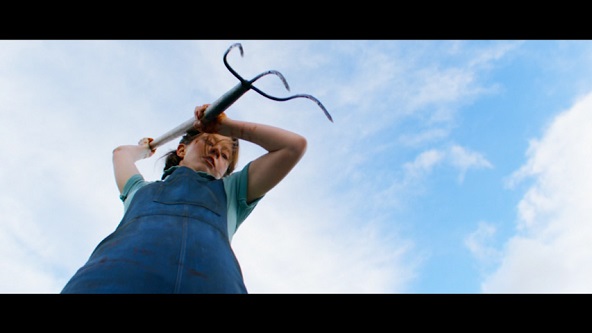
In my review of the movie Zombieland I suggested that 2007 might be taken as the year of “peak zombie.” It just seemed like zombies were everywhere and nothing new was being done with the genre. So this comic, billed as a prequel to Road of the Dead though I’ve never heard of that book, was coming very late to the party (it was published in 2019). In particular, this really feels like a colour version of Kirkman’s The Walking Dead mixed with even older elements borrowed from the Romero films. There are highways jammed with stalled vehicles. There are warrior biker gangs. There’s a pair of pet zombies kept on chain leashes. There’s a guy with a spiked baseball bat. There’s a battle tank that turns out to be surprisingly (and unrealistically) effective in taking out zombies. There’s a story involving the attempt to transport a scientist working on a cure for the zombie virus to a safe haven in . . . you guessed it: Canada!
I don’t think there’s any way writer Jonathan Maberry wasn’t aware of all this. He even kicks things off with a billboard advertising the Monroeville Mall (setting of Romero’s 1978 classic Dawn of the Dead). But it’s hard to draw much of anything from a well that’s already been pumped dry. You can go the route of zombie parody, but even that was getting stale by this time. So there isn’t much to do here but watch the splatter. There’s a slightly more contemporary wrinkle added by the fact that the gang chasing our heroes are members of a sort of conspiracy cult, believing that a cure is being kept from them by government elites. But that’s never developed. And of course the underlying philosophy of the zombie genre is still in play: that the zombie apocalypse only reveals the state of nature as it already exists, a war of all against all with civilization a transparently thin membrane stretched over the abyss. Our lives so routine, meaningless, and devoid of human attachment we might already be dead. As the narration explains:
This is how it is now. Everywhere is a trap. Everyone is an enemy. Each of us is a traitor to the living the second we die.
Ten thousand years of human civilization. Everything we learned, everything we built, all we know about the world and the universe. And now the only thing that defines us is whether we’re predators or prey.
No dignity left. Hope and optimism are getting bitch-slapped. Compassion’s lying dead in a ditch somewhere.
It’s not that I don’t have sympathy for this sort of end-of-days nihilism, but as I say it’s something that’s foundational to the zombie genre and the fact is that Road of the Dead: Highway to Hell doesn’t have a new story to package it in. It’s the sort of comic I’d usually recommend only if you’re a huge fan of zombie stuff, but actually if you’re a huge zombie fan then you might feel let down by how unoriginal it all feels, since I’m sure you’ll have seen it all before. So while it’s an OK comic, it’s kind of hard to recommend to anyone except splatter-action devotees.
Diddling
While reading John A. Farrell’s biography of Richard Nixon I came across a brief account of Nixon’s soon-to-be wife Pat standing around Hollywood sets but rejecting a career in show business because she “saw through the movieland taradiddles.”
I don’t think I’ve ever come across the word taradiddles before and even in context I wasn’t sure what it meant. The strange thing is, after looking it up I still wasn’t all that clear on it and I can’t even say if Farrell is using it correctly. I might also add here that its etymology is uncertain. It was probably just an arrangement of funny syllables that don’t mean anything.
At the most basic level a taradiddle is a lie. Or perhaps fib would be a better way of putting it. But most dictionaries present it as having two meanings: (1) pretentious nonsense, and (2) a small, petty, or trivial lie. My problem is that these seem like two different things. Or at least two different kinds of lying.
I don’t know what sense Farrell was using it in. Probably pretentious nonsense. Hollywood has some of that. In any event, it was a new word for me but not one that I have any intention of ever using myself just because it’s so long-winded, cutesy, and vague.
Bookmarked! #65: Coin and Elephant
So last weekend was the Book Bash, a sort of fair where local authors and publishers have tables set up where they sell their books. This year it was held at the Farmer’s Market, which was a good venue. Anyway, at one of the tables there was a jewelry designer named Margaret-Anne Cripps (her website is Black Star Vintage) and she had a selection of bookmarks made out of little items connected by a ribbon. Each one unique! I got one with an elephant attached to a coin from the island of Tonga.
Book: Flaubert: A Life by Geoffrey Wall
The good old days 3
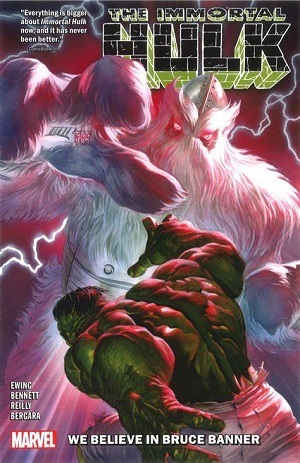
Green Lantern Corps Volume 2: Alpha War
There are actually two different storylines here. The first is the Alpha War one, which has an excessively rigorous bunch of super-Lanterns on the HQ planet of Oa tasked with policing the rest of the Corps. Quis custodiet ipsos custodes? Who will guard the guardians? The Alpha Lanterns, that’s who!
And who is watching over the Alphas? The bobbleheaded Guardians hanging out in their Planetary Citadel. And you wouldn’t want to trust that lot.
Anyway, one of the dark moments in the previous volume had John Stewart kill a fellow Lantern who was being tortured by the Keepers into giving up the pass code they needed to break into Oa. As things kick off here, Stewart is judged by the Alphas and sentenced to death. But then Guy Gardner and some of his buddies break John out of his prison (what they call the “sciencell”), and have a battle royale with the Alphas, who end up being defeated.
I didn’t care for any of this. I couldn’t tell any of the Alphas apart except for the centaur guy and nothing about the plot seemed right to me. To be honest, by the time they wrapped things up I was thinking of giving up on this series.
I’m glad I didn’t, because in the next story line, that only gets introduced here, we learn about some space zombies who are just floating around turning everyone, including any Lanterns who cross their path, into more zombies. These zombies form a “third army” that the Guardians seem to be behind in some way. I told you those bobbleheads can’t be trusted. They’re also up to something when they release Xar from his prison and send him out to stir things up. Meanwhile, Kilowog and Salaak are on to the Guardians but they’re a little slow in piecing things together.
Then John Stewart, who has been sent off on a wild goose chase, meets up with the busty Fatality, and Guy Gardner gets his team of Lanterns wiped out by the space zombies, which results in him getting kicked out of the Corps and sent back home to Earth without any of his Lantern powers.
I don’t know where any of this is going, but I’m interested enough in what Fatality, Xar, the Guardians, and the space zombies are all doing to keep reading for another volume. Power up!
Correspondences III

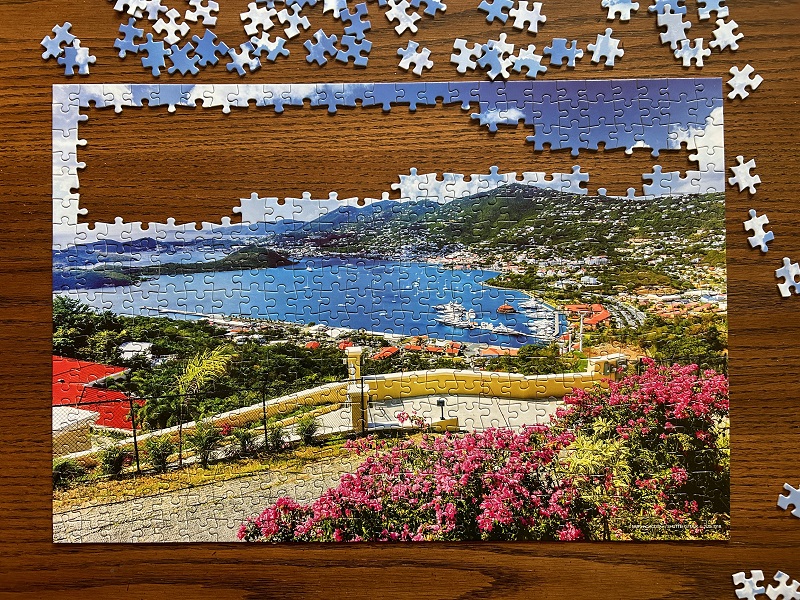
A while back I posted a picture of a circular puzzle of a bouquet in an octopus vase. At the time, a keen-eyed commenter asked if it was based on a painting because it was very familiar-looking. I didn’t think it was based on a painting, but this weekend I was watching a documentary on ancient Greek art and saw a vase that I recognized.
It’s actually called an amphora, not a vase. I wasn’t sure what the difference was, so I looked it up. Amphorae are smaller, at least when referring to ancient Greek pottery, and they have narrower necks. But today I think these distinctions are meaningless.
Anyway, this particular octopus amphora is dated to the 15th century BC and was found among the grave goods in a Mycenean cemetery near Argos. The octopus is typical of Minoan vase painting though.