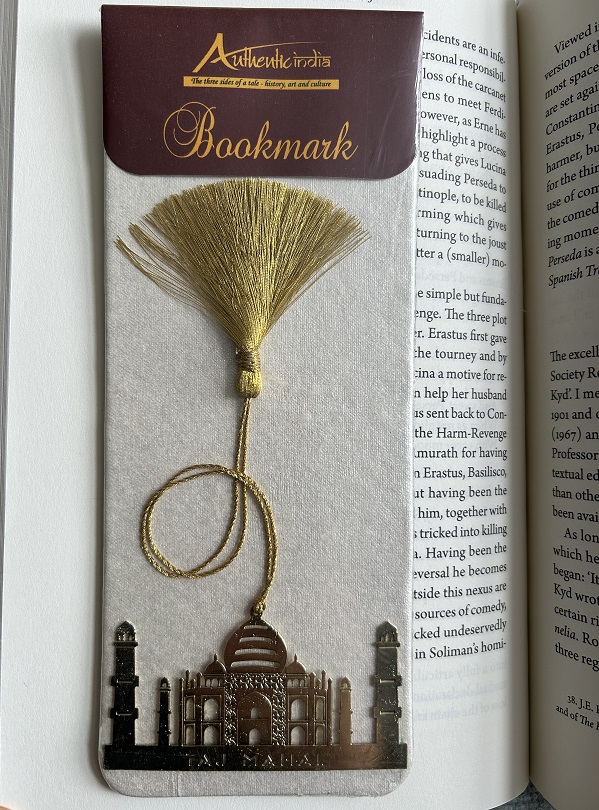
Nope, I’ve never been to the Taj Mahal. Or India. But some friends brought me back this fancy keepsake that looks so nice in its package I don’t dare take it out.
Book: Thomas Kyd: A Dramatist Restored by Brian Vickers
Nope, I’ve never been to the Taj Mahal. Or India. But some friends brought me back this fancy keepsake that looks so nice in its package I don’t dare take it out.
Book: Thomas Kyd: A Dramatist Restored by Brian Vickers
If you’ve read around in any of Agatha Christie’s work you know that one of the things that characterizes her mysteries is their theatrical nature. Murder is rarely a spur-of-the-moment sort of thing. It’s not just planned and premeditated but scripted, along with prepared costumes and very exact timings built into the plot.
If you’re playing along at home, these mysteries are often the most difficult to figure out. You may correctly guess whodunit but throw your hands up at how they did it because the “how” is so layered. One of the prime instances of this is Death on the Nile, but this short story is another good example. I think I knew right away who was going to kill Miss Greenshaw, and the way the murder was presented was so ridiculously dramatic made clear that it was being stage-directed, but I didn’t have it all figured out. In part because I don’t think that would be possible based on the evidence we’re given. As one critic remarked, this story is “a notable example of Miss Marple’s habit of drawing solutions from a hat, with hardly a trace of why or wherefore.”
At least the murderer had the good sense not to leave the body in the library. We’d already been down that road before with Miss Marple, and it was as much a cliché as it was then as it clearly is here. “The only thing the library needs is a body,” the collector of “monstrosities” opines. “Those old-fashioned detective stories about murder in the library” knew what they were about. So instead we settle for the drawing room. Bonus points though if you know what the reference to “Paul and Virginia” is to. They are, apparently, the subjects rendered in a “colossal bronze” found in the library of Greenshaw’s Folly. My guess is that they represent the lovers in an eighteenth-century French novel of the same name.
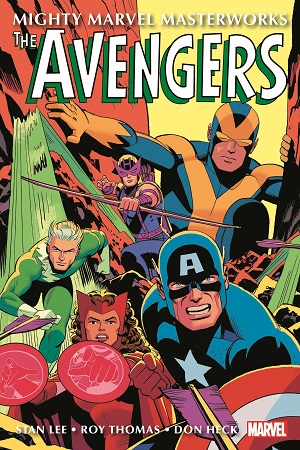 I read this shortly after reviewing the Marvel Epic Collection containing The Avengers #1-20. What we get here are issues #31-40, and while the line-up of heroes is mostly the same as at the end of the Epic Collection volume, and I think the spirit of their adventures is similar, things were under different management. Jack Kirby had been replaced by Don Heck and Stan Lee was in the process of letting Roy Thomas take over writing duties. And as much as Lee and Kirby are justly lionized for being two of the creative giants who got Marvel started, I don’t think there’s any falling off. In fact, I prefer what we get from Heck and Thomas over any of the Lee and Kirby collaborations. Comics were growing up fast.
The earlier issues have more of Lee’s hyperbolic salesmanship. “Read this yarn slowly – carefully! It’s just possibly one of the most deeply-moving, off-beat thrillers of the year, and we want you to savor every prize-winning panel!” I wonder what prizes he was referring to. Or there’s this: “Caution! Whatever you do, wherever you go, be sure to hang on to this irreplaceable ish, for it’s certain to become one of the most talked-about collectors’ items in the annals of comicophilia! We kid you not!” Lee said “I kid you not!” a lot, and I think it’s where I picked the expression up.
We’re also still in the days when The Avengers actually weren’t the Earth’s Mightiest Heroes. Captain America’s shield is just a regular metal disc that is easily bent or destroyed and then replaced. The Scarlet Witch only seems to know a few basic spells, and her “hex power” is underwhelming. The Wasp is pretty much useless, as always, and forever swooning over the hunky boys she meets. Goliath starts off being stuck in his giant size and one of the storylines has him having to figure out a way to get small again. And he still needs to work on other things. In the final issue the Wasp has to give him a ride because she has wings and he doesn’t and she asks an obvious question: “Why don’t you give yourself the power to gain wings when you shrink?” His lame reply: “Y’know, I’ve been so busy on other projects, I never thought about it! Maybe I will, one of these days!”
As a result, they need to focus on teamwork to fight off the bad guys they face. Especially the mighty Ixar (“the Invincible”). Or the Thinker and his team of B-listers. I kind of liked how the Thinker wasn’t some superhero but just a computer nerd who tries to calculate the best way to take down the Avengers. A computer nerd must have seemed cutting edge at the time. Then in the final issues Hercules unofficially joins the team and he adds some much needed muscle given that Thor and the Hulk are out. Giant Man never seems to pull his weight as a clean-up hitter.
So this is quite entertaining in the mid-‘60s Marvel way. I enjoyed seeing the word “sawbuck” for the first time in a long time, and then realized I’d never had any idea what a sawbuck was. It’s a $10 bill, in case you were wondering, so called because the Roman numeral X looks like a sawbuck, which is a style of sawhorse. Timely trivia aside, the Avengers were on their way here to becoming the franchise they would become but they still needed a lot of work before they’d be fully assembled.
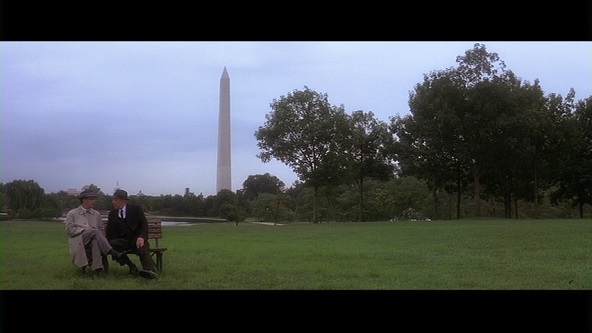
At one point in the book Pale Horse Rider Mark Jacobson describes the scene in Oliver Stone’s JFK where crusading DA Jim Garrison (Keven Costner) gets a crash course in conspiracy theories from Mr. X (Donald Sutherland) while they sit on a bench with a view of the Washington Monument. Painting a picture of the setting, Jacobson has them “dwarfed by the upward thrust of the lingamic monument.”
I’ve often heard the Washington Monument described as “phallic” but “lingamic” was a new one for me. For once, a knowledge of Greek or Latin won’t help you. The word derives from the Sanskrit lingam, which is an aniconic phallic representation traditionally worshipped as a symbol of or in connection with Shiva. Or, in a secondary meaning, it’s a penis. So basically the word means phallic. But it’s most often used in reference to religious statuary: “a short cylindrical pillar-like symbol of Shiva, made of stone, metal, gem, wood, clay or precious stones.” These pillars also usually have a circular base, which the Washington Monument does have if you see it from above.
I suspect Jacobson just wanted to avoid the cliché of a phallic Washington Monument so he went with a word that had a more exotic flavour. And he certainly got that, as I don’t think lingamic is an adjective you see used very often. And I can’t say I’ll be adopting it anytime soon myself.
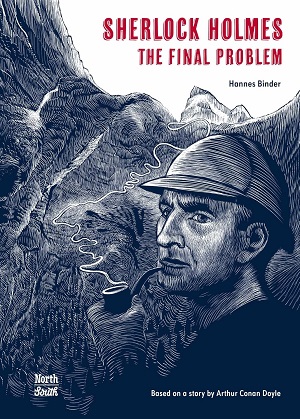 Most graphic adaptations of classic literature are massive disappointments. They tend to either go with a generic comic-book look or adapt the work in some way that makes a mess of the source material, often without even being interesting.
Swiss artist Hannes Binder’s illustrated version of Conan Doyle’s “last” Sherlock Holmes story, “The Final Problem,” is a wonderful exception. I put last in quotation marks because this is the story where Holmes was supposed to be killed off, falling from the Reichenbach Falls, only Doyle had to bring the great detective back due to popular demand. Even though it’s not really much of a story, it’s always been a favourite among illustrators because of the iconic scene where Holmes and Moriarty grapple at the top of the falls before plunging to their supposed deaths. That’s a moment you get here as well, though I think it’s worth pointing out that it’s not an event that is ever described in the story itself because in fact it never happens.
Binder’s black-and-white scratchboard technique is well suited for evoking mists and smoke and spider-webs, as well as hinting in a way I can’t really explain at a sort of aural quality. I think this latter is something Binder is conscious of too, as the full-page drawings of a screaming mouth and then an ear point toward the same thing. The mouth and ear are also suggestive of vortices that, like Moriarty’s sinister web, draw us in to our doom. Then the illustrations of a falling brick or a utensil shattering a dessert explode in ways that don’t require any textual effects. We can hear them well enough.
The text is abridged and adapted quite a bit, but in a way that I thought was remarkably efficient. And I liked the way Moriarty, a figure almost entirely absent, at least as a physical presence, from the story, shows up as a glowering atmospheric presence, a demonic eye of God. Binder isn’t just doing his own thing here but is making something distinctively in his own style while respecting the source. Holmes has been illustrated by a lot of different artists, right from the first published versions of his stories, but Binder doesn’t take a back seat to any of them.
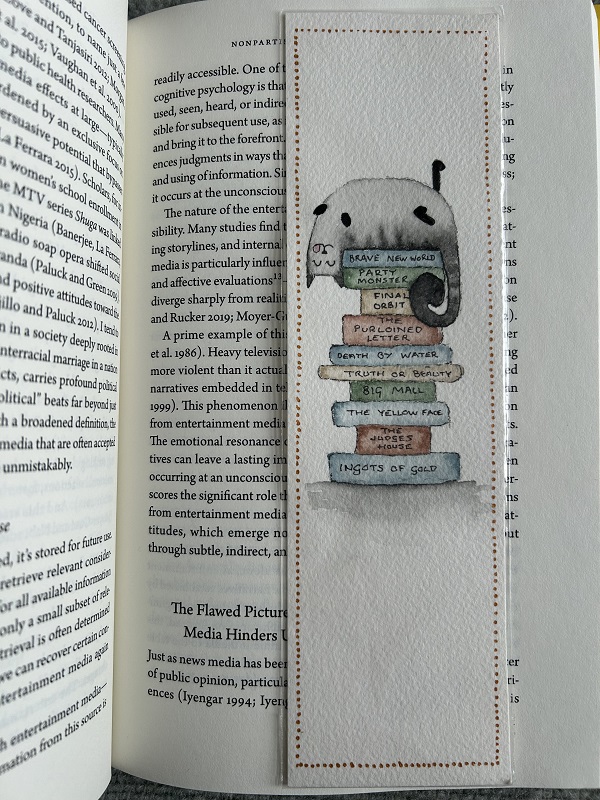
A very special bookmark this week from the fabulous Fraggle! It’s a handpainted comic scene with a feline taking a catnap on top of a pile of books (which I’ve reviewed). Not a very comfortable perch for that kitty, but they always seem to make do.
Book: American Mirage: How Reality TV Upholds the Myth of Meritocracy by Eunji Kim
In “The Greek Interpreter” Doyle shook things up a bit by introducing Sherlock’s brother Mycroft. In “The Final Problem” (published only a few month later) Mycroft has a cameo as a cab driver but of more importance is the introduction of Professor James Moriarty.
These two characters would go on to have a huge importance in later Holmes mythology, but I find it interesting that Doyle himself didn’t make much out of either. They are only referred to in a handful of stories in the canon, and usually don’t have any significant role to play.
In “The Final Problem,” however, Moriarty does have a critical function, which was to kill off Holmes and thus free Doyle to write what he thought were more important literary works. As we know, that didn’t take, but it does show a real spirit of idealism given how much money writing Holmes stories was bringing in.
It’s a different sort of Holmes story in that there’s no mystery to be solved but just a game of cat and mouse between Holmes and Moriarty that ends with the two of them plunging, presumably to their deaths, from the Reichenbach Falls.
That dramatic plunge is one of the iconic moments in all of fiction, so much so that I think all of us can picture it in our memories. We might also be thinking of any of the many illustrations of the scene, beginning with different versions in both the original British and American publications. Re-reading the story for the first time in a long while I was actually surprised to find that Watson didn’t witness the event at all. He’s been sidelined and only returns to the Falls after the fact to find some footprints in the blackish soil and an awkward note from Holmes explaining what was about to happen. After that, we’re told that an “examination by experts leaves little doubt that a personal contest between the two men ended, as it could hardly fail to end in such a situation, in their reeling over, locked in each other’s arms.”
That must have been quite an expert examination! What did they base their conclusions on, especially given that neither of the bodies was ever recovered? The only evidence for what occurred were the footprints and the note, which don’t paint a very full picture.
So as it turns out, one of the most iconic moments in all of fiction is one that’s wholly imagined. Unless you’re reading an illustrated version there’s nothing of it on the page. And Doyle could have easily arranged things so Watson sees the fatal plunge from a distance. Was he leaving himself an out? Or just playing a game? Even though this isn’t one of my favourite Holmes stories it remains one of the most intriguing.


Once the plows have built up these piles of snow in parking lots I always wonder how long they’ll last. We’ve had a fair bit of snow this winter, with more on the way, so I suspect these will hang around a while. I walk past the top one every day so I’ll try and report back. I suspect some of it will still be there well into April.
Lew Archer is a bit out of his usual L.A. stomping grounds here. While on his way to Sacramento he stops for “the ghastliest hitchhiker who ever thumbed me.” This turns out to be a young man who has been shot and left for dead in a ditch by the road. And just like that Archer is involved in a complicated web of murder and corruption in the sleepy town of Las Cruces.
Two things stood out to me. First of all there’s the speed with which the plot unfolds. It got to the point where I started to write down Archer’s full Las Cruces itinerary. He picks up the dying man just as the sun is setting “and the valley was filling with twilight.” From there he takes the man to Kerrigan’s Court – Deluxe Motor Hotel (it is later described as a “motor court”; the word “motel” was first used in 1925 but seems not to be known by anyone here). From the motel he goes to the hospital, where the hitchhiker dies without regaining consciousness and being able to say what had happened to him. Then Archer goes back to the motel, or motor court. Then he goes to a Chinese restaurant and eavesdrops on a conversation between Kerrigan (the motel’s owner) and a sexy young chanteuse. Then he visits the trucking company the dead man drove for. Then he goes out to the house where the owner of the trucking company lives and gets hired by him to find out what happened to the load of booze the dead man had been driving. Then he goes to the sheriff’s house and meets the sheriff’s sexy wife. Then he goes to the apartment of the daughter of the owner of the trucking company. She has gone missing. Then he goes to a sleazy bar and interrogates one of the prostitutes about the missing girl. Then he goes to the singer’s apartment. Then he goes to the motel owner’s house, remaking that by this time “it was getting late.” Then he goes to a drive-in burger joint where he witnesses what looks like a handoff of some money. Then he goes to an abandoned air base just outside of town. At around 1 o’clock in the morning he’s back at the motor court, where he gets knocked out (or at least knocked on his ass) for the third time. Then he goes back to the motel owner’s house. We’re told it’s now 2 o’clock. The motel owner’s wife sends him off to check out a cabin on a lake two hours’ drive away. On the way there exhaustion (finally!) catches up to him and “something broke like a capsule behind my eyes. It leaked darkness through my brain and numbness through my body.” He keeps driving until he comes to a tourist camp where he rents a cottage and spends the rest of the night (or early morning) “wrestling nightmares on a lumpy bed.”
This is a busy guy! And even given Las Cruces isn’t that big a place I still found it hard to believe he was going so many places and meeting so many people in the space of at most eight hours. But that’s the nature of stories like this.
The scenes are set with some quick brushstrokes. Macdonald is particularly fond of personifying buildings, so one will have yellow rust streaks running “down from the balconies like iron tears” while another sports “a peeling yellow face with blinded windows, surrounded by a wild green hair of eucalyptus trees.” I also loved this description of the owner of the trucking business’s man cave:
His living-room was the kind of room you find in backcountry ranch-houses where old men hold the last frontier against women and civilization and hygiene. The carpets and furniture were glazed with dirt. Months of wood ashes clogged the fireplace and sifted onto the floor. The double-barreled shotgun over the mantel was the only clean and cared-for object in the room.
We’re even told that the place smells like a bear cage, which I can believe.
Information in these wonderfully degenerate settings will be conveyed in clipped dialogue with lots of snappy comebacks, and may end in fisticuffs. And then it’s time to hop in the car and go to the next stop.
The second thing that struck me was the evocation of a now long-vanished time. In part this has to do with the language, so I’ll include some notes here for fellow word nerds. “Wasn’t he drunk on Sunday?” Archer asks the singer of the motel owner. “He was pixilated all right,” she replies. This does not mean that the motel owner has the appearance of being an enlarged, low-resolution digital image where the individual pixels stand out, giving it a blocky texture. The word for that is pixelated, though apparently pixilated is now accepted as a variant spelling of the same thing. Anyway, pixilated is a much older word referring to someone behaving in a strange, eccentric or mentally disordered way, as though being led by pixies. Obviously the singer has in mind this older meaning, but even so it seems a bit inappropriate to describe someone who is actually an angry and dangerous drunk.
At another point Archer is driving over a rough road whose “surface was pitted with chuckholes.” I had to look this up and found that it refers to any hole or rut in a road or track. So a pothole. I’ve never seen or heard the word chuckhole before and I don’t think it’s in wide use.
I was far less successful tracking down the term “sluff.” At one point Archer interrogates a drugged out girl who asks him “Are you sluff?” From the context I think she’s asking if he’s with the police. Later, her boyfriend will beat Archer up and say “God damn you, sluff.” So again, I think he’s saying that he thinks Archer is a cop. But I looked around for any information on this one and found nothing except dictionaries giving it as a variant spelling of “slough,” which is clearly not what was meant.
Aside from the language, there are also some other parts of the book that give its date away. In The Way Some People Die Macdonald had indulged his dislike for the drug business by giving us a heroin junkie going through withdrawal. There’s another druggie in this book but she’s hooked on marijuana and she really needs a reefer bad. I think in our own time we’d be put off by such a depiction of “reefer madness” (the film of that title had come out in 1936), as while marijuana can be addictive in most cases it isn’t, and certainly not to the extent depicted here. The scene plays today as silly, but luckily Archer has some reefers in his car (hey, it’s evidence) and he’s able to use it to get her to open up. Which is kind of low, but worse will happen to her later.
There are the usual Archer elements here, especially his fascination with breasts. The sheriff’s wife is stacked, “heavy-breasted and very female, almost too female for comfort.” Later, while he is holding onto her, these same breasts will move “against me like wild things in a net,” and later still she will grip them “cruelly” herself. I don’t know what’s going on with all this. Boobs just have a way of grabbing Macdonald’s attention.
And finally there’s Archer’s sense of mission. Told that he’s brave at one point, he replies “Not brave. Merely stubborn. I don’t like to see the jerks and hustlers get away with too much. Or they might take over entirely.” The jerks and the hustlers, however, aren’t the real problem here. They rarely are. Instead the rot runs deeper, into perverted family dynamics and degenerate psychologies. Archer can afford to be understanding, but is no doubt relieved to finally get out of this town.
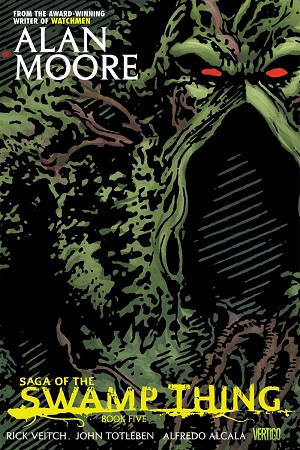 I liked the introduction to this volume by artist Stephen Bissette where he talks about how Alan Moore’s interest in the grand cosmic battle between the forces of good and evil that ended the previous storyline had been waning and that a change in direction was necessary. As I’ve said before, I think Moore is at his best when he keeps his feet on the ground, and I didn’t like where the “American Gothic” story ended up.
So things start off on a slightly better foot here. But only slightly better because the new storyline is all about the romance between Abby Cable and Swamp Thing, which for some reason fascinated Moore but which I don’t care for at all. I don’t think of Saga of the Swamp Thing as a romance comic. The plot is also predicated on the absurd legal problems Abby gets into when it’s made public that she’s been getting physical with Swampy. It’s a real stretch to see why she’d be prosecuted for this to the degree she is, but you just have to take it as a given so that Swamp Thing can rocket through the Green to her rescue by turning Gotham into a botanical garden full of hippies. This is “the greening of Gotham,” which I take it is a nod to Charles Reich. But there’s a dark side to this too, suggested by the title of one issue as “The Garden of Earthly Delights.” Bosch’s carnivals have an ambiguous colour to them.
Anyway, with Swamp Thing becoming “very nearly a god” there are a bunch of people who want to take him down. Batman tries using a Super Soaker filled with defoliant but that gets him nowhere. Then Lex Luthor figures out, somehow, that Swampy’s ability to zip away into the Green and regenerate himself whenever he’s in danger can be blocked by an electronic jammer. So after being tagged with one of those he then gets napalmed, which sends his spirit to a blue planet while a despairing Abby heads back to the bayou. They both dream of each other, in their different ways.
The “blue heaven” Swampy is exiled to looks interesting, with Rick Veitch giving us a different take on the sort of psychedelic otherworldliness you get in the Doctor Strange comics. But I also thought Moore’s writing went over-the-top again, with the shades of blue likened to “the color of saxophones at dusk . . . of orbiting police lights smeared across tenement windows . . . of a flame’s intestines . . . of the faint tracery of veins visible beneath the ghost-flesh of her forearm’s underside . . . of loneliness . . . of melancholy. The blues.” But this is the complete Moore, and you have to take him all together. I really wonder what the average comic reader thought of it though. In any event, Moore’s run with Swamp Thing was nearing the end. In fact, he was writing Watchmen at the same time as he was working on the stories collected here, which is both a sign of being in a particularly hot creative phase as well as an indication that his attention was starting to wander.

