Bookmarked! #96: The Man in the Iron Mask

Who was the Man in the Iron Mask? Historians have suggested various candidates. According to the story by Alexandre Dumas he was Philippe Bourbon, the twin brother of Louis XIV. But most people today know he was really Leonardo DiCaprio, in this 1998 movie.

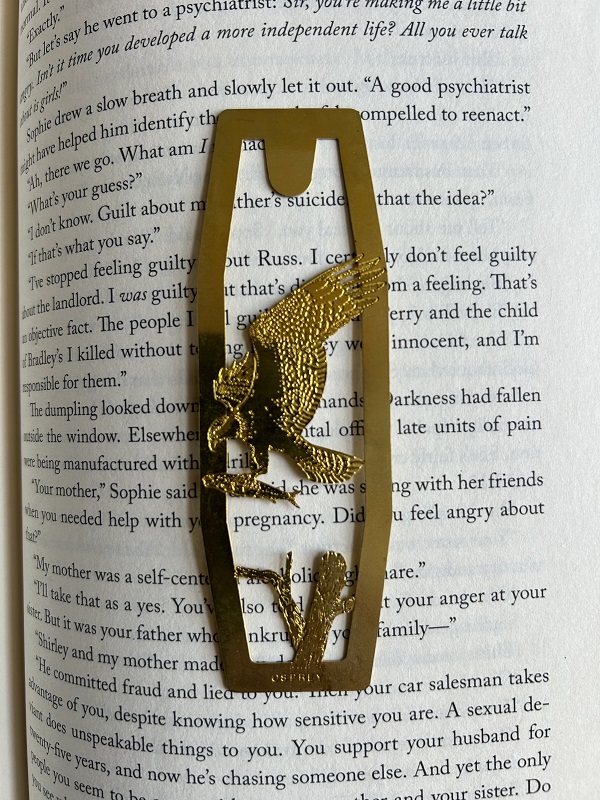
Thirty years ago there used to be a lot of bookmarks you could pick up for free that were promotional items for new books and movies. You rarely see them anymore. Which is one of the things that make them such great collectibles.

Book: King of the World: The Life of Louis XIV by Philip Mansel

Bookmarked Bookmarks

Holmes: The Adventure of the Copper Beeches

First publication in The Strand Magazine June 1892. It was apparently around this time, which was still relatively early going, that Doyle wanted to abandon Holmes. But his (Doyle’s) mother came to him with the germ for this story so the great detective’s (false) demise was postponed. I mean, how can you turn down writing a story for your mom?

I don’t think it’s a great story, as it seems to borrow a number of basic elements from previous cases without adding much. And once again there is the business of removing obstacles blocking a pair of young lovers uniting. Solving a crime, or unwrapping a mystery, is of course fundamental to the way detective fiction works, but Doyle seems to have had an atavistic attachment to an even more basic plot. That the lovers in this case manage well enough on their own, leaving Holmes to clean things up with an explanation of what’s been going on, is only a slight wrinkle in the fabric.

If you’re a collector of Holmes’s words of wisdom though you get fair service. Beginning with the opening utterance:

“To the man who loves art for its own sake,” remarked Sherlock Holmes, tossing aside the advertisement sheet of the Daily Telegraph, “it is frequently in its least important and lowest manifestations that the keenest pleasure is to be derived.”

That’s an observation that I think can be extended far beyond where Holmes immediately takes it, which is to commend Watson for writing up his more “trivial” adventures rather than the “many causes célèbres and sensational trials” in which Holmes has taken part. By “low” Holmes means something intellectual, involving the processes (or art) of “logical synthesis.” I like the idea of the man who loves art for its own sake being a connoisseur of the “lowest manifestations” of entertainment the newspapers have to offer, but I realize that’s the opposite of what is meant. Unfortunately, Holmes’s lecture on high and low is mixed up quite a bit here, as he concludes that “Crime is common. Logic is rare. Therefore it is upon the logic rather than upon the crime that you should dwell. You have degraded what should have been a course of lectures into a series of tales.” The pleasure of the story is here lower than the operations of logic, which is more what you’d expect him to say.

Another interesting topic of discussion comes up on the train ride to Winchester. Watson admires the green and pleasant countryside they pass through but it fills Holmes with horror.

“It is my belief, Watson, founded upon my experience, that the lowest and vilest alleys in London do not present a more dreadful record of sin than does the smiling and beautiful countryside.”

“You horrify me!”

“But the reason is very obvious. The pressure of public opinion can do in the town what the law cannot accomplish. There is no lane so vile that the scream of a tortured child, or the thud of a drunkard’s blow, does not beget sympathy and indignation among the neighbours, and then the whole machinery of justice is ever so close that a word of complaint can set it going, and there is but a step between the crime and the dock. But look at these lonely houses, each in its own fields, filled for the most part with poor ignorant folk who know little of the law. Think of the deeds of hellish cruelty, the hidden wickedness which may go on, year in, year out, in such places, and none the wiser.”

I think in the 1890s this would have been seen as a perverse take, which is how Watson immediately responds to it. One can see Holmes’s reasoning, but even in Victorian England I’m not sure how persuasive it is. Rural isolation does leave people more vulnerable to crime. I’ve had experience of that myself. Call the cops and you may have someone come by later that afternoon. But urban living is in many ways more anonymous, which helps conceal a lot. As far as the psychological effects are concerned, again isolation may not be conducive to robust mental health, but then nothing degrades one’s love for humanity than being stuck in traffic or packed in a subway for hours every day, or living crammed into a tiny apartment alongside people who smell bad or make a lot of noise. I don’t think we can be as certain about these matters as Holmes is.

Things wrap up quickly. Holmes sees the solution as obvious, but it’s only obvious when seeing the events as a dramatic story, not as a logical system. Which sort of undercuts what he kicks things off by saying. Then Miss Violet Hunter is dismissed to head a private school, as Holmes “manifested no further interest in her when once she had ceased to be the center of one of his problems.” The young couple are hitched and sent to Mauritius. What I find most interesting is the fate of Mr. Rucastle, who survives “a broken man, kept alive through the care of his devoted wife.” And his “old servants.” And (though this isn’t mentioned) their demonic, cockroach-killing kid. I would have thought everyone would have abandoned the old miser after all he’d done. But I guess they had fewer options back in those days. People had to stick together.

Holmes index

DNF files: Murderland

Murderland: Crime and Bloodlust in the Time of Serial Killers

By Caroline Fraser

Page I bailed on: 28

Verdict: It might not be a bad book but it wasn’t what I was expecting or what I wanted. Given the title, which drops murder, crime, bloodlust, and serial killers, I was expecting something in the true crime vein. But it only comes at this indirectly.

More specifically, it’s a book that addresses the amount of serial killer activity in Washington State in the 1970s and ‘80s. Think names like Ted Bundy, Gary Ridgway (the Green River Killer), Randy Woodfield (the I-5 Killer), or any of the other bad people you’ll find in books by Ann Rule, who made a career out of covering this beat. Fraser gives these killers a context that is meant to give some explanation for their appearance at this time and in this place. It begins by talking about something called the Olympic-Wallow Lineament, but we’re immediately told that “Nobody knows what it is.” After reading Fraser I had to do an Internet search to find some better explanation. I came away just as confused. Then we get a chapter on the building of a couple of bridges: the famously doomed Tacoma Narrows Bridge and the Mercer Island floating bridge. Interesting if you’re into bridges, or engineering in general. I wasn’t sure what it had to do with serial killers. After this, skimming ahead, we turn to the smelting industry and the pollution it caused. I think this is where Fraser is hanging her hat, making a connection between lead poisoning and an increase in headline murders.

Maybe she’s onto something, but I’d lost interest and was just turning pages. Fraser’s prose is overgrown with literary flourishes, like the one that begins on page 28 (not coincidentally, the page I bailed on):

Let us linger for a moment in that frothy postwar fizz of euphoria, when people are eager to swallow the cost of progress. How bad can it be, after the world has gone to war? It is a time of celebration.

Just for a moment, if you will, let us float across the country in that effervescent bubble of champagne elation and planetary subjugation and heedless sexual entitlement to look down from our cloud somewhere above Philadelphia and witness the conception of a noteworthy child.

Wait, are we in a bubble or a cloud? Either way, no thanks.

Also, as a child of the region Fraser can’t resist introducing a memoir angle into the proceedings, which as you may know by now is something I despise in true crime writing. This needs to stop.

In any event, as far as explainers go, I think Rule addressed the same subject in her books and for a sharp analysis of why this period became a “golden age” of serial killers I’d recommend Peter Vronsky’s American Serial Killers: The Epidemic Years. Fraser’s speculations on pollution being partially at fault could have been the subject of a magazine article, but they feel lost in a grab-bag book of this size.

The DNF files

Alien: Icarus

Alien: Icarus

All of these Alien comics present self-contained storylines that ran for 5 or 6 issues. There’s a sort-of through line that’s covered in the opening to each, but it’s not necessary to read them in order. For what it’s worth, this volume is a sequel of sorts to Alien: Revival, as the events of that series are briefly mentioned here. But this is a wholly separate adventure. And like all of the Alien comics (at least all the ones I’ve read) it’s another interesting and original story that reimagines the familiar monsters in a new setting.

For reasons not worth getting into a team of super-synth soldiers are sent to a radiated planet overrun by Xenomorphs in order to retrieve a Xenomorph egg that contains an experimental genetic modification that the United Systems (that would be the U.S. government, rivals of the Weyland-Yutani Corp.) believes contains an antidote to radioactivity.

So it’s off to Tobler-9 and it looks like the Xenos actually have an opponent in their own weight class, since the synths are all trained mercenaries who use their plasma rifles, bows and arrows, and samurai swords to go toe-to-toe (or claw, or whatever) with the evil critters. One synth even tears a Xenomorph’s head off with his bare hands. And you don’t have to worry about the synths getting bred in the usual way since the Xenos can’t use them for that. Alas, there are only five synths in the team and as usual an unending supply of Xenomorphs to kill, including a giant Queen and then later an insect-human-Xenomorph hybrid thing.

So that’s something a bit new, though it had been foreshadowed in one of the stories in Aliens: The Original Years. And I thought there was a higher gross-out and gore level here than in previous comics. But like I say, I found the story compelling and original. Writer Phillip Kennedy Johnson also entertains a couple of ideas that I had to think about, even if I ended up rejecting both of them. First there’s the notion that the synths can be more human (meaning, they display more empathy and altruism) than the humans. Would that be the result of their programming? Something to make them a more effective team? Or are they evolving on their own? Then, speaking of evolution, there’s the way the Xenomorphs seem to take biological cues from their hosts, at least under lab circumstances. This is what leads to the insect-human-Xenomorph hybrid. I found myself wondering how much of this was Weyland-Yutani’s efforts to create a new bioweapon and how much was “natural.” Because why would the Xenomorphs evolve when they’re already perfect killing machines?

So great fun for fans, delivering on lots of brutal action and plenty more of what you came for. There’s a simple but effective story with all the usual elements worked in effectively alongside a couple of new wrinkles. There’s been no end of criticism of the Alien film franchise, and for good reason, but readers of the comics have had nothing to complain about.

Graphicalex

Gideon Falls Volume 5: Wicked Worlds

Gideon Falls Volume 5: Wicked Worlds

Sheer chaos. “Please . . . just slow down,” Dr. Xu begs of Danny when he tries to explain. “What does all of this mean? I am . . . I’m so confused.” Join the club, Doc.

Here it is in a nutshell. After the Black Barn got blown up at the end of the previous volume we’re told that it didn’t get destroyed but was instead “set free.” Whatever that means. What it seems to involve is the multiverse collapsing in on its center point, which is Gideon Falls. You see, “for some reason we can never know,” the “heart of it all” (that is, the heart of everything that ever has or ever will exist in space and time) is Gideon Falls. It was all that existed before the fragmentation into an infinite number of timelines, and now after that initial Big Bang reality is experiencing a Big Crunch back to its singular identity. Because of the darkness. Which is where the Laughing Man/Bug God comes in.

If it all sounds fuzzy that’s because it is. In this volume various characters in different parts of the multiverse (a Wild West environment, a dystopic police state) run away from zombie Laughing Men until they can regroup as the “New Ploughmen.” Which is an homage to the original bunch of Black Barn conspiracy nuts. There’s a lot of running around but it feels like running in place since you can’t even say they’re going in circles. We’re just left to understand that someone, somewhere understands what they’re doing and has arranged things to work out the way they’re meant to.

The plot itself doesn’t advance, but lots of things do happen. The main draw here though is again Andrea Sorrentino’s art. He was really off leash with this series and it’s a lot of fun seeing what he comes up with in terms of page design and layout. So enjoy that, because the story in this part is thin gruel and what there is will probably leave you scratching your head.

Graphicalex

Marple: The Second Murder at the Vicarage

Oh, what a disappointment.

This is the second story in the Marple: Twelve New Stories anthology that got off to a great start with Lucy Foley’s “Evil in Small Places.” As the title indicates, it’s a sequel set several years after the first Miss Marple novel, The Murder at the Vicarage. Once again narrative duties are handled by the vicar. He and his wife have a young son now (Griselda had only been pregnant at the end of the novel), and their nephew Dennis is a probationary police constable working under Inspector Slack. As things kick off here the vicar discovers yet another body in his home, this time of his former maid, Mary. She was his maid in the novel but had run off with the ne’er-do-well poacher Bill Archer. Now both Bill and Mary are dead: he from eating poisonous fungi and she from having her head bashed in with a cast-iron omelette pan.

All of that sounds like it could be a lot of fun, but it’s not. Val McDermid is a big name in mystery fiction but I’m not familiar with her work. On the strength of this story I won’t be looking for more. It’s hard to even call it a mystery. Miss Marple just pulls a rabbit out of a hat in her quick explanation of what happened. The killers are a couple of minor characters whose names are dropped in passing in the rest of the story but who we never meet or even catch a glimpse of. The clues Miss M uses to solve the case go unmentioned. We’re only told that Miss Marple seems to be noticing things, and then at the end she tells us what it is she had noticed. So there’s no way as a reader you could even guess at whodunit. This won’t do.

Marple index

AIU

Almost as soon as stories about ChatGPT and generative artificial intelligence started breaking a few years ago there were people commenting on the impact it might have on education. It wasn’t hard to imagine even the earliest chatbots writing essays better than most students were capable of, and in a world where they were doing all of their essays and taking all of their tests on screens we were immediately tossed into a massive multiplayer Turing test, with teachers being challenged to see whether the work they were grading was real.

Students took to AI like fish to water, with one survey saying that within a year or two 90% of them were using the assistance of AI in writing papers. The one figure I found for Canadian students said that well over half were using AI to do their homework in 2024. I wasn’t surprised by this, or the speed of AI’s adoption, or by the way an increased use of AI led to questions being asked as to what the worth or even the point of an education was if it could so effectively be faked without any effort. There was always another side of the story, however, that I thought all of these reports were missing.

When news of the impact of AI on education started breaking I understood that students were going to make use of it. What I don’t think many people appreciated, because I didn’t see anyone talking about it, was that their teachers would too.

Even when I was at university it was clear to me that many of my professors’ lectures were basically just cribs of other people’s work. In some cases they were adding nothing to decades-old secondary literature that they were almost reading verbatim. Since I graduated I’ve listened to many lectures online, even ones that have been highly recommended by top profs from prestigious institutions, and thought that they could have basically been written by an AI. In an adult education program I’ve been involved in that creates lecture series on topics of interest one such course, on AI, was designed by AI as a sort of cheeky proof of concept.

The fact that professors were cheating didn’t surprise or upset me. Many academics don’t make a lot of money but work on short-term contracts. Why wouldn’t they use AI to prepare some of their lectures? And why would tenured faculty be above taking such shortcuts? In some cases I’m sure that using AI might even make their lectures better.

I recently had lunch with a professor friend where I mentioned this and he seemed surprised and a bit horrified at the thought. I thought he was naive. And a couple of weeks ago a news story that caught my eye gave me some support. According to the story a student at Northeastern University in the U.S. had requested a refund of her tuition after discovering that her professor had been using ChatGPT to prepare his lessons.

Wondering if it was just an isolated incident, she found more signs of AI usage in previous lessons, including spelling mistakes, distorted text, and flawed images.

Because of this, she decided to request a refund for the tuition she paid for the class, since she was paying a significant amount to receive a quality education at a prestigious university. For that course alone, she was paying $8,000 per month.

She pointed out that the same professor had strict rules regarding “academic dishonesty” by students, including the use of artificial intelligence. However, shortly after graduating, Ella was informed that she would not be reimbursed.

Speaking to The New York Times, Rick Arrowood, Ella’s professor, said he had uploaded the content of his classes into AI tools like ChatGPT to “give them a new approach.” While he explained that he reviewed the texts and thought they looked fine, he admitted he “should have looked more closely.”

Arrowood also said he didn’t use the slides in the classroom because he prefers open discussions among students, but he chose to make the material available for them to study.

Meanwhile, a spokesperson for Northeastern University stated that the university “embraces the use of artificial intelligence to enhance all aspects of its teaching, research, and operations.”

Several U.S. universities are adopting similar positions, arguing that the use of AI tools is seen as useful and important by faculty. But not all students are convinced.

On websites like Rate My Professors, a platform for evaluating instructors, complaints about professors using AI are also on the rise. Most students complain about the hypocrisy of teachers who ban them from using AI tools while using them themselves.

Furthermore, many question the point of paying thousands of dollars for an academic education they could get for free with ChatGPT. The topic remains under debate, but most students and faculty agree that the main issue is the lack of transparency.

I don’t agree that the main issue is lack of transparency. I think the main issue is that AI may be better at this than the professors who are using it not just as a time-saving technology but as a crutch or surrogate already, with their numbers “on the rise” given that it’s such a “useful and important tool.” And it’s not just being used in the preparation of lectures. Another story I found in The Byte online talks about a program called Writable that “is allowing teachers to use AI to evaluate papers, which the company says saves ‘teachers time on daily instruction and feedback.'” As the story concludes:

It’s a bizarre new chapter in our ongoing attempts to introduce AI tech to almost every aspect of life. With both students and teachers relying on deeply flawed technology, it certainly doesn’t bode well for the future of education.

Bizarre indeed! The future of education may have AI programs grading essays written by AI, based on lectures prepared by AI, with nobody being any the wiser. In fact, that may not even be the future. It’s almost certainly happening already.

We should be concerned about where we’re heading. But my point is this: don’t just blame the kids.

Batman/The Shadow: The Murder Geniuses

Batman/The Shadow: The Murder Geniuses

I’ll grant that crossovers can get messy. And crossovers with two writers may get even messier. That said, the idea of having Batman and the Shadow joining forces must have seemed like a good fit, as they’re both dark, mysterious crime-fighters hailing from the same era (both debuted in the 1930s). Unfortunately, it’s hard to think of anything this comic series does right, at least in terms of its storyline.

I found that story impossible to follow. I don’t know the Shadow character very well, but I think even if I did I would have been lost. As far as I can figure out he’s an immortal figure or spirit from another dimension: the fabled city of Shamba-La. What is Shamba-La? Why it’s a “foothold on your plane of existence, anchored by heavy dimensional ballast.” People there live “on a higher thaumic frequency.” Got it?

Anyway, apparently the Shadow has had his eye on Batman for a while and has selected him to be his heir. But then this manga-masked super-villain from Shamba-La named the Stag (because he wears an antler headdress, you see) shows up and starts killing off all the best people in the world. This makes him the reverse Shadow, as the Shadow’s mission is to take out the worst people in the world. So Batman and the Shadow team up to defeat the Stag, who has allied with the Joker. Batman sort of gets killed but then he’s revived by going to Shamba-La and meeting Cthulhu. The Stag is finally beaten and the Shadow is stuck still being the Shadow and Batman stays on as Batman.

I may be getting something wrong in all that. I’m probably getting a lot wrong. I just didn’t know what was going on. The Stag has a backstory but he only speaks a single enigmatic line (“I am an honest signal”) over and over. The Joker is roped into action just because this is a big Batman title and they figured the Joker had to show up and do something. But this is one of his least impressive incarnations. The Shadow looks dramatic in his magic red scarf unrolling like Spawn’s cape, but honestly I didn’t understand what he was going on about most of the time. Harry Vincent and Margo Lane show up too, but just as props. I guess the art isn’t bad, but Batman’s boyish face doesn’t really go with his scarred tank of a physique and the Joker seems like a puppet figure.

I didn’t like this one. The crossover idea had a lot of potential but they needed to keep the script a lot tighter. With all the background mythology I just had the sense that things were getting away from Scott Snyder and Steve Orlando right from the start. It was fairly well received by fans though, which makes me wonder if coherence or intelligibility is something that people even look for anymore in pop entertainment.

Graphicalex