Over at Alex on Film I’ve added my notes on Cat People (1942) and Curse of the Cat People (1944), a pair of very different horror movies produced by Val Lewton. Though you might question whether Curse of the Cat People is really a horror movie, or a sequel. I really wanted to include notes on Paul Schrader’s 1982 remake, starring Nastassja Kinski, but you’ll have to wait for that. I haven’t seen it in years!
Dangerous Dining with Alex #10
Harvey’s Meal Deal
Overview: With the coupon I had, I guess it was a deal. But was it a meal?
Label: Not much sticker shock from the nutritional guide on this one. The Harvey’s “original burger” is only 360 calories undressed. 17 g of fat and 970 mg of sodium. That’s liveable. As part of the meal deal I had a coupon for, however, it came with a side order of fries. This, remarkably, had the same amount of sodium and 50% more fat than the burger! Throw in a medium soft drink (not my thing, but it’s part of the deal), and some fixings for the burger, and the total came to just under 1,000 calories. That’s still not too bad. Of course there’s nothing here that’s actually good for you, but it’s not a health crisis either.
Review: Harvey’s is pretty much the only burger chain I can stomach. The burgers still retain some faint resemblance in taste and texture to a real hamburger patty, and I like that you can watch them make it the way you want it with a nice range of toppings. Like black olives. I put those on everything because I read something a long time ago that said they were healthy. Alas, the burgers are so small that the olives keep falling off.
I think some people get carried away with all the choice. The woman behind me in line wanted ketchup, mustard, and relish on her burger. That struck me as in some way counterproductive. It’s like she was making a burger slurry.
I really enjoy the atmosphere at my local Harvey’s. There are often a lot of oddballs in there, including, this time, one of the biggest guys I’d ever seen. His head was almost touching the ceiling, which I would have thought was impossible. Ordering was an adventure, as I honestly couldn’t make out a single word the cashier was saying, and she was speaking English. I had to get her to repeat everything three times. Best of all, they always play great classic rock. I ate my meal to AC/DC’s “For Those About to Rock We Salute You,” a song I haven’t heard for decades. It doesn’t get any better than that.
The big problem I had with the meal deal itself was that it wasn’t enough. As I’ve said, the burger seemed really small. I think I could have easily eaten three of them in one sitting. I’d already eaten a lot that day, but by the time I finished walking home I was hungry again. So while the numbers weren’t too bad, I wasn’t getting stuffed. To be honest, it felt more like a snack than a meal.
Price: $5.99
Score: 5 / 10
Leapin’ lethiferous looters!
In Simon Sebag Montefiore’s The Romanovs he describes Napoleon entering a Moscow abandoned and on fire: “Only a few French tutors, actresses and lethiferous bands of looters haunted the streets as Moscow burned for six days.” If you know Latin, or if you’re just good at guessing based on cognates, you’d figure (correctly) that “lethiferous” means “deadly” or “lethal.” Still, it’s an obsolete word I don’t recall seeing used before. Another one for the word bank!
Buzz, buzz, buzz
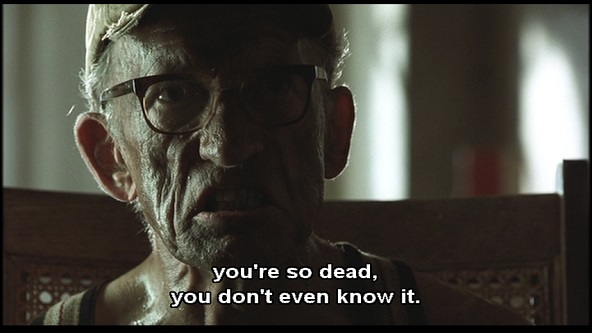
Wow. That’s pretty dead.
Over at Alex on Film I’ve added my notes on the 1974 classic The Texas Chain Saw Massacre and its 2003 remake. I still find Tobe Hooper’s movie disturbing and effective. The remake, like all the twenty-first century horror franchise resets, is just something to be endured. There’s a more general point to be made here about horror movies in our time that I hope to address in an essay soon.
The silence of the Internet
This week the popular film site IMDb (the Internet Movie Database) closed its message boards. Apparently this was because commenting was “no longer providing a positive, useful experience for the vast majority of our more than 250 million monthly users worldwide.” I don’t know how true that is. I spent a lot of time reading those threads. Sure there was some trolling, but less than you might imagine, and a lot of the conversations were well informed and informative. Roger Ebert even used to quote from them in his later essays.
I’ve also heard that the message boards made less income from ads and were costing too much to run, which sound like more accurate reasons for shutting them down.
In any event, I’ll be very sad to see them go. A year ago I wrote a post about how large parts of the Internet were turning away from the model of an open forum by disallowing comments on news stories. A lot of the backlash has latched on to the figure of the villainous troll, and how anonymous haters spreading fake news and all the rest of it represent a clear and present danger to civil society. I’m not defending the trolls, but that seems like a massive exaggeration to me, and I suspect it’s just an excuse being used to stifle different points of view. I’ve certainly had comments I’ve made at various news sites deleted by moderators over the years, all of which were just expressions of political opinions (that is, non-obscene, non-personal, non-threatening). Sure there were silly posts on the IMDb boards, but I suspect what’s really happening here is that advertisers didn’t have any use for them and the site operators found them uncontrollable, so they had to go.
Is this the Internet 3.0 taking shape? I don’t like it.
Canada Post humour
I don’t think mail delivery is that boring a job. I’ve never done it, but it can’t be as bad as, say, working on a line in a factory. Even so, I guess mailmen do have to find ways to amuse themselves, just to get through a dull day.
As evidence, I present this:

Well played, Canada Post.
As someone who reviews books, I get a lot of books in the mail. Some come in boxes. This box apparently just fit into the small parcel slot in my community mailbox. A very snug fit indeed. Getting it in couldn’t have been easy! Removal, of course, proved to be impossible, even with the use of a screwdriver and other tools. You can’t tell from the picture, but there’s a lip over the edge of the parcel slot once the main mailbox door is closed, so there really was no way to retrieve the package.
I have to admit, I just laughed when I saw this. Of course, right next to the small parcel slot is the large parcel slot, which was empty (I shone a light in to check). Well played, Canada Post. Well played.
Hunting humans
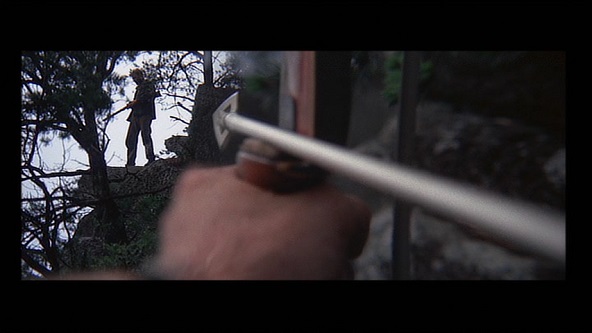
Over at Alex on Film I’ve been watching movies that deal, however loosely, with people (or monsters) hunting people. This is a pretty basic theme, and has been expressed in a variety of different ways. In the first place there are all the adaptations of the famous Richard Connell story “The Most Dangerous Game. ” Then there’s the Predator franchise. And then there are movies where people just go off into the woods and discover that the woods are no longer a safe place to be. Here’s the line-up:
The Most Dangerous Game (1932)
A Game of Death (1945)
Run for the Sun (1956)
Bloodlust! (1961)
Deliverance (1972)
Shoot (1976)
Rituals (1977)
Predator (1987)
Predator 2 (1990)
Hard Target (1993)
Eden Lake (2008)
Predators (2010)
Embedded (2012)
Beyond the Reach (2014)
The Purge: Election Year (2016)
The Hunt (2020)
Prey (2022)
Predator: Badlands (2025)
Re-reading Shakespeare: Titus Andronicus
(1) There was no Titus Andronicus. I don’t know why this bothers me, but it does. Of course there was no Prospero. There probably was no King Lear (or Leir). But in Lear’s case you can at least place the character in a historical context (pre-Roman Britain) and give the story a source (Holinshed’s Chronicles). And Shakespeare’s other Roman plays are all about real historical figures and draw on sources like Plutarch. But Titus Andronicus is a made-up figure living in a fantasy world. The presumed source dates the events to the reign of the Emperor Theodosius, but that’s nothing more than a wave of the hand. In many ways this is a more primitive Rome than that of Coriolanus, which is set half a millennium earlier.
Like I say, this shouldn’t matter. Shakespeare’s Rome, like his England in the history plays, is a fictional place. And yet it’s always made me uncomfortable. Perhaps I just don’t like fantasy, or fantasy that plays fast and loose with history. It’s the same sort of feeling I get from the Nibelungenlied, which has its germ in actual historical events but really can’t be thought of in those terms. Burgundy might as well be Middle Earth. What you’re getting isn’t an interpretation or mythic re-imagining of history but something entirely other. And by breaking that link it seems to me that you end up with a play that loses some of its connection to the present as well.
(2) When Marcus discovers Lavinia after she has been raped and mutilated, he exclaims
Sorrow concealed, like an oven stopped,
Doth burn the heart to cinders where it is.
This is very well observed. Physically, Lavinia is incapable of speaking her sorrow because her tongue has been cut out, but we can see her silence as metaphorical as well. One response to rape is shame, and when the victim doesn’t speak out her rage often does turn inward, expressing itself later through other emotional disorders. With no outlet, the victim’s anger is directed back upon itself. The heart consumes itself in silence, but it does burn.
(3) Titus makes Lear’s mistake of giving up power. He could have been emperor but he turns the job down. Richard II is another example of a Shakespearean king who flubs the same test, effectively deposing himself. This was an important lesson in leadership for pre-modern rulers: If you’re the king you have to be a king. But I wonder if such a message resonates as much today, when institutions take precedence over individuals.
I think it is still relevant, though perhaps not in the way it is most often taken: to do unto others before they do unto you. In Shakespeare such situations lead to more than just a passing of the guard; they toss the whole world into chaos, and begin cycles of violence with long tails. That’s a pattern we should be familiar with today, though twenty-first century blowback is less of a family matter.
I don’t think they misunderstood anything
From The Invention of Russia (2015) by Arkady Ostrovsky:
The new class of businessmen that emerged from the rubble of the Soviet economy thought of themselves as the champions of capitalism as they understood it. In some ways they were the victims of Soviet propaganda that portrayed capitalism as a cutthroat, cynical system where craftiness and ruthlessness were more important than integrity, where everyone screws each other and money is the only arbiter of success.
Russian capitalism was far removed from the concept of honest competition and fair play or Weber’s Protestant ethics. It was not built on a centuries-long tradition of private property, feudal honor and dignity. In fact, it hardly had any foundations at all, other than the Marxist-Leninist conception of private property as theft. Since Russia’s new businessmen favored property, they did not mind theft. The words conscience, morality and integrity were tainted by ideology and belonged to a different language — one that was used by their fathers’ generation. “For us these were swear-words which the Soviet system professed in its slogans while killing and depriving people,” Vladimir Yakovlev said.
The tenets of socialism were removed only to reveal a vacuum of morals — in itself the result of the Soviet experiment in breeding a new being. The transition from Soviet to post-Soviet society was accompanied by a change in perception of what makes one succeed in life. In 1988, 45 percent of the country felt it was “diligence and hard work.” In 1992 only 31 percent felt these would get you anywhere. The factors that gained importance were “good connections,” “dexterity” and “being a good wheeler-dealer.” The first Russian businessmen had all those qualities and boasted about them.
The happy nine-fingered shepherds of pastoral
From Deliverance (1970) by James Dickey:
There is always something wrong about people in the country, I thought. In the comparatively few times I had ever been in the rural South I had been struck by the number of missing fingers. Offhand, I had counted around twenty, at least. There had also been several people with some form of crippling or twisting illness, some blind or one-eyed. No adequate medical treatment, maybe. But there was something else. You’d think that farming was a healthy life, with fresh air and fresh food and plenty of exercise, but I never saw a farmer who didn’t have something wrong with him, and most of the time obviously wrong; I never saw one who was physically powerful, either. Certainly there were none like Lewis. The work with the hands must be fantastically dangerous, in all that fresh air and sunshine, I thought: the catching of an arm in a tractor part somewhere off in the middle of a field where nothing happened but the sun blazed back more fiercely down the open mouth of one’s screams. And so many snakebites deep in the woods as one stepped over a rotting log, so many domestic animals suddenly turning and crushing one against the splintering side of a barn stall. I wanted none of it, and I didn’t want to be around when it happened either. But I was there, and there was no way for me to escape, except by water, from the country of nine-fingered people.

