Over at the Canadian Notes & Queries website my review of John Metcalf’s The Canadian Short Story has been posted. It’s a review that turns into an essay on the increase in socially aware literary criticism we’re presently experiencing, and how that has in turn pushed Metcalf’s brand of aesthetic criticism to the margins.
Reading event: Tim Conley and Amy Spurway
Tim Conley, Collapsible and Amy Spurway, Crow
BookShelf, April 23 2019:
Even though there were two authors on tap (and there were supposed to be three but the third couldn’t make it) this reading wasn’t held in the eBar but at the back of the bookstore. Which is cozier (there were only fifteen chairs) but not the greatest place to be for sound. The authors didn’t have mics and you could hear all the plates rattling and orders being called from the kitchen of the restaurant just next to us, which meant you really had to pay attention.
That said, both authors read well and chose good material. Conley (whose first book, Whatever Happens, I reviewed thirteen years ago, which made me feel old) read a short story that was short enough, and made use of enough repetitive language, to let the audience see the pattern being drawn — something that isn’t easy to do at a reading. Spurway read from the beginning of her novel, which worked well because it’s told in the first person and the narrator is playing with different ways of introducing herself. So it’s a natural way to introduce the book.
This was one of the more enjoyable readings I’ve been to lately. It was informal (they didn’t even have anyone to introduce them!) and quick. The questions from the floor were good and received some interesting answers. All done in about half an hour. Time well spent.
Unwrapped
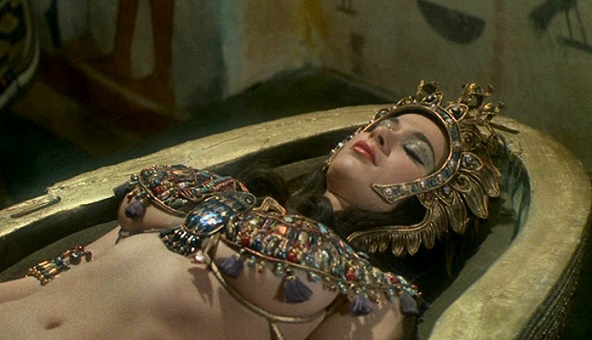
A particularly well-preserved mummy.
Over at Alex on Film I’ve been watching a bunch of mummy movies. It was not time well spent, as mummies make dull movie monsters and few of these movies are any good. The 1999 Brendan Fraser vehicle is still a bit of fun though, and Don Coscarelli’s Bubba Ho-Tep is worth checking out. Aside from that there’s the classic 1932 film that started it all and the 1959 Hammer version. They’re OK. The rest you can pass on.
The Mummy (1932)
The Mummy’s Hand (1942)
The Mummy’s Tomb (1942)
The Mummy’s Ghost (1944)
The Mummy’s Curse (1944)
Pharaoh’s Curse (1957)
Curse of the Aztec Mummy (1957)
The Robot vs. The Aztec Mummy (1958)
The Mummy (1959)
Orgy of the Dead (1965)
Death Curse of Tartu (1966)
The Mummy’s Shroud (1967)
Blood from the Mummy’s Tomb (1971)
Dawn of the Mummy (1981)
Bram Stoker’s Legend of the Mummy (1998)
The Mummy (1999)
The Mummy Returns (2001)
Bubba Ho-Tep (2002)
The Mummy: Tomb of the Dragon Emperor (2008)
The Mummy (2017)
The decay of lying
I’ve recently been re-reading Seymour Hersh’s series of investigations into some of the lies told by the Obama administration, first published in the London Review of Books and then collected in The Killing of Osama bin Laden. It’s a measure of the impact Trump has had that it all seems so quaint now. And I’m not just referring to the arrival of truth-tellin’ Michael Flynn in the final pages of Hersh’s book to tell us that Russia is our friend.
Obama’s lies were variously motivated, but mainly had to do with reasons of state and the always-in-operation cover-your-ass principle. The cover story or “narrative” (a word that has now become synonymous with fiction) about the assassination of Osama bin Laden was primarily concocted in order to conceal the cooperation of Pakistan’s military intelligence. As far as cover stories (or lies) go, this struck me as fairly innocuous, even though it gave rise to Zero Dark Thirty and the hard-to-kill myth of torture’s efficacy.
I felt the same way about the misinformation given out regarding what the administration knew of the use of chemical weapons in Syria. This again seems to have been politically motivated, and stemmed largely from a chaotic situation on the ground and no clear directing policy framework for dealing with it. I’m not even sure how much it matters, at the end of the day, who was gassing whom, much less who the U.S. said was responsible.
But that was then. These lies were purposeful, political, and at least to some extent persuasive. Zero Dark Thirty even won an Oscar by taking the lies about the hunt for bin Laden and running with them. The lies of Trump, in comparison, are random, personal, and easily exposed. Are they, however, less consequential? As many commentators have pointed out, his indiscriminate carpet-bombing of lies isn’t meant to mislead about any particular point as to make the whole concept of truth seem irrelevant.
The post-truth world is the endgame in sight, a political environment like Putin’s Russia as described by Peter Pomerantsev in Nothing Is True and Everything Is Possible. Pomerantsev’s book is held up by Timothy Snyder as a warning of where the West is heading, and it’s hard to disagree with his general assessment of the course we’re on.
I was thinking of matters like these this past week when following some media scandals. First there was the testimony of Jody Wilson-Raybould, who was commended, even by some Liberal party members, for telling “her truth.” I’ve been vaguely aware of this expression for a while but I’m not sure where it got started. As near as I can tell, when someone says they appreciate you telling your truth what they’re saying is that they don’t believe what you are saying is true, but they accept that you believe it to be true. It’s very much a backhanded way of saying nothing much. It’s also a perfect political soundbite. In response to the recent accusation of inappropriate behaviour on the part of possible presidential candidate Joe Biden, other Democratic candidates again rushed to acknowledge the complainant coming forward with “her truth.” I guess this covers the bases pretty nicely, without committing anyone to saying what the truth in any particular situation is.
But isn’t this a problem? By just saying that someone has told their truth aren’t we making the claim that no objective truth can be arrived at or is recoverable? That everything is relative to one’s own subjective experience? How is this different from a world where nothing is true and everything is possible?
Are identity politics progressive?
 From First World War: Still No End in Sight (2014) by Frank Furedi:
Although expressed through a radical rhetoric of liberation and empowerment, the shift towards identity politics tended to reflect a conservative sensibility that celebrated the particular and regarded the aspiration for universal values with suspicion. The politics of identity focused on the consciousness of the self and on how the self was perceived. It was and continues to be the politics of “it’s all about me.” Even when self-identity was expressed through a group form, the imperative of recognition by others remains its axial principle. As the historian Tony Judt stated, the doctrines that were developed to express the politics of identity were directed towards psychology and were often indifferent to the “traditional projects of social revolution.” Indeed “they sought to undermine the very concept of the human subject that had once underlain them,” argues Judt. People whose identity is defined by their biology, emotional disposition, history and culture have as their focus what they are rather than what they could be. As we shall see, such low expectation towards the exercise of human subjectivity interlocked with a tendency to devalue the ideas of progress and development.
Unaccountable, Part two
 From The Bling Ring (2013) by Nancy Jo Sales:
By the 1980s, kids were looking around at a country where lawbreaking and lawlessness were no longer conditions of poverty and life in the inner city alone. Now these were omnipresent aspects of American business, politics, and the media at the highest levels. “There were no rules governing the pursuit of profit and glory,” Michael Lewis wrote of the culture of Salomon Brothers in the 1980s. “The places was governed by the simple understanding that the unbridled pursuit of perceived self-interest was healthy. Eat or be eaten.”
“Today,” writes Glen Greenwald in With Liberty and Justice for Some (2011), “in a radical and momentous shift, the American political class and its media increasingly repudiate the principle that the law must be equally applied to all.” It gives one pause to consider what the Founding Fathers would have thought of the pardoning of Nixon after the Watergate scandal; the overturning of the convictions of Lieutenant Colonel Oliver North and former National Security Advisor John Poindexter after the Iran-Contra scandal; or the Bush administration’s warrantless wiretapping, politicized prosecutions, torture, and “black sites” — for which no one was ever prosecuted. Every step along the way has been an even bigger departure from the insistence of the framers of the Constitution that in a democracy everyone must be equal before the law. Meanwhile, Greenwald laments, “the media [directs] its hostility toward those who investigated or attempted to hold accountable the most powerful members of our political system.”
And then there was the financial meltdown of 2008 that brought the world economy to its knees. While its causes have barely been investigated or made transparent, it has become sufficiently clear that the crisis was largely the outcome of widespread fraud and lawbreaking. Yet there has been virtually no prosecution of those responsible. “There is no fear of individual punishment,” Rolling Stone‘s Matt Taibbi said in an interview in 2012. “That’s the problem.”
So why did Rachel Lee think she could get away with stealing celebrities’ clothes? Maybe Vince was right, after all: ‘Cause she hadn’t been caught. Yet.
See here for Unaccountable, and here for Unaccountable, Part three.
The dead zone
I’m an early to bed, early to rise kind of guy. Very early. In fact, I live close to a gym that’s open 24-hours and I often go there to exercise at 2 or 3 o’clock in the morning. I usually have the place to myself at that hour, though there are a few other regulars. I’m never sure if they’re getting up as early as I am, or if they’ve stayed up late.
I’ve always been a bit this way. I enjoy the dead hours of the morning when there’s no traffic on the streets. When I lived in the country you could really feel like you were the last man on earth, though I had one farmer friend who would pass me on the road at 3 o’clock and mention wistfully how this was the greatest time of the day. A true kindred spirit.
The reason I bring this up is because this week I’m supposed to be filling out one of those TV viewing surveys. I told the survey company that I didn’t have a TV and they said that didn’t matter. I do, however, watch the TVs they have at the gym. So, being the responsible person I am, I figured I would enter this in the journal they gave me, in the column “Watched TV Out of Home.”
But no! You see, each diary page begins at 4 in the morning. And each day ends at 2 the next morning. So from 2 o’clock to 4 o’clock is a TV-viewing dead zone. Which is the only time of the day, at least most days, that I watch any TV. I don’t even exist within a measurable viewing demographic, despite the fact that stations no longer “sign off” at the end of the day. Sure they repeat programming, but they’re not just broadcasting a test pattern.
This is what life is like on the other side.
Why do we think rich people must be smart?
In the last few weeks the news cycle has run headlines about a couple of prominent rich guys behaving badly. Or perhaps not badly but certainly stupidly. First Jeff Bezos, the richest person in the world, went public with being blackmailed after sending “dick pics” to a girlfriend (that is, a woman other than his soon-to-be ex-wife). Then Robert Kraft, billionaire owner of the Superbowl champion New England Patriots was charged with soliciting prostitution at a Florida massage parlour (his lawyers deny Kraft was engaged in any illegal activity).
One question that was often asked in the wake of both scandals is how two people who had so much money could be involved in such behaviour. Bezos practically owns the Internet, did he not understand that exposing himself in emails was a bad idea? And why would someone with as much money as Kraft be caught dead going to a massage parlour, where the sexual favours on the menu start at $70?
Part of the problem is in our understanding of intelligence. People can be smart in very different ways. Many academics, for example, have no practical common sense at all. I’ve known prominent scientists, considered among the greatest minds in their field in the world, who are totally incapable of carrying on a conversation. Business people know how to make money, but that may be it. Someone who is mechanically inclined might not know how to read. Intelligence comes in many different forms.
Perhaps an even bigger obstacle though, especially when it comes to thinking about the situations Bezos and Kraft found themselves in, is our belief that anyone who is rich must be smart, as there is no clearer marker of success in our society than having a lot of money. Donald Trump has exploited this misconception as much as anyone, despite the fact that (1) he’d have far more money if he’d just invested his massive inheritance in the stock market instead of getting involved in the real estate business, and (2) he’s declared bankruptcy many times. It’s also believed that he vastly overstates his personal wealth in order to make himself seem richer (and hence smarter) than he is.
Instead of acknowledging that rich people might not be all that smart (most rich people, after all, were born rich) we see other explanations offered for these latest incidents. Like the sense of privilege billionaires have: their belief that they are somehow above the law and that normal rules don’t apply to them. I think there may be some of that at work. Rich people do live in a bubble, surrounded by people who flatter their vanity and who would never dream of telling them when they’re doing something wrong. Still, I think the most likely explanation is that a lot of rich people are smart when it comes to making money but not so much with regard to other things. That should not surprise anyone.
Update, November 21 2022:
I took another look at stupid rich people here.
Miles to go
I think most of us still know the words to some poem, favourite or not, that we learned years ago in school. I have a few, and one of them is Robert Frost’s “Stopping by Woods on a Snowy Evening.” But just like we all “know” the words to a pop song whose lyrics we’ve never actually looked up but that we’ve sung along to countless times, we might not always have the words right. In the case of songs the results can be hilarious. I remember hearing of one fellow who turned U2’s “Sunday Bloody Sunday” into the far more threatening “Someday buddy, someday.” And it worked for him.
I was reminded of this recently when thinking of Frost’s poem. I found myself reading it and was surprised to find I didn’t have some of the words right. Surprised because it’s really a very simple poem.
For starters, I’d remembered the third line — “He will not see me stopping here” — as “He will not mind me stopping here.” I guess that’s pretty bad, but the thing is, I kind of like my version better. Why would the person who owns these particular woods see the traveler? Presumably he and his horse are some ways out from the homestead, and it’s night out in the country, where there are no streetlamps. Also I think the point of the line is that the property owner wouldn’t be bothered by some minor trespass. What difference would it make even if he did see the man and his horse? Would he be upset? Why? Are they up to something they shouldn’t be?
Then, at the end of the second stanza, I’d always read “The darkest evening of the year” as “The coldest evening of the year.” And again I prefer my replacement word. What does the darkest evening of the year even mean? Any night with a new moon? But on a snowy winter night it’s always a bit lighter than at any other time of the year because the snow reflects whatever light there is. And there has to be some light because the man is watching the woods fill up with snow. Or does he mean it’s the darkest evening of the year because it’s the shortest day of the year? That may be, but it’s not what he says. Meanwhile, since it’s winter and the man doesn’t want to dawdle, having it be the coldest night of the year makes some sense.
Unlike a song whose lyrics I may have misheard, I don’t know where these revisions to Frost’s poem came from. I guess my brain replaced these words at some point many years ago, and because I liked them better they stuck. It makes you wonder how much of this goes on in any oral culture, and whether such indeterminacy is always a bad thing.
Bird watching
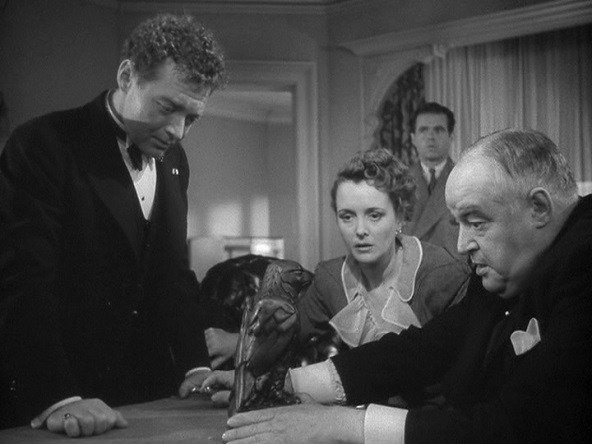
The stuff that dreams are made of.
Over at Alex on Film I just finished watching three versions of Dashiell Hammett’s novel The Maltese Falcon: The Maltese Falcon (1931), Satan Met a Lady (1936), and The Maltese Falcon (1941). The last is the classic directed by John Huston and starring Humphrey Bogart as Sam Spade. It’s one of my favourite movies of all time.

