(Getty Images – Anatolii Stepanov)
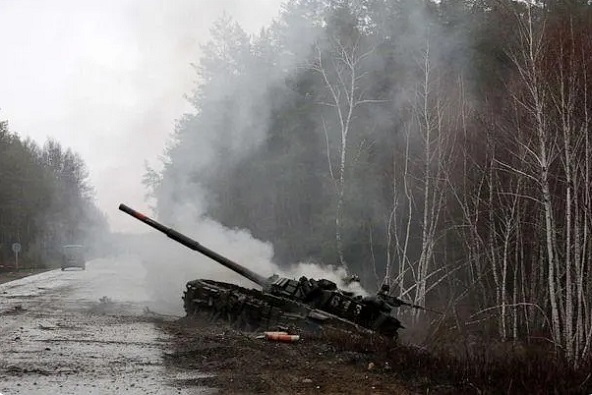
On February 24 Russia launched an unprovoked invasion of Ukraine. This was a mistake, but an even greater crime. According to the judgment of the International Military Tribunal at Nuremberg: “To initiate a war of aggression, therefore, is not only an international crime; it is the supreme international crime differing only from other war crimes in that it contains within itself the accumulated evil of the whole.” Few events in recent times have had such moral clarity, and the invasion has been met with near-universal condemnation.
Intelligence leading up the outbreak of war was good and (a bit surprisingly) much of it was made public. Still, when the invasion came it took many people by surprise. I think mainly because it seemed to make no sense. It was often repeated by the talking heads and experts featured in various media that the only person who knew what was going on was Russian president Vladimir Putin, who seemed to be behaving erratically as of late.
This isn’t hard to understand. With all our talk of privilege — white, male, or whatever — the master privilege of those who are wealthy and powerful has always been the ability to create and live within their own alternate realities. These bubbles are never impermeable. Illness, in particular, has a way of breaking in, like the Red Death crashing Prince Prospero’s party. But while they last, bubbles can be both a nice place to visit and to live in.
A bubble’s biggest weakness, however, is the denial of reality that is their whole reason for being. Within the court of Prince Prospero, nary will be heard a discouraging word. The wealthy and powerful, surrounded by courtiers, yes-men, flunkies, and flatterers, come to believe not only that all their jokes are funny but that they have an invincible destiny.
I wrote about the effect this can have in my review of Hillary Clinton’s campaign memoir What Happened. Clinton should not have run for president in 2016 but by that point ClintonWorld, as it had come to be known, was a bubble swollen to bursting. Critics and detractors had been weeded out of an inner circle where, in her words, loyalty was “prized most among human traits.” Trump, in turn, was no different, prizing loyalty just as highly and making sure that everyone around him was an obsequious toady. And while today his bubble has shrunk to Mar-a-Lago and fringe news outlets, it is still being maintained.
Another example of the bubble phenomenon, bearing perhaps even more directly on the Ukraine invasion, was Hitler’s Operation Barbarossa. The German high command wanted nothing to do with the folly of launching a war against Russia, but by that point Hitler was in such control and had been proven right so often that no one dared speak out against his decision.
It’s quite natural to want to shape reality to one’s own desires and push contradiction (or “negativity”) to the side. Natural, but dangerous. Of course, you may still get away with it. It’s been often remarked, for example, how J. K. Rowling badly needed an editor on the final Harry Potter books, someone to tell her that things were going wrong, but who would have done that? And why? By that point nothing was going to hurt her sales anyway.
I’ve heard it said that Warren Buffett has an advisor on the payroll whose only job is to argue against every decision he makes. He has to do this because he knows that otherwise nobody would speak out against him. I think this shows how smart a guy Buffett is.
My own hunch is that Putin fell into this same trap. Russia has no opposition party or critical press. Putin enjoys unchallenged political power and enormous wealth. Watching his televised meeting with his security council in his throne room I was reminded of when Trump made everyone in his cabinet humiliate themselves by going around the table and forcing them to debase themselves before their Dear Leader. The difference being that Putin has even more control over his bubble, and his flunkies were almost fainting in terror. Trump was only ever a wannabe dictator, not on that level at all.
A piece in Slate by Ben Judah fleshed out some of my thoughts on how this works, describing Russia today in political-science terms as a “personalist dictatorship, where the whims of one man, and one man only, determine policy”:
Americans tend to see the world in much the same way as President Joe Biden frames it in his speeches, divided neatly between “democracies” and “autocracies.” But the reality is that authoritarian states exist on a political spectrum depending on how much power is exercised by a single individual—and where states land on this spectrum has a big impact on matters of war and peace. At one end, you have civilian-run regimes, like Hu Jintao’s China or Leonid Brezhnev’s Soviet Union, where political power is checked and shared within a ruling party. At the other, you have personalist dictatorships like that of, say, Saddam Hussein, where rivals are purged, loyalists are rewarded, cults of personality flourish, and all authority runs through the glorious leader.
As Judah goes on to observe, “A key reason that many wise foreign policy hands thought Russia was bluffing about an invasion was that they assumed Putin wasn’t making his decisions alone. . . . But the world is now realizing that the Putin regime is really just Vladimir Putin. And he is apparently no longer worried about what war will mean for Russia’s rich, much less its masses.”
I don’t think this is all that’s going on, but I do think that a big part of why Putin invaded Ukraine is that there was nobody left within his bubble to tell him that it was a stupid idea. There’s a line about celebrities going bad when they start believing their own press. For politicians it’s changed to believing their own propaganda. It comes to the same thing. Living in a bubble must be great most of the time, but you have to be conscious of the fact that none of it is real. If you imagine that it is then you may be heading for a fall.