TCF: Number Go Up

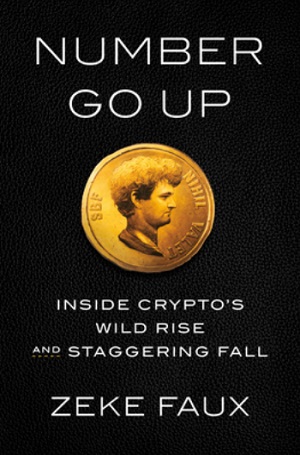
Number Go Up: Inside Crypto’s Wild Rise and Staggering Fall
By Zeke Faux

The crime:

In 2022 the cryptocurrency exchange FTX (short for “Futures Exchange”) went bankrupt, after having hit a peak valuation of $32 billion just weeks earlier. The founder and CEO Sam Bankman-Fried (popularly designated SBF) was later convicted of fraud, conspiracy, and money laundering.
The book:

The FTX story is only the best known part of the crypto chronicle Zeke Faux tells here. There’s a funny image of an SBF coin on the cover with the latin tag “Nihil Valet” (No Value), but this is really a more general look at, as the subtitle has it, the rise and fall of cryptocurrency. In fact, the main target of Faux’s suspicions throughout is the “stablecoin” Tether, which turns into a kind of crypto white whale that he never lands. Nevertheless, Money Go Up is a great read: tart, funny, and filled with telling anecdotes from a journalist who circled the globe, apparently several times, to get the story. I burned through it in a day.

It’s not the whole story of crypto, or, for that matter, of FTX. For example, Faux deliberately eschews going into much detail about how cryptocurrencies works. This is something I can’t fault him for though, as I’ve consumed a number of explainers on the subject and come away with only the fuzziest notion of how the system operates. In my personal experience, however, I’ve found I know more than most people who’ve dabbled in cryptocurrency (including many obnoxious true believers mixed in with the merely crypto-curious), and there are several times in Faux’s narrative where he has crypto insiders admit that they don’t know much more.

Of course, being opaque has always been a feature and not a bug when it comes to crypto. As its name suggests, this is a currency whose whole point is to slam the door on transparency. And it is this character that, in turn, has made crypto the currency of choice for all kinds of criminal activity: Internet scams, tax evasion, human trafficking, and (most of all) money laundering. As a lawyer I knew told me back when this stuff just started taking off: there’s a reason why they want to keep it secret. And as I wrote here several years ago:

As with anything involving a lot of tech, a lot of money, and a lot of secrecy, I am suspicious of all of this. “Cutting out the middleman” and facilitating faster financial transactions may be of some value, but they don’t seem like really pressing needs for anyone. Meanwhile, avoiding any oversight is the kind of thing mostly bad actors want to take advantage of.

What’s the point of crypto anyway? As Faux entertainingly makes clear, it is not a convenience. The middlemen aren’t cut out, and indeed they take an even bigger piece of the crypto action than the much-despised banks do with regular (fiat) currency. When, strictly for journalistic purposes, Faux purchases and then sells a mutant ape NFT he names Doctor Scum the process is described as “excruciating” and confusing (the NFT is actually sold hours before he knows about it, which he accounts “some of the worst hours of my life”). Then there are the extra costs involved (and keep in mind this was only a $20,000 sale):

Had I been trading in U.S. dollars, I would have lost about $800. But in crypto, there’s a fee associated with every transaction. I ended up wasting at least another $1,160: $36 to Coinbase, $497 to Yuga Labs for their 2.5 percent cut on all ape sales, another $497 to the NFT marketplace, $90 to Bank of America, and about $40 in Ethereum fees.

Convenience? Getting rid of the middle man? Lower fees and transaction costs? Not likely. When Faux travels around the world trying to use crypto, even in states where its use is encouraged by the government, all it leaves him with is

a new appreciation for my Visa card. It worked instantly, with just a tap, charged no fees, and never asked me to memorize long strings of numbers, or to bury codes in my backyard. It even gave me airline miles. When my wife’s account was hacked and used to book an Airbnb, we were given a full refund with just a phone call.

Say what you want about the inconvenience of dealing with your bank, and I could say a lot, when it comes to customer service for your cryptocash account the bottom line, as relayed by one artist profiled here, is “SORRY YOU’RE FUCKED.”

The inconvenience of actually using crypto for anything leads to some funny stories, but they underline that question I asked earlier: What’s the point of crypto? Some of its popularity seems to be driven by the kind of thing that in politics is referred to as negative or affective polarization. A good example of this comes when Faux attends a crypto conference in the Bahamas (a “giant volcano of crypto bullshit”) where SBF was interviewed on stage by business author Michael Lewis. Now at the time Lewis was writing a book on Bankman-Fried (Going Infinite), which is always a bad sign. A very bad sign. Faux describes him as “lavishing praise” on big tech’s latest wunderkind, and asking questions “so fawning, they seemed inappropriate for a journalist.” But aside from that, it’s interesting to note some other things.

Lewis said he knew next to nothing about cryptocurrency. But he seemed quite confident that it was great. The writer said that, contrary to popular opinion, crypto was not well suited for crime. He posited that U.S. regulators were hostile to the industry because they’d been brainwashed or bought off by established Wall Street banks. I wondered if he simply hadn’t heard about the countless crypto scams, but the thought seemed preposterous.

“You look at the existing financial system, then you look at what’s been built outside the existing financial system by crypto, and the crypto version is better,” Lewis said.

Better? In what way? Michael Lewis is no dummy. So why, aside from the fact that he was being given access to SBF in order to write his book, was he so deep in the tank for crypto? One part of it, I think, is that negative polarization I mentioned. Crypto is obviously shady, but the government, the “established Wall Street banks,” “the existing financial system” and the elites running it, they are the enemy that needs to be destroyed. The hate, amplified by media and social media, becomes such a powerful drug that even successful elites become willing to cut off their nose to spite their face.

Another draw for crypto is that it is, effectively, a form of gambling, with supposed insiders and people who know the system making piles of money off of the suckers. At several points Faux even likens the crypto exchanges as being a casino. Meanwhile, time and again he tries to think of some real world use for cryptocurrency and comes up with nothing, aside from (obviously) enabling and concealing criminal activity. And, I suppose, letting rich kids play at being crypto bros, happy to give their money to bored billionaires rather than having to do anything so déclassé as paying taxes. Bored billionaires who, in turn, don’t give a damn about consumer protections or safeguards and are just squirreling their money away in offshore boltholes while running schemes many of them openly acknowledge to be fraudulent. One crypto executive thought his job title should be “Ponzi Consultant.” Another “happily” described his business as a “never-ending Ponzi scheme . . . what I call Ponzinomics.”

One thing that struck me is how brief a run FTX enjoyed. The exchange was only founded in 2019, took just a couple of years to reach stratospheric valuations, and was then kaput by 2022. The rise and fall of crypto (and at this point we can only pray that crypto won’t make a comeback, at least to the kind of hysterical levels described here) didn’t take very long. J. P. Morgan CEO Jamie Dimon compared it to a pet rock, and I don’t think NFTs lasted any longer than that iconic fad from from the 1970s. Do we even remember the bored ape NFTs anymore? Or Razzlekhan, the self-styled rapper who was one half of the biggest heist in history? If not, at least we won’t have to explain them to future generations.

That said, crypto is still with us, and all the terrible shit that comes with it. As Annie Lowrey recently reported in The Atlantic:

The FBI reports that cyper-investment scams cost Americans $4.6 billion in 2023 [remember: FTX collapsed in 2022], up 38 percent from the year before, and 1,700 percent over the previous five years. That’s more than ransomware scams, fake tech-support swindles, web extortion schemes, phishing attacks, malware breaches, and nonpayment and nondelivery frauds combined. And it is an undercount, given that it includes only complaints made to law enforcement; most folks don’t bother making a police report in an attempt to get their bitcoin back, knowing it is hopeless.

So why does crypto persist? Because people, greedy people looking to make a very quick and very easy million, or billion, want to believe in it. It’s basically a cult, and Faux isn’t under any illusions that it will be going away anytime soon.

I didn’t think the prices of all of the cryptocurrencies were about to go to zero, or that we’d never see another hot new coin mint overnight billionaires. On the stock market, pump-and-dump scams have persisted for hundreds of years, and yet there are still new suckers willing to buy shares in some shell company that claims to have struck gold.

The one coin I especially wouldn’t bet against is Bitcoin. It’s not that it’s useful – if anything, it’s more unwieldy than the others. But Bitcoin’s true believers are so convinced that it’s hard to imagine anything will change their minds. To them, whatever the question, the answer is “buy Bitcoin.” Everything they see is evidence Bitcoin will rise, like the members of a cult certain that the apocalypse – and their salvation – is just around the corner.

What surprised me, after finishing Number Go Up, was how little I ended up caring about SBF. Perhaps it’s just because that, while a crook, he was far from the worst crook in an industry rife with scammers. But I also couldn’t help feeling that he didn’t care all that much either way about the money. To be sure, he was no altruist, effective or any other kind. But the impression I had was that he knew all along FTX was a joke, a funhouse ride filled with smoke and mirrors, and he was just waiting for the inevitable collapse in his 12,000-square-foot Bahamian penthouse, eating junk food and playing videogames until the Feds came calling. Faux registers surprise at how blasé he appeared when the whole house of cards came crashing down, which for some reason made me think of the response the chief weapons investigator had when he informed George W. Bush that Iraq didn’t have any weapons of mass destruction. He was struck by how uninterested the president seemed. Did he believe they did? Or did he just not care? That’s the thing about bullshit, as defined by Harry Frankfurt. It’s not a lie if you don’t care if it’s true or not. I think SBF was living in an entire ecosystem of bullshit, unconcerned over whether any of it was real.

This is part of what makes Number Go Up such an entertaining and even downright funny a book. But that would be the wrong takeaway. Yes, there are plenty of freaks and geeks to amuse us, like the “laughably weird founders” of Tether. The crypto world is one, Faux tells us, “where a lack of experience or competence has never been a barrier to fame and fortune.” So much for the meritocracy! But dig a little deeper, as Faux does, and you see beyond the great fortunes to the destroyed lives and violent crimes that are such a big part of the crypto story. The book gets progressively darker, finally taking us to a slave-labour cyber-scam camp in Cambodia. It’s a horrifying vision of a world we rarely get to see, and the worst part of it is that it’s probably not even the smallest or most evil part of what’s really going on.

Noted in passing:

What does money buy?

Alex Mashinsky was co-founder and CEO of the crypto lending network Celsius, a company whose business model never seemed to make the slightest bit of sense. When we last see Mashinsky it’s in a Manhattan courtroom, as part of a hearing into a dispute between Celsius and a former employee after Celsius’s bankruptcy (Mashinsky himself would later be arrested and tried for fraud). But when Faux interviewed him at a smoothie shop he was still riding high.

The interview doesn’t go well. Mashinsky blows a bunch of smoke at Faux about Celsius being a five-legged stool or a candy shop, but then gets distracted by his disintegrating paper straw which requires him to order his public relations representative to bring him another one. I’m sure it’s just me, but I would hope that if I ever get to be really rich I’ll never ask someone to fetch me a straw. I’ll get my own.

Things get worse though when Mashinsky gets annoyed at the noise of the smoothie shop’s blender (something I would have thought very much part of the atmosphere in such a joint). “Can we get out of here? It’s just driving me crazy!” he yells. Retreating to his $8.7 million apartment the interview continues as picks “at a tray of fruit brought by another assistant.”

Why do people want to be rich? For some of them it’s just so they can be like this.

Takeaways:

You don’t really invest in cryptocurrency. Investment means buying shares in a company which then does things in a real economy, like employ people and make things. At best, cryptocurrency is a form of gambling. As Faux concludes, the promises made about crypto have proven empty, while “the benefits of crypto to the rest of the world seemed to be limited to enabling a zero-sum gambling mania.” And gambling is always odious and profoundly damaging to society and individuals.

And, just to repeat: it’s only gambling at best. It can be a lot of other things that are worse.
True Crime Files

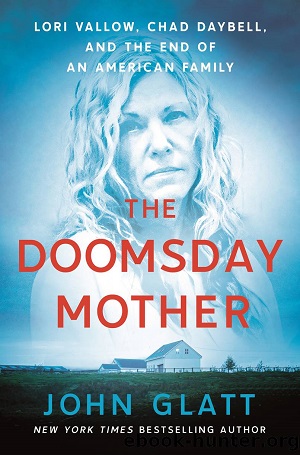
TCF: The Doomsday Mother

The Doomsday Mother: Lori Vallow, Chad Daybell, and the End of an American Family
By John Glatt

The crime:

Lori Vallow was living with her fourth husband, Charles Vallow, when she met Chad Daybell, a Mormon author of religious-themed end-time books who was married at the time to Tammy, with whom he had had five children. Vallow had a young daughter, Tylee, by a previous marriage and had adopted an autistic grandnephew of Charles named J.J.

As near as can be reconstructed, Lori talked her brother Alex into killing Charles. (Alex would not be prosecuted for killing Charles, arguing he had shot him in self-defence. Then Alex would die, apparently of natural causes, before the later trials involving Lori and Chad, though he was complicit in those murders as well.) Both Tylee and J.J. disappeared and were found to have been murdered and buried on Chad’s property at his home in Idaho. Chad is thought to have then killed Tammy. Chad and Lori, cashing in on the deaths, flew to Hawaii where they married. That is also where they were later arrested. At trial after being returned back to Idaho, Chad was found guilty of the first-degree murder of Tammy, Tylee, and J.J. and sentenced to death. Lori was found guilty of the murder of Tylee and J.J. and conspiracy to murder Tammy. She was sentenced to life imprisonment.

The book:

While the story of the Vallow-Daybell doomsday murders (as they came to be known in the media) is a singular and horrifying one, it also hits on a lot of themes that readers of the True Crime Files will be very familiar with. For example, in two previous books by John Glatt (Love Her to Death and Tangled Vines) I’ve noted how bad an idea it is for women to meet up with their exes, or soon-to-be-exes, on their own. In both those books the wives in question ended up being murdered. In this book it’s slightly different in that it was Lori wanting to meet with Charles. He had a bad feeling about this, and even mentioned to Lori’s (normal) brother Adam some misgivings. He ended up being shot to death by Alex.

Charles should have also paid more attention to what were clear red flags. Actually, calling them red flags at this point would be putting it mildly. When she met Charles, Lori had already been divorced three times, with two kids by two different fathers. All by the age of 32. That’s not a red flag, it’s a klaxon. By the time of the fatal visit Lori was clearly a madwoman, and Charles had even arranged to have her committed. After all, in the days just proceeding their fatal meet-up she’d (1) cleaned out his bank accounts and then changed the numbers on them so he couldn’t access them (because he ran a business this meant he couldn’t make payroll); (2) was clearly interested in another man; (3) changed the locks on their house; (4) stole his truck, and (5) accused him of being possessed by an evil demon.

But he still “loved her to death” (his death, as it turned out). Alas, as I’ve had occasion to remark several times in these case files, there’s just no talking to a guy who’s in love.

You’d think any man would have to be crazy to take up with Lori after all this, but then crazy came along. Chad not only knew all about Lori’s history before getting involved with her but took notes on her previous relationships and family connections. To be sure, Chad was messed up himself, but it’s also true that some women just have a poisonous “it.”

Another familiar story worth flagging (because, as I’ve long maintained, we’re supposed to be taking notes and learning something from all this) is the significance of life insurance policies. Just before his wife’s death Chad “made ‘significant increases’ on several life insurance policies he had taken out on Tammy, bringing them to the maximum legal payout allowed.” And yet this wasn’t any kind of tip-off to the underwriters or police when Tammy just suddenly died. Meanwhile, I did get a bit of a kick out of how upset Lori was that Charles had made his sister the beneficiary of his policy just before he was killed. If she wanted that money I guess she should have moved a little faster.

In ways like this, and I’m being selective, what we have here then is a fairly standard murder story: married man meets married woman and they have to get rid of spouses and children to enjoy their new lives together. There are two twists that give it special interest though. The first is the apocalyptic belief system and “prepper” culture that Chad and Lori were immersed in. In fact, Chad could be described as the leader of a mini-cult that separated people out in the usual way (the saved and the damned, the sons of light and the spawn of darkness) in anticipation of the Rapture. Like a lot of modern cults, there also seemed to be some heavy drawing from pop culture. This goes back at least as far as L. Ron Hubbard and the roots of Scientology in C-list science fiction stories. Here’s something I took note of in my review of Steven Singular’s book Killer Cults that I think is relevant:

What is the link between cults and the products of pop culture? Charles Manson thought the song “Helter Skelter” from The Beatles’ White Album contained a hidden message about a coming race war. Adolfo Constanzo based his brutal crime cult on a 1987 flick called The Believers starring Martin Sheen and Jimmy Smits that I have only the vaguest recollection of today. The Heaven’s Gate cult took its lead from Star Trek mythology, with its members thinking of themselves as parts of an “Away Team” as they killed themselves. Why do so many people put so much faith, or even find any meaning, in such crap? I know that’s a question every outsider asks of any belief system, but Star Trek? I guess fandom and cult membership have to be plotted on a spectrum.

Insofar as Chad was starting his own cult he seems to have borrowed from the same range of sources. We’re told he believed, for example, that the spells and curses in the Harry Potter books actually existed but required “great focused will to use.” Indeed, Chad even described himself to Lori as “a grown-up version of Harry Potter.” Meanwhile, one observer “felt like many of them [the cult’s beliefs] were ripped out of a Dungeons & Dragons manual. Between the stats, accounts of dark and light weapons . . . it sounded like someone had created a tabletop [Book of Mormon game] based on the Bible.”

It wasn’t clear to me from the evidence Glatt presents just how much of the stuff about light and dark spiritual possession and people turning into zombies Chad, as opposed to his followers, really believed. But this aspect of the case is gone into in more depth in Leah Sottile’s book When the Moon Turns to Blood so I won’t say more about it here.

The other thing that makes the story interesting is that we don’t really know that much about how Charles, Tylee, J.J., and Tammy were killed. By that I don’t just mean the actual causes of death, but how their murders might have been planned and arranged or who was directly involved. Clearly, however, Chad and Lori were responsible. This leads, however, to the deeper question of who was the dominant partner in their relationship.

As Glatt remarks in his postscript, despite all the coverage that the case received none of the accounts “have explained how the seemingly mild-mannered end-times author Chad Daybell managed to lead the glamorous grandmother into homicidal madness. But the real question is, what came first, the Lori chicken or the Chad egg?” Did Chad really lead Lori along, or was she leading him?

Let’s look at both sides.

The case for Lori being led by Chad was put by Special Prosecutor Rob Wood, who called what Chad did “spiritual abuse” and “spiritual manipulation”:

“I’m so torn. It’s such a conflicting feeling to know that this person’s been good her whole life, and then made this error in judgment and got sucked into this vortex of this man [Chad]. I feel for her. I just have so much compassion towards her because I know that’s not what she would have ever done on her own. And I hate her for that.”

Now Wood was talking to Lori’s sister at the time he said this, so not all of it may have been sincere. Lori had hardly been good “her whole life.” Not even close. But it does seem clear that she took a swerve for the worse when Chad entered in her life. Her marriage with Charles seemed to have been working, enough for him to have risked everything to save it. And even J.J.’s grandparents thought she’d been great with J.J. up until she met Chad. “You couldn’t ask for a better mother,” said J.J.’s grandfather. “She loved J.J. She loved Charles, and I don’t know what caused this conversion. You don’t go from being the mother of the year of a special needs [boy] to the person that won’t even tell you where they are. That just doesn’t happen.”

If you buy into the idea of Chad as cult leader you also find support for this notion of him leading Lori on. It’s telling in this regard that after their arrest Chad did talk her out of cooperating with the police and making a plea deal with prosecutors. One cult expert interviewed by Glatt says Chad was “still manipulating his new wife, even while she was behind bars” with his daily calls and scripture readings.  “He continued the marination of her mind.” Another expert interviewed by Sottile says Chad used “classic grooming techniques” on Lori. This strongly suggests someone very much in control.

On the other hand . . .

I don’t think Lori was ever normal. There seem to have been mental health issues running in her family.  Her father waged a quixotic life-long legal campaign against the government, claiming that he didn’t have to pay any taxes. Her brother Alex, who shot Charles, probably killed Tylee and J.J., and who attempted to kill the husband of Lori’s niece, may have had improper relations with Lori when they were both kids. Her sister Stacey went crazy starving herself to death, fearing that all food was poison. Stacey’s husband would liken the family to “a psychological hornet’s nest,” and that may have been selling it short. I don’t like the overuse of the excuse of mental illness when it comes to a lot of criminal cases, but it’s clear that Lori was sick.

As far as her personal relationships go, Lori also seems to have been a dominant personality. A friend named Melanie was described by someone who knew them both as “almost subservient to Lori . . . a passenger on Lori’s bus.” “Lori was definitely running the show,” was how the friendship was characterized. This seems to chime with the powerful hold Lori had over her brother Alex, and makes one wonder about her relationship with Chad. According to the minister who presided over their beach wedding in Hawaii: “Lori was definitely more forward than Chad . . . She really did all the pushing on this. She was definitely wearing the pants that day.” Also: “There were a couple of times when he really manned up, but most of the time she was the pilot.” For what it’s worth, this is the same impression I got seeing the video of them together when they were ambushed by a reporter in Hawaii. Lori seems far more in charge, with Chad sort of trailing beside her like he’s on a leash. As reported in When the Moon Turns to Blood, the police who first called on Chad and Lori when doing a wellness check on J.J. were singularly unimpressed with the man of the house:

Daybell was a jowly, potbellied man with an awkward, quiet demeanor, who gave off the air of a person who was deeply unsure of himself. He wore too-large clothes and walked with a forward-leaning slant, and when he spoke, he mumbled sleepily, like his words were smooth river rocks dropping from his lips.

That image of rocks dropping from his lips is an odd one, but the picture is pretty clear. In the language of the manosphere, Chad, despite his archetypal alpha name, was a confirmed beta. Whenever Chad’s father phoned him as the case became public he tried to speak to him alone, but Chad would always click the call on to speaker so Lori could listen in. Again, this sounds like Lori was in control.

Having set out the two arguments I’ll conclude by sharing the blame. What seems most likely to be the case is that Lori and Chad were an instance of folie à deux, or shared madness. My hunch is that Lori was a stronger personality, that she was (pick your metaphor) driving the bus or piloting the plane, but for things to go so spectacularly bad they had to come together.

Glatt was once again writing a timely book here, that’s his métier, and went to press before either Chad or Lori had gone to trial. That said, this is a readable account of a series of terrible crimes and one that helps set the complicated story straight. In his postscript Glatt tells us that “In my many years of writing true crime books I have never seen another case as terrifying as that of Lori Vallow Daybell. It simply defies logic, lying somewhere between cold-blooded murder and wild religious science fiction – the very embodiment of the truth being stranger than fiction.” But was it really so strange? Chad and Lori were just kindred spirits, not so much for their shared heretical beliefs (both were excommunicated from the LDS Church, eventually) as for having arrived at a point in their lives where they just didn’t care about anyone or anything very much anymore aside from having a good time. And that level of indifference to others can result in incredible cruelty.

Noted in passing:

Lori liked to live large and spend a lot of money, something perhaps related to her being raised in privilege but her family having come down in the world due to her father’s legal problems. But after her third divorce, at the age of around 30, she apparently owed $724,000 to creditors. At the time she was working as a self-employed hairstylist. How do you burn through that kind of money?

“In September 2001, Chad won a Cedar Fort Publisher’ House Award for his Emma Trilogy, despite the conflict of interest as they had published it and just hired him.” Ha-ha. Oh, literary awards. How does anyone take them seriously?

A week after killing Tylee and burying her burned remains in what amounted to a pet cemetery, Chad and Lori did a podcast entitled “Chad Daybell Sharing Jesus’ Love.” You can see why so many people today are cynical about religion.

Joe Ryan, Lori’s third husband, died alone, his body only discovered three weeks later in his apartment, with “an open jar of spaghetti and dirty dishes in the sink.” A jar of spaghetti? Or a jar of spaghetti sauce? The latter seems far more likely.

Takeaways:

Apocalyptic beliefs usually have something nasty about them, viewing most of humanity as either damned or worthless, which in turn justifies seeing all the zombies sent straight off to hell. But such beliefs are also dangerous, because if you think the end of the world is coming soon then you don’t have to care much about the long-term consequences of your actions. If you meet someone who’s convinced the Rapture is imminent (as opposed to thinking that the world is sliding into a more secular sort of catastrophe at its own leisurely pace) I’d keep a polite distance.

True Crime Files

TCF: Bad Blood

Bad Blood: Secrets and Lies in a Silicon Valley Startup
By John Carreyrou

The crime:

In 2003, at the age of 19, Stanford drop-out Elizabeth Holmes started Theranos, a company that sought to revolutionize blood testing by creating a machine capable of doing a number of different blood tests using only a small amount (a fingerprick) of blood. Theranos attracted large amounts of investment capital and at its height had a valuation of $9 billion, making Holmes herself both a media star and “the youngest and wealthiest self-made female billionaire in the United States” (according to Forbes magazine). The blood-testing machines, however, never worked as advertised, and when the truth came out Theranos went bankrupt. Both Holmes and her second in command, Ramesh “Sunny” Balwani, were convicted of fraud, sentenced to prison, and subjected to massive fines.

The book:

I think it’s a testament to the power of financial crime stories that they’re all the same but are still interesting. Enron, Bernie Madoff, FTX. The particulars vary, but every scam is driven by greed. People kill for all sorts of reasons (including greed), but they swindle others and commit fraud for money. And the people who get suckered are lured on by their dreams of avarice. That’s all there is to it.

I keep coming back to the Bre-X story (which I doubt many people have any memory of now, even though it was the basis for a movie) because it was one of the oldest cons in the book – the salted gold mine – and it basically represents the archetype for most frauds. Enron and Madoff’s Ponzi scheme and Theranos were all salted gold mines. People saw the shine of easy money and were struck by the fear of missing out. But in every case it was fake.

Should they have known it was too good to be true? I’m not sure that old admonition works in a lottery or casino economy like ours. Sometimes investments that seem too good to be true really do strike the jackpot. It’s all so random. That said, Holmes was making some very specific claims about what the Theranos testing devices could do that anyone with a medical background should have been able to see through quite easily. That her all-star board was made up primarily of very old men whose eminence had nothing to do with scientific knowledge wasn’t that surprising, or the fact that they did nothing to call any of Holmes’s claims into question. If there’s one thing that that the history of financial crime in our time proves it’s that corporate boards can be expected to do absolutely nothing in the face of even the most egregious misbehaviour. They’re just window dressing.

The more interesting question then is how many people knew Holmes’s pitch was fake but were just happy to make a killing on it, figuring they’d be able to get out in time and leave someone else holding the bag. My own sense is that most of the people taken in really were blinded at the thought of a ginormous pot of gold at the end of the Theranos rainbow. John Carreyrou, who was the first to break the story in the pages of the Wall Street Journal, makes it out that investors were “bewitched by Holmes’s mixture of charm, intelligence, and charisma.” Which may be true, up to a point. But I think most people seduce themselves in such matters. They fervently want to believe, and that desire is their undoing more than any spell cast by the con.

These were, after all, the gold rush days of Silicon Valley, and fortunes were being minted overnight by companies whose business models made far less sense. “Every startup founder in the Valley wanted to be the next Mark Zuckerberg and every VC [venture capitalist] wanted a seat on the next rocket ship to riches.” And the thing is, the idea for a fast and convenient method of blood testing was a good one, and since the demise of Theranos other companies have made progress working in the same direction. Holmes, however, had no experience in the field and there were red flags all over the place signaling that her device was humbug. There were also expert voices that raised doubts, but they were rigorously suppressed by the corporate thought police. Legal legend David Boies and his law firm come across as some of the real villains of the piece, perhaps because Carreyrou’s own interactions with them were so strained. Theranos was incredibly secretive and paranoid about bad press, and this wasn’t because they were trying to protect valuable intellectual property. What this resulted in was a lot of legal “hardball” which played very ugly indeed. If you were wondering why whistleblowers need protection, this could be a case study. The fact is, nobody wants to stop a money train.

Given all of what I’ve said about how typical a story of financial fraud Theranos was, it’s worth asking what made it so noteworthy. The key factor is the figure of Elizabeth Holmes. As a young, attractive, “female Steve Jobs” you have to think that if she hadn’t created herself (meaning that persona, complete with the black turtleneck and fake deep voice) then the media or the culture more generally would have had to invent her. She was what the age demanded even more than it demanded a portable, instant blood-test kit, and she was just as wonky a product when brought to market.

Carreyrou makes a convincing case that Holmes made a mistake in taking as her model for a startup the “fake it ‘til you make it” model of the tech giants and not the more disciplined approach of a medical company. But since she didn’t seem to have much affinity for either tech or medicine I think it was easy for her to get confused. In any event, tech was the “rocket ship to riches.” Beyond that, she was able to borrow the specious Silicon Valley rhetoric of wanting to change the world and improve everyone’s life through technology that has long been a hallmark of tech startups. And once again, this rhetoric was exposed as a sham. I find it amazing there are people, and among them even critics of the tech giants, who continue to echo this nonsense. There are people who still think that Microsoft, Apple, Google, Facebook or Twitter/X are going to make the world a better place, or have ever had that as their goal. This is just sad and deluded. Elizabeth Holmes, like all the tech nerd-bros who came before and after her, wanted to be rich and powerful and that’s all there was to it.

But there are things about Holmes that are harder to explain. Chief among these is her mysterious relationship with Sunny Balwani. I say mysterious both because she attempted to keep the fact that they were living together hidden from everyone the entire time Theranos was in operation, and also because I just can’t figure it out.

What did she see in him? They seem to have first met when she was a student and he was a guy who had made a lot of money when a software company he’d been president of was acquired at the height of the dot-com bubble. Five months later the bubble burst and the company eventually went bankrupt. “His timing was perfect,” Carreyrou drily notes.

Holmes was young, stylish, smart, and capable of being charming. Balwani was nearly twenty years older, two inches shorter (he was about 5’5”), “portly,” “lacking in the most basic grace and manners,” not at all good-looking, and as for style . . .

The way Sunny dressed was . . . meant to telegraph affluence, though not necessarily taste. He wore white designer shirts with puffy sleeves, acid-washed jeans, and blue Gucci loafers. His shirts’ top three buttons were always undone, causing his chest hair to spill out and revealing a thin gold chain around his neck. A pungent scent of cologne emanated from him at all times. Combined with the flashy cars, the overall impression was of someone heading out to a night-club rather than to the office.

And it got worse. Balwani was born in Pakistan, which apparently helped shape his abrasive and authoritarian management style. While most people seemed to like working for Holmes, Balwani was a presence that few could endure. When he wasn’t firing employees for petty infractions he was “boastful and patronizing,” “haughty and demeaning . . . barking orders and dressing people down.” Like a lot of blowhards who have risen to positions of prominence on the basis of nothing more than blind luck, this arrogance was probably defensive. Theranos employees soon found ways to manage his moods, “as it dawned on them that they were dealing with an erratic man-child of limited intellect and even more limited attention span.” They even played practical jokes on him that exploited his ignorance of chemistry and engineering. If he hadn’t been placed in a position of responsibility everyone would have just considered him an obnoxious jerk and tried to steer clear of him.

Which brings us back to the question of what Holmes saw in him. Even Carreyrou is left shaking his head.

One school of thought is that she became captive to Balwani’s nefarious influence. Under this theory, Balwani was Holmes’s Svengali and molded her – the innocent ingénue with big dreams – into the precocious young female startup founder that the Valley craved and that he was too old, too male, and too Indian to play himself. There’s no question that Balwani was a bad influence. But to place all the blame on his shoulders is not only too convenient, it’s inaccurate. Employees who saw the two interact up close describe a partnership in which Holmes, even if she was almost twenty years younger, had the last say. Moreover, Balwani didn’t join Theranos until late 2009. By then, Holmes had already been misleading pharmaceutical companies for years about the readiness of her technology. And with actions that ranged from blackmailing her chief financial officer to suing employees, she had displayed a pattern of ruthlessness at odds with the portrait of a well-intentioned young woman manipulated by an older man.

Yet why were they still living together up until the end? Again: what did she see in him? Something here doesn’t add up.

Bad Blood is one of those slightly frustrating true crime books that on the one hand stands as definitive, being both well written and giving the perspective of a journalist who became closely involved in the events leading up to the company’s unraveling, but that, in the usual rush to be timely, came out several years before the Theranos trials brought some closure to the story. Still, it remains the best if not the fullest account of what happened, and Carreyrou’s assessment of what went wrong strikes me as right on target.

Noted in passing:

When Theranos’s corporate HQ (what had previously been Facebook’s building) was being given a makeover Holmes wanted motivational quotes painted in black on the white walls. These were the usual guff from people like Michael Jordan and Theodore Roosevelt. But pride of place went to a quote that she fell in love with “from Yoda in Star Wars” (actually The Empire Strikes Back): “Do or do not. There is no try.” She had this “painted in huge capital letters in the building’s entrance.”

As far as red flags go, I think this might have been enough for me to hold off investing any money in the company. I mean, really. Yoda?

One of the more surprising names on the list of Theranos marks was Rupert Murdoch (yes, another old guy). Indeed, after putting $125 million into the company he was its biggest investor. But after everything went smash and the lawsuits were gearing up, he seems not to have been too distressed.

Most of the other investors opted against litigation, settling instead for a grant of extra shares in exchange for a promise not to sue. One notable exception was Rupert Murdoch. The media mogul sold his stock back to Theranos for one dollar so he could claim a big tax write-off on his other earnings. With a fortune estimated at $12 billion, Murdoch could afford to lose more than $100 million on a bad investment.

This is what the game looks like when you’re a billionaire. Even when you lose you win.

Takeaways:

I think Holmes was basically blind with greed and ambition, but the way she shut herself off from any criticism or nay-saying really spelled her doom. I think it was super-investor Warren Buffett who said that he likes to keep someone on the payroll who will disagree with every position he takes and decision he makes, because otherwise he would just be surrounded by yes-men. One of Holmes’s friends became worried that in “her relentless drive to be a successful startup founder, she had built a bubble around herself that was cutting her off from reality.” At one point Holmes even told an all-hands meeting that she was “building a religion” and that “if there were any among them who didn’t believe, they should leave.”

As I’ve said before, the bubble is a danger for anyone who achieves a position of relative wealth and power. The state of being insulated from negativity is something I think a lot of people dream of. It’s very seductive, but the results can be fatal.

True Crime Files

TCF: The Infernal Machine

The Infernal Machine: A True Story of Dynamite, Terror, and the Rise of the Modern Detective
By Steven Johnson

The crimes:

With Alfred Nobel’s invention of dynamite in 1867, criminals and revolutionaries were handed a new weapon in their war on the ruling classes and peace, order, and good government more generally. To fight against a spate of bombings, law enforcement had to up their game and develop the kinds of practices we now associate with modern policing.

The book:

If that summary of what The Infernal Machine is about seems kind of broad, don’t blame me. Steven Johnson specializes in these sorts of popular history grab-bags, and the elements are even more random than usual here. Just for starters I had to shake my head at the subtitle calling this “a true story” – not because any of it is fiction but because there is no story in evidence. The narrative, to give it a fuzzier label, takes us basically from the assassination of Alexander II to the Palmer Raids, with various bombings in-between. Are there threads connecting all of this? Sure. But all too often they struck me as coincidental. I mean, if you stand back far enough, tilt your head, and squint, then I guess everything is connected to everything else on some level. But not really.

I’ll stick to talking about the two main narrative axes that Johnson travels along. The first is political or thematic:

This book . . . is the story of two ideas, ideas that first took root in Europe before arriving on American soil at the end of the nineteenth century, where they locked into an existential struggle that lasted three decades. One idea was the radical vision of a society with no rules – and a new tactic of dynamite-driven terrorism deployed to advance that vision. The other idea – crime fighting as information science – took longer to take shape, and for a good stretch of the early twentieth century, it seemed like it was losing its struggle against the anarchists. But it won out in the end. How did that happen? And could the story have played out differently?

Later, Johnson expresses the terms of this “existential struggle” in slightly different terms, seeing “two rival ideologies” in conflict: “the dream of a stateless society, radically egalitarian, free of the oppressive institutions that had come to define the industrial and imperial age” vs. “the surveillance state, where individual identity is measured, recorded, and archived by vast and often invisible institutions, using the latest science and technology to contain potential subversion.”

This is interesting, but was there really that strong a connection between these two ideas or ideologies? Anarchism never took political root anywhere, but was that because it lost an existential struggle with scientific crime fighting? The surveillance state and modern policing are now ubiquitous facts of life, but did that have anything to do with these early battles against bomb throwers?

I think both developments were, if not inevitable, then at least very likely to have taken place without any engagement with the other. Anarchism suffered the fate of a lot of socialist movements with the outbreak of the First World War, while crime fighting was being driven as much by the advance of technology and the response to other threats like organized crime as it was by dealing with political enemies. And then of course there is the difficulty of defining terms. What is, or was, anarchism anyway? A libertarian movement? A call for class warfare? Were the anarchists who practiced “propaganda of the deed” typical of anarchist thought, or outliers? Is it fair to say that all that survives of the anarchist movement today is terrorist bombings like the 9/11 attacks (“the general tactics of terrorism remain anarchism’s most enduring legacy”)? That seems tenuous to me. Terrorism was a tool used by different ideologies, and it predates the invention of dynamite.

The second narrative axis is built around telling the life stories of a pair of prominent anarchists: Emma Goldman and Alexander Berkman. As a biographical sketch of the two what you get here is fine, but again the connection to “infernal machines” (that is, explosive devices) and modern policing isn’t that strong. They were both anarchists, of a sort. Maybe Berkman was in cahoots with a cell of bomb makers at some point. Goldman probably wasn’t. The police kept thick files on both, though they were prominent public figures and didn’t keep any secrets when it came to their radical beliefs. So again: is there a connection? Yes, but not a strong one. Neither story really depends on the other.

The critics on the back cover rave: “Johnson is a polymath. . . . [It’s] exhilarating to follow his unpredictable trains of thought” (Los Angeles Times); “Johnson’s erudition can be quite gobsmacking” (New York Times Book Review). I think my gob may be harder to smack. To me, The Infernal Machine just seemed like a whole lot of everything and not much of anything in particular. The effect was sort of like reading a bunch of linked Wikipedia articles. Did Johnson really need to kick off a chapter on the Ludlow Massacre with an account of how coal deposits were formed in the Cretaceous period? That’s not erudition, it’s just cheap display of superficial learning.

There are a few perceptive moments. I liked it when the following comparison was drawn between then and now.

Berkman and Goldman were living in a world where one side of the spectrum thought it was appropriate to execute people who objected to a seventy-two-hour week of life-threatening work – while the other side of the spectrum thought that we should abandon both governments and corporations and reinvent society along the lines of Swiss watchmaking collectives. Those were the distant poles of the debate. What we would now call the Overton window – the space of potentially valid political beliefs – was far wider than anything in American politics today.

That’s well observed, and it’s a point that’s expanded on after a description of the public memorial service held for a group of anarchists who had blown themselves up while constructing a bomb meant to avenge Ludlow:

More than a century later, it is not hard to imagine a small band of disaffected New York City residents – in our present moment – spinning themselves into some kind of cyclone of hate and building a dirty bomb or a bioweapon in their basement. What is harder to imagine is five thousand people showing up in Union Square to mourn their deaths as martyrs to a greater cause. We still have people willing to kill for political ends in countries like the United States, though far fewer of them than there were back in 1914. But when those beliefs materialize into actual dead bodies, you don’t conventionally see a great outpouring of public support for those violent acts. There were no rallies for the Unabomber.

This is something work keeping in mind when thinking of how we live in an age of extremes. I still think it’s fair to consider various schools of political thought today as extreme, but they’re extreme in different ways. One of the things that has changed the most is the level of sheer crazy we’ve grown accustomed to.

Noted in passing:

Johnson uses the word “attentat” over a dozen times in this book. It wasn’t familiar to me, though it’s the same word (same meaning, same spelling) in both French and German as in English. The basic meaning is of a violent criminal act, or assassination. It also has a legal meaning in English, but that is considered obsolete. In fact, I found several sources online that give its use as meaning an attack or assassination as obsolete as well. So I can’t blame myself for being surprised to see it. But it’s properly employed, as it correctly describes the bombings and attempted assassinations that are a big part of Johnson’s subject matter, and was used by Goldman herself, though she capitalized it. I suspect reading Goldman is where Johnson might have picked it up. So I did learn something here, though it’s not a word I’m likely to ever use myself.

Takeaways:

There’s no invention or technical advance that can’t be made to serve wicked ends. And given time, almost any invention will end up being so used.

True Crime Files

TCF: A Murder in Hollywood

A Murder in Hollywood: The Untold Story of Tinseltown’s Most Shocking Crime
By Casey Sherman

The crime:

On April 4, 1958 gangster and gigolo Johnny Stompanato was killed by a single stab wound to his belly in the bedroom of his then girlfriend Lana Turner. There had been a long history of Stompanato being a violent domestic abuser. At the coroner’s inquest it was found that Turner’s 14-year-old daughter, Cheryl Crane, had held the knife, but the jury found it a case of “justifiable homicide” so there was no criminal trial.

The book:

My previous attempt at a Casey Sherman book hadn’t gone well. His account of the serial killer Tony Costa’s rampage on Cape Cod, Hell Town, even made it into my DNF files. It was bad. But I still wanted to give this one a shot, mainly because it’s a case I’d often heard of but didn’t know much about.

As usual with true crime, the title oversells things. Was this really Hollywood’s “most shocking crime”? I’m not sure a woman (or a woman’s daughter or other family member) killing an abusive husband or boyfriend counts as very shocking. I mean, also on the cover there’s a blurb from Ben Mezrich calling it “one of Tinseltown’s darkest moments,” but even that seems like a stretch to me.

Even more questionable though is the subtitle’s assertion that this is an “untold story.” Really? The case was given saturation coverage by the media, for obvious reasons. And the fact is that Sherman’s sources consist mainly of the published memoirs of the main players in the drama, including Turner, Crane, and L.A. crime kingpin Mickey Cohen. Does Sherman add anything new to the mix? I don’t see where he has, and keep in mind that the most recent of these memoirs is over 25 years old. I also didn’t register a single point where he called into question the accounts of events described by Turner, Crane, and Cohen, despite the fact that autobiography is the least trustworthy genre of non-fiction writing there is.

As it is, we’re left with a number of scenes that we just have to take on faith. And not only faith in the memoirist making an honest report, but in their having an accurate recollection of events that may have happened thirty years before they set them down. When I reviewed Hell Town I called Sherman out for his description of events that I didn’t see how he could know so much detail about. Here he at least has a source for most of his stories, but if you don’t trust the source this doesn’t always help very much. Take the following two incidents, which I just flagged at random. The first describes Turner coming home to her husband Lex Barker after learning that he’d been molesting her daughter Cheryl:

While Cheryl remained at Mildred’s [Turner’s mother], Lana drove back to the house she shared with Barker. With rage building inside her, she walked quietly upstairs and into their bedroom. Lana had kept a pistol by her bedside after the foiled kidnap attempt of her daughter. Barker slept soundly while Lana reached for her gun. She stood over her husband with the weapon pointed directly at his head. One shot and he would be dead. Her finger rested on the trigger. She was ready to pull, but she stopped herself. If she murdered Lex Barker in cold blood while he was sleeping in their bed, she would undoubtedly get the gas chamber herself. And what good would she be to Cheryl then? Lana lowered the pistol and left the room. She stayed up for the rest of the night, smoking, crying, and contemplating her next move.

Of course the only possible source for this would be Turner, though the notes only refer to Crane’s memoirs. So I really don’t know how much to credit it. It makes for a very dramatic, even cinematic, moment (the book was immediately optioned for a film deal), but that just makes me more suspicious as to how much of it really happened.

A few pages later another dramatic scene plays out, this time with Frank Sinatra confronting Mickey Cohen. Stompanato had apparently been making a play on Sinatra’s then wife, Ava Gardner.

“Look, I want you to do me a favor,” Sinatra said, staring at Cohen with his famous blue eyes. “I want you to tell your guy Johnny Stompanato to stop seeing Ava Gardner.”

Cohen did not care how famous Sinatra was or what his deep connection to the underworld were. He damn sure wasn’t going to play Mr. Fixit for Sinatra’s love life. Cohen peered out his living room window and noticed the unmarked police car parked across the street.

“You mean to tell me you came all the way out here where they’re recording everybody’s name and number that comes near this house?” he asked rhetorically. “This is what you call important? I don’t get mixed up with no guys and their broads, Frank.”

Sinatra was not accustomed to getting dressed down in this manner. At that point, Cohen took out the proverbial dagger and stuck it in his back.

“Why don’t you go home to Nancy where you belong?” he asked spitefully in reference to Sinatra’s first and long-suffering wife, Nancy Sinatra.

Again, there is only one possible source for this story and that’s Cohen. Did he really “dress down” Sinatra in this fashion? Did he say these exact words? Or is he making himself the hero of his own story?

What makes the dependence on a few far-from-disinterested sources more troubling still is the fact that there is a real mystery at the heart of Stompanato’s murder. Is it true that Cheryl Crane killed him? She always claimed that she did, but many have their doubts, as do I. (If you’re wondering why the defence team would want to pin the rap on her, it’s because as a minor she wasn’t liable for the death penalty in California.) The narrative of what happened on the night in question is pretty shaky (per Sherman: “Lana went black for a moment. All the rage growing inside her had made her blind. Suddenly, there was a frenzy of motion in the bedroom . . .”), and the post-murder behaviour of Turner and her entourage was highly suspicious. In particular I’m talking about the staging of the crime scene. You don’t have to be as cynical as I am to raise an eyebrow skyward at what happened immediately upon the death of Stompanato. Did Turner call the police? No. Instead, she made “four frantic phone calls” to: her mother, a doctor, her ex-husband (Cheryl’s father), and her lawyer, Jerry Giesler. When Giesler arrived he then called “his clean-up man” Fred Otash.

Otash despised Stompanato and was happy to see his lifeless body sprawled out on the carpet of Lana’s pink bedroom. Otash looked around the bedroom and got to work. It took the private investigator two full hours to stage the crime scene to Giesler’s satisfaction. The attorney gathered Lana and Cheryl in the bedroom. . . .

Giesler huddled with Lana and her fourteen-year-old daughter and painstakingly walked them through his plan. Content with the narrative he was about to weave for police and the public, Giesler finally dialed the authorities.

When police officers were summoned to North Bedford Drive more than 120 minutes after Stompanato was stabbed to death, there was something peculiar about the setup in Lana’s bedroom. Investigators were surprised to see that there was little or no blood on the rug, and the bedroom walls were damp and appeared to have been recently scrubbed. Stompanato’s body looked like it had been moved from its original location. Also, the cover had been taken off Lana’s bed and was nowhere to be found. “It looked like a hog had been butchered on it,” Giesler reportedly told friends later on. The murder weapon, the kitchen knife, was located on the sink in the en suite bathroom. The fingerprints on the handle were wiped clean. It also looked like all the bathroom towels were missing from their racks, possibly used to soak up all the blood in the room. Were the bloody linens now stuffed in the trunk of Otash’s car to be burned later?

I don’t know about you, but this doesn’t inspire a lot of confidence in me that the “narrative” Giesler prepared had much relation to what really happened in Turner’s bedroom. It’s certainly something you’d think Sherman would want to look into a little more deeply, making some reference to later accounts of what Turner and others reportedly said about what went down the night of the murder. But he pretty much leaves the finding of the coroner’s inquiry alone, only tossing in suggestive tidbits like Lana dreaming of Johnny: “A long knife appeared in her subconscious, but who was wielding it? Was it her? Or was it Cheryl. It was all a blur to her now.” What are we to make of this? What is Sherman’s source? I couldn’t find any. In any event, for a book selling the “untold story” of Stompanato’s murder not having more to say about it than a sleepy “blur” is leaving a lot on the table.

“To me,” Sherman concludes in an Author’s Note, “Lana was a feminist hero and a pioneer.” Before the #MeToo movement, he writes, “we all must offer thanks to a female star from the golden age of Hollywood who broke a vicious cycle of violence and took her life back.” This is problematic on several counts. First of all, the #MeToo movement mainly had to do with “shitty” industry men preying on women who were trying to make it in the business. Harvey Weinstein was the totemic figure. But Turner sought out inappropriate men who the studio heads, most notably Louis B. Mayer, didn’t want her having anything to do with precisely because they would damage her career.

And in at least some cases she sought them out because they were bad boys. We want to tread lightly here because of the knee-jerk response to calling out a woman’s bad life decisions as victim-blaming. But the fact is that Turner, easily one of the most desirable women in the world at the time, was married 8 times to 7 different men (she re-married Stephen Crane, Cheryl’s father, when she found out she was pregnant). They were a line-up of drunks, losers, abusers, and one pedophile. And this isn’t including Stompanato, who she never married. Everybody is allowed one mulligan for making a bad choice of partner, but it’s only stating the obvious to say that Turner wasn’t just a poor judge of character in the men she dated but was setting herself up for serial disasters. After a while you have to own up to the fact that the problem is you.

Take her mésalliance with Stompanato, who endeared himself to her at one point by climbing a fire escape, breaking into her apartment, and attempting to rape her. “His consuming passion was strangely exciting,” she would later write. “Call it forbidden fruit, or whatever. But his attraction was very deep – maybe something sick within me – and my dangerous captivation [with him] went far beyond lovemaking.” That, at least, shows some self-awareness. But as a feminist “hero” I think Turner is compromised.

In sum, this is a pulpy read but not one that I thought added anything by way of new research or a fresh interpretation of the case. It’s basically just a recitation of what Turner, Cohen, and Crane had already said about it. And I’ll add another of my standard complaints about how the pictures are no good. They’re small, grainy, and mostly credited to Sherman himself, being pictures of locations as they appear now. Which isn’t always how they appeared back in the day. Why even include a recent picture of the famous Hollywood sign when (1) everybody already knows what it looks like, and (2) as the text makes clear, the sign at the time when Turner arrived in town read Hollywoodland (the “land” was only dropped in 1949). For a historical work of true crime like this there must have been a full archive of better pics to draw on. Could the publisher just not get the rights? There are even pics available online of the crime scene and the police looking at Stompanato’s body. You’d expect a photo section in a book like this to be stacked with pictures of Hollywood stars and the murder scene, but you get nothing like that. So in my opinion they would have been better off leaving pictures out entirely. If you’re not going to do it right then you might as well not bother.

Noted in passing:

“Cheryl had lost four pounds while being locked up at Juvenile Hall.” This statement was dropped in out of nowhere and I didn’t know how to take it. Was I supposed to think that losing four pounds in a week, or however long she’d been in for (it isn’t clear), was a lot? Because it isn’t. Even for a tall, skinny kid. I can easily lose four pounds in a couple of days by not eating as much, and I’m not obese. I suppose Cheryl didn’t care for the food in Juvie and wasn’t eating as much, so losing four pounds doesn’t strike me as either surprising or a big deal.

Takeaways:

Some women sure can pick them.

True Crime Files

TCF: Vanished

Vanished: Cold-Blooded Murder in Steeltown
By Jon Wells

The crime:

Acting on a tip that came in on Easter weekend 1999, police found a garbage bag stuffed with body parts on steelworker Sam Pirrera’s front porch. The remains were later identified as belonging to Maggie Karer, a Hamilton sex worker. As police investigated the case it became clear that Pirrera might also have had something to do with the disappearance of his first wife, Beverly Davidson, eight years earlier. Charged with the murder of both women, Pirrera died of a drug overdose, almost certainly suicide, just before his court date.

The book:

While grisly, the crimes here were nothing out of the ordinary for tales of domestic abuse escalating to murder. Pirrera was a violent cocaine addict who spiraled out of control. In fact, the presumed murder of Beverly took place in a manner that I have alerted people to before on several occasions and I can only repeat my earlier takeaways: If the relationship is over, it’s over. You don’t arrange to meet up with your ex for a talk about whatever outstanding issues you may have, especially if there’s not going to be anyone else around. This is part of the value of reading true crime; you can learn something from it.

I suppose killers could learn some lessons as well. One of the chief among these is the disposal problem. Especially given the advances made in forensics, a killer has to be able to make all of the evidence disappear. And I don’t mean just tossing body parts in the garbage, or trying to flush them down the toilet (the latter method being how both Dennis Nilsen and Joachim Kroll were caught when the remains backed up the plumbing). Not even the wood chipper from Fargo is going to do the trick, since that will leave blood splattered all over the inside of the machine. It’s hard to make the evidence of a body disappear entirely. When Dellen Millard used a portable livestock incinerator (known as “The Eliminator”) to get rid of the remains of Tim Bosma there were still some of his bone fragments found in it.

No, if you’re going down this road you have to be able to make a victim literally disappear. When looking for evidence of Pirrera’s having killed his first wife, Beverly, police scoured the house they had lived in together eight years previously, and which had long been occupied by another family, scanning the basement and bathrooms for microscopic traces of blood. They didn’t find anything, but the very idea that they would undertake such a search gives you some idea of what is possible.

Unfortunately for the police, Pirrera is presumed to have disposed of the body of his first wife in a way that was practically foolproof. As noted, he was a steelworker, employed (fitfully, as his issues with cocaine addiction ramped up) at the local Stelco works. (To explain the title to those not familiar with the place: Hamilton, where the crimes took place, is known as “Steeltown” because of its history with that industry) The theory the police had was that he cut the body up and then threw the pieces into a vat of molten steel. That’s making a body disappear. It reminded me of how Robert “Willie” Pickton, the serial killer/pig farmer in British Columbia who killed nearly 50 women, may have got rid of the bodies of his victims by taking them to a rendering plant, feeding them to the pigs, or grinding them up and mixing them with pork he sold to the public. I think the rendering plant theory in particular almost as effective as the vat of molten steel. In any event, what caught Pickton out in terms of physical evidence was the fact that he held on to some personal items belonging to his victims. I think the only body parts they located were a few skulls.

This was a brutal case, with the brutality mostly being the consequence of Pirrera’s drug abuse. That sort of thing rarely ends well, though it doesn’t often blow up as badly as it did here. It’s a tribute to Wells’s ability to tell a story though that he turns these events into such an effective work of true crime reporting. I think two things helped. First, it isn’t a timely book. Karer’s murder took place nearly ten years before Wells wrote about it, which allows for a bit more perspective from all the people involved. Second, the specially commissioned photos by Gary Yokoyama add a lot. I like to complain about true crime books where the photo sections consist of poorly reproduced pictures that sometimes have only a tenuous connection to the story, so it’s nice to be able to give credit to a book that made an extra effort in this regard.

Noted in passing:

The house where Pirrera killed Karer turned into a local site of interest, so that people would even come and knock on the door asking the new owners if they could look at the basement (which had subsequently been refurbished). It got so bad that the owners “asked, and received, city permission to change the number 12 on the façade to a different number for a $130 fee.” Which is nice, but I didn’t understand how that would work. Legally the address would have to be the same for emergency services, so I guess this just meant they put a different number on the door or over the garage. But who would this fool? Anyone motivated enough could just count the numbers of the houses on the street and would notice a jump from 10 to 14, while everyone else would just get confused. How would deliveries work? This seems really strange to me.

Another point I wanted to flag has to do with the book’s preliminary material, being a couple of pages of blurbs of “Praise for Jon Wells.” One of these blurbs comes courtesy of Alex Good in a review of the book Poison that I did for The Record back in 2009. Two things struck me about this. One good: all too often these blurbs are just quoted and then the name of the publication given. It’s nice that I got credited by name. Thank you! Reviews don’t write themselves, you know. One bad: I looked and couldn’t find my review of Poison. I remember reading and reviewing it but I guess I never posted the review at Good Reports and it wasn’t anywhere else I checked. If I want to retrieve it now I’m probably going to have to fire up an old computer and see if it’s somewhere on the hard drive. I sure don’t have a print copy. Nothing lasts forever, people!

Takeaways:

Cocaine is a hell of a drug. Stay away from the stuff.

True Crime Files

TCF: A Plot to Kill

A Plot to Kill: A True Story of Deception, Betrayal, and Murder in a Quiet English Town
By David Wilson

The crime:

Ben Field was a university student working toward a Ph.D. in English while also training to enter the ministry when in 2015 he murdered his then 69-year-old lover, the novelist and former academic Peter Farquhar. He was acquitted of attempting to also murder Farquhar’s elderly neighbour, but pled guilty to charges of fraud and burglary against both of them. He was sentenced to life imprisonment with a minimum term of 36 years.

The book:

If you want to learn about Field’s crimes then this isn’t the book for you. Channel 4 made a documentary on the case as part of the series Catching a Killer that will serve you better in this regard, and there was also a dramatized version of the events in the BBC miniseries The Sixth Commandment. For his part, David Wilson has very little to say about what actually went down, and barely even mentions Ann Moore-Martin, the neighbour, or Field’s friend Martyn Smith, who was accused of being his accomplice (charges he was later cleared of). There was a seventy-seven day trial (which included a whopping twenty-four days of jury deliberation) that Wilson breezes through in under 15 pages. So if you want all those kinds of details you’re out of luck.

This is frustrating. I really liked A Plot to Kill, but I have to register some disappointment at finishing it and not coming away with any clear understanding of what it is Field actually did or how he did it. Leaving that aside . . .

This is the sort of true crime book I normally dig my heels in against. It’s very much written in the first person, as the crime took place in what Wilson considers to be his hometown (Buckingham, or Maids Moreton to be more precise). But Wilson doesn’t make a big deal out of this, and uses it mainly as a way of introducing the question of why the members of a small community didn’t recognize what was going on and try to stage an intervention:

In Maids Moreton and in Buckingham – both the town and the university – no one publicly questioned, or challenged from a professional and ethical standpoint, what a student in his twenties was doing staying in the home of a man in his sixties, who was also at some stage responsible for that student’s instruction and supervision at the university. No one intervened. Perhaps it was discussed in private, but in public people minded their own business and simply got on with their lives.

This is an important point that and it’s one that Wilson worries over. It seems to have been clear that Field was “grooming” Farquhar but this didn’t raise any red flags. “I tried to make sense of how Peter’s murder could have happened in plain sight . . . If nothing escaped our gaze, why didn’t we notice that Peter was being groomed?” Or “Perhaps some did notice Field’s grooming of Peter, but simply chose to ignore what they saw. ‘It was their business,’ I was repeatedly told. That estrangement played a crucial part in how Field manipulated and then controlled Peter and us.”

Wilson goes on:

Should we blame Peter for what happened to him, like some people in Buckingham were keen to do, conveniently removing themselves from shouldering any responsibility? I really don’t think what happened to Peter was his “business,” by which was implied his “fault.” Haven’t we all done things on the spur of the moment, or against our better judgement, especially when we are in love? I know that I have.

Sure. But let’s be realistic. As I’ve pointed out several times already in these True Crime Files, there’s simply no talking to people who are in love. We all know this. This was my takeaway from She Wanted It All and the case of the murder of Steven Beard, whose murder was arranged by his gold-digging younger wife Celeste:

I mentioned how obvious it was – even to Steven, I believe – that Celeste was a gold-digger as well as a nut-job. But even the people around him, including close friends and family, realized it was useless saying anything to him about it. There’s no warning men (or women) in such situations. All you can do is hope for the best and prepare for the worst.

Well, in that case as in this the worst is what happened.

Broadening things out a bit, I don’t think the idea that Farquhar’s personal relationship with Field was nobody’s “business” implies that it was their fault for not stepping in. I think it’s just part of the way we deal with all such matters these days. We get angry at people who are quick to judge others. Why should a huge age gap, or a flaunting of professional boundaries upset you? If someone isn’t doing anything illegal, and the state should be kept out of the bedrooms of the nation anyway, then wouldn’t the good people of Buckingham, even Farquhar’s close friends and family, have been playing nosey neighbours if they’d gotten involved? Then there was the fact that, as Wilson puts it, Farquhar and Field lived in the community without really being part of it. They weren’t isolates, but didn’t seem that well connected either. Throw in that this was a gay relationship (though Field himself seems to have only been playing gay) and one can imagine any well-intentioned inquiries being met with accusations of homophobia or worse.

That said, I don’t want to shy away from the extent that what happened to Farquhar was his fault. Sure he was a lonely old gay man, living with “the fears of dying alone,” and yes Field was an accomplished “snake-talking” seducer, but Farquhar wasn’t a complete fool. And yet Wilson is torn.

Ultimately, I came to realize that I was actually asking the same question about both of these cases [the Maids Moreton murder and a murder Wilson wrote about in a previous book]. Who was responsible for the murder?

From the very outset, I detected that some people felt everything that had happened had simply been Peter’s “business” – by which they meant it was his fault he’d been killed.

After all, it was Peter, they reasoned, who had invited a much younger man to live in his home. Later on, when it became abundantly clear that all was not right with their relationship, Peter had nonetheless remained loyal to his younger partner. Why had Peter not done something when it was obvious, at least from the outside, that the relationship was failing? Wasn’t it inevitable that a young man couldn’t live with an older partner? This wasn’t “normal,” as one person explained it to me. Peter should have kicked Field out of his house and got on with his life.

This is a subtle form of victim-blaming, masked by the politest of concern, all wrapped up in the self-serving belief that they’d been respecting other people’s privacy. It seemed to me like weaponised gentility.

But is it really so bourgeois to respect other people’s privacy, especially in such intimate domestic matters? I would have thought it was close to a commandment in contemporary life. And how should we read that “normal” in scare quotes? Surely the person who expressed that opinion had a point. Personally, I feel a bit the same toward the relationship in this case as I do toward the men and women conned by romance scammers. They have my sympathy, and I respect the ones who come forward in the hopes of warning others by their example, but every time I see them being interviewed, and then look at the (usually fake) profiles of the people who have swindled them, I wonder what they could have been thinking. An obese middle-aged man, twice-divorced, falling for a photo of a girl in a bikini twenty or more years younger than him? A drab middle-aged woman in a dull office job who matches with a millionaire businessman who looks like a cover model from a men’s fitness magazine? A retired English prof seeing a good-looking fellow 35 years younger than him as his salvation from dying alone? Come on, people.

Shifting our gaze, A Plot to Kill also offers some interesting points of departure for thinking about Ben Field, or killers in general. The question I found myself pondering in particular here was this: do corrupt or slack institutions create bad men, or are bad men drawn to such institutions? In the case of Field the latter was clearly in play, as he saw, correctly, academe and the Church as being easily exploitable. Like many opportunists he realized it would be relatively easy to get into a position of trust and authority and then abuse both those perks of office. I still find it surprising how many people express shock at cases of police officers, doctors, or church ministers who turn out to be homicidal psychopaths. Why should psychopaths be less represented in any of these groups than they are in the general population? Indeed, given the advantages arising from their placement within such professions, like being regarded as above suspicion, wouldn’t they be more drawn to them? Wilson has his own thoughts on the subject, introduced by the results of a review made by the Church of England in the light of Field’s conviction even as he was preparing to enter the ministry. A comparison was drawn to the criminal career of Harold Shipman, a British doctor who may have killed as many as 250 people, making him one of the most prolific serial killers in history.

In many respects the review saw Field as someone similar to Harold Shipman, whose criminal career was treated in much the same way by the medical establishment. Killing over two hundred of his overwhelmingly elderly patients didn’t result in fundamental changes to the organization of medicine in this country. Instead, the medical establishment tinkered with the issuing of death certificates and tightened up the regulations related to doctors working in singleton practices. Could it stop someone like Shipman killing again? I think not. And that has essentially been the formal reaction to Field from the Church authorities too. Nothing to see here, they seem to be saying; move along now; don’t worry.

In the same way that we were asked to take comfort from the fact that most doctors are not murderous serial killers, so too we are in effect being assured that most people wanting to become priests don’t have their sights set on killing their parishioners. That’s manifestly true, and so perhaps we really should take comfort from that. However, we also need to acknowledge that the likes of Field and Shipman think very carefully about the weaknesses in the formal structures and the informal cultures of the institutions and professions they want to join, so they can exploit those weaknesses for their own ends. It’s not so important that they are exceptional and unique, but rather the role the very fact of their existence plays in degrading what we know to be true and predictable.

I think this is a point worth reflecting on. It connects with some of the stories Brian Klaas tells in his book Corruptible about how professions and institutions of power, trust, and authority attract some of the worst people in the world. Ben Field was on track to become both a professor and a minister. And he might have got away with it if he hadn’t been so greedy. It is up to these (often “self-regulating”) bodies to police themselves and be on the lookout for those who can identify “the weaknesses in their formal structures and informal cultures.” This is something they do a poor job of, in part because of their desire to defend their special status and privilege. There’s a funny example of this when Wilson pays a fee to get the post-mortem report on Farquhar but receives the run-around before having his request denied. As he concludes, “Denying me an opportunity to scrutinise their processes and procedures . . . allowed the coroner’s office to helpfully maintain their public appearance of infallibility, even though they clearly messed up in this case.” Weak institutions are always against public oversight, precisely to maintain that “public appearance” which gives them their power, influence, and credibility.

Wilson puts some extra spin on this when he comes to describe the University of Buckingham, where Field was studying, as embodying a new model of higher education in tune with the then emerging neoliberal revolution (Margaret Thatcher was an early booster). In this case, the values of the institution itself, if they didn’t “make” Field, were at least a good match for his personality:

I propose that, beyond Field’s personal responsibilities for the crimes he committed, he was influenced by the institution where he studied, and which was founded on the values of individual action and freedom; private entrepreneurship rather than state funding; and a neoliberal world view that prioritised, in the words of the university’s former vice-chancellor, following the market as a means to prosper. Field seems to have internalized these values completely and recognises this himself – he is “vulgarly commercial.” He may have started out as someone who wanted to espouse liberal arts values, but he quickly descended into the murderous equivalent of a vocational school.

Personally, I don’t think the University of Buckingham did much to shape, or “nurture,” Field, but it is an interesting connection to make, and has roots going back to that foundational text of neoliberal psychopathy, Bret Easton Ellis’s American Psycho.

I also don’t think literature or religion meant much, if anything, to Field. From what Wilson offers up, his work seems to have mostly consisted of just tossing the then-current jargon at whatever texts he happened to be reading. “Ergodicity” was the latest buzz word, and I have no idea what it means. In any event, Field wasn’t particularly smart, but he didn’t have to be. What he had to be was ingratiating, which he was. Because the Church, much like the Humanities, is a dying institution ridden with poor morale and ripe for infiltration by grifters, that’s all he needed.

Noted in passing:

This will be a long “noted in passing” section because it took me down a bit of a rabbit hole. It leads into the chief takeaway eventually though.

At the time of his arrest, Field was living with the woman who was supervising his thesis at the University of Buckingham, a professor named Setara Pracha. Was this proper? Wilson registers doubts: “To make an obvious point, it simply isn’t good pedagogic practice to start a relationship with a student that you are supposed to be supervising; frankly, at the very least it is an abuse of power.” What’s more, Field was just coming off being in a relationship with Farquhar, who was also his supervisor, not to mention a man. One would have thought this would raise some red flags with Pracha. If Wilson is surprised no one spoke out about Field dating (or even marrying) Farquhar – “no one publicly questioned, or challenged from a professional and ethical standpoint, what a student in his twenties was doing staying in the home of a man in his sixties” – shouldn’t his new supervisor have at least been put on the alert?

I’m not sure. When I was at university thirty-plus years ago (at the same institution where Pracha received her Master’s) it was an open secret that many of the faculty were in relationships with their students, to the point where I later referred, in print no less, to academia as “a happy-hunting ground” for such types (I think I may have even called them predators). I can’t exaggerate how common this was, and how openly it was flaunted. I think it’s less flaunted today, but just as common. Years after graduating I remember having dinner with someone in the upper reaches of university administration and talking about a then notorious scandal involving a professor who had been caught having an affair with one of his students. The point that came out of our conversation was that there were no rules against such behaviour. It was considered risky, but given that these were consenting adults, the university wasn’t going to sanction them in any way. In other words, what these people were doing may have been stupid, but nobody wanted to come out and say it was wrong.

Apparently Pracha was the third wife of someone named Terry Green, a guy who got rich from creating and providing the voice for an automatic queuing system in use around the world. According to one news report, “Along with car alarms, mobile phones and the ever-increasing roar of traffic, the dulcet tones of a smooth male voice saying, ‘Cashier No 3, please’ is an unavoidable part of the soundscape of modern Britain.” This surprised me a bit, as I had no idea what soundscape this was even referring to. How do you make a fortune out of something that sounds less efficient than just taking a number from a ticket-spitter and waiting until it’s called? This system of “consumer flow management” is apparently ubiquitous in Britain but I’ve never encountered anything like it here. It’s just another thing that makes me think there’s something odd about the British.

Anyway, the reason Green was in the news was because there was some nasty legal fight over his messy divorce from his second wife. Pracha’s involvement came up because she married Green in 1998. He divorced her in 2004. So she was available when Field came calling.

But this is the point I was working my way around to. Leaving the matter of professionalism aside: Pracha was 10 years younger than Green; Field was 44 years younger than Farquhar, and 20 years younger than Pracha. Folks, these age gaps don’t work. I know we can all think of exceptions, but they remain exceptions that prove the rule. You can call it victim-blaming for judging motives in such cases, but I didn’t come away from this book liking any of these people very much.

Takeaways:

Bad people are everywhere. But all too often the people who escape blame are their enablers.

I don’t mean by “enablers” people who look the other way, the ones Wilson criticizes for not getting involved because it wasn’t their business. It is not enough, to use the old line often misattributed to Edmund Burke, that for evil to succeed all that is necessary is for good men to do nothing. Evil needs a hand. Evil needs its suckers, dupes, and people who just want to be in on whatever the scam is because they think there’s something in it for them. Narcissistic psychopaths have a special sense for detecting the smell of weakness, cynicism, and ambition that will make someone useful to them. Such people, while they may not be accomplices, cannot simply be described as collateral victims.

True Crime Files

TCF: A Deadly Secret

A Deadly Secret: The Bizarre and Chilling Story of Robert Durst
By Matt Birkbeck

The crime:

Robert Durst was heir to a New York City real estate fortune whose wife Kathleen disappeared in 1982. For years there were suspicions that Durst had murdered her, and as the investigation ramped up Durst went into hiding. In 2000 a long-time friend of Durst’s, Susan Berman, was found murdered in Los Angeles. In 2003, while staying in Galveston, Texas, Durst killed a man named Morris Black, chopped Black’s body up, and threw the remains (minus Black’s head) into the bay. Claiming self-defence at trial, Durst was found not guilty of murder. But in 2021 he was found guilty of killing Berman. Durst died in 2022.

The book:

If you know the name Robert Durst it’s probably because you were either following the tabloids closely back in the early 2000s or you saw the six-part HBO documentary on him by Andrew Jarecki called The Jinx: The Life and Deaths of Robert Dust. The Jinx aired in 2015, making it one of a trio of docuseries that all came out around the same time, signaling an explosion of interest in true crime – the others being Making a Murderer (also 2015) and the podcast Serial (which began in 2014).

The first thing to say about A Deadly Secret then is that it was first published in 2002, with later updates in the form of very brief notes that take us up to the point of Durst’s arrest for the murder of Berman (which followed immediately upon the airing of the final episode of The Jinx). So while it does a good job covering the initial investigations into the disappearance of Durst’s first wife, it only skims over the later parts of the story, which are also the ones that you’re probably more familiar with. While Durst died in 2022, Jarecki made a sequel, The Jinx Part 2 that came out in 2024 and brought the story even more up to date. For true crime addicts the Durst saga was the gift that just kept on giving.

I think everyone at the time realized the story was gold. Multiple murders. An unsolved mystery. And at the heart of it a superrich eccentric. And because it was such a great story, everyone involved in its telling wanted a piece of it, to claim some degree of ownership over it. This was a criticism leveled at Jarecki, whose The Jinx Part 2 was seen as being a little too self-congratulatory about having bagged Durst in the first docuseries. But it was the same with Jeanine Pirro, the New York DA who saw the case as her meal ticket for greater things. In addition to forbidding anyone in New York from talking to the media, Pirro would jet about the country (Texas, California), insinuating herself into all the different Durst investigations even when her presence was neither welcome nor necessary. Other jurisdictions came to dislike her, feeling she was just playing to the camera and “talked too much.” They hadn’t seen anything yet.

Another figure who tried to take ownership of the story was a friend of Kathleen’s named Gilberte Najamy. She would play the media with the same skill as Pirro, and it wouldn’t take long before the two would be working together. Both Pirro and Najamy come off looking pretty bad in Birkbeck’s book, and I don’t think he was being unfair to either.

But the figure who did the most damage to Durst’s case by talking too much was Durst himself. This was his undoing at the end of The Jinx, when a hot mic caught him confessing that he “killed them all.” But that’s a moment foreshadowed here after Durst is caught shoplifting a chicken-salad sandwich from a Wegman’s when he had $500 in his pocket. Sitting in the back of the police cruiser taking him to his booking he was overheard muttering to himself about how stupid he’d been.

His biggest mistake, however, wasn’t the hot mic moment so much as his agreeing to sit down and be interviewed for The Jinx in the first place. This surprised Birkbeck, as up until then Durst hadn’t talked to anyone. But as Shakespeare knew, people are no good at keeping secrets. Murder, in particular, will out. This is the logic behind Hamlet’s staging of The Mousetrap:

I have heard
That guilty creatures sitting at a play
Have, by the very cunning of the scene,
Been struck so to the soul that presently
They have proclaimed their malefactions;
For murder, though it have no tongue, will speak
With most miraculous organ.

Dostoyevsky and Freud both said something similar. The way people give themselves away, even if through a process of subconscious compulsion, has long been recognized.

As long as you keep in mind that this was a very early take on the story and so leaves a lot out, I think people with an interest in the Durst case will find it worthwhile. It offers a fuller perspective than you get in The Jinx, especially from the point of view of some of the police investigators. But I have to confess that I started off really digging my heels in against the way Birkbeck was presenting things. What I mean is that he goes for a novelistic style that often had me shaking my head at how he could possibly be recounting events in such detail. Here, for example, is how things kick off:

It was late November 1999, and a misty haze enveloped the northern New York City suburbs, soaking the landscape. [New York State Police investigator Joe] Becerra, who ran his usual four miles on the muddy trails, never once had to call out to his dogs to keep up, and worked up a good sweat in the unusually warm, late-fall-morning air. Becerra was drenched, beads of sweat and rain falling from his brow. At the end of the run, which took him in a full circle back to his cottage, he stood bent over, breathing heavily, his palms down on his knees.

The dogs were right with him, their paws, lower legs, and underbellies muddied. They barked and reached up to Becerra on their hind legs.

Becerra pushed them off, then wiped the mud from his sweatpants.

“C’mon, you guys. You’re filthy,” he said, still taking deep breaths.

The dogs still continued to bark.

“Okay, I know,” he said.

Is this exactly what Becerra said? An approximation? Did he stand bent over, hands on knees? Did he wipe mud from his sweatpants? This is very cinematic, and made me think of the opening of The Silence of the Lambs. But it seemed too perfectly visualised to be an exact recollection.

Then a few pages later we have this scene:

Becerra thought for a moment, then looked over to Luttman, who was still reading his paper. . . . Becerra walked over to Luttman’s desk.

“Henry, did you ever hear of a woman named Kathie Durst?”

Luttman quickly took his eyes off the paper.

Really? And later, as part of the same episode: “Luttman folded his newspaper, took a last sip of coffee, and stood up.” How does Birkbeck know that’s what Luttman did on that particular day? How would Luttman have remembered? It’s impossible to recreate moments like these at this level of detail. It does make for an easy read, but these are dramatic reconstructions and can’t be taken as entirely factual.

As a final point relating to when this book was written, there’s a lot of time spent considering whether or not a case could have brought against Durst either for the murder of his wife or Susan Berman. Because we know he was later convicted of killing Berman and almost certainly at least had a hand in killing his wife, it’s easy to be critical of the police and prosecutors in this regard. But what were the prosecutors in particular supposed to do? They might have got to Berman quicker, but it’s unlikely she was going to talk. And if Durst was acquitted in the murder of Morris Black in Texas, a case where he was caught dead to rights, what were the chances of getting convictions in New York or L.A., where they had far less evidence? In fact, as the one detective puts it, they had “nothing.” I’m usually all for criticizing the police, but in this case it doesn’t seem fair. Unless you want to call out the two-tier justice system that makes it so hard to convict rich clients like Durst of anything in the first place.

Noted in passing:

The New Jersey Pine Barrens are huge: just over a million acres of forest and wetlands. I’d recently read a magazine piece on the Jersey Devil, a resident evil spirit, so I should have been more up on it, but I was still surprised at how a big chunk of Jersey the Barrens constitutes. For various reasons – ease of digging, a reputation as a favourite place for mobsters to hide bodies, the phone record of a call from the area – it’s thought that Durst might have disposed of Kathleen’s body there, and there were some preliminary efforts made to search parts of it. Which would have been a tall task indeed if we’re talking about having to cover the entire Barrens. But I wonder if it would have been possible to narrow things down quite a bit. Durst wasn’t a big guy, so you’d figure a burial site would have to be somewhere near a road. And on the evidence of what he did with Morris Black’s remains, Durst was no genius at getting rid of bodies.

Takeaways:

Guilty or innocent, it doesn’t pay to talk to anyone about possible crimes you’re being investigated for. As one of the detectives working Durst’s case remarked before The Jinx interview, the only way of pinning anything on him would be “if Bobby Durst himself would tell the world what happened to his long-lost wife.” That seemed a long-shot at the time. But maintaining silence requires a lot of discipline. Most people want to tell their story, in their own words. Robert Durst certainly did. And you can see where it got him.

True Crime Files

TCF: The Best American Crime Reporting 2008

The Best American Crime Reporting 2008
Ed. by Jonathan Kellerman

The crimes:

“The Story of a Snitch” by Jeremy Kahn: snitches get stitches, or in Baltimore they’re shot multiple times and left for dead.

“A Season in Hell” by Dean LaTourrette: an American finds himself on the wrong side of the criminal justice system in Nicaragua.

“I’m with the Steelers” by Justin Heckert: claiming to be a member of the Steelers (an NFL team) gives a boost to a romance scammer living in Pittsburgh.

“The House Across the Way” by Calvin Trillin: a fight between neighbours on a New Brunswick island gets nasty.

“The Caged Life” by Alan Prendergast: Tommy Silverstein spends a very long time in isolation.

“Badges of Dishonor” by Pamela Colloff: the case of a pair of border guards who shoot an illegal and then try to cover it up becomes a political football.

“Dangerous Minds” by Malcolm Gladwell: the “science” of criminal profiling may only be a parlour trick.

“Dean of Death Row” by Tad Friend: a profile of Vernell Crittendon, who was in charge of executions at San Quentin for thirty years.

“The Tainted Kidney” by Charles Graeber: serial killer Charles Cullen (whose crimes were covered by Graeber in more depths in The Good Nurse) wants to donate a kidney. This turns out to be more difficult than it would be in, say, China.

“The Ploy” by Mark Bowden: army interrogators track down an al-Qaeda leader in Iraq by interviewing people connected to him.

“Day of the Dead” by D. T. Max: author Malcolm Lowry died after drinking heavily and taking a bunch of barbiturates. His wife may have helped him along.

“Just a Random Female” by Nick Schou: the capture of serial killer Andrew Urdiales.

“The Serial Killer’s Disciple” by James Renner: child murderer Robert Buell is executed, protesting up until the end that he was innocent of one of the murders he’d been implicated in. James Renner suggests Buell’s nephew may have had some responsibility for that one.

“Mercenary” by Tom Junod: the security manager at a nuclear power plant in Michigan imagines a fantasy life as a super-soldier.

“Murder at 19,000 Feet” by Jonathan Green: Tibetans looking to escape China by crossing over the Himalayas are shot by border guards, but the incident is viewed, and filmed, by Western mountaineers.

The book:

I’ve talked before about how I’m a big fan of this series, and how disappointed I was that it was cancelled. That said, I found this to be one of the weaker entries. For starters, there were a few stories I don’t think I would have included, for various reasons. One outlier would be acceptable, but even though true crime is a big tent I wouldn’t have included the Malcolm Lowry story here (which is just speculation), or the stories about the security manager who is a fabulist, the army “gators” at work, or the Chinese border incident. That’s not to say they aren’t good reads – I found “Mercenary” to be particularly intriguing – but I just didn’t think they belonged here.

I also didn’t think any of the stories stood out as being particularly memorable, aside from maybe Malcolm Gladwell’s critique of the science of criminal profiling. I even remembered much of that one from when I first read it in the New Yorker almost twenty years ago. I’m no fan of Gladwell, not even a little bit, so you can take it from me that it’s a piece worth checking out. Though his take really isn’t original. Indeed, it draws on a lot of work that had been done in the field, and various other true crime writers and reporters had been saying similar things. By coincidence, in one of the other pieces collected here, “The Serial Killer’s Disciple,” the police go to the FBI to get some help hunting a killer preying on young girls. I’ll let Renner tell the story:

The FBI commissioned a criminal profile of the perpetrator by Special Agent John Douglas, whose pioneering studies of the habits of serial killers inspire the book The Silence of the Lambs. Krista’s killer should be in his early to late 20s, Douglas said. He is a latent homosexual.

“When employed, he seeks menial or unskilled trades,” wrote Douglas. “While he considers himself a ‘macho man,’ he has deep-rooted feelings of personal inadequacies. Your offender has a maximum of high school education. When he is with children, he feels superior, in control, non-threatened. While your offender may not be from the city where the victim was abducted he certainly has been there many times before (i.e., visiting friends, relatives, employment). He turned towards alcohol and/or drugs to escape from the realities of the crime.”

Even without knowing how things turned out, I would have thought this unhelpful. Who doesn’t feel superior, in control, and non-threatened when among children? In any event, the police arrested Robert Buell only after one of his victims escaped.

At the time, Buell was 42 years old. He had a college degree and was employed by the city of Akron, writing loans for the Planning Department. He was dating an attorney. He had a daughter at Kent State. Those who knew him described a neat, clean, orderly man, almost to the point of obsessive-compulsive disorder. He didn’t exactly fit the FBI’s profile of their child killer.

So that’s the second burn of John Douglas in the book, which you’d think would be two too many for someone with his reputation as a legendary mindhunter. As I’ve said before, there are good reasons why the public has stopped trusting experts.

Though it’s hard to characterize an annual anthology like this as having a particular theme, the fact that they have editors with presumably different interests and points of view does mean that each volume has its own character. In the inaugural collection edited by Nicholas Pileggi I noticed a recurring interest in the theme of bad fathers. In 2007 I found a lot of the stories had to do with a betrayal by individuals in a position of trust. If I had to point to a theme for the 2008 edition I might say it’s community.

Before the advent of the digital age, with its romance scammers and crypto frauds, most crime was local. It matters that the first story here is set in Baltimore, the second takes place in Nicaragua, the third in Pittsburgh, and the fourth on an island just off the coast of New Brunswick. In each of these stories the place plays an active part in the events, as do the later stories dealing with border incidents. But community isn’t just about these sorts of locations. It’s also about places like death row, and the community of prison officials and inmates.

In the early twentieth century there was a literary movement known as Naturalism that saw humanity as basically bound by deterministic laws. One’s fate was a combination of heredity (genetics) and environment. This is something a little different than nature and nurture, the terms most often used in explaining criminality, and the question of whether criminals are born or made. Obviously an emphasis on community puts the focus on the environment, but it’s not an equation that’s being argued for here, or even a strict chain of causation. It’s more that place and community do a lot to define what constitutes criminal behaviour in the first place. Is “snitching” worse than witness intimidation? Is taking a shot at a noisy newcomer who’s wrecking the neighbourhood by running a purported drug house a crime? It depends on the neighbourhood and its community values.

Noted in passing:

Over the years I’ve come back many times to an essay by Tennessee Williams called “The Catastrophe of Success,” which was about the impact the success of The Glass Menagerie had on his life. It seemed to me to be the kind of paradox that isn’t often addressed, either by artists themselves or the people who write about them. The point being that it can actually be harder to follow-up a critical or commercial triumph than to break through in the first place, and that success itself can be a crushing creative burden or otherwise be destructive to the conditions that made the breakthrough possible. As Williams put it:

The sort of life that I had had previous to this popular success was one that required endurance, a life of clawing and scratching along a sheer surface and holding on tight with raw fingers to every inch of rock higher than the one caught hold of before, but it was a good life because it was the sort of life for which the human organism is created.

Success, however, brought not only the comfort of “an effete way of life” but a sense of “spiritual dislocation.” “Security,” Williams concluded, “is a kind of death.”

For Malcolm Lowry life never became that cozy, but after Under the Volcano there would be no second act. And he might have recognized something in what Williams said. “Success,” Lowry wrote to his mother-in-law, “may be the worst possible thing to happen to any serious author.”

Takeaways:

Crime is defined by a community, and though not always restricted by place it at the very least always has a specific cultural context. From the Histories of Herodotus:

Just suppose that someone proposed to the entirety of mankind that a selection of the very best practices be made from the sum of human custom: each group of people, after carefully sifting through the customs of other peoples, would surely choose its own. Everyone believes their own customs to be by far and away the best. From this, it follows that only a madman would think to jeer at such matters. Indeed, there is a huge amount of corroborating evidence to support the conclusion that this attitude to one’s own native customs is universal. Take, for example, this story from the reign of Darius. He called together some Greeks who were present and asked them how much money they would wish to be paid to devour the corpses of their fathers – to which the Greeks replied that no amount of money would suffice for that. Next, Darius summoned some Indians called Callantians, who do eat their parents, and asked them in the presence of the Greeks (who were able to follow what was being said by means of an interpreter) how much money it would take to buy their consent to the cremation of their dead fathers – at which the Callantians cried out in horror and told him that his words were a desecration of silence. Such, then, is how custom operates; and how right Pindar is, it seems to me, when he declares in his poetry that “Custom is the King of all.”

True Crime Files

TCF: Deadly Little Secrets

Deadly Little Secrets: The Minister, his Mistress, and a Heartless Texas Murder
By Kathryn Casey

The crime:

When Kari Baker was found dead by her husband Matt on April 7, 2006 it was judged to be a suicide by drug overdose, mainly because that is what Matt, a Baptist minister, told the authorities had happened. He also showed them a suicide note. Kari’s family, however, didn’t believe she would have killed herself and pursued a wrongful death civil case against Matt. After much prodding the police filed charges and, with Matt’s mistress testifying against him, he was found guilty of murder and sentenced to 65 years in prison.

The book:

There’s a blurb of praise from Ann Rule on the cover of Deadly Little Secrets and I think that’s entirely apt as Kathryn Casey has always struck me as the Texas version of Ann Rule. What I mean is that while both authors cover a fair bit of ground, their real specialty is doing these deep dives into marriages and relationships that hit the rocks in a big, bad way. And I’m not knocking that, since I think there’s a real value in digging into such stories, precisely because they are so commonplace. If you’re going to be murdered, chances are pretty good it will be at the hands of a domestic partner. It’s certainly a lot more likely than being killed by a stranger. So it helps to be familiar with some of the warning signs.

Matt Baker’s murder of his wife Kari was a terrible tragedy but at the same time it was nothing much out of the ordinary. I was even a bit surprised that national news programs like 48 Hours and 20/20 ran segments on it, as I would have thought it was mainly a story of local interest. But I guess the “murdering minister” angle, which is all that sets it apart from countless similar stories of husbands killing their wives, played well in the media.

That a so-called “man of god” could go bad, or be bad in the first place, didn’t strike me as being news. I’m more concerned at how many people there still are who think individuals in positions of trust and authority are deserving of so much respect and deference. Cops, doctors, and clergy, to take just the most obvious examples, are no better or worse than anyone else out there. Given that, and the fact that at over 400 pages this is a book that goes into Matt and Kari’s break-up in granular detail, what lessons can we learn?

I think the red flags with Matt were all the obvious ones. He was overly possessive and controlling. He had no friends. He couldn’t stick with any one job for very long, usually being dismissed for some inappropriate conduct that wherever he was working wanted to keep hushed up. He was a sex addict. None of this meant he was bound to end up killing his wife, but they were bad signs. Only being a minister bought him a lot of trust, and Kari never wanted to believe the worst.

The other thing that stood out to me for it’s not being remarkable was the way the police investigation got off on the wrong foot and then only got worse because people in authority never want to admit making a mistake. By sheer coincidence I read David Wilson’s A Plot to Kill right after Deadly Little Secrets and both books deal with murders involving drug overdoses that were originally considered to be suicides or accidents so that the authorities didn’t have to perform an autopsy. When Wilson tried to get a copy of the coroner’s report on Peter Farquhar he was shut down in a way that he clearly felt miffed by. But I think he also understood why he was getting that treatment, and it’s not because he was a famous author. There are few rules more absolute when it comes to corporate culture than CYA (Cover Your Ass), and the police are nothing if not a corporate bureaucracy.

As with any bureaucracy, the failure of the police in this case wasn’t the result of corruption or incompetence but instead could mainly be put down to simple laziness. In my experience this is the Occam’s Razor of explaining how things go wrong in most organizations. It’s not the fault of bad people so much as people who can’t be bothered doing anything more than the bare minimum to keep their jobs. In this case, the police were offered an easy explanation for Kari’s death so they just took it at face value (a typewritten suicide note?) and called it a day. No need to bother with an investigation.

Because there was so little physical evidence collected the trial itself turned into a very near-run thing. Matt might have even been able to beat it if he’d known enough, or been better advised, to keep his mouth shut. You should always keep your mouth shut in such situations. This was the takeaway I offered in my review of The Count and the Confession: “Innocent or guilty, you have nothing to gain by talking to the police. It won’t do you any good and could get you in a lot trouble.” Talking to the police almost sent Beverly Monroe to prison for life, and she was innocent. It’s what nailed Matt, who otherwise had a good chance of walking out of court  a free man.

Noted in passing:

Guy James Gray, Matt’s defense lawyer, got angry with Matt when he found out that Matt had been lying to him about not having an affair with the younger woman he hooked up with after Kari’s death. Indeed, Gray was so furious that he filed a motion to be taken off the case, citing a “serious breach of confidence.”

That didn’t sit well with Gray, who’d convinced himself early on that he had an innocent client. Suddenly Gray, like the prosecutors, had Baker pegged as a liar. “I think the judge should have let me leave,” he says, with a frown. “From that point on, I never talked to Baker unless I legally had to. I wanted nothing to do with him.”

This isn’t how it works. Or at least it’s not how it’s supposed to work. In the first place, Matt had only confessed at this point to lying about his affair, he hadn’t admitted to killing Kari so was still at least potentially an “innocent client.” But more than that, a defense attorney has a professional duty to present his or her client’s case as best they can, and the question of whether their client is actually guilty or innocent doesn’t come into it. For Gray to suggest he gave up on the case, a sort of “quiet quitting,” when he wasn’t allowed to resign (which would have been very difficult given how late in the day it was) is something I found really surprising.

Takeaways:

One can make any number of stupid mistakes in killing someone and still get away with it. Matt Baker was no criminal genius and should have been caught dead to rights but for the fact that he was a minister. What finally tripped him up though was the fact that his wife had a lot of close family members and friends who weren’t going to let the matter of her death slide and who had the resources to pursue Matt when the police and DA didn’t want to get involved.

There’s a reason so many serial killers manage to keep murdering for years without getting caught. They tend to prey on individuals who are socially isolated or who exist on the fringes of society. Runaways, homeless people, the down-and-out. Killing people with stronger connections to their community is a lot riskier.

True Crime Files