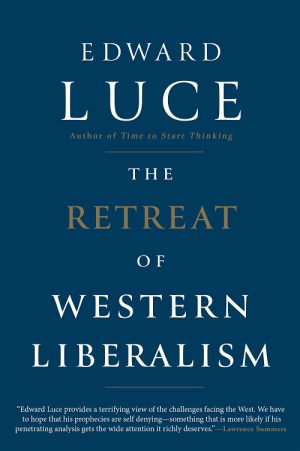
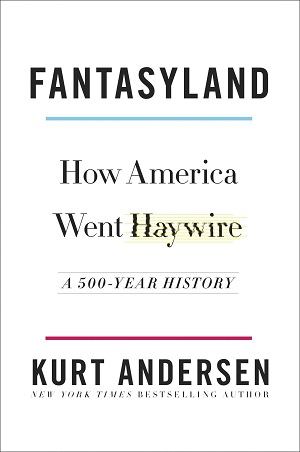
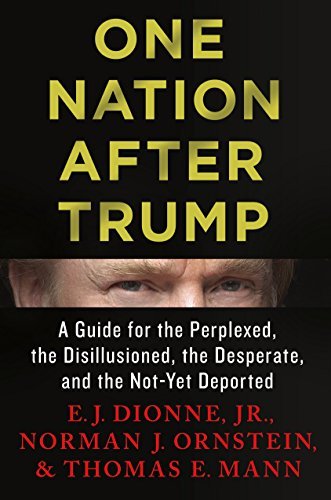
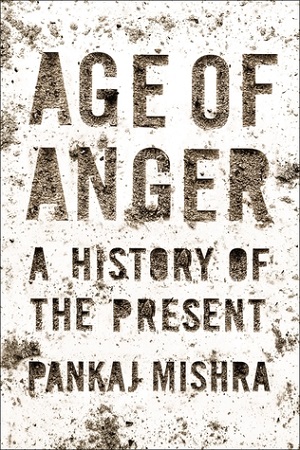
I’ve been doing a lot of reading lately in order to write an omnibus book column looking at the flood of books on the Trump election, geared toward the release of Hillary Clinton’s ill-advised What Happened. Here are some gleanings.
Ressentiment, writ very large
From Age of Anger: A History of the Present by Pankaj Mishra:
1.
 Today, however, this vision of universal uplift seems another example of intellectuals and technocrats confusing their private interest with public interest, their own socio-economic mobility as members of a lucky and fairly arbitrarily chosen elite with general welfare. Nowhere does the evidence of moral misery accumulate faster than in the so-called public sphere. The setting for opinion and argument originally created in France’s eighteenth-century salons by face to face relations, individual reason and urbane civility, is now defined, in its digital incarnations, by racists, misogynists and lynch mobs, often anonymous.
In the absence of reasoned debate, conspiracy theories and downright lies abound, and even gain broad credence: it was while peddling one of them, “Obama is a foreign-born Muslim,” that Donald Trump rose to political prominence. Lynch mobs, assassins and mass shooters thrive in a climate where many people can think only in terms of the categories of friends and foes, sectarian loyalty or treason. The world of mutual tolerance envisaged by cosmopolitan elites from the Enlightenment onwards exists within a few metropolises and university campuses; and even these rarefied spaces are shrinking. The world at large – from the United States to India – manifests a fierce politics of identity built on historical injuries and fear of internal and external enemies.
2.
The world has never seen a greater accumulation of wealth. The fruits of human creativity – from smartphones to stem-cell reconstructions – continue to grow. But such broad and conventional norms of progress cloak how unequally its opportunities are distributed: for instance, nearly half of the world’s income growth between 1988 and 2011 was appropriated by the richest tenth of humanity and, even in rich countries, there is a growing life-expectancy gap between classes.
In an economically stagnant world that offers a dream of individual empowerment to all but no realizable dreams of political change, the lure of active nihilism can only grow. Timothy McVeigh with his quintessentially American and First World background illustrates the passage from passive to active nihilism as vividly as men from impoverished postcolonial societies. For he claimed to be defending, with his spectacular brutality, the idea – individual autonomy – that modernity itself had enshrined, and then barred him from.
He was born into a way of life common until the 1980s among large numbers of the depoliticized and apathetic working-class and middle-class populations in the United States and Europe. [. . .] McVeigh grew up as this period of general affluence and leisure peaked, and a series of economic crises from the 1970s onwards began to make the American Dream, as he himself pointed out, seem less and less credible. McVeigh found it hard to get jobs commensurate with his sense of dignity. Brought up by a culture of individualism to consider himself unique, he seemed to have suffered from a sense of diminishment as he grew older and sensed the vast political and economic forces working around an on him. In our own time, support for Donald Trump’s white nationalism connects with middle-aged working-class men, who have suffered a dramatic deterioration in mortality and morbidity due to suicide, and drug and alcohol abuse.
3.
A heightened sense of rhetoric of self-empowerment accompanied, for instance, the IT revolution, as young graduates and dropouts became billionaires overnight in the Bay Area, and users of Facebook, Twitter and WhatsApp briefly appeared to be toppling authoritarian regimes worldwide. But the drivers of Uber cars, toiling for abysmally low fares, represent the actual fate of many self-employed “entrepreneurs.”
Capital continually moves across national boundaries in the search for profit, contemptuously sweeping skills and norms made obsolete by technology into the dustbin of history. We may pretend to be entrepreneurs, polishing our personal brands, decorating our stalls in virtual as well as real marketplaces; but defeat, humiliation and resentment are more commonplace experiences than success and contentment in the strenuous endeavour of franchising the individual self.
4.
There is plainly much more longing than can be realized legitimately in the age of freedom and entrepreneurship; more desires for objects of consumption than can be fulfilled by actual income; more dreams than can be fused with stable society by redistribution and greater opportunity; more discontents than can be allayed by politics or traditional therapies; more demand for status symbols and brand names than can be met by non-criminal means, more claims made on celebrity than can be met by increasingly divided attention spans; more stimuli from the news media than can be converted into action; and more outrage than can be expressed by social media.
Simply defined, the energy and ambition released by the individual will to power far exceed the capacity of existing political, social and economic institutions. Thus, the trolls of Twitter as much as the dupes of ISIS lurch between feelings of impotence and fantasies of violent revenge.
Growing tired of an excess of democracy
From The Retreat of Western Liberalism by Edward Luce:
1.
 In Enlightenment terms, our democracies are switching from John Locke’s social contract to the bleaker Leviathan of Thomas Hobbes. We are on a menacing trajectory brought about by ignorance of our history, indifference towards society’s losers and complacency about the strength of our democracy. It has helped turn society into a contest of ethnic grievances, in which “awakened whites” – as the alt-right now call them – are by far the largest minority.
2.
The story of liberal democracy is thus a continual tension between the neat democratic folk theory and the more complex liberal idea. Nowadays they have turned into opposite forces. Here, then, is the crux of the West’s crisis: our societies are split between the will of the people and the rule of the experts – the tyranny of the majority versus the club of self-serving insiders; Britain versus Brussels; West Virginia versus Washington. It follows that the election of Trump, and Britain’s exit from Europe, is a reassertion of the popular will. In the words of one Dutch scholar, Western populism is an “illiberal democratic response to undemocratic liberalism.” The British and American people supposedly reclaimed their sovereignty in 2016. I call it the Reaction. It is pretty clear which direction the Western elites are bending. Davos is no fan club for more democracy. Having hived off many areas that were once under democratic control (such as monetary policy and trade and investment), post-2016 Western elites now fear they have not gone far enough.
But elite disenchantment with democracy has been rising for many years. According to the World Values Survey, which offers the most detailed take on the state of global public opinion, support for democracy has plummeted across the Western world since the fall of the Berlin Wall. This is particularly true of the younger generation. For a long time, academics assumed that rising signs of disaffection with democracy were simply a reflection of dislike of the government of the moment. Government legitimacy may have been on the wane, but regime legitimacy was still robust. There were no alternatives. Democracy, after all, was the only game in town. That reading was far too complacent.
The United State of Anger
From The People Are Going to Rise Like the Waters Upon Your Shore by Jared Yates Sexton:
1.
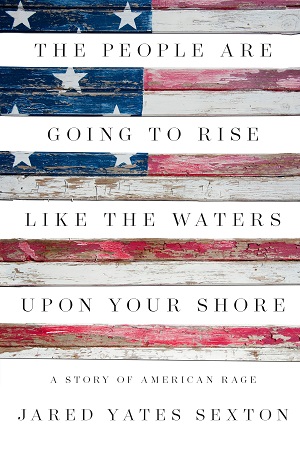 Everyone had it backward and they’d had it backward all along. The pundits had wrung their hands over the poll numbers, wondering what it would take for Trump to finally lose his momentum while Saturday Night Live booked him to host and the cable news programs interviewed him every second they weren’t showing him live at his rallies.
Between appearances, they’d wonder aloud: How does Trump drag so many people to his extreme point of view?
Trump hadn’t dragged anybody anywhere. And he didn’t have impressive poll numbers because he’d somehow or another convinced anybody of anything. Trump was, as of that moment, the heartbeat of an America with which many of us were unaccustomed. His was not a proactive candidacy but a pure, unadulterated reaction to what a slice of the American public wanted. This was a group that lived their lives steeped in unbelievable anger. They were either poor or less rich than they thought they should be, they were middle or upper middle class, and they were, almost to a person, white. They were angry and all they wanted in the fucking world was to blame somebody.
Trump wasn’t the cause; he was the disease personified.
Hillaryland and Clintonworld: Building a better bubble, together
From Shattered: Inside Hillary Clinton’s Doomed Campaign by Jonathan Allen and Amie Parnes
1.
 Over the course of the summer, the confidence of party insiders had been replaced by a degree of paranoia that nearly matched Hillary’s own outsize phobia. She was convinced that leaks of information had helped doom her 2008 campaign. In reality, the leaking and disloyalty were symptoms, not the cause, of the dysfunction in her first run for the White House. As long as she was seen as the prohibitive favorite to win the primary and the election, Democrats would fear being branded traitors or leakers. But if she wasn’t going to be in a position to reward or punish them, they had no reason to worry about whether they were rated as ones or sevens on her loyalty scale. After the 2008 campaign, two of her aides, Kris Balderston and Adrienne Elrod, had toiled to assign loyalty scores to members of Congress, ranging from one for the most loyal to seven for those who had committed the most egregious acts of treachery. Bill Clinton had campaigned against some of the sevens in subsequent primary elections, helping to knock them out of office. The fear of retribution was not lost on the remaining sevens, some of whom rushed to endorse Hillary early in the 2016 cycle.
2.
The one person with whom she didn’t seem particularly upset: herself. No one who drew a salary from the campaign would tell her that. It was a self-signed death warrant to raise a question about Hillary’s competence – to her or to anyone else – in loyalty obsessed Clintonworld. Most of the people around her were jockeying to get closer to her, not make her wonder about their commitment. And many didn’t know her very well personally. Even Huma Abedin, who was close to her, had all but given up on guiding her toward shifting course. She had long since started telling Hillary allies outside the campaign to take their complaints and suggestions straight to the candidate. For the mercenaries who had joined the campaign in hopes of finding jobs in the next administration, there was little percentage in getting on Hillary’s bad side. They also feared – appropriately – that unflattering words about Hillary or the strategy would be repeated at their own expense by those who hoped to gain Hillary’s favor. Concern about being cast out to the perimeter of Hillary’s overlapping circles of influence far outweighed the itch to tell Hillary what she was doing wrong.
3.
The rise of populism, and particularly right-wing populism, wasn’t a phenomenon limited to American politics. Brits were locked in a tense battle between those who wanted to exit the European Union and those who wanted to remain. Populist figures with nationalistic tendencies – like Nigel Farage in Britain, Marine Le Pen in France, and Norbert Hofer in Austria – were on the rise across Europe. By ceding the reformer mantle to Sanders – and to Trump – Hillary was dismissing a whole world’s worth of evidence that she was running into the headwinds of history.
The blunt instrument
From Devil’s Bargain: Steve Bannon, Donald Trump, and the Storming of the Presidency by Joshua Green
1.
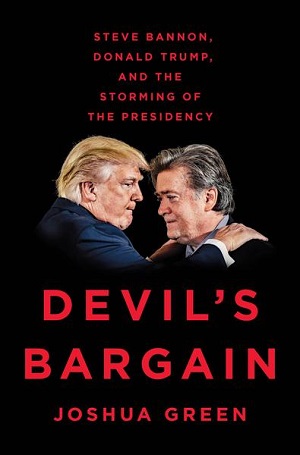 Trump, who has an uncanny ability to read an audience, intuited in the spring of 2011 that the birther calumny could help him forge a powerful connection with party activists. He also figured out that the norms forbidding such behavior were not inviolable rules that carried a harsh penalty but rather sentiments of a nobler, bygone era, gossamer-thin and needlessly adhered to by politicians who lacked his willingness to defy them. He could violate them with impunity and pay no price for it – in fact, he discovered, Republican voters thrilled to his provocations and rewarded him. National polls taken in mid-April, two weeks before the White House Correspondents’ Dinner, showed Trump leading the field of 2012 GOP presidential candidates.
Privately, what amused him the most, he later told a friend, was that no party official in a position of power dared to stand up to him. In his first nationally televised interview, on C-SPAN, the new chairman of the Republican National Committee, Reince Priebus, was confronted about Trump’s possible candidacy and his birther attacks on Obama. “Is the birther debate good for the party?” Jeff Zeleny, a reporter for the New York Times, asked him. “I think all these guys are credible,” Priebus replied, looking slightly nauseated. “I mean, obviously, people are going to have different opinions. And, you know, you’re going to have a lot of different candidates that are running, they’re gonna talk about different things at different times. . . . I think having a diversity of opinion is fine.”
The lesson Trump took away was that the party gatekeepers, who were privately appalled at his behavior and did not want him in the race, would pose no threat to him at all if he decided to run.
2.
In the summer of 2016, Bannon described Trump as a “blunt instrument for us.” But by the following April, Trump was in the White House and Bannon had raised his estimation of him to path-breaking leader. “He’s taken this nationalist movement and moved it up twenty years,” Bannon said. “If France, Germany, England, or any of these places had the equivalent of a Donald Trump, they would be in power. They don’t.”
When he took over Trump’s campaign in August, Bannon did indeed run a nationalist, divisive campaign in which issues of race, immigration, culture, and identity were put front and center. This wasn’t by accident or lacking purpose, even if the candidate himself didn’t care to understand its broader historical context. By exhuming the nationalist thinkers of an earlier age, Bannon was trying to build an intellectual basis for Trumpism, or what might more accurately be described as an American nationalist-Traditionalism. Whatever the label, Trump proved to be an able messenger.
Trump: the show (part one)
From Insane Clown President: Dispatches from the 2016 Circus by Matt Taibbi
1.
 There are some people now who are urging the media to ignore Donald Trump, and simply not cover him. But it’s a little late for that.
The time to start worrying about the consequences of our editorial decisions was before we raised a generation of people who get all of their information from television, and who believe that the solution to every problem is simple enough that you can find it before the 21 minutes of the sitcom are over.
Or before we created a world in which the only inner-city black people you ever see are being chased by cops, and the only Muslims onscreen are either chopping off heads or throwing rocks at a barricades.
This is an amazing thing to say, because in Donald Trump’s world everything is about him, but Trump’s campaign isn’t about Trump anymore. With his increasingly preposterous run to the White House, the Donald is merely articulating something that runs through the entire culture.
It’s hard to believe because Trump the person is so limited in his ability to articulate anything. Even in his books, where he’s allegedly trying to string multiple thoughts together, Trump wanders randomly from impulse to impulse, seemingly without rhyme or reason. He doesn’t think anything through. (He’s brilliantly cast this driving-blind trait as “not being politically correct.”)
It’s not an accident that his attention span lasts exactly one news cycle. He’s exactly like the rest of America, except that he’s making news, not following it – starring on TV instead of watching it. Just like we channel-surf, he focuses as long as he can on whatever mess he’s in, and then he moves on to the next bad idea or incorrect memory that pops into his head.
Lots of people have remarked on the irony of this absurd caricature of a spoiled rich kid connecting so well with working-class America. But Trump does have something very much in common with everybody else. He watches TV. That’s his primary experience with reality, and just like most of his voters, he doesn’t realize that it’s a distorted picture.
If you got all of your information from TV and movies, you’d have some pretty dumb ideas. You’d be convinced blowing stuff up works, because it always does in our movies. You’d have no empathy for the poor, because there are no poor people in American movies or TV shows – they’re rarely even shown on the news, because advertisers consider them a bummer.
Politically, you’d have no ability to grasp nuance or complexity, since there is none in our mainstream political discussion. All problems, even the most complicated, are boiled down to a few minutes of TV content at most. That’s how issues like the last financial collapse completely flew by Middle America. The truth, with all the intricacies of all those arcane new mortgage-based financial instruments, was much harder to grasp than a story about lazy minorities buying houses they couldn’t afford, which is what Middle America still believes.
Trump isn’t just selling these easy answers. He’s also buying them. Trump is a TV believer. He’s so subsumed in all the crap he’s watched – and you can tell by the cropped syntax in his books and his speech, Trump is a watcher, not a reader – it’s all mixed up in his head.
He surely believes he saw that celebration of Muslims in Jersey City, when it was probably a clip of people in Palestine. When he says, “I have a great relationship with the blacks,” what he probably means is that he liked watching The Cosby Show.
In this he’s just like millions and millions of Americans, who have all been raised on a mountain of unthreatening caricatures and clichés. TV is a world in which the customer is always right, especially about hard stuff like race and class. Trump’s ideas about Mexicans and Muslims are typical of someone who doesn’t know any, except in the shows he chooses to watch about them.
This world of schlock stereotypes and EZ solutions is the one experience a pampered billionaire can share with all of those “paycheck-to-paycheck” voters the candidates are always trying to reach. TV is the ultimate leveling phenomenon. It makes everyone, rich and poor, equally incapable of dealing with reality.
That’s why it’s so ironic that some people think the solution to the Trump problem is turning him off. What got us into this mess was the impulse to change the channel the moment we feel uncomfortable. Even if we take the man off the air, the problem he represents is still going to be there, just like poverty, corruption, mass incarceration, pollution and all of the other things we keep off the airwaves.
2.
Of course, Trump’s ignorance level, considering his Wharton education, is nearly as awesome as what Bush accomplished in spite of Yale. In fact, unlike Bush, who had the decency to not even try to understand the news, Trump reads all sorts of crazy things and believes them all. From theories about vaccines causing autism to conspiratorial questions about the pillow on Antonin Scalia’s face to Internet legends about Americans using bullets dipped in pigs’ blood to shoot Muslims, there isn’t any absurd idea Donald Trump isn’t willing to entertain, so long as it fits in with his worldview.
But Washington is freaking out about Trump in a way they never did about Bush. Why? Because Bush was their moron, while Trump is his own moron. That’s really what it comes down to.
And all of the Beltway’s hooting and hollering about how “embarrassing” and “dangerous” Trump is will fall on deaf ears, because as gullible as Americans can be, they’re smart enough to remember being told that it was OK to vote for George Bush, a man capable of losing at tic-tac-toe.
We’re about to enter a dark period in the history of the American experiment. The Founding Fathers never imagined an electorate raised on Toddlers and Tiaras and Temptation Island. Remember, just a few decades ago, shows like Married With Children and Roseanne were satirical parodies. Now the audience can’t even handle that much irony. A lot of American culture is just dumb slobs cheering on other dumb slobs. It was inevitable, once we broke the seal with Bush, that our politics would become the same thing.
Madison and Jefferson never foresaw this situation. They knew there was danger of demagoguery, but they never imagined presidential candidates exchanging “mine’s bigger than yours” jokes or doing “let’s laugh at the disabled” routines. There’s no map in the Constitution to tell us how to get out of where we’re going. All we can do now is hold on.
3.
Politics at its most basic isn’t a Princeton debating society. It’s a desperate battle over who gets what. But during the past 50 years, when there was a vast shift in the distribution of wealth in this country, when tens of millions of people were put out of good, dignified jobs and into humiliating ones, America’s elections remained weirdly civil, Queensberry-rules reality shows full of stilted TV debates over issues like abortion, gay marriage and the estate tax.
As any journalist who’s ever covered a miners’ strike or a foreclosure court will report, things get physically tense when people are forced to fight for their economic lives. Yet Trump’s campaign has been the first to unleash that menacing feel during a modern presidential race.
Some, or maybe a lot of it, is racial resentment. But much of it has to be long-delayed anger over the way things have been divvied up over the years. The significance of Trump’s wall idea, apart from its bluntly racist appeal as a barrier to nonwhite people, is that it redefines the world in terms of a clear Us and Them, with politicians directly responsible for Us.
It’s a plain rebuttal to the Sullivan explanation for why nobody between the coasts has a decent job anymore, i.e., that there are “global economic forces” at work that we can no more change than we can the weather. Trump’s solutions are preposterous, logistically impossible and ideologically vicious, but he’s giving people a promise more concrete than “tax cuts will stimulate growth that will eventually bring jobs back.” He’s peddling hope, and with hope comes anger.
4.
Trump’s early rampage through the Republican field made literary sense. It was classic farce. He was the lewd, unwelcome guest who horrified priggish, decent society, a theme that has mesmerized audiences for centuries, from Vanity Fair to The Government Inspector to (closer to home) Fear and Loathing in Las Vegas. When you let a hands-y, drunken slob loose at an aristocrats’ ball, the satirical power of the story comes from the aristocrats deserving what comes next. And nothing has ever deserved a comeuppance quite like the American presidential electoral process, which had become as exclusive and cut off from the people as a tsarist shooting party.
The first symptom of a degraded aristocracy is a lack of capable candidates for the throne. After years of indulgence, ruling families become frail, inbred and isolated, with no one but mystics, impotents and children to put forward as kings. Think of Nikolai Romanov reading fortunes as his troops starved at the front. Weak princes lead to popular uprisings. Which brings us to this year’s Republican field.
There wasn’t one capable or inspiring person in the infamous “Clown Car” lineup. All 16 of the non-Trump entrants were dunces, religious zealots, wimps or tyrants, all equally out of touch with voters. Scott Walker was a lipless sadist who in centuries past would have worn a leather jerkin and thrown dogs off the castle walls for recreation. Marco Rubio was the young rake with debts. Jeb Bush was the last offering in a fast-diminishing hereditary line. Ted Cruz was the Zodiac Killer. And so on.
The party spent 50 years preaching rich people bromides like “trickle-down economics” and “picking yourself up by your bootstraps” as solutions to the growing alienation and financial privation of the ordinary voter. In place of jobs, exported overseas by the millions by their financial backers, Republicans glibly offered the flag, Jesus and Willie Horton.
In recent years it all went stale. They started to run out of lines to sell the public. Things got so desperate that during the Tea Party phase, some GOP candidates began dabbling in the truth. They told voters that all Washington politicians, including their own leaders, had abandoned them and become whores for special interests. It was a slapstick routine: Throw us bums out!
Republican voters ate it up and spent the whole of last primary season howling for blood as Trump shredded one party-approved hack after another. By the time the other 16 candidates finished their mass-suicide-squad routine, a tail-chasing, sewer-mouthed septuagenarian New Yorker was accepting the nomination of the Family Values Party.
Trump: the show (part two)
From Fantasyland: How American Went Haywire by Kurt Andersen
1.
 Donald Trump is a pure Fantasyland being, its apotheosis. If he hadn’t run for president, I might not have mentioned him at all. But here he is, a stupendous Exhibit A. To describe him is practically to summarize this book.
He’s driven by resentment of the Establishment. He doesn’t like experts because they interfere with his right as an American to believe or pretend that fictions are facts, to feel the truth. He sees conspiracies everywhere. He exploits the myths of white racial victimhood. His case of Kids “R” Us Syndrome – spoiled, impulsive, moody, a seventy-year-old brat – is extreme.
And he is first and last a creature of the fantasy-industrial complex. “He is P. T. Barnum,” his sister, a federal judge, said to his biographer Tim O’Brien in 2005. Even as a teenager in the early 1960s, Trump himself told O’Brien, he understood that any racket in America could be turned into an entertainment racket. “I said, ‘You know what I’ll do? I am going to go into real estate, and I am going to put show business into real estate. I’ll have the best of both worlds.” Back then, in 1961, the historian Daniel Boorstin already saw what was coming in politics, what would make Trump president. “Our national politics have become a competition for images or between images, rather than reality,” Boorstin wrote. “Strictly speaking, there is no way to unmask an image. An image, like any other pseudo-event, becomes all the more interesting with our every effort to debunk it.”
Although the fantasy-industrial complex had been annexing presidential politics for more than half a century when candidate Trump came along, his campaign and presidency are its ultimate expression, like nothing we’d witnessed in real life or imagined we ever would. [. . .] Before the full emergence of Fantasyland, Trump’s various enterprises would have seemed an embarrassing, ridiculous, incoherent jumble for a businessman, let alone a serious candidate for president. What connects a Muslim-mausoleum-themed casino in New Jersey to a short-lived sham professional football league to an autobiography he didn’t write to hotels and buildings he didn’t build to a mail-order meat business to a beauty pageant to an airline that lasted three years to a sham “university” to repeatedly welshing on giant loans to selling deodorant and mattresses and a vodka and toiled waters called Empire and Success to a board game named after himself to a TV show about pretending to fire people?
What connects them all, of course, is the new, total American embrace of admixtures of the fictional and real and of fame for fame’s sake. Trump’s reality was a reality show before that genre or term existed.
Tyranny of the minority
From One Nation After Trump by E. J. Dionne, Jr., Norman J. Ornstein, and Thomas E. Mann
1.
 Trump took advantage of a trend in American politics toward minority rule, or what might be called “non-majoritarianism.” Our system is now biased against the American majority because of partisan redistricting (which distorts the outcome of legislative elections), the nature of representation in the United States Senate (which vastly underrepresents residents of larger states), the growing role of money in politics (which empowers a very small economic elite), the workings of the Electoral College (which is increasingly out of sync with the distribution of our population), and the ability of legislatures to use a variety of measures, from voter ID laws to the disenfranchisement of former felons, to obstruct the path of millions of Americans to the ballot box. Trump profited from this bias against the majority, becoming president despite losing the popular vote by the largest margin ever for an Electoral College winner.
2.
Trump’s victory was less an endorsement of his program than a rejection of Clinton. Exit polling found that in the electorate that made Trump president, 60 percent had an unfavorable view of him; only 38 percent had a favorable view, which suggests how small his core support was on Election Day. But Clinton’s numbers were nearly as bad, as 55 percent had an unfavorable view of her. Here is what should be seen as the decisive piece of data about the 2016 election: Among voters who had an unfavorable view of both Trump and Clinton (nearly a fifth of the electorate), Trump won decisively, 47 percent to 30 percent. Among the quarter of voters who explicitly said that the main motivation of their choice was dislike of the other candidate, the numbers were similar: 50 percent for Trump, 39 percent for Clinton. The 2016 election was a negative verdict, not a mandate for Trumpism.
These numbers are critical for understanding how fragile Trump’s hold on the public is and why he began his term with the lowest approval ratings of any new president in the history of modern polling. They explain why his disapproval numbers increased so quickly after he took office and why a large-scale grassroots movement rose up against him so rapidly. Trump did not speak for the country, and Trumpist ideology – to the extent the he even has a consistent ideology – does not command majority support.
Through all of the controversies in Trump’s early months in office, political analysts regularly argued that despite his problems, Trump was still hanging on to support from his “base.” But his base was a minority, and Trump showed little capacity for expanding beyond this core. This will have consequences in the long run, and it should give heart to Trump’s foes.
The diagnosis
From Twilight of American Sanity: A Psychiatrist Analyzes the Age of Trump by Allen Frances
1.
 So, how does it add up? Successful politicians succeed in winning hearts and minds because they are good at understanding and exploiting human nature. Platforms, policy, and pronouncements are just empty words without empathic connection – the bond that conveys to the electorate that they are listened to, understood, and will be cared for. Hucksters like Trump are expert at feigning this connection, to the detriment of all of us. True statesmen aspire to see political life as a selfless journey with, and for, their constituents – not a game of self-promotion and self-aggrandizement. At the beginning of our experiment in democracy, political discourse was conducted in the high-toned intellectual style of the enlightenment. Arguments used logic and were meant to appeal to reason. In this past election campaign, the contrast between the cortex and the amygdala was won by the amygdala – extravagant emotion triumphed over rational thought.
Trump won. American democracy, societal sanity, and the future welfare of our children and planet all lost. He isn’t crazy, but we are for electing him. And for allowing our society to degenerate to the point that someone like Trump could be taken seriously as a presidential candidate. The contingencies contributing to his win were crazily long-shot, requiring the unlikely convergence of sixteen Republican dwarfs in the primary, a vulnerable opponent in the election, the Putin push, the heavy hand of the FBI, the spite of Julian Assange, and wacky third-party candidates splitting the vote. We are now paying the price.
 Over at Goodreports I’ve added a brief review of the latest Project Censored yearbook, Censored 2018. I’ve covered quite a few of these over the past fifteen years, sometimes in depth and sometimes with only marginal notes. Here’s a list: 2003, 2009, 2010, 2011, 2012, 2013, 2016, 2018.