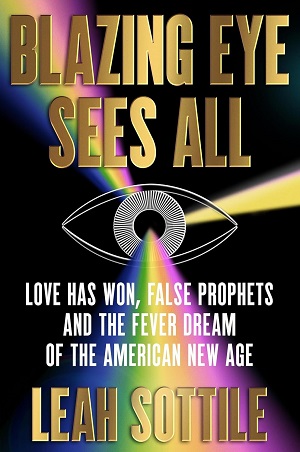
Blazing Eye Sees All: Love Has Won, False Prophets, and the Fever Dream of the American New Age
By Leah Sottile
The crime:
In the 2000s Amy Carlson, then a McDonald’s manager, left her family (she’d had three children, with three different fathers) and started up a New Age religious group that later became known as Love Has Won. Carlson took the title of Mother God, claiming to be a 19-billion-year old entity who had been reincarnated thousands of time, including as Jesus (now revealed to have been female). An alcoholic anorexic who took massive amounts of colloidal silver as a cure-all, Carlson died in 2021 at the age of 45. Her followers kept her mummified body for weeks wrapped in a sleeping bag covered in Christmas lights.
 The book:
I suppose the first point I should address is whether this belongs in the True Crime Files. I think Love Has Won (LHW) was a cult that operated various scams, but was there a crime involved in all this? There were charges against six LHW members for “tampering with a deceased person’s body” (Carlson’s) and abuse of children (as there were a couple of kids living at the LHW compound), but these were subsequently dropped without explanation. I think they probably figured that with Carlson dead there was no point taking things any further, and given how the group immediately dissolved that may have been the right call.
As it is, cults occupy a gray area when it comes to legality, and this is a point that’s actually quite important to the historical survey of various New Age groups that Leah Sottile conducts. The test case is the U. S. Supreme Court 1944 decision of United States v. Ballard. This was an action for fraud brought against the “I AM” movement and it was decided that the First Amendment protection of religious freedom meant that you couldn’t challenge beliefs on the basis of whether or not they were true. This basically nullified any chance of going after such groups on the basis of fraud, as the justices could only shrug their shoulders at the question of truth in such a context. As the majority opinion put it: “The religious views espoused by respondents might seem incredible, if not preposterous, to most people. But if those doctrines are subject to trial before a jury charged with finding their truth or falsity, then the same can be done with the religious beliefs of any sect.”
With Ballard the door was opened for spiritual entrepreneurs, and in America these have always been thick on the ground. The most successful would go on to be legally recognized as religions and become huge international franchises worth billions of dollars. Others would fade from memory with the death of their charismatic founder, or more tragically with group suicide. But, free from charges of fraud, unless they were breaking the law in some way they were in the clear, no matter how ridiculous or even damaging their beliefs might be. As Sottile summarizes where things came to rest: “People can believe in just about anything with their entire being. And if they believe it completely, it’s protected.”
Love Has Won didn’t have a coherent message or theology. Sottile traces a through line connecting LHW to various earlier spiritual movements loosely camped under the label New Age, but these struck me as only a random set of borrowings that added up to nothing. LHW theology begins in the legendary continent of Lemuria, for which Sottile provides a helpful backgrounder. And it ends in some kind of Holy Mountain (filled with Lemurians) in northern California. In between there’s a cosmic battle going on between Galactics from the fifth dimension (they’re the good guys) and a reptile Cabal of Illuminati, descendants of the evil Anunnaki. In an early credo Carlson wrote how she was “choosing to release all the pain and suffering of illusion and step into my Magnificence, Beauty, and Greatness I am destined to Be.” “From this day forth, I release the darkness that society and the status quo have placed on me and choose my Heart, my Truth, my Divine Birthright of Abundance and accept my Royal heritage.”
As with any cult we can roll our eyes or laugh or get angry at just how ridiculous all of this sounds. Personally, I’m always put in mind when I read this stuff of the Carl Sandburg poem “To a Contemporary Bunkshooter.” “I like to watch a good four-flusher work,” Sandburg writes, but not the trashy sort of performance that he sees hustling today. This resonates with me even outside of the realm of cult leaders. It never ceases to amaze me how many successful artists (or “creators”), businesspeople, and politicians aren’t even any good at what is supposed to be their job. Usually their success is attributed to some special charismatic gift that I can never see.
If you try to explain the LHW world view in so many words of course nobody would buy it. But add Carlson’s presentation of it – the sparkly lights, the purple robes, the healing crystals – and you have a cult. I’m more than willing to accept that a charismatic individual can sell anything if their pitch is good enough. I like to watch a good four-flusher work too. But when Carlson passed herself off as God incarnate or when Donald Trump does his “weave” (and don’t worry, more on him shortly) I’m just confused. As we know from studies of the MAGA movement and cult memberships, the followers of such leaders aren’t, at least in general, stupid or poorly educated. So who is fooled by any of this? I mean, even the cult’s name was garbage. Love Has Won? That’s just poor branding.
As you will have picked up from my Trump reference, there was also a political angle to LHW that isn’t forced by Sottile but is a part of the cultural matrix that gave birth to Carlson and fashioned her message. That matrix of madness was made up of various general as well as more specific ingredients: end-times religion, Christian nationalism, the Tea Party and QAnon, anti-vaccine activists, the militia movement, populist rage against experts and elites, all amplified by social media and exacerbated by growing inequality. Two books published in 2017 tried to explain and describe what was going on. First up was Kurt Andersen’s Fantasyland: How America Went Haywire:
America was created by true believers and passionate dreamers, by hucksters and their suckers—which over the course of four centuries has made us susceptible to fantasy. . . . In other words: mix epic individualism with extreme religion; mix show business with everything else; let all that steep and simmer for a few centuries; run it through the anything-goes 1960s and the Internet age; the result is the America we inhabit today, where reality and fantasy are weirdly and dangerously blurred and commingled.
And this is from David Niewert’s Alt-America:
Alt-America is an alternative universe that has a powerful resemblance to our own, except that it’s a completely different America, the nation its residents have concocted and reconfigured in their imaginations. It is not the America where the rest of us live. In this other America, suppositions take the place of facts, and conspiracy theories become concrete realties. Its citizens live alongside us in our universe, but their perception of that universe places them in a different world altogether, one scarcely recognizable to those outside it.
I am not shoehorning a political argument into Sottile’s book. The political valence of the “fever dream of the American New Age” during these years became inextricably tied up with right-wing political messaging. In bookstores, the books on natural healing, crystals, and tarot cards were shelved alongside those debunking the COVID hoax, the perils of socialism, and the latest from Bill O’Reilly and Tucker Carlson:
This felt like the aisle of lost hope – that even New Ageism, with all its promise of being something different, was in fact just as red-pilled as the rest of the country. This was the aisle where believers became radicals. A series of books called the Rise of the New World Order was on display; one yelled from its cover that “the next election could be the last.”
A book called Nazi UFO Time Travelers asked, “Do we owe the future to the fuhrer?” Books about Hitler and “the Nazi’s incredible secret technology” were mixed along books on the “5 Love Languages.”
Tucker and Amy Carlson (no relation) were not strange bedfellows. Focusing on female New Age leaders Sottile also tells the story of Elizabeth Clare Prophet, who started something called The Church Universal and Triumphant. This was a millenarian movement that posited a final battle between Ascended Masters and the Fallen Ones. What this morphed into in the real world was a survivalist ideology that took its lead from the Patriot movement. Church members began building compounds and stockpiling weapons while railing against a Zionist-Communist takeover. In much the same way, Ramtha’s School of Enlightenment (RSE), headed by J. Z. Knight (who was possessed by the spirit of an eternal spiritual being, also from Lemuria, named Ramtha), identified the forces of darkness in contemporary political terms with a nefarious New World Order, its doctrine sharing common talking points with “far-right militias and members of the antigovernment Patriot movement.” Though a long-time supporter of the Democratic Party, Knight flipped for Trump in a turn that many were making at the time. The RSE publicly came out in support for Trump and endorsed the QAnon movement wholeheartedly, even hanging a giant Q on the front gate of their compound and selling Q hats and shirts. COVID was decried as a hoax and vaccines as poison.
Carlson (Amy, not Tucker) rode this same wave. She inveighed against then President Biden while encouraging her followers to watch Trump’s speeches on TV. Tearing pages from the QAnon songbook, she thought Trump was going to disclose government secrets about aliens and elitist cabals (with the elites, naturally, being all of the left: “the Rothschilds, Hollywood, Obama, Hillary, all of the elite are the cabal”). It seemed everything flowed together in Fantasyland or Alt-America, from Love Has Won’s “labyrinthine beliefs about UFOs, conspiracy theories, the cabal and Illuminati, Atlantis and Lemuria, to their ever-growing love for Donald Trump.” Eventually Carlson would even claim Trump was her father in Lemuria, and begin to sound like Trump in her social media posts. As one such “divine decree” put it: “The Entire [9/11] truth, as well as The UFO Conspiracy Cover-Up, Must Be Revealed immediately. . . .If these are Not Revealed immediately, WE the people, Will Abolish that illusionary Government.”
On the face of it, it’s hard to square Mother God (a.k.a., Mother Earth, Divine Mother, Universal Mother, White Buffalo Calf Woman) making a “divine decree” that appeals to the authority of WE the people. But the whole tone of the post sounds exactly like a Trump Truth Social tweet: the random capitalizations, the commanding tone, and the sheer craziness.
So not strange bedfellows at all. Nor were there any strange bedfellows among the 144,000 “saved” in post-Carlson LHW theology, a group that included Prince, Bob Marley, Michael Jackson, Trump, Putin, and Hitler. This was the great American political-theological right-wing melting pot. “While the aesthetics and dialects of the Patriot movement, QAnon, and conspirituality influencers couldn’t have been more different, the ideas were essentially the same. One researcher dubbed this New Age influencer/vaccine denial space ‘pastel QAnon,’ for the ways the Q aesthetic was softened and feminized for a whole new audience.” Not the manosphere then but something just as toxic in its own way.
Given that Sottile’s focus is on a female-led New Age, from the spirit-rapping Fox sisters through figures like Edna Ballard (Lotus Ray King), Elizabeth Prophet (Guru), and J. Z. Knight (Ramtha) leading up to Carlson (Mother God) she also has some thoughts on how this plays out in gender terms. Among male cult leaders there is often a need to establish a dominance hierarchy where sexual behaviour is controlled and only the leader is given procreative opportunities. Among the pastel QAnon leaders there seems to be little of this kind of sexual dominance or maternal feeling. Knight took on a male identity in Ramtha. Carlson rejected her own children entirely, and despite having a series of Father God associates doesn’t appear to have been sexually driven. What these figures mainly wanted was attention. “Even as a kid, Amy wanted to be onstage. Maybe, in the end, that was what this was all about. She was admired and revered; not an actress, or a singer, but a goddess.” “Amy wanted to be worshipped. She found believers willing to do that.”
In sum, the essential ingredients for a Fourth Great Awakening were all in place at this time. There was a populace primed to believe anything. Sottile references a 2023 survey that found roughly half of those polled believed houses can be haunted by spiritual entities, 20 percent believed in Bigfoot, and a third believed we are being observed by aliens. There was the growth of the Internet and social media, which vastly expanded the reach and the profitability of fringe theories while also promoting the most narcissistic elements in society. And finally there was a breakdown in traditional social orders, leading to the rise of charismatic cult leaders as new icons of hope and authority. Carlson responded to “a brutal society – a society that discards anything and anyone that is broken, that prizes beauty and fame and God and money and little else.” That Carlson was broken just made her need for beauty and fame and God and money more essential. With the law largely sidelined, her path was clear.
Noted in passing:
As various commentators have noticed, people who say they existed in previous lives nearly always find themselves upwardly mobile. They weren’t a peasant on the eve of the French Revolution, but Marie Antoinette. They weren’t a slave building the pyramids but the Pharaoh himself. Carlson was no slouch in this department, claiming that among her 534 previous lives she pre-existed as a who’s who of historical biggies: the Queen of Lemuria, Cleopatra, Jesus, Joan of Arc, Pocahontas, and Marilyn Monroe, to name just a few. I guess this was part of accepting her “Divine Birthright” and “Royal heritage.”
There’s a reason we speak of celebrity “worship.” In our culture to be a celebrity is to be a god, so it’s no surprise Carlson couldn’t, or didn’t feel the need, to distinguish between them. Did she want to be God, or did she just want to be famous, loved, and adored? It’s a silly question. She thought they were the same thing.
Takeaways:
People will believe anything. Not almost anything, anything.
Just because new spiritual movements can’t be charged with fraud doesn’t mean there aren’t a lot of frauds out there. To be safe, I think you should assume they all are.
Also: colloidal silver has no proven health benefits. If you take enough of it though it will turn your skin blue.
True Crime Files
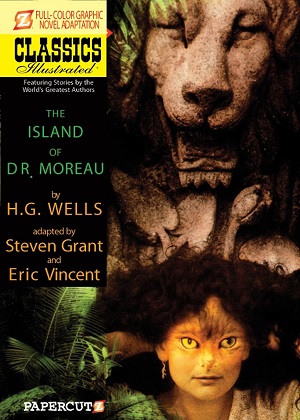 I’ve always felt a special connection to The Island of Dr. Moreau, at least ever since I picked up a movie tie-in paperback when I was a kid (I mean the 1977 Burt Lancaster-Michael York movie, not the 1996 Marlon Brando-Val Kilmer one). I don’t know how many times I’ve read Wells’s novel, but this was my second time through the Classics Illustrated adaptation, with text by Steven Grant and art by Eric Vincent. I recall not being impressed with it my first time around, but on this re-read I thought it held up slightly better. Even though I had to groan at the back cover, which proclaims: “Edward Prendick is . . . . LOST . . . and trapped on the Island of Dr. Moreau – the one island you want to be voted off of!” So there’s two timely references to American television that I don’t think will age as well as Wells’s book has.