Hammer: My Gun is Quick

I, the Jury is a great title, both apt and unforgettable to the point of being iconic. My Gun is Quick isn’t nearly as good. Mickey Spillane’s second Mike Hammer novel does have a great dedication though: “To all my friends / past, present and future.” That’s nice.

We don’t hit the ground running. Instead, things kick off with an uncharacteristically philosophical prologue as Mike muses over the difference between a comfortable life of reflection that is safely removed from the savage life and lawlessness of the jungle “out there.” Meaning, in Mike’s case, life on the mean streets. This opening feels out of place and dropped in apropos of nothing, but I suspect it was meant as a response to some of his critics. And by “his” I mean Spillane’s.

Moving right along, and that quickly, Mike confronts a pimp in a diner with language that again shows his influence on Dirty Harry. “Just touch that rod you got and I’ll blow your damned greasy head off. Go ahead, just make one lousy move toward it.” Yeah. Make my day, punk.

Not that Hammer didn’t have his earlier screen progenitors. When he checks himself out in a mirror he sees “a character straight out of a B movie.” It’s a look that makes him grunt in satisfaction. He’s a type of the hard-boiled private dick: a tough guy who can handle himself as well in the bedroom as a barroom brawl (and in both locations he gets plenty of opportunities). You can beat the crap out of him if you catch him by surprise, but that only makes him angry. And women don’t just throw themselves at him, but run to the kitchen to make him coffee and bacon and eggs in the morning: “Breakfast is served, my lord.” Now that girl’s a keeper!

All of which is pretty much what you’d expect from a hero of this genre. But Hammer also has some individual traits that set him apart. In the first place, he’s a bulldog. This is the quality that his police buddy Pat Chambers respects and finds useful. “You could be a good crook but you’re a better cop,” Pat tells him. “You get something and hang on to it longer than anybody else and make something of it.” Plus, he knows how to play the game. As he explains to Lola:

I hate the lice that run the streets without even being scratched. I’m the guy with the spray gun and they hate me, too, but even if I’m a private cop I can get away with it better than they can. I can work the bastards up to the point where they make a try at me and I can shoot in self-defense and be cleared in a court of law. The cops can’t go that far, but they’d like to, don’t forget it.

I don’t know how accurate a statement of the law this was in 1950, but it’s hard to imagine a cop getting in trouble for shooting someone who pulled a gun on them first in the twenty-first century. Leaving that aside, what makes Hammer so tenacious is his thirst for vengeance. He knows what he wants to do to whoever killed Nancy: “They were going to die slower and harder than any son of a bitch had ever died before, and while they died, I’d laugh my goddamn head off!” No, a guy with that kind of fire in his belly isn’t going to quit. He’s going to hang on longer than anybody. And, finally, what provides fuel for his vengeful crusades is the dark cloud of fatality that surrounds him. “I’m trouble for everything I touch,” he warns Lola. But such a warning comes too late, leaving him to mete out brutal justice after the fact. And so the Mike Hammer plot is concluded in a blaze (a literal blaze here) of guts and glory: “He was still screaming when I pulled the trigger.” Then, onward! As Spillane advised one younger writer: “The first chapter sells the book and then the last chapter sells the next book.”

Now just a few other things I pulled out.

In my review of the Ross Macdonald story “Death by Water” I mentioned its interesting plot point about a victim who is drowned in a bathtub and then taken out and thrown in a swimming pool so it would look like an accident. The clue is that the water in the victim’s lungs is bathwater and not the chlorinated pool water. That sounded like the big clue in the movie Chinatown where Hollis Mulwray is found drowned in a reservoir but he has salt water in his lungs. But “Death by Water” had been written in 1947 and it had never been published so Robert Towne couldn’t have had it in mind. He might, however, have been thinking of this novel, which was published in 1950. Here we have Ann Minor being found drowned in a river. Hammer knows she didn’t kill herself so he has the water in her lungs tested and it turns out to be from the tub in her apartment.

Maybe this was an idea that had been around for a while, which makes me wonder what the first mystery story to use it might have been.

Did Spillane and Ross Macdonald both have a fetish for busty women? Or were breasts just a substitute or synecdoche for sexuality in general? Either way, it leads to some crazy paeans like the following: “She was a wide-shouldered woman with the high firm breasts of youth unrestrained by the artifices of a brassiere, each a soft hemisphere of beauty desiring to be touched.” This is the same girl, I’ll add, who makes breakfast for her lord. Is it any wonder he proposes? Lola is turned on by his toughness (“You have a brutish quality about you that makes men hate you, but maybe a woman wants a brute.”), and she makes her desire clear in her kisses: “Her mouth was a soft bed of fire, her tongue a searching thing asking questions I had to answer greedily. . . . She didn’t have to tell me that she was mine whenever I wanted it. I knew that.”

Sure you can make fun of all this, but I suspect Spillane was laughing too as he wrote it and it’s a hoot to read. Of course some of the sexual politics have dated – homosexuals, or “butt boys,” are again figures of weakness and degeneracy – but that too is part of the genre landscape. Noir was of a time and place.

My Gun is Quick is a longer book than either I, the Jury or Vengeance is Mine! (the next Hammer novel), and while it never drags it did lead me to feel some impatience, especially as it was so obvious from the get-go who the main villain was. I don’t think many people rank it among their favourite Hammer adventures. But Spillane already had his formula set and delivers what he knew his readers wanted. There’d be plenty more of much the same.
Hammer index

Holmes: The Doctor’s Case

I think I knew that Stephen King had written a Sherlock Holmes story, but finding “The Doctor’s Case” was still a bit of a surprise. Detective fiction wasn’t really his thing. Luckily this came out in 1987, a time when King was writing at the height of his considerable powers. I’ve written before about the Rule of Ten when it comes to authors, and for King you could place his big decade roughly in the 1980s. 1987 was the same year as Misery, one of his best books. So Holmes was in good hands here.

The doctor whose case this is, you’ll be interested to know, is Dr. Watson himself. The hook here is that it is Watson who actually solves the case, or mostly solves it. And this is no small matter of just providing Holmes with a helpful nudge, perhaps unconsciously. No, this is a prize “locked room” mystery that Lestrade has specially invited Holmes in to investigate and it is Watson who figures out how the murder was committed. Admittedly the house where the crime took place is full of cats and Holmes has an allergy to felines so he is congested and breaking out in a rash, meaning he’s not operating in peak condition, but still it’s impressive how Watson scoops him. And Holmes does give him credit, while belittling him a bit at the end for not extending his observations so far as to grasp the full story of what happened.

This is a solid pastiche that never winks at the reader with parodic intent but deals out various canonical elements while presenting a neat puzzle that’s basically a sort of magic trick. Then there’s a denouement that involves a shuffle of moral justice that Doyle often indulged. In short, King knew the assignment and delivered. Whatever else you want to say about him, the man has always been a total pro.

Holmes index

Saga of the Swamp Thing Book Six

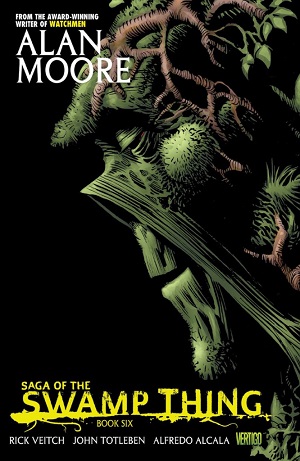
Saga of the Swamp Thing Book Six

This volume collects the final issues written by Alan Moore for Saga of the Swamp Thing, with his usual collaborators providing the art. And in fact, regulars Stephen Bissette and Rick Veitch also took turns with writing duties for single issues (Veitch would take over writing the series full-time after Moore’s departure).

In outline, the main work of the issues collected here was to bring Swampy home to the bayou and the arms of Abby Cable after his exile on the blue planet. This is done in a very roundabout and bizarre way, beginning with an adventure on Adam Strange’s adopted planet of Rann, then taking us through an indescribable mechano-psychedelic space journey illustrated by John Totleben that even Moore had trouble keeping pace with, a stopover at a planet of sentient plants that drives Swamp Thing a little crazy before he’s put back on track by a member of the Green Lantern Corps, a surreal chapter break where he’s turned into a floating armchair by Darkseid, all before finally crashing back to Earth, visiting revenge on the people who “killed” him, and reuniting with Abby.

It is pure Moorishness, even in the issues not written by Moore. We go from pages of untranslated Rannspeak (“Tra. Ols sistrit bu, emsec. Claab glusten tho. Bad dol fao ael ap bu phanaglisp”), then pages of Swampy being raped, I guess, by a machine (“Peeling back the lids of circuit-laced cellulose from the photosensitive steel of new eyes, he watched in terror; in fascination as my drones dug finger-skewers of white gold into the soft plantflesh of their abdomens, cold hands glistening wet, groping amongst their intestines to reset, recalibrate, alter coordinates before entering the pulsing aperture of their choice . . .”), to some high-flown rhetoric from Veitch (“How does one convey the act of seeing all of infinity within one gigantic instant? To drink in billions of actions, the totality of everything, observed from every point in the universe, all in less time than it takes to draw a single breath”), and of course a sprinkling of over-the-top sexiness (“Her tongue . . . a miniature rose manta . . . reined by silver spittle threads”).

At some point you just have to throw your hands up at all this. You’re either grooving to it or you’re not. As I’ve said before in my notes on this series, I prefer it when Moore is more restrained and sticks to relatable storylines with traditional punchlines. I loved Swampy’s revenge tour, for example, which gives us several grotesque climaxes. The journey through space, however, for all the literary and visual pyrotechnics, didn’t work for me. It’s brilliant on one level, but also ridiculous, given that Swamp Thing is such an earthy creature. He doesn’t belong out in the cosmos.

Like everything about this run, and much the same can be said of Moore in general, it goes too far. I mentioned how, when he took over Gotham and turned it into a new Eden, Swamp Thing was presented as “very nearly a god.” Now he is a god (“For am I not a god?” he asks), and while this leads to some interesting thoughts on what being eternal and omnipotent might mean (in the end, just basically sitting back and watching the show) it’s all a bit much. But again, a bit much might be exactly what you came for. Though I’m curious as to how well these titles sold. Sure, now they’re considered classics among the comic cognoscenti, but did Swamp Thing fans like them?

Whether they liked it or not, the fact is that Moore reinvented the character, though I’m glad the psychotropic tubers he has sprouting like bacne never became as big a thing as Moore clearly wanted them to be. And I’m also glad he left the series when he did because you could read these issues as a high note, and one where there was no clear next step to follow. In sum, I think it was a landmark run, both a terrific bit of teamwork and a remarkable expression of a unique personal vision. But I wouldn’t want any more of it, and I can’t say I found all of it enjoyable.

Graphicalex

Hammer: I, the Jury

We’ve all heard of Harry Callahan, a cop in the San Francisco Police Department who despised legal niceties. And you may remember the backlash against him and his unorthodox methods from well-meaning liberal film critics. Wasn’t Harry really just a fascist with a badge?

The controversy over Dirty Harry had been prefigured a quarter-century earlier by the reaction of critics and book reviewers to Mike Hammer (“a dangerous paranoid, sadist, and masochist” per Malcolm Cowley). No surprise, as Hammer, in this his first book, sounds a lot like Harry. He’d have been a cop himself “if there weren’t so damn many rules and regulations to tie a guy down.” You see, “cops can’t break a guy’s arm to make him talk, and they can’t shove his teeth in with the muzzle of a .45 to remind him that you aren’t fooling.”

I, the Jury is the first of Mickey Spillane’s Mike Hammer novels and he claimed to have written it in nine days. That sounds right. When Mike’s buddy Jack is killed in a sadistic manner he swears vengeance, declaring that he’s “not letting the killer go through the tedious process of the law” just so some fast-talking attorney can get him off scot-free. Specifically, he promises to take the killer out the same way Jack died, “with a .45 slug in the gut, just a little below the belly button.”

A jury is cold and impartial like they’re supposed to be, while some snotty lawyer makes them pour tears as he tells them how his client was insane at the moment or had to shoot in self-defense. Swell. The law is fine. But this time I’m the law and I’m not going to be cold and impartial.

It’s Hammer time!

Spillane is writing tough-guy, American-style detective fiction, albeit with a bit more brutality than the likes of Chandler or Macdonald. For one thing, unlike Marlowe or Archer Hammer is a tank who never gets sapped (at least in this book). Sure, sometimes the bad guys get the drop on him, but it doesn’t take long for him to turn the tables. He’s a comic-book character, and in fact that’s where he started out (under the name “Mike Lancer”) when Spillane was writing comics. Hammer’s such a force of nature that I have to admit to doing a double-take when he reveals that he only weighs 190 pounds. And that’s meant to impress us. There’s been some inflation in action heroes since then. I think today we’d expect any tough guy to be coming in at around 220 pounds of lean muscle today. But then Spillane wanted readers to be able to relate to Mike Hammer, which is one reason he never described him in any detail.

Mike is a man’s man. Which doesn’t mean he’s a “fruit,” like the odd couple in this novel. No, he has an eye for the ladies, and they look right back at him. Even the ones who aren’t nymphomaniacs (and they’re here too). What kind of woman (or “wench”) does he go for? He’s not into girls who are “tall and on the thin side”: “Me, I like ‘em husky.” Husky and busty. Or maybe they come to the same thing. Private dicks at the time, and Archer is an equal offender in this regard, had a thing for ogling a woman’s frontage.

The female psychiatrist Charlotte Manning is a lady right up his alley. He first sees a picture of her in a bathing suit: “A little heavier than the movie experts consider good form, but the kind that makes you drool to look at.” She has muscular abs, broad shoulders, and “breasts that jutted out, seeking freedom from the restraining fabric of the suit.” When he later meets her in the flesh she’ll be dressed in business garb, but still he’ll notice how her “breasts fought the dress as valiantly as they had the bathing suit.” And here she is in evening wear: “Her breasts were laughing things that were firmly in place, although I could see no strap marks of a restraining bra.” It’s like they have a life of their own. When he kisses Charlotte he can even feel them “pulsating with passion.”

It’s not much of a detective story, with few real clues to follow. Hammer just has to beat enough heads in and survive long enough (meaning until all the main suspects are killed off) so he can take down the last one standing. Which he does in a great climax that comes by way of a strip-tease, ending with a notorious and brutal final line. Comic book stuff to be sure, but it’s comfort food that’s hard to put down once you get going.

Hammer index

The Hound of the Baskervilles

The Hound of the Baskervilles

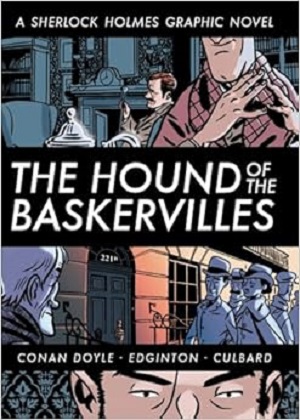
When it comes to graphic novel versions of the classics, artists are in a tough spot. They’re rarely free to go their own way and the text, of which there is usually a lot, can be quite an anchor. Nevertheless, the right combination of an artist’s visual style with a classic author’s sensibility can have magical results.

This adaptation of Conan Doyle’s The Hound of the Baskervilles falls somewhere in the middle range. It’s very faithful to the text, not just incorporating a lot of the original dialogue but even keeping the novel’s chapter breaks and titles. Luckily, Doyle’s story isn’t that long so it’s a manageable job. And the art by I. N. J. Culbard isn’t generic. He does have his own style, as perhaps best seen in his signature way of drawing faces with a curved vertical slash that descends from the middle of the forehead to past the end of the nose. I have to say this really puzzled me as it shows up on every face and I couldn’t figure out what it was supposed to correspond to. A cheekbone? Ritual scarring?

Was Culbard’s style a good fit though? I think so, at least for a version aimed at younger people. The violence is softened, with the bruises and welts on Beryl’s body, for example, turning into the faintest of shadowing. And I’m afraid the hound itself, in its climactic appearance, bears an uncomfortable resemblance to Slimer from Ghostbusters. But then the hound, whether in illustrated versions of the story or appearing on screen, is almost always a disappointment, going on over a century now.

Graphicalex

Foul Play!

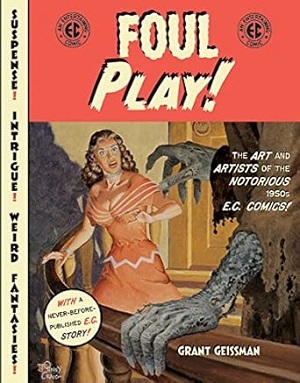
Foul Play! The Art and Artists of the Notorious 1950s E. C. Comics!

One of the most remarkable things about the immediate cultural impact and subsequent legacy of E. C. Comics is that their glory days only lasted for about five years, from 1950 and the beginning of their “New Trend” in (mostly horror) comics, to 1955 and the implementation of the Comics Code. They weren’t DC or Marvel, comic-book brands that are not only still with us but bigger now than ever. Even MAD, an E. C. spin-off that became an American institution for several decades, is today mostly defunct. Nothing of E. C. lasted in a business sense, even though they were always ahead of the game and the comics and magazines they published are now widely acknowledged to have been among the finest examples of the form ever. Meanwhile, we’re drowning in MCU and DCU slop. There’s a depressing lesson in there about how it doesn’t pay to be too good at what you do.

Foul Play! by Grant Geissman is an oversize coffee-table book taking the form of a gallery of pocket bios of the artists who made E. C.’s New Trend such a comics phenomenon. Presented in this way, it led me to a deeper appreciation of names like Johnny Craig, Jack Davis, Graham Ingels, and Wally Wood. To be sure, E. C. did have a house style, but taking the time for a closer look you become more aware of their individual qualities. Also included for each of the main artists is a full story pulled from their time at E. C. Not reproduced in the remastered format fans will know from the reprint editions recently put out by Dark Horse, but in all their original, faded and yellowed glory.

Along the way a lot of interesting tidbits come up. I liked hearing about the Leroy lettering system (not mechanical, but hand-drawn using a template), which was used by Wroten Lettering to do all the comics here. That outfit must have stayed busy. Having always been curious about the ads to send away for photos of the GhouLunatics – were they actual photos, or illustrations made to look like photos? – I was delighted to see reproductions. And yes, they were actual photos, with Johnny Craig made up to look like the Vault-Keeper, the Crypt-Keeper, and the Old Witch. It was interesting to find out that at a convention in 1972, the story “Horror We? How’s Bayou?” was voted the fan favourite as Best E. C. Horror Story, with Graham Ingels (who did the art) being voted “Favorite E. C. Horror Artist.” That story is included in full here. “Ghastly” stuff indeed, and its popularity tells you something about what readers wanted more of.

I’ve called this a coffee-table book, and I hope it’s clear that I don’t mean the label in a disparaging way. There are great books of this kind, and Foul Play! (a terrible title, by the way) is one of them. If you’re a collector of E. C. comics, or have any interest at all in the comics of the time, it’s well worth a look.

Graphicalex

Holmes: Holmes and the Dasher

This story was first published in 1925, making it one of the first efforts from A. B. Cox, a prominent golden age mystery writer probably best known today for the books he wrote under the pseudonym Frances Iles.

The fact that it is only two pages long is all I can think of to recommend it. It’s a trivial piece that’s basically just a single gag, and the gag doesn’t land. A “dasher” (I guess a looker, in modern terms) of a young lady named Cissie Crossgarters writes to Holmes complaining that the man who proposed marriage to her while under the influence of the Demon Rum doesn’t want to go through with it the morning after. One would have thought Cissie more likely to consult with a lawyer on a matter such as this, as there is no mystery to resolve, but it’s all just a set up to Holmes himself getting engaged to Cissie at the end.

This doesn’t sound like Holmes, and that’s the main problem I had with the story. For parody to work you have to take elements in the original and distort or exaggerate them in some way, not change them entirely. Cox makes a lot of play here about Holmes ending nearly everything he says to Watson with “what?”, “what, what?” or even “what, what, what?” I don’t know if Holmes ever talked like this in any of the canonical stories. I could be wrong, but the fact that I don’t recall him ever saying “what, what?” at least means it’s not something that ever stood out. So why did Cox want to run with it? I get that it’s a joke, but it’s a joke I don’t get.

Holmes index

Archer: The Bearded Lady

This is another proto-Lew Archer story where the detective’s name was changed, by Macdonald himself, from Sam Drake to Lew Archer for publication in the aptly titled collection The Name Is Archer. It’s a long story that feels rushed in not being a novel. And when Macdonald feels rushed you know things are moving quickly. I think all of the action here takes place in under 24 hours, and it involves Archer visiting multiple locations, some several times, one fist fight (which Archer wins because there’s just no time for him to take another whupping and have to recover), and the discovery of two murdered bodies. I’ve mentioned elsewhere how the sheer amount of running around in an Archer novel is enough to make your head spin and “The Bearded Lady” is very much the same way. It’s like Archer needs to keep moving in order to think.

You get a double dose of other what-would-become-standard elements too. There’s not just one big house to visit but two: one the home of the Colonel – or wait, he’s an Admiral this time – and the other the fortress of a shady crime boss who is crippled in some grotesque way. The plot revolves around Archer trying to figure out who killed an old war buddy he’d come to San Marcos to visit, but there’s also a stolen Chardin to find. That would be the painter Jean Siméon Chardin (1699-1779), which is something anyone who could read was presumed to know in 1948. And finally there are the twisted family dynamics. The way it works is all here in embryo: the no-good trophy mother-in-law (oversexed, alcoholic, “raddled with passion”) and the dangerously sexy daughter who is pretty poison to all the men she meets. At least I think she’s supposed to be sexy. How would you take a description of a girl who “filled her tailored suit like sand in a sack”? Is that a compliment?

It all goes by in a rush and I enjoyed every page of it. Though I did have to go back and re-read parts to understand what was actually going on. When Archer visits the crime boss’s mansion he’s taken to a library where “the walls were lined with books from floor to ceiling – the kind of books that are bought by the set and never read.” The boss is only a collector, you see. Is he ever going to take that Chardin out of his wall safe? Probably not. But some of us do read books by the set, so my notes on the Archer files will continue.

Archer index

Amazing Fantasy Omnibus

Amazing Fantasy Omnibus

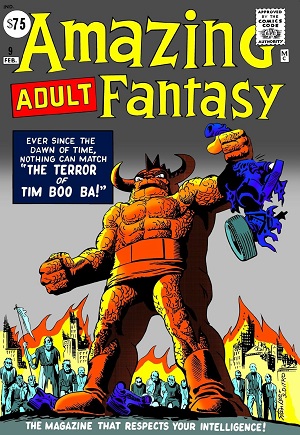
The comics collected in this omnibus edition cover a Marvel title that was in flux for most of its short life: from Amazing Adventures to Amazing Adult Fantasy, to simply Amazing Fantasy (the first issue of which contained the debut of Spider-Man). The numbering remained constant though, so Spidey’s first appearance was in Amazing Fantasy #15, even though that was the first in the serie to be so titled.

Anyway, Marvel was spinning its wheels a bit here trying to find its core programming, not yet having landed on superhero fare as its bread and butter. Titles like Fantastic Four and The Hulk were just starting at the same time and in the recurring adventures of Doctor Droom in Amazing Adventures we can see an obvious precursor to Doctor Strange. Instead of superheroes, Amazing Adventures was mainly about monsters, while Amazing Adult Fantasy (“The magazine that respects your intelligence!”) was more like a comic version of The Twilight Zone.

It’s always nice to read an honest critical introduction. In his intro to the Amazing Adventures section Stephen Bissette makes the point that, well, these weren’t great comics. Nowhere close to being up to the level of EC ten years earlier (admittedly pre-Code), they’re only juvenile and silly, culminating in the giant Ssergo being yoinked from the surface of the Earth by a “large sky-hook from Jupiter.” That wouldn’t have impressed six-year-old me.

“Truth be told,” Bissette admits, “what Amazing Adventures became remains far more interesting than what it was.” And what it most immediately became was Amazing Adult Fantasy. It was an unfortunate title even when it debuted in 1961. As Stan Lee tried to explain in a mailbag, “the only reason we put the word ADULT on the cover, is to distinguish our carefully-edited, and literately-written mag from the usual crop of comics which seem to be slanted for the average 6 year old with a 3 year old mentality! Anybody with brains enough to appreciate AMAZING ADULT FANTASY is our type of reader.” Remember, this is the magazine that respects your intelligence! And to their credit, the short stories in AAF (mostly written by Stan Lee’s brother Larry) are all pretty interesting in the Twilight Zone style I mentioned, with lots of last-panel plot twists. “The Terror of Tim Boo Ba!” which graces the cover of issue #9 as well as this omnibus edition is a great example. And there are even a couple of stories that riff on the classic Twilight Zone “To Serve Man” episode. But whether I’d call this stuff brainy is another question. The stories rely pretty heavily on simplistic caricatures, like the guy who builds a fallout shelter in his backyard and says things like this as he locks himself away:

“Goodbye, you poor fools! I don’t care what happens to all of you! But I shall live safely in my shelter and laugh at you when the bombs fall! Nothing can harm me here – nothing! Not even a direct hit by a nuclear bomb! I’ve enough provisions and oxygen to last five years! No matter what happens to the others, I shall survive! And if any of them try to get in to share my safety with me, I’ll laugh at them! I paid for this shelter . . . it is mine alone! . . . Nothing can harm me! No one can hurt me! Ha ha ha . . . let the rest of mankind perish! Who cares?!! I’ll be the last man alive on Earth!”

I don’t have to tell you that things don’t work out quite as he expected.

Still, as corny as it all is these stories are a lot of fun, and Steve Ditko’s art gives them an extra jolt. There’s a thing throughout of placing all-red figures against all-yellow backgrounds that has an electric effect. It’s all about heightening the impact, the visual correlative of the all-caps, all-exclamation mark speech bubbles that were the fashion at the time. I mean, when you have a character introduce himself matter-of-factly by saying “My name is Henry Burke! I’m a scientist!” then you know there’s nothing that isn’t going to feel like it’s being yelled or screamed in your face.

But in our own age of eye-ball grabbing headlines and click-bait thumbnails I think we have to smile. You do what you have to do to get attention in the media economy, and if that means always being dialed up to 11 then so be it.

Graphicalex