Alien: The Illustrated Story

Alien: The Illustrated Story

This is, on the face of it, the graphic novel version of Ridley Scott’s 1979 film Alien, but there’s some backstory that has to be added to that.

It was published (after parts of it previewed in Heavy Metal magazine) at the same time as the movie’s release, and the writer (Archie Goodwin) and illustrator (Walter Simonson) hadn’t had a chance to see the film. Goodwin was working from the shooting script while Simonson had seen production stills and a rough cut. This helps explain the sense one has reading it that it’s something the same but different from the movie. The biggest difference I was struck by is the use of colour, which isn’t at all like the palette Scott was using. That giant emerald green spaceship, for example. Or the sickly shade of yellow of the facehugger.

It was a huge hit, becoming the first comic to appear on the New York Times bestseller list, and has gone on to be recognized as a classic in the genre of comic adaptations. I think it’s wonderful. The change-ups made to the paneling in the page layouts particularly stand out, though it’s hard to find fault with anything. Maybe the narrative voice, which they may have felt was necessary to explain things to an audience that didn’t already know the story cold. But that said, I don’t think any movie franchise has been better served, for so long, by its comics. And it all started here.

Graphicalex

Holmes: The Stolen Cigar-Case

I don’t think Bret Harte’s read much today, but during his lifetime he was quite popular. He primarily wrote Westerns, but also penned a number of parodies of contemporary authors. I also don’t know if he personally knew Conan Doyle, but Doyle had read some of his writing and even admitted an early debt.

“The Stolen Cigar-Case” came out in 1900, a time when Doyle was still cranking out Holmes stories at a good clip. It’s very much a parody pastiche, with the narrator being the assistant of the great detective “Hemlock Jones.” It’s quite funny, but I wonder what Doyle thought of it. It has a real edge, playing up Watson’s sycophancy as a sniveling codependent (the story begins with his throwing himself at Jones’s feet and then caressing his boot) while giving us a Holmes who is just a brainless, bullying airbag with delusions of grandeur. This isn’t a gentle satire and I got the sense that there was something about the Holmes stories that really bothered Harte. The thing is, I don’t know if that would have upset Doyle. He’d already had his fill of Hemlock too.

Holmes index

In the mountains of misreading

In doing some background work for a longer writing project, I’ve been going over examples drawn both from my own experience and in my reading of instances where people have fallen short of a basic level of competence in their supposed fields of expertise. Whether we’re talking about contractors or bankers, members of the medical establishment or waiters, I think we’ve all had occasion, occasions that are increasing in frequency, to be frightened at the realization that the people we are dealing with don’t actually know what they’re doing or what they’re talking about.

I recently found an example of this in a place I wasn’t expecting it, while reading a cultural study of the work of H. P. Lovecraft. In the Mountains of Madness: The Life and Extraordinary Afterlife of H. P. Lovecraft was published in 2016. It’s not really an academic book, though I think the best work of this sort now takes place outside of the academy now, and the author, W. Scott Poole, is a professor of history with a Ph.D. In any event, I thought I’d supplement my reading of it with some of Lovecraft’s fiction, which I haven’t revisited in years.

I’ve been enjoying In the Mountains of Madness, but reading it alongside Lovecraft’s stories I’ve found my confidence shaken in Poole as a trustworthy authority. While acknowledging that he’s writing “as a historian,” he plays pretty fast and loose with the literary evidence. A case in point is the very first Lovecraft story that he bores into, the early “Dagon.” Here’s how he begins talking about it:

The story’s absurdly unlucky protagonist escapes from the German U-boat that sank his merchant ship only to find himself a castaway on an island that’s no island at all.

We’re off to a bad start. The narrator’s ship isn’t sunk by a U-boat but by what is later described as a “German man-of-war.” Which makes sense, because how was he to escape from a submarine in a small boat? That’s quite a mistake, but while I’d also object to the narrator being a “castaway” (he escapes from the German ship) and the island as “no island at all” (then what is it?), even more significant errors were to come.

The story’s climactic moment comes when the narrator witnesses a sea beast slide out of the water and embrace a strange carved monolith. Or, as Poole describes it: “Falling into a troubled sleep, he [the narrator] wakes to a terrible sound, another upheaval from the shadowy sea that brings forth a slippery, slurping, sucking monstrosity that slithers its way to land and crawls over the monolith, almost seeming to sloppily absorb it in a cacophony of rubber menace.”

This is all wrong. In the first place, the narrator doesn’t awaken to this sight, he’s standing looking at the monolith when the monster comes out of the water. No terrible sound awakens him because he’s not asleep. Then it’s not clear why the monster itself is characterized in such a way. In the story it’s said to “dart” on the land, not slither. It’s also not clearly described here, and words like slippery, slurping, and sucking don’t appear. We’re only told that it has “gigantic scaly arms.” So it’s like a fish (Milton famously described the fallen idol Dagon as “upward man, and downward fish”), but perhaps only in terms of its flesh. We’re definitely not talking about a tentacle beast.

Finally, there’s the story’s ending. The narrator, rescued and now living as a morphine addict in California, has prepared us for it by saying in the opening paragraph that he’s going to throw himself from his window to the street below as soon as he’s finished. At the end he hears “a noise at the door” that startles him, and the sound of a body “lumbering against it.” Determined that “It shall not find me” he turns to “The window! The window!” And there the story breaks off.

What happens seems clear. But in Poole’s account it all kicks off when the narrator “hears something at the window.” Then he talks of “some Thing from out of the sea showing up on his window casement.” As with the escape from the U-boat, it’s hard to see how Poole even arrived at such a reading. Why would the monster be on his window casement? I don’t even know what it means to be “on” a window casement. And it’s made clear the monster, or a monster, is at his door.

“Dagon” is a short story, only five pages long in the edition I was reading it in. To find this number of errors in a thumbnail analysis of its meaning was more than a little surprising. I’ve still found In the Mountains of Madness to be a good read, and I’m sticking with it. But I can’t shake the feeling that standards are slipping.

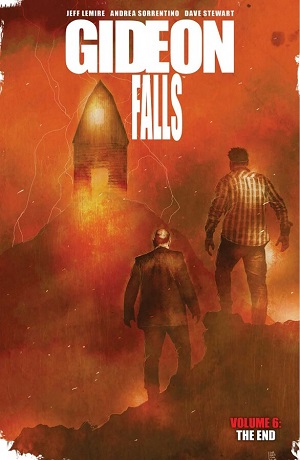
Gideon Falls Volume 6: The End

Gideon Falls Volume 6: The End

I began my review of the previous Gideon Falls volume, Wicked Worlds, with the précis “Sheer chaos.” Well, I hadn’t seen anything yet!

In this final part of the story reality comes even more undone, exploding into a barrage of double-page spreads that make you turn the book upside-down to read, or that shatter the page layout or invoke the stairways of Piranesi, or that finally dissolve into ALL WHITE. NOTHING. That latter being the text description from the script for the comic that’s included in this edition as a bonus.

Also included is a visual essay by Andrea Sorrentino on “The Inner Workings of Gideon Falls.” I was hoping this would explain the comic’s multidimensional geography (or “Gideonverse”) a little better, as it even comes with maps that look borrowed from academic editions of Dante’s Comedy, but I ended up being just as confused after looking at them. I doubt there’s any way of explaining what’s going on adequately.

Which means there’s no way I can summarize things here. I’m not sure what happens or why. Our heroes dive into the evil half of the cosmos, confront the Bug God, and destroy the Pentoculus. This action turns out to be of more consequence than blowing up the Black Barn, which can always be rebuilt. And maybe the Pentoculus gets rebuilt too, since we get an inevitable, irritating final panel that suggests there’s no way of putting things right.

I did like this series, mainly as a showcase for Sorrentino’s art. But in The End I thought that art had taken over too much, shoving the story to one side and not bringing things together in a way I found very satisfying. I thought the story as it originally started out had more potential than this. To be honest, it felt like Lemire had checked out by this point and told Sorrentino to just draw anything before turning the lights out when he was done.

Graphicalex

Simpsons Comics Colossal Compendium: Volume One

Simpsons Comics Colossal Compendium: Volume One

I do like the Simpsons’ comics, a lot, and these Colossal Compendiums offer a selection of their best stories so they’re usually quite enjoyable. That said, I didn’t think this volume was all that great. None of the stories were particularly funny and the weird ones were only slightly off-kilter, unlike the really creative (and demented) stuff in the Treehouse of Horrors collections. There are a lot of good ideas here, like the characters transformed into different digital avatars in MMORPGs, a full-length “official movie adaptation” of the Radioactive Man movie, and a trip to a Simpsons Museum in the future that explains how they saved (and then doomed) humanity. But there aren’t a lot of good gags and I didn’t feel the writing was as sharp or as smart as it usually is.

There’s lots of Professor Frink though, if that’s your jam. And only a brief appearance by Ned Flanders, if he isn’t.

As a bonus, each Colossal Compendium comes with a little cut-paper project of a Springfield building that you can fold together. Volume One has The Android’s Dungeon comic and baseball card shop.

Graphicalex

Marple: They Do It with Mirrors

This isn’t a great mystery novel, but I had a good time with it anyway just for its knowingness. I felt like I could have been checking boxes, whether we’re talking about elements specifically having to do with the character of Miss Marple or tactics general to any of Christie’s mysteries.

With regard to the former there’s Miss Marple’s long acquaintance with the evil of a “sweet peaceful village” and her method of finding “the right parallel” between said evil and other crimes, given that “human nature . . . is very much the same everywhere.”

Chief among the general tactics is the information overload. We begin with a layout of the main floor of Stonygates (that’s the country estate setting). Should we be studying this? Then there follow two chapters of background material filling us in on the family dynamics. You see Ruth suspects that something isn’t quite right at Stonygates and that her sister Carrie Louise may be in danger, so she sends Miss M to investigate. But to understand what’s going on you have to know that Carrie Louise is on her third husband, with children (stepchildren, adopted children, natural children, grandchildren) all assembled around her. So yes, two chapters have to be spent filling us in here. But is any of this relevant? Or is it all a smokescreen? It’s natural to think we should be paying attention to it, perhaps even making notes, but our attention always has a filter and naturally we want to get on with the story. I mean, we don’t even have a body yet.

A regular motif in Christie’s mysteries is the crime that’s conceived and presented as a dramatic performance, which is something that really gets leaned into here. I don’t think anyone reading this book for the first time will have any doubt that the argument, which takes place behind a closed door, between Lewis Serrocold and Edgar Lawson is just a show (Edgar is immediately flagged by Miss Marple as being an excessively “dramatic” young man, delivering lines as though “playing in amateur theatricals”). But to what end? To create a distraction? Because it would be too obvious if one of them turned out to be the killer then, wouldn’t it?

But there are even more obvious suspects that we feel can’t be in play for the same reason. The two guys who weren’t in the great hall at the time of the murder, for example. No matter how suspicious they seem – one is sullen and American, the other a drama queen – we feel like they can be struck off the list.

In approaching the mystery this way, generically as it were, we’re not even looking for clues. Which is a good thing because there aren’t any. The solution just comes to Miss Marple, after it just comes to one of the other characters (who then must be disposed of in a secondary murder). There is no single event or material fact that triggers this but just an awareness of the drama of life at Stonygates, where amateur theatricals are in fact part of the curriculum at an adjacent school for juvenile delinquents. All the world’s a stage, or a magic show, and when the one churchly widow looks “exactly as the relict of a Canon of the Established Church should look” it surprises the police detective “because so few people ever did look like what they were.” Which, in turn, make us think that she can’t possibly be the murderer either.

But if everyone is an actor performing a part it’s hard to tell why one particular bit of stagecraft should mean more than any other. Or, for that matter, one character’s view of reality should be privileged over someone else’s. This is what makes the book finally disappointing. But I still enjoyed it, especially for the way it foregrounds the reality vs. illusion nature of most of Christie’s contrivances, with murder being presented knowingly as a magic trick pulled off with stagecraft, misdirection, and sleight of hand. You go into every whodunit like you do a magic show, expecting to be fooled in all the usual ways. Knowing this doesn’t diminish the experience but is part of the fun.

Marple index

Chew Volume Two: International Flavor

Chew Volume Two: International Flavor

Great stuff. I had my hopes up high after Chew Volume One: Taster’s Choice and International Flavor exceeded all expectations.

There is a self-contained story here sending F.D.A. agent Tony Chu to an island in the Pacific called Yamapalu that grows a kind of fruit (it’s called a gallsaberry, or gallus sapadillo) that tastes like chicken. This is important because, as you’ll remember, chicken is now a black market delicacy after an outbreak of bird flu. While on Yamapalu there is a sort of revolution or civil war that Tony gets caught in the middle of, alongside his partner John Colby (now out of the hospital with his face rebuilt after half of it got hacked off with a cleaver), his brother (invited to the island as a celebrity chef), and his sort-of girlfriend, the food columnist Amelia Mintz.

It’s zany action from start to finish, and introduces a number of new plot points (like an ersatz vampire who’s really an evil cibopath), while dropping hints to storylines that are still being developed (the massacre at the Russian observatory, the missing Mason Savoy, the crime boss Montero and his horny frogs). Meanwhile, Tony’s boss Applebee is still being a jerk and Amelia remains just out of reach.

It’s fun keeping track of all these different threads and characters because nothing is random. Even Yamapalu’s governor had a cameo appearance in Taster’s Choice that you’ll likely remember. Which makes you figure that we probably haven’t seen the last of the corrupt police chief Raymond Kulolo, though I’m afraid the super-sexy U.S.D.A. agent is good and dead.

More good writing from John Layman and great art from Rob Guillory, who delivers “pure aesthetic zing.” I really love what they’ve built here and can’t wait for the next course.

Graphicalex

Scary waters

I think it’s widely known that a flock of crows is called a “murder.” Less well known are some other words for groups of different species. These include

a raft of otters
a scold of jays
a skulk of foxes
a hover of trout
a gam of whales
a wisdom of wombats
a fever of stingrays
a clowder of cats

The reason I looked these up, and I don’t think I knew any of them except the first two, is because of a line I came across recently in the book Eden Undone. The author describes a fish cleaning operation in Ecuador where the heads and entrails of the fish are dumped into a bay, “drawing shivers of sharks.”

I originally thought “shivers of sharks” was a typo, but apparently it is the word used to refer to small groups of sharks, usually composed of only two or three individuals. These individuals are also usually of only one gender, so a shiver is either all male or all female.

Words, words, words

TCF: Eden Undone

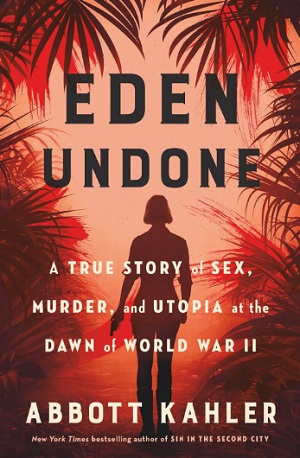
Eden Undone: A True Story of Sex, Murder, and Utopia at the Dawn of World War II
By Abbott Kahler

The crime:

In the late 1920s-early 1930s a bunch of German drifters took up homesteading on the then deserted Galápagos island of Floreana. First to arrive were Friedrich Ritter and Dore Strauch. They became minor celebrities back home and were soon followed by another German couple: Heinz and Margret Wittmer. Then an eccentric Austrian, the Baroness Eloise Wehrborn de Wagner-Bosquet, showed up, along with two lovers: Rudolf Lorenz and Robert Phillipson. The Baroness declared herself the Empress of Floreana and talked of plans of building a hotel there.

The islanders had trouble getting along, and in 1934 the Baroness and Phillipson both disappeared, never to be heard from or seen again. Shortly after, Lorenz hitched a ride on a boat off the island but he and the boat’s captain shipwrecked on another island, where they both starved. And a little later Friedrich Ritter died of food poisoning.
The book:

I got this one out of the library after having seen the 2013 documentary film called The Galapagos Affair: Satan Came to Eden. As an unsolved crime story with a surprising amount of evidence in the form of letters, memoirs, and even home movies, there’s plenty of meat on these bones to pick over, and a dramatic version of the same events was even released in 2025, directed by Ron Howard and starring Jude Law as Friedrich Ritter.

Eden Undone came out in 2024, and while it presents a fuller accounting of what happened there still aren’t a lot of answers. To the point where it’s fair to ask if this is really a “true crime” book. Murder is in the subtitle, though technically we don’t know if the charge fits. A couple of people disappeared. Another got sick and died from food poisoning. Was there a murder, or murders? It’s widely assumed, I think fairly, that the Baroness and Phillipson were murdered. But their bodies were never found, and while the idea that they left the island by ship is far-fetched (no ship had been seen visiting Floreana at the time, and neither missing person was ever seen or heard from again), it’s just possible there was some kind of accident. We really don’t know.

That uncertainty is part of what makes the story so interesting. But the stuff we do know is just as intriguing. Life on Floreana was a sort of petri dish, very much like one of today’s reality-TV shows, a real-life Survivor or Big Brother. As such, what it provides is a fascinating study in small-group dynamics, one with lots of psychosexual overlays.

The smell of sex permeated Floreana. One visitor referred to the Baroness’s “hotel” as a “festering sex complex.” Lorenz and Phillipson were her toy boys, with Lorenz being the odd man out in their messy ménage. Apparently all three slept in the same bed together, and the Baroness still wasn’t satisfied, as she tried to seduce both Ritter and Heinz Wittmer as well. If Floreana was an Eden, I think it’s fair to say that she was the serpent in the garden, or the apple of discord, to switch metaphors. She wasn’t any great beauty, but she flaunted what she had and there was little competition. Freidrich and Heinz were probably hungry for something different. Another visitor, upon leaving the island, observed how “man seems to need the conquest of his mate. To be too sure is to become stale. It apparently is more interesting to live with your neighbour’s wife than with your own. There is a real basis in psychology here which can be critically analyzed.” Indeed there is, as even the Bible had something to say about coveting your neighbour’s wife. It’s forbidden fruit, and there we are back in the garden. The fact that both the other couples had adulterous origins probably only made things easier for them to stray.

That said, the Baroness seems to have squandered her competitive advantage by being a royal pain in the ass who rubbed everyone the wrong way, at least eventually. Lorenz was clearly a man past his breaking point by the end of his stay on the island. Dore noticed the gradual development of his “deadly hatred” toward the Baroness and I don’t think she was making that up (though I wouldn’t trust her on much else). Phillipson, probably because there’s less of a written record, remains a cipher to me. Friedrich was a crank, tyrant, and hypocrite, in no particular order. Isolation is the only practical option for such a personality. His plan for being a settler was to have no plan but to “be driven by our id – our inner demon – and its whims.” That’s not always the best idea. Dore, who I would have thought far too ill to have managed under such circumstances, was a self-dramatizing type who had some weird kind of codependency going on, with love-hate feelings rhythmically flaring up. The Wittmers were at least a semi-stable family unit, which probably explains their continued residence on the island. Their descendants still live there today.

Sorting through all of this is difficult, in part because the pile of documentary evidence I mentioned tends to point in different directions. In their letters and memoirs the different players tried to spin the story their own way, and often misrepresented or lied about what happened. As I’ve said, I think there’s a most likely scenario that is understandable, but if the true explanation was something a lot weirder I can’t say I’d be surprised.

Noted in passing:

Whatever you think of the personalities involved, and I think they were a mixed-up bunch, I have to confess to being impressed at how well they made a shift of it. Life on Floreana was a hardscrabble existence, isolated and with few amenities. Ritter was a doctor, but a bit of a quack and medical care was limited anyway. Add to this the fact that Dore had multiple sclerosis, that Margret Wittmer arrived on the island in an advanced state of pregnancy and that the Wittmers’ son was a sickly child, and it’s truly remarkable what they accomplished. I don’t think you could take many people today and plunk them down in such a situation and expect as much. As previously noted, this is the stuff of reality TV now, shows that (however they’re billed) are carefully controlled experiments.

A hundred years ago the islanders were celebrities, and for some reason popular among American millionaires who liked to visit Floreana on their yachts, but in terms of their capabilities I think they were probably pretty average urban citizens of the time. The average was just a higher level of general competence back then.

Takeaways:

If someone indicates that they want to be left alone, you should respect their wishes and leave them be.

True Crime Files

Titans Vol. 3: A Judas Among Us

Titans Vol. 3: A Judas Among Us

The title of this Titans story arc refers to an insight that Omen gets while interrogating Psimon, who is being held in prison on Rikers Island. It seems one member of the Titans is going to betray the team. So who, we’re left to wonder when this information gets out, is the Judas?

Such a plot hook lets the series once again dwell on how important it is that the Titans are a team of superfriends, whose loyalty to each other is a special bond. Though some of the them are more than ready to take things from being friends to the next level. Garth/Tempest is in love with Lilith/Omen. Roy/Arsenal is in love with Donna Troy, but she may have a crush on Wally/Flash. Karen/Bumblebee needs to get her memory back (it’s been stolen by H.I.V.E. but luckily downloaded onto a flash drive) so that she can remember that she’s in love with Mal/Vox. “My, it’s like a soap opera,” Psimon says to Omen. “You’re not a hero, Lilith. You’re a counselor for a group of maladjusted young adults.” And he’s not wrong.

Anyway, they string things along for a few issues and several possible Judas scenarios, before (spoiler alert) it turns out Donna is the enemy within. But it’s not really Donna, but Donna-from-the-future, where she’s adopted the name Troia and has taken a heel turn. This Troia enters our world through a dimensional portal (yawn) and transforms Psimon, Vox, Gnarrk, the Key, and Mr. Twister into ramped-up villain avatars before taking on the Titans in a battle royale.

I didn’t get into any of this. Perhaps because there were so many different characters. Perhaps because the fighting was so generic, with no interesting strategies or twists. Wally West dies (because of the damage to his heart that he got in the fight against Deathstroke), but is then brought back to life because it turns out he was just frozen in the speed force. Happens to superheroes all the time. And Donna defeats Troia with a double-page punch that launches her right back to whatever dimension she broke out of. No messy clean up! We’re left with the certainty that everybody’s going to be enjoying pizza and pop back at Titans Tower, while holding hands with their new sweethearts and stealing kisses when they’re alone with their crushes.

A pull quote on the cover announces this is “Everything a Titans fan wants and more.” And that may be right. But for a non-fan like me it was less, and I don’t imagine I’ll be coming back this way again.

Graphicalex