Token MAD

Token MAD

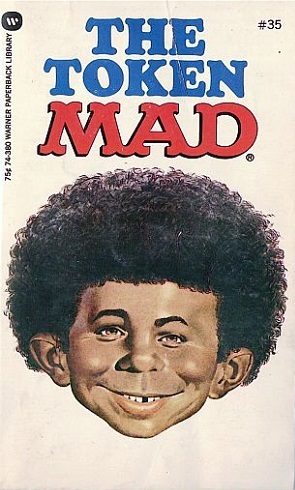
Nope, I don’t think you’d get away with that cover today. But in 1973 (this is a first edition!) you could. It’s meant as a send-up of tokenism (think wokeness, but fifty years ago). The back cover declares: “Is MAD guilty of tokenism? You bet we are! We’ve always offered our readers token humor, token satire, token good taste! And this book is no different . . . just another token attempt at courageous publishing! So even though the price is only a token of what a good book would cost, you’ll be taken . . . with . . . The Token MAD.”

That token price, by the way, was $1.50. Wouldn’t see that on many covers today either.

This is another grab-bag MAD collection, full of bits and pieces mostly from the 1960s. The movie and TV satires, both illustrated by the great Mort Drucker, are for The Professionals (1966) and I Spy (1965-1968) respectively. For years I didn’t know anything about either of these shows, and by the time I finally saw them it was through the lens of the Mad versions that I knew practically by heart. Alongside recurring features like David Berg’s Lighter Side of . . ., the Don Martin Dept., and Spy vs. Spy (they each win one) there are some great one-offs like “Vanishing Human Types and Their Modern Replacements” (do you remember “the inexpensive handyman”? or are you more familiar with “the specialized service technician”?), “Historical Events as Covered by Modern News Feature Writers” (the Battle of Bunker Hill written up by the sports editor) and “Obituaries for Comic Strip Characters.” I got a real laugh out of this last one, and the obit for “noted man about town Donald Duck,” who was killed in a hunting accident after being mistaken for a wild canvasback. I loved this paragraph especially: “A spirited eccentric, Duck was known for his clever wit, all of which was unintelligible. He countered this, however, with savage bursts of temper which accomplished nothing.” That’s our Donald! And that was MAD!

Graphicalex

Holmes: The Adventure of the Gloria Scott

Or: “Holmes’s First Case.” Which is its single claim to fame. Though young Sherlock wasn’t a detective yet but a student on holidays when a school chum invited him to spend some time at his family estate. While there he stumbles into the usual mess of a blackmail plot involving a shady old acquaintance from the colonies.

I didn’t find any of it very interesting, and Holmes’s great skills at detection aren’t put to much of a test. For example, he picks up on the fact that his chum’s father had known someone with the initials J.A. who he had subsequently tried to forget based on the fact that he had had “J.A.” tattooed on his arm and then tried to erase the tattoo. Clever. And then he solves the easiest code ever by figuring out that he just has to read every third word in an otherwise baffling note. (Experts, by the way, point out that this means the note is in fact written in cipher, not code. There is a difference, albeit not one I’m keen on explaining.)

Basically this is just Holmes narrating the events to Watson and reading a long letter from the father explaining all that was happening in the blackmail scheme, which is something Holmes didn’t figure out on his own. It may have been his first case but it’s also among his most forgettable and well worth skipping.

Holmes index

Old Man Logan: Past Lives

Old Man Logan: Past Lives

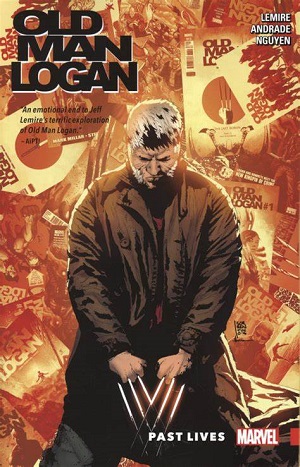
This was the final issue of the Old Man Logan series to be written by Jeff Lemire and it has even more of a retrospective feel to it than usual. As things get started Logan has decided he wants to go back in time and to the specific part of the multiverse where the saga began so that he can save Baby Hulk, and maybe his family too. Unfortunately, none of his friends and enemies want to help (he appeals to the Marvel science-and-sorcery brain trusts, from Doctor Strange and Scarlet Witch to Black Panther and Doctor Doom), so as a last resort he springs a devil-worshipper named Asmodeus from supervillain prison. Asmodeus says he’ll send Logan back into his past, but –surprise! – he’s actually going to double-cross Logan. I don’t know why Logan would have expected anything less. That struck me as silly.

Anyway, instead of going straight back to the Wasteland, where it all got started, Logan ends up being unstuck in time, forced to “re-enact [his] greatest hits.” His fight with Hulk. The climax of the Phoenix story. As Patch in the streets of Madripoor. He even gets to re-use his famous tag-line about bad guys taking their best shot but now it’s his turn. But eventually he does get back home, only to have to say good-bye to his wife and kids, knowing that he can’t save them.

(An aside: I was a bit put off by Lemire not knowing the difference between a combine and a tractor. When Logan gets back to his farm he’s shown working on what is referred to as “the combine” but which is really just a tractor. A combine is a combination harvester. From the looks of it, I don’t think they’d have any use for a combine in the Wasteland, which is a Western desert landscape like that of the homestead in The Searchers. And I never could figure out what kind of farming the family was doing in that movie. On further reflection though, I thought this made for a fitting vision of our dystopic future, caring for and repairing old machinery that nobody has any use for now anyway.)

As a way of wrapping Lemire’s part of the series up this sort of thing is fine, but it doesn’t stand out as being a great or essential comic on its own. It has the feel of the last episode of some long-running TV show, like Seinfeld, where you just bring everybody back for a cameo before shutting things down. I like the art by Filipe Andrade (the first couple of issues here) and then Eric Nguyen, the latter feeling influenced by Sorrentino’s earlier modeling of the character while also doing its own thing. And the mechanism for the time-skips, a magic amulet, is at least easy to follow, even if there’s no discernible rhyme or reason to how it works. Of course this wasn’t to be the end of the line, as the series would continue. But there’s still a well-deserved sense of an ending.

Graphicalex

Fame!

In a post last month I mentioned how I’d been reading Geoffrey Chaucer’s The Book of the Duchess, and how it kicks off with a description of insomnia that felt on target for me 600 years later. But back in the fourteenth century people probably had a lot of the same problems with sleep as we do. Or maybe they had it worse. In any case, Chaucer was describing the sort of experience that everyone, even today, can relate to.

This month I was reading The House of Fame and several things about it struck me as very contemporary, albeit in a less direct way. It’s a dream vision, which means it’s set in a fantasy landscape that is meant to be read allegorically, and what’s surprising is that a lot of the allegory still works. The House of Fame itself, for example, is like a giant surveillance/data hub that gathers in everything that is said by anyone all over the world. The narrator is amazed when this system and how it operates is described to him. “I can’t believe it’s possible to hear all that,” he says, “even if Fame had all the informers in a country, and all the spies.” Fame isn’t just a passive recipient in his imagining, but something like a giant AI monitoring all of our social media traffic, and indeed all information on the move everywhere. It seems we’ve always been capable of imagining such a thing, only now it’s not only possible but we can measure and monetize the data that’s harvested on a granular level.

Then there’s the pursuit of fame itself. Today I think we see “fame” and “celebrity” as pretty much being synonyms, and I actually don’t think that’s too far off where things were in Chaucer’s day (the word “celebrity,” in slightly different spelling, may have even first appeared in English in Chaucer’s translation of Boethius). As The House of Fame makes clear, fame is a fickle goddess and you have no idea what’s going to give rise to it, how accurately it will reflect anything real, or how long it will last. Fame could be merit-based, but just as easily be mere rumour or gossip. But people of all types still clamour for it, and in the poem Fame is appealed to by various suitors. One of these struck me as representing the modern notion that any kind of news coverage is good for you. Don’t worry about what’s being said, just count the column inches.

Or at least that used to be the way it was put. Now I don’t think “column inches” means much to anyone. Still, in our attention economy the basic point remains the same: it doesn’t matter what you’re doing to be famous, or go viral, for. The only thing that matters is being famous. Getting attention.

Umberto Eco addressed the subject in Chronicles of a Liquid Society (2016), which came out just before the advent of the influencer:

. . . in an age of great and ceaseless movement, when people leave their villages and lose their sense of home, and the Other is someone with whom they communicate via the Internet, it will seem natural for human beings to seek recognition in other ways, and the village square is replaced by the global audience of the television broadcast, or whatever comes next.

But perhaps not even schoolteachers, or those who take their place, will recall that in that bygone time there was a rigid distinction between being famous and being talked about. Everyone wanted to become famous as the best archer or the finest dancer, but no one wanted to be talked about as the most cuckolded man in the village, for being impotent, or for being a whore. If anything, the whore would claim to be a dancer and the impotent man would make up stories about his gargantuan sexual exploits. In the world of the future, if it is anything like what is going on now, this distinction will be lost. People will do anything to be “seen” and “talked about.” There will be no difference between the fame of the great immunologist and that of the young man who killed his mother with a hatchet, between the great lover and the man who has won the world competition for the shortest penis, between the person who has established a leper colony in central Africa and the man who has most successfully avoided paying his tax. Every little bit will help, just to be seen and recognized the next day by the grocer or the banker.

Once this all-seeing Witness [God] has gone, has been taken away, what remains? All that’s left is the eye of society , the eye of the Other, before whom you must reveal yourself so as not to disappear into the black hole of anonymity, into the vortex of oblivion, even at the cost of choosing the role of village idiot who strips down to his underpants and dances on the pub table. Appearance on the television screen is the only substitute for transcendence, and all in all it’s a satisfying substitute. People see themselves, and are seen, in a hereafter, but in return, everyone in that hereafter sees us here, and meanwhile we too are here. Think about it: to be able to enjoy all the advantages of immortality, albeit swift and ephemeral, and at the same time to have a chance of being celebrated in our own homes here, on earth, for our assumption into the Empyrean.

At one time the threat to privacy came from gossip. The fear of gossip, or the washing of dirty linen in public, came from the impact it had on our public reputation. But perhaps in the so-called liquid society, where people suffer from lack of identity and values, and have no points of reference, the only means for obtaining social recognition is through “being seen” at all costs.

Anyway, here is the passage from The House of Fame that set off these musings. I think it shows that what Eco had to say about their being an earlier time, specifically the Middle Ages, when fame was something with more exclusively positive connotations, is not entirely accurate. Someone has come to Fame to request being made famous for his villainy. He’s requesting that the horn of slander rather than praise be sounded for him. The Middle English is a little tough in this passage so I’ve followed it up with a shonky translation of my own.

“Lady, lefe and dere
We ben swich folk as ye mowe here.
To tellen al the tale aright,
We ben shrewes, every wight,
And han delyt in wikkednes,
As gode folk han in goodnes;
And Ioye to be knowen shrewes,
And fulle of vyce and wikked thewes;
Wherfor we prayen yow, a-rowe,
That our fame swich be knowe
In alle thing right as hit is.”

“I graunte hit yow,’ quod she, ‘y-wis.
But what art thou that seyst this tale,
That werest on thy hose a pale,
And on thy tipet swiche a belle!”

“Madame,” quod he, “sooth to telle,
I am that ilke shrewe, y-wis,
That brende the temple of Isidis
In Athenes, lo, that citee.”

“And wherfor didest thou so?” quod she.

“By my thrift,” quod he, “madame,
I wolde fayn han had a fame,
As other folk hadde in the toun,
Al-thogh they were of greet renoun
For hir vertu and for hir thewes;
Thoughte I, as greet a fame han shrewes,
Thogh hit be but for shrewednesse,
As gode folk han for goodnesse;
And sith I may not have that oon,
That other nil I noght for-goon.
And for to gette of Fames hyre,
The temple sette I al a-fyre.
Now do our loos be blowen swythe,
As wisly be thou ever blythe.”

‘Gladly,’ quod she; ‘thou Eolus,
Herestow not what they prayen us?’
‘Madame, yis, ful wel,’ quod he,
And I wil trumpen hit, parde!’
And tok his blakke trumpe faste,
And gan to puffen and to blaste,
Til hit was at the worldes ende.

Translation:

“Dear Lady,
We’re the kind of guys you may have heard of.
To tell the truth,
We’re scoundrels, every one of us,
And we take delight in wickedness,
Just as good people do in goodness.
And we like being notorious,
Known for being full of vice and for our wicked deeds.
Which is why we’ve come to ask you
To broadcast our bad reputations,
And show us just as we are.”

“I’ll grant your wish,” she said,
“But who are you to talk like this,
And why are you dressed like a clown?”

“Madame,” he said, “truth to tell,
I’m the same desperado
Who burned the temple of Isis
In the city of Athens.”

“And why’d you do that?” she asked.

“I swear,” he said,
“I did it for the attention,
Just like the others get in that town,
Even though they’re well known
For their virtue and good qualities.
I figured rogues should be as well known
For being wicked
As good people are for being good.
And since I can’t have a good reputation,
Because I won’t stop being bad,
In order to get famous
I set the temple on fire.
Now let everybody know!”

Doctor Strange: A Separate Reality

Doctor Strange: A Separate Reality

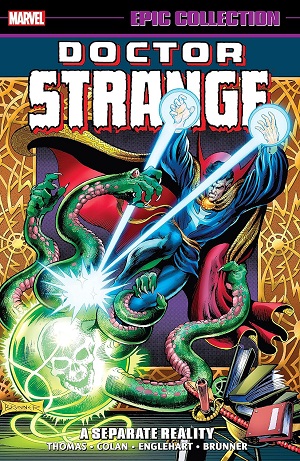
This is the third volume in the Epic Collection series of Doctor Strange comics and it kicks off with a character who was still in flux. For one thing, he’s wearing a full black hood/mask and underneath his cloak he’s sporting conventional superhero tights that show off his generic superhero musculature. Thank goodness they realized that look wasn’t working and went back to letting him wear his usual duds. This guy gets his kicks above the neckline, sunshine. And when you have perhaps the most recognizable face in the Marvel pantheon, why pull a bag over it?

There are three main story arcs here. The first is the longest, with the good doctor taking on a series of Lovecraftian demons with names like Dagoth, Sligguth the Abominable, N’Gabthoth the Shambler from the Sea, Ebora the Dark Priestess of Evil, and Kathulos of the Eternal Lives. All of these baddies are defeated on the way to a showdown with Shuma-Gorath. That climactic issue has the title “Finally, Shuma-Gorath!” as though even the writers were getting tired of all the build-up.

This first story arc ends with the Ancient One dying, or more properly becoming one with the universe, leaving Doctor Strange as the Sorcerer Supreme. The next story has him fighting a sorcerer from the future named Sise-Neg, who is traveling through time absorbing all the magic in history so that he can recreate the Big Bang and become God. This is obviously very serious stuff, or as Dr. S. puts it “The power of Sise-Neg is the greatest threat our reality has ever known!” Which is weird because I thought Shuma-Gorath was the greatest threat our reality had ever known. After a while the inflated rhetoric runs out of places to go.

Finally, the third storyline has a villain named Silver Dagger hunting down the Doctor and killing him with his eponymous weapon. Except our hero saves himself by diving into the Orb of Agamotto and facing off with Death. Then he comes back to our world and rescues his girlfriend Clea and puts Silver Dagger in his place.

I went through this breakdown only because it illustrates a point that I think it worth drawing attention to. The thing is, both Shuma-Gorath and Sise-Neg are awesomely powerful multidimensional entities who threaten the existence of the entire universe, or at the very least “our reality” (which contains the universe). The way Doctor Strange engages them in cosmic battle is certainly dramatic and colourful, but neither is very interesting as a villain. Silver Dagger, on the other hand, is a buff old guy dressed in a silly midriff-baring halter top and with a crazy backstory that had him narrowly missing being elected Pope and then digging into the occult section of the Vatican’s library so as to learn how to become a demon hunter. He’s a fundamentalist Catholic and not at all a standard bad guy so much as someone with a monomaniacal thing for using magic to destroy magicians wherever he finds them. He’s a man with a mission, and it’s a mission that’s far more relatable than destroying the universe or becoming God. He’s humanized even to the point where Clea falls asleep listening to him tell his origin story, and he’s taken off stage at one point because he has to go to the bathroom: “Now excuse me. Nature calls.” I can’t think of another time I’ve seen a superhero excuse himself like that, and it made me laugh.

But even Doctor S has his human side here, with a different part of his nature calling when he realizes he’s “neglected” Clea “both as a man and your mentor in the mystic arts.” She can take a hint, and when he offers to instruct her in the way of the Vishanti she tells him she’ll be happy if he tells her about it later. “And with the soft, dancing flames lighting her smile, there is no doubt of her meaning . . .” When next we see Clea she’ll be on the floor “still warmed by the afterglow of love,” happily telling her pet rabbit how her lover is “so much a man . . . so much.” That was pretty risqué for a comic at the time.

Even in the Silver Dagger storyline however the emphasis is on what the back cover here calls “eldritch horrors and psychedelic threats!” Our hero is always getting sucked into different dimensions where he may meet floating skulls or man-eating plants or even a hookah-smoking caterpillar. The art of the dream dimension is “a kaleidoscopic cosmos filled with shifting shapes and colors – beyond even the imaginings of a Freud – a Dali – a Kandinsky!” Those lines come in a full-page spread by Gene Colan, who kicks things off really overloading the reader with large-format artwork. I think he averages four panels per page and has a lot of full-page and even the occasional double-page illustrations. By the end of the volume though we’re into the run of Frank Brunner and a more detailed look. But with either artist the language mirrors the visuals. We hear of how the “awesome eruption of cabalistic conjurations emblazoned the night.” Of how “dire perils” and “frightful abysses of forgotten fears and chasms of primordial horrors gape wide to destroy our world!” Of how “arcane bolts of bedevilment – flaring garishly against the surrounding pitch – leap from rigid fingers!” Nothing is too over the top for the Sorcerer Supreme!

It all makes for a fun series of adventures, with the dread Dormmamu put on hold so that the Doctor can fight new faces of evil with helpful allies (it’s always fun to have Namor pop by for a cameo) and old stand-bys like the Eye of Agamotto, the Vapors of Valtorr, the Shield of the Seraphim, and the Crimson Crystals of Cyttorak. All of these Epic Collections are substantial volumes, running around 450 pages, but I was entertained throughout this one. Even being weird and strange can become stale after a while, but by mixing up writers and artists and looking to grow the Doctor Strange universe with new characters they did a great job in these early days keeping things fresh and creative.

Graphicalex

Holmes: The Unique “Hamlet”

This is an early Holmes pastiche, being first published in 1920. It’s also a favourite of many fans, and Vincent Starrett was himself a Holmes superfan, as well as a great lover of books. He was even born above his grandfather’s bookshop in Toronto, which seems fitting.

It’s not much of a mystery – the only clue is cut-and-paste from “Silver Blaze” – but it’s an engaging bit of fan service. Starrett doesn’t send anything up, but you get the sense that he’s having fun telling the story of the theft of a Hamlet quarto inscribed by Shakespeare himself. Mr. Harrington Edwards, book collector (a type of person “mad enough to begin with”), collapses at Holmes’s doorstep and explains the situation, which leads to Holmes and Watson catching a train to Walton-on-Walton and Poke Stogis Manor to investigate. Just the names make the story worth a read.

When upbraiding the thief Holmes does say something that stood out for me though. “Surely you must know that in criminal cases handled by me, it is never the obvious solution that is the correct one. The mere fact that the finger of suspicion is made to point at a certain individual is sufficient to absolve that individual from guilt.” While this is a general principle in most mystery fiction, it’s not one that’s well represented in the Holmes canon, and in any event it’s a bias that most mystery authors know how to exploit. My sense is that this wasn’t meant to be a reflection on Holmes’s method (Doyle’s own statements of those tend to be more honoured in the breach than the observance), but was just intended as another gentle poke.

Holmes index

Daredevil: Identity

Daredevil: Identity

At the end of the previous Daredevil volume, Dark Art, poor Blindspot had been blinded. Specifically, he’d had his eyes gouged out by the mad artist known as the Muse. So now, as if Matt Murdock didn’t have enough good ol’ Catholic guilt already weighing him down (the cover art to issue #15 is an homage to the classic Born Again cover by David Mazzucchelli), he also has to live with blaming himself for what’s happened to his protégé. He’s so down he’s even pursuing a kind of death wish by putting a bounty on his own head as Daredevil.

It all sets up a story arc whose main purpose is to provide the backstory for why everyone in the world forgot that Matt Murdock was Daredevil. This is related by Matt in the confessional to a muscular priest (he’s a member of the Ordo Draconum) who absolves him by sending him on his way to go back to fighting crime. I won’t go into the details of the mass amnesia event, but it involves the Purple Man, who has built a machine that, along with his purple brood of kids, allows him to amplify his powers and control the minds of every human on the planet. Who knew this B-lister baddie would go on to have such an impact?

This plot device was criticized at the time, and fairly so. It’s all ridiculous, even for a superhero comic. And it’s most of what you get here. So the Back in Black series by Charles Soule continues its up-and-down progress. Chinatown good. Supersonic bad. Dark Art good. Identity bad. My hopes are up for the next instalment!

Graphicalex

TCF: The Peepshow

The Peepshow: The Murders at Rillington Place
By Kate Summerscale

The crime:

John Reginald Christie lived on the ground floor of a building at 10 Rillington Place in London. In 1949 a man named Timothy Evans lived on the top floor of the same building along with his wife Beryl and newborn daughter Geraldine. When Beryl and Geraldine were discovered to have been strangled, Evans was tried and found guilty of their murder and executed. Christie was a key witness at his trial.

In December 1952 Christie strangled his wife Ethel. In 1953 he would go on to kill another three women, concealing their bodies behind walls in his apartment. Shortly after he moved out the bodies were discovered and after a brief manhunt he was arrested, tried, and convicted of the murder of his wife. He was hanged in 1953. Subsequent investigations strongly suggest that Christie had also played a role in the murder of Beryl and Geraldine Evans, a crime for which Timothy Evans was posthumously pardoned.

The book:

I want to kick off with a bunch of comments specific to this book.

First: Where are the pictures? I’ve mentioned before in these True Crime Files how photos shouldn’t be considered an extra in a true crime book, any more than maps are in a military history. So why are there none here? Is it because Summerscale finds something prurient or in poor taste about photos? Perhaps in some cases that’s a valid criticism, especially if we’re talking about crime scenes. But why not a picture or two of Christie? Or of the house in Rillington Lane? At a couple of points in the text Summerscale makes reference to pictures, why not show them? We’re told that a newspaper published a panoramic photograph of Rillington Lane, “shadowy and stark as a film noir set.” Don’t just tell us about it! We also have a picture that appeared in the papers at the time described to us as “Christie in his garden, dwarfed by hollyhocks, his cat Tommy on his shoulder and his dog Judy at his feet.” That sounds interesting too. Where is it?

If not including pictures was a conscious decision made for some reason other than expense (and I find that hard to credit since Summerscale is a bestselling author and this is a major hardcover release), it may have been a desire to avoid the “peepshow” or voyeuristic effect. But why is this book even called The Peepshow? The main connection seems to be to a book published by Fryn Tennyson, a crime reporter who covered the case. Otherwise the notion of a peepshow doesn’t have much to do with these killings. Christie did like to take nude pictures of women but there’s no attempt made to build a psychological profile out of this.

Moving past the title, why is the book’s epigraph taken from the story of Bluebeard? Specifically, Bluebeard’s warning to his new bride to stay out of the room containing the bodies of his previous wives. As with the notion of a peepshow, I don’t see the connection to the Christie case. It’s true that at the time at least one newspaper did refer to Christie being “the Bluebeard of Notting Hill,” but this was mere sensationalism. Neither Evans nor Christie were Bluebeard figures. Not even close. And Summerscale doesn’t help her case by attempting to shoehorn in references to the classic fairy tale. After the police left 10 Rillington Place, for example, a pack of neighbourhood women tried to break into the place:

Perhaps their raid on Christie’s house was an act of defiance. Like Bluebeard’s wife, the trespassers wanted to enter the killer’s lair. They wanted to see for themselves the scene of domestic horror in which Ethel Christie had been trapped, and into which those young women had stumbled. Christie’s acts were as irresolvable as a dream or a fairy tale, difficult either to assimilate or to dispel.

An act of defiance? Defiance of what? The property rights of the guy who actually owned the building and was looking to sell it? They were just a bunch of nosey neighbours, destructive rubberneckers looking for a cheap thrill. And what about Christie’s acts made them irresolvable? The bodies were all recovered and Christie was tried, convicted, and executed. This is all just nonsense and again there is no connection to Bluebeard at all.

Moving on from issues I had with The Peepshow to say something about Summerscale more generally as a true crime writer, I’ll confess I’m not a fan of the way she likes to expand her focus in order to take in parts of the story that are only marginal to the main course. Here this takes the form of biographical sketches of two of the reporters covering the case: Harry Procter and the aforementioned Fryn Tennyson. Now these two were interesting characters in their own right, but I didn’t want to read a book about them and in the end they didn’t add anything to my understanding of the Christie case. And once again I was left wondering why Summerscale keeps doing this.

But now back to Rillington Place.

The year was 1953 and England was . . . a very different place. The Second World War took a heavy toll on Britain, and London spent a long time rebuilding from the Blitz. In the U.S. Eisenhower had just been sworn in as president and Leave It to Beaver was only a few years away, political and cultural landmarks of what is now seen in a rosy rearview mirror as a golden age of American greatness. Things weren’t as sunny back in dear old Blighty. Notting Hill and North Kensington have now been gentrified, with Hugh Grant even having a bookshop in the former location, but at the time they were slums. “The ugliest and the most unsafe and the most negro-populated part of London,” in the words of (the progressive, for her time) Fryn Tennyson. “I’ve been in plenty of tough areas in London,” a local business owner said to the Daily Mirror, “but this beats the lot.” I was frankly surprised at the “rank squalor of Rillington Place” described here. 10 Rillington Place was a three-story building (with the confusing British habit of not numbering the ground floor, so the second floor is the first) without electricity so that the rooms were lit with gas. The single lavatory was basically an outhouse. And here’s an account of one of Christie’s victims spending a night at his place, in the company of her boyfriend:

The temperature fell below freezing that night, and they all stayed in the kitchen, the only warm room in the flat. Ina sat in the deckchair strung with rope, Christie perched on a wooden board laid over a coal bucket, and Alex sat in a small wooden armchair. Ina and Christie remained in the kitchen for the next two nights, while Alex slept on the mattress in the bedroom.

Christie’s trial, one paper reported, would reveal a lot of this “shabby underworld of bleak lodgings and even bleaker homes.” But England wasn’t just a primitive, physical wreck. It was also a backward place in its public morality. I mentioned Tennyson’s casual racism, but that is as nothing to what a judge had to say at the trial of a Black man who was renting Christie’s place and also dealing in marijuana a couple of years later. He was arrested in the company of a (white) woman who had some reefers in her handbag. Apparently the man had been showing the flat to curious sightseers. The judge expressed outrage:

“You showed her where the bodies are stored, I suppose. . . . You are a foul beast. It’s a pity we cannot deport you. Very often people like you get hold of these fools of little white girls and supply them with Indian Hemp. Then the girls become the sluts you see in the court from time to time, and later on some of you live on their immoral earnings.”

This from a judge, speaking from the bench! The “little white girl” in the case apparently faced no charges. The man got six months in jail.

The grim social and cultural context doesn’t explain Christie, though it does put his racism into perspective. He was, as Summerscale finally concludes, a figure both familiar and exaggerated, conventional and unique:

Christie was a grotesque cartoon of the old-fashioned Englishman. Like many of his class and generation, he had seemed to adhere to a rigid moral code: he was emotionally reserved, courteous, disapproving of immigrants, prostitutes, pubs and strong liquor, devoted to his pets and his garden, deferential to his social betters, admiring of the police and the army. Because he appeared in many ways so conventional, some commentators were at pains to define his difference. A doctor who attended the Old Bailey trial on behalf of the Daily Herald described him as a “necrophiliac sado-masochist, a hair-fetishist and a psychopath.” A “psychopath,” a term popularised by the psychiatrist Hervey Cleckley in 1941, was an individual who appeared normal but was incapable of feeling love, remorse or shame. To label Christie in this way was to identify him as intrinsically alien, and to distance him from the society that had helped forge him, in the same way that calling him a “monster” or a “creature” discounted him as an exception.

It’s hard, but not impossible I think, to sort this out. The key is in understanding that Christie didn’t just present as a conventional or old-fashioned Englishman but really was one in many if not most ways. Summerscale’s evocation of the blighted nature of life in the ‘hood in 1950s London helps us see how this worked. And it might have worked for a lot longer but for the fact that Christie wasn’t very bright and was largely without resources.

The final point Summerscale addresses, as best she can, is Christie’s culpability in the murder of Beryl and Geraldine Evans. She discusses a note uncovered in her researches containing a report of Christie’s “confession” to a guard to both of their murders, but it’s next to impossible to figure out how much stock to put in this as Christie kept changing his story based on whatever temporary advantage he thought he could gain. That said, I thought Summerscale’s scenario was at least a plausible explanation for what really happened, and at this point plausibility is the best we’re going to get.

Noted in passing:

Christie worked a lot of odd jobs, often as a low-level government functionary, suggesting to me that he wasn’t much good at anything and didn’t get along with others very well. At the time of the murders he was unemployed. For a while during the war he worked as a police auxiliary in London, where the more unpleasant aspects of his personality came out:

When Christie was working for the Metropolitan Police war reserve force, from 1`939 to 1943, he had taken pleasure in his role as a law-enforcer. Mrs. McFadden remembered how bossy he had been, in his high-collared blue uniform and peaked cap. He would chastise neighbours for the slightest chink in their blackout curtains, she said: “He threatened to report practically everybody in the street.” A colleague at the Harrow Road police station agreed that Christie’s uniform “gave him a certain status and a sense of power over ordinary people.” He flashed his warrant card about, said his fellow officer, and boasted about the number of people he had arrested.

Whatever sort of closet case Christie was sexually, he was definitely a closet authoritarian. Give these guys a uniform and they think they’re God. We all know the type.

Takeaways:

Respectability is a front that’s almost always hiding something.

True Crime Files
Alien: The Illustrated Story

Alien: The Illustrated Story

This is, on the face of it, the graphic novel version of Ridley Scott’s 1979 film Alien, but there’s some backstory that has to be added to that.

It was published (after parts of it previewed in Heavy Metal magazine) at the same time as the movie’s release, and the writer (Archie Goodwin) and illustrator (Walter Simonson) hadn’t had a chance to see the film. Goodwin was working from the shooting script while Simonson had seen production stills and a rough cut. This helps explain the sense one has reading it that it’s something the same but different from the movie. The biggest difference I was struck by is the use of colour, which isn’t at all like the palette Scott was using. That giant emerald green spaceship, for example. Or the sickly shade of yellow of the facehugger.

It was a huge hit, becoming the first comic to appear on the New York Times bestseller list, and has gone on to be recognized as a classic in the genre of comic adaptations. I think it’s wonderful. The change-ups made to the paneling in the page layouts particularly stand out, though it’s hard to find fault with anything. Maybe the narrative voice, which they may have felt was necessary to explain things to an audience that didn’t already know the story cold. But that said, I don’t think any movie franchise has been better served, for so long, by its comics. And it all started here.

Graphicalex

Holmes: The Stolen Cigar-Case

I don’t think Bret Harte’s read much today, but during his lifetime he was quite popular. He primarily wrote Westerns, but also penned a number of parodies of contemporary authors. I also don’t know if he personally knew Conan Doyle, but Doyle had read some of his writing and even admitted an early debt.

“The Stolen Cigar-Case” came out in 1900, a time when Doyle was still cranking out Holmes stories at a good clip. It’s very much a parody pastiche, with the narrator being the assistant of the great detective “Hemlock Jones.” It’s quite funny, but I wonder what Doyle thought of it. It has a real edge, playing up Watson’s sycophancy as a sniveling codependent (the story begins with his throwing himself at Jones’s feet and then caressing his boot) while giving us a Holmes who is just a brainless, bullying airbag with delusions of grandeur. This isn’t a gentle satire and I got the sense that there was something about the Holmes stories that really bothered Harte. The thing is, I don’t know if that would have upset Doyle. He’d already had his fill of Hemlock too.

Holmes index