So a couple of days ago I went down one of those click-bait rabbit holes where you keep answering odd multiple-choice questions that are meant to determine your personality type. In this case the purpose was to be assigned a “spirit animal.”
Before long I started having regrets, as the questions just went on and on. I think it must have taken me at least ten minutes to click through all of them. And in many cases none of the choices were any good. But after a while I just figured it made sense to keep going seeing as I’d already invested so much of my precious time. A few minutes seems like an eternity online!
Anyway, from the pictures that kept coming up as I was doing the quiz, and just because of the nature of these things in general, I got the sense that my spirit animal was going to be either a tiger or, more likely, a wolf. Imagine my surprise then when I finished up and was taken to this final screen:

That didn’t seem very flattering! I mean, I wasn’t even a sloth but a “slot,” which sounds kind of indecent.
But the more I thought about it, the more I think the algorithm probably got it right. I am a lazy guy. And this is an animal named for its laziness! In Spanish-speaking countries, where they are native, they are even known as osos perezosos, which translates to “lazy bears.”
And the question I would ask is “What’s wrong with that?” Being cool and collected and letting nothing really bother you sounds pretty good to me.
Nevertheless, sloths generally get a lot of bad press. In fact, they are kind of disgusting creatures, whose dirty habits I won’t get into. But sloth as a pejorative term is, I think, harsh. It’s rooted in ideas propagated by Christian moralism and the industrial work ethic: “idle hands are the devil’s workshop” and “time is money.” Meanwhile, I hang my hat on Blaise Pascal’s dictum that “All of humanity’s problems stem from man’s inability to sit quietly in a room alone.”
Seeing my spirit animal made me think back to the appearance of Idlenesse in the procession of the Seven Deadly Sins in Edmund Spenser’s Faerie Queene. In that poem the Redcrosse Knight visit the evil House of Pride, where he witnesses Lucifera (Pride) being pulled in a chariot by the six other Deadlies, each counselor riding a representative animal and holding an iconic object. This is how it kicks off:
XVIII
But this was drawne of six unequall beasts,
On which her six sage Counsellours did ryde,
Taught to obay their bestiall beheasts,
With like conditions to their kinds applyde:
Of which the first, that all the rest did guyde,
Was sluggish Idlenesse the nourse of sin;
Upon a slouthful Asse he chose to ryde,
Arayd in habit blacke, and amis thin,
Like to an holy Monck, the service to begin.
XIX
And in his hand his Portesse [a book of prayers] still he bare,
That much was worne, but therein little red,
For of devotion he had little care,
Still drownd in sleepe, and most of his dayes ded;
Scarse could he once uphold his heavie hed,
To looken, whether it were night or day:
May seeme the wayne was very evill led,
When such an one had guiding of the way,
That knew not, whether right he went, or else astray.
XX
From worldly cares himselfe he did esloyne [retire],
And greatly shunned manly exercise,
From every worke he chalenged essoyne [claimed exemption],
For contemplation sake: yet otherwise,
His life he led in lawlesse riotise;
By which he grew to grievous malady;
For in his lustlesse limbs through evill guise
A shaking fever raignd continually:
Such one was Idlenesse, first of this company.
Idleness isn’t just any deadly sin here, but the one leading the way and nurse to all the others! That said, this guy doesn’t sound like he’s representing sloth or idleness very well. He’s just another hypocritical churchman, of which there were plenty in the literature of the Renaissance. A truly idle man doesn’t save himself up for riotous living and party times. He can’t be bothered. Nor is he ruled by a shaking fever of passions. He is beyond care.
I’d write more on this subject, but I can’t be bothered. It’s too much effort. But thanks for making it this far, and if you did then you should know that you are not a lazy person at all and that your characteristic sin (or spirit animal) is no doubt something different. And probably much worse!

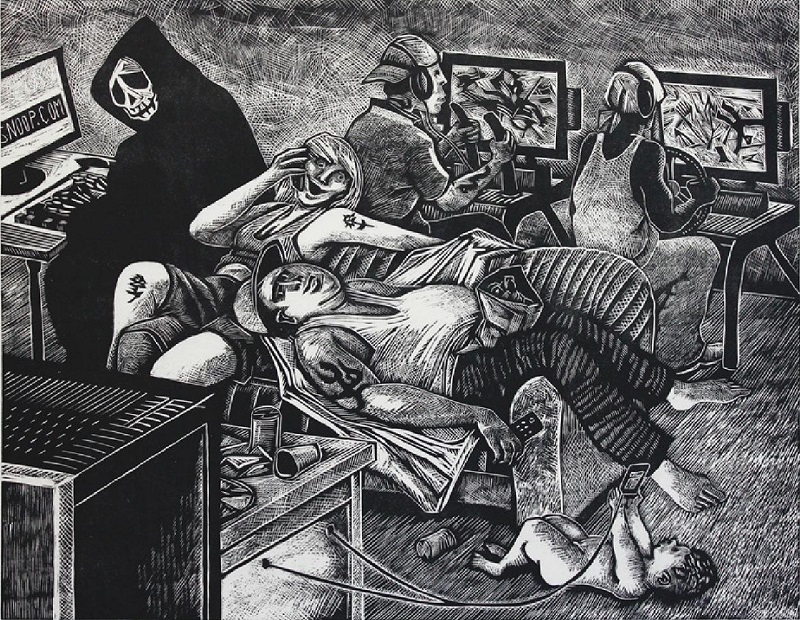
“Sloth” by James Todd (2010).