Looking backward

Over at Good Reports I’ve added a review of Chuck Klosterman’s The Nineties. I found this a real nostalgia trip, leading me into all sorts of reflections on what the meaning of that decade might have been.

I’m sure everyone who lived through the nineties will have a different idea or impression of them. If you try to stand far enough back though I think the big changes had to do with the coming of the Internet (social media came later). That would literally change everything, and I think most people understood that, at least somewhat, at the time. I still find it a point of wonder that I’m a member of the last generation to have grown up without the Internet or computers in the home. And overall I consider that a blessing.

In fact, I’m hard pressed to think of things that have gotten better since the nineties. We’re more aware of environmental issues, but nothing significant has been done to address any of them. Politics has become angrier, stupider, and far more polarized. The economy has become more dysfunctional. Culturally the nineties were not a golden age, but they stand up well against what we’ve seen in the twenty-first century.

Sure, this is an old guy grumbling. But I don’t have any complaints about young people, who I like pretty well. I think people my age, and even more the dreaded Boomers, have to answer for most of what’s gone wrong. And I don’t think ignorance is any defence. We knew what we were doing.

Wallpaper: The glory years

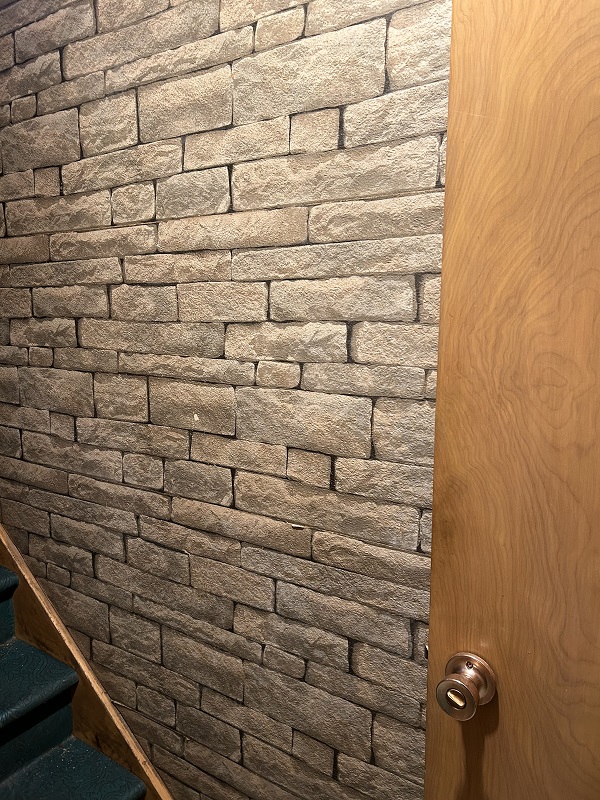
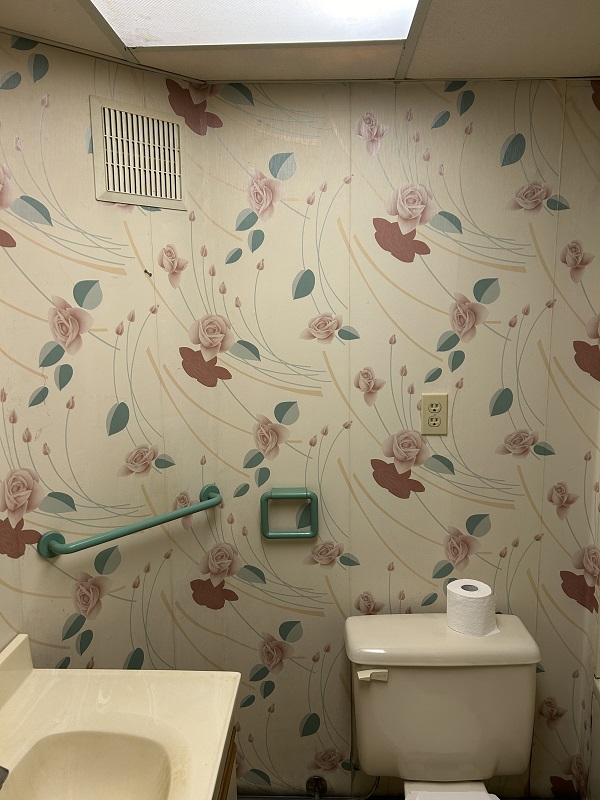
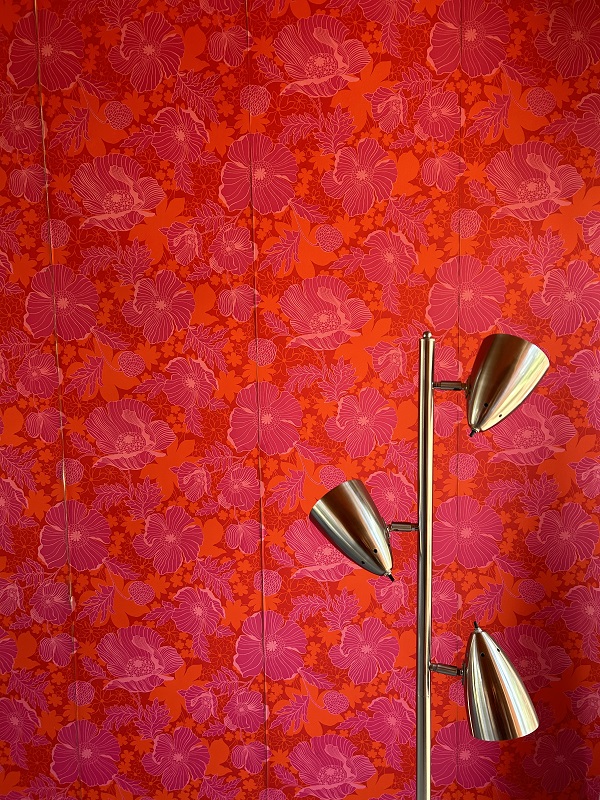
This weekend I visited an open house in my neighbourhood that had just been listed. The owner, a 102-year-old man, had moved into a retirement home. I guess it was time, as they say. From the looks of things inside, I don’t think any work had been done on the place since the early 1970s. The layout of the house was fabulous, but the wallpaper not so much. Submitted for your approval.

On our way down to the basement we have this lovely brickwork. But it’s not brick! It is, in fact wallpaper that looks like brick. Does this count as trompe l’oeil? If you run your hand over it, it even has a rough, pebbly texture.

You can really enjoy your trip to the washroom with this fun and friendly wallpaper. Who would want to leave?

This is the wallpaper in the upstairs washroom. Some people might think it’s a bit too much, but it matches nicely with what we get in the large sitting room just outside . . .

Can any words to justice to this? And it covers all four walls of a very large room. I felt I’d stepped onto the set of an Argento film.

Mythbusters

In a review I wrote recently of the book Corruptible by Brian Klaas I talked about the problem of kakistocracy, or “rule by the worst,” and saw it as “the complement to the failure of meritocracy in our time. As many recent commentators have pointed out – see, for example, my reviews of Twilight of the Elites by Christopher Hayes and The Tyranny of Merit by Michael Sandel – meritocracy, which from the get-go was a hard sell (with roots going back to a dystopic satire), has conclusively failed in the Age of Trump.” Near the end of my review I related the following anecdote:

Thirty years ago I was chatting with a professor friend of mine who was sitting on a committee overseeing applications for tenure-track appointments to the department he taught in. I mentioned the long odds that candidates even then were facing and that the successful ones would have to be truly remarkable. What he said has always stayed with me: “You’d think with so many people applying for so few jobs, the people we’d be hiring would be great. Only the best. But they’re not. We’re hiring the worst people. I don’t know why that is.”

This anecdote came to mind yesterday when reading an essay online by Hamilton Nolan on the low quality of thought coming out of opinion columnists even at prestige publications. His main example is Pamela Paul, who writes a column for the New York Times.

There is no reason for there to be even one shitty New York Times columnist. They can hire anybody they want. Anybody. The existence of shitty New York Times columnists, therefore, is an unimportant thing that reveals some important things about the myths of meritocracy. The most self-assured liberal institutions are in some ways more profoundly corrupt than some of the more raffish institutions that they look down on. I mean, the NFL is one of the sickest symbols of America’s barely subdued imperial impulses, but you don’t see a guy playing nose tackle on the New York Giants because he was the owner’s kid’s college roommate at Yale. Can the New York Times say the same?

This is a subject that interests me, and I quote from Nolan’s piece only because it chimes so well with what I (and many others) have been saying. It never ceases to amaze me how in so many fields today we see people who are scarcely even competent at what they do being lionized as geniuses or an “elite.” As Nolan’s example suggests (and I’ve made the same point several times over the years), about the only field where the term “elite” can still be assured of meaning anything is sport.

This might signify a more dangerous shift in public thinking than at first seems. We often decry the current lack of trust the masses have in “expertise,”  but the fact is that the institutions that we have traditionally looked to for guidance and to lead public opinion (the media and academia) are now so compromised and even corrupt that you can understand people turning away from them. In order to have faith in elites or experts you have to believe in the process that elevated them to that station. With meritocracy exposed more and more as a myth, that faith has been lost.

Avatar evolution

Thought it was time to update with a new avatar and give Shere Khan a break. The new pic was taken from the Art Gallery of Guelph’s sculpture garden and the bronze installation “Living Room Suite” (2001) by the artist Seth. I had to sweep a broken beer bottle off the couch to sit down.

Easter design fail

Whose bright idea was this? I can just kind of get behind those Terry’s chocolate oranges, but who thinks chocolate and carrots go together? I guess some people do, but to me they’re like ice cream and mayonnaise. Not that this chocolate has a carrot taste. At least I didn’t detect any.

What bugged me the most though was the way that the green plastic stem goes right down into the carrot, so you can’t bite through it but have to nibble around the edges. The whole thing seems like a swallowing hazard for small children, and was super annoying for me. Too clever by half!

Erasing the past

“Typewriter Eraser, Scale X” by Claes Oldenburg and Coosje van Bruggen (1999).

I was watching a documentary last week on modern art and at one point the discussion turned to pop art and the sculpture of Claes Oldenburg. I was familiar with a few of Oldenburg’s works, but I hadn’t seen the one they splashed on the screen: Typewriter Eraser, Scale X.

What really took me aback though was that without the title I wouldn’t have even known what this was a (giant-sized) sculpture of. Something about it triggered a very vague memory. I’m sure I’d seen erasers like this somewhere before, but I couldn’t tell you where or when. And I learned to type on a classic Underwood that was as heavy as an engine block, complete with a long silver arm that you swatted back for carriage return. But I never used a typewriter eraser. I think there are few people alive who have, and fewer every day. And yet this was a 1999 sculpture (albeit one Oldenburg had apparently been thinking about doing since the 1960s).

The reason this struck me as meaningful is that Oldenburg’s sculpture, like a lot of pop art, was based on representations of instantly recognizable, everyday objects. He made giant clothespins and giant cheeseburgers. So what happens to pop art when the objects it represents have become so alien? I mean, a giant typewriter eraser might even be an alien, with the spindly brush a shock of blue hair coming out of a round pink cyclopean head. Less imaginatively, it’s a wheeled pizza cutter with a handle that’s come apart.

It seems like an interesting question for art appreciation. If the point is to have you recognize an object that is immediately identifiable even when it’s presented on a different scale and in a different setting, but you don’t know what the object is supposed to be in the first place, then the whole effect of the piece has changed. It hasn’t been lost, mind you. Just changed. I think there’s an analogy that can be made to how we respond to current events when we’ve lost so much historical understanding and perspective. Events lose their meaning, or their meaning changes, when they no longer have any generally understood context. The giant eraser becomes a metaphor.

What happened to YouTube?

Back in 2020 I had a post asking What happened to Amazon? What inspired it was my observation that the behemoth online retailer’s prices had gone up, way up, during the pandemic, while their search function had gotten so overgrown with sponsored links that it was nearly useless. Their ability to deliver packages quickly and efficiently was (and still is) impressive, but the shopping experience has gone to the dogs.

A couple of years after this Cory Doctorow came up with the label of “enshittification” to describe the death spiral of platforms: “Here is how platforms die: first, they are good to their users; then they abuse their users to make things better for their business customers; finally, they abuse those business customers to claw back all the value for themselves. Then, they die.”

I don’t know enough about the operation of the big platforms to judge how close to death they are, but from a user’s point of view I can certainly testify to how shitty they’ve become. As I said in my earlier post, Amazon took a steep dive into the shit at the time of the pandemic (a time when it was also raking in the cash). More recently, however, I’ve been noticing a similar trajectory being followed by YouTube.

I like YouTube. I watch a lot of stuff on it, from shorts to half-hour lectures and podcasts, to full-length documentaries. I’m often impressed at the production values of a lot of the videos I see, if not always as impressed at the content. But there are lots of things to click on and have playing in the background while I get something to eat.

But there are ads. There have always been ads. These cut in, unannounced, sometimes at really annoying moments that can’t be predicted (I’m sure on purpose). If it’s handy I just click to skip these when they start up, but since a lot of them are short (5 to 15 seconds has long been a standard) I often let them play.

What I’ve noticed happening just in the past month though is that not only do there seem to be more ads, but the ads themselves are getting longer. Much longer. Much, much longer. Ads that run for a minute and a half are now not uncommon. But I’ve also seen them run 4 and 5 minutes, and (this was the record) one a couple of days ago that was 8 minutes and 30 seconds! That’s not an ad, it’s a full infomercial. This goes beyond being annoying, to the point where it actually has had the effect of driving me away.

It’s no secret why they’re doing this. They want you to pay for a premium service where you don’t have to see ads. Or so they say. I don’t know how true that is (sponsored ads, I assume, are still included), or how long it’s likely to last. I can remember when cable TV became a big thing and it was known as Pay-TV and the deal was you paid a subscription and you got to watch everything with no ads. That’s not cable TV today.

Still, I’m scratching my head at advertising that’s so deliberately alienating. Who wants to watch an eight-and-a-half-minute ad? Absolutely no one. That isn’t an irritant, it’s a nuclear bomb being dropped on the platform. It’s a message to everyone that if you’re not paying for a subscription they don’t want you there at all. That seems self-defeating to me. But Amazon is still going strong despite its enshittification and I suspect YouTube will still be in business even after it’s become so overwhelmed with advertising it’s barely functional. There’s a lot of room for things to get shittier yet.