Titans: The Lazarus Contract

Titans: The Lazarus Contract

If you’ve been following along you’ll remember that I’ve taken note of the presence of Deathstroke lurking in the shadows of the previous two Titans books I’ve reviewed (The Return of Wally West and Made in Manhattan). I’d started in on Titans Volume 3 when I found a reference to the team’s battle with Deathstroke in the past tense. Had I missed something?

Turns out I had. But I picked up a big pile of these comics for a dollar each from the library’s overstock sale so I had the missing piece, which is this book. It didn’t have a number because it was part of what’s known as a “crossover event” involving a bunch of different titles, in this case Titans, Teen Titans, and Deathstroke.

This led me to the next question: Was all the build-up worth it?

No.

Basically what you need to know here is that one of Deathstroke’s kids, Grant Wilson, was recruited by H.I.V.E. (ahem: the Hierarchy of International Vengeance and Extermination), who gave him a serum that turned him into the supervillain Ravager but that ultimately brought caused him to have a heart attack while fighting the Teen Titans. Deathstroke sort of blames Grant’s death on the Titans, and decides he’ll use the Flashes’ (Flash and Kid Flash’s) ability to enter into the time force to go back into the past and save his son’s life. Since everyone knows disruptions in the space-time continuum always go wrong, the Titans and Teen Titans team up to stop Deathstroke. This they manage to do and Deathstroke, more disappointed than angry, decides to “retire” by setting up a new team of hero/villains composed of his other kids.

I don’t like most time-travel stories. This one doesn’t work for all the usual reasons. I particularly didn’t care for the blather trying to explain the mechanics of time travel. You see, Deathstroke modified an extractor made by someone for Flash to keep his speed power under control. Deathstroke uses this device to store that energy in battery cells connected to his fancy new “Ikon suit” (complete with lightning bolts!) that has a “gravity sheath” that allows him to move at near-light speed and enter the “time stream.” Then, when the Titans and Teen Titans want to follow Deathstroke they mimic his combination of Kid Flash’s super-speed and the gravitational properties of his costume by joining Jericho’s gravity sheath with Flash’s speed to create a “time vortex” stabilized by Raven’s “chrono-kinesis” and Starfire’s energy, all while being tethered by Raven’s mind-meld to the rest of the team as Flash goes running into the speed force, at least until Raven’s “vast mystical powers” begin to fray and her soul-self is in danger of being trapped in the “speed force,” which is where Deathstroke has looked into the face of God and achieved a higher consciousness.

Enough already. I lost interest in all of this long before the end. It all just seemed like a bunch of sparks and noise, with too many characters involved and not much for most of them to do but stand around barking at each other. Not that I knew who a lot of these people were anyway, or cared. I do know Deathstroke and have found him an interesting character in the past, but he’s a lot less so here, especially when he starts spouting scripture (a lot of scripture) in the epilogue. I think maybe there are fans who like this kind of story but it wasn’t my thing and by the time I finished I was glad that I was done with it, and nearly done with my Titans book haul.
Graphicalex

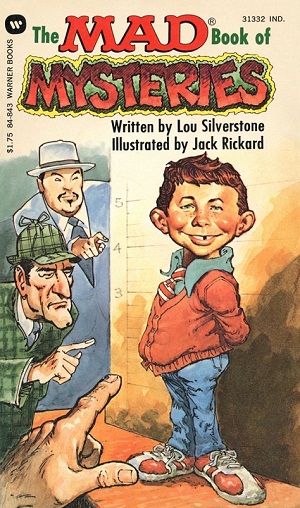
The MAD Book of Mysteries

The MAD Book of Mysteries

Since I’m a fan of both MAD Magazine and classic detective fiction, a book like this couldn’t really miss. I also like that it’s full of original stories and not a grab-bag of previously published material, and that all the stories have the same author and artist (Lou Silverstone and Jack Rickard, respectively).

So the line-up of crime-solving all-stars here sounds like the cast of Murder by Death. There’s Hercules Pirouette, Archer Spillane Spayed, Shtick Tracer, Allergy Queen, Charlie China, Perry Maceface, and Shamus Holmes. And there’s also a spoof on G-Men movies now and then, a quick trip to Peanuts-land with Chuck Frown, Private Eye, and a bunch of gags about what cops say vs. what they really mean. Alas, there’s no Nero Wolfe or Miss Marple, though they’re on the back cover. I would have loved seeing them.

The gags aren’t terribly funny but Silverstone knows his stuff and the way he pokes fun at the material will make you smile. He takes digs at Poirot’s long, drawn-out and confusing explanations of the crime, and has Number One Son getting back at his dad for all the mean cracks made at his expense. But the style of humour is mainly geared around running a gag-a-page of snappy comebacks. When Shamus Holmes declares that a murder victim lived near a canal Dr. Whatso says “A canal? That’s eerie, Homes.” To which Holmes replies: “No, alimentary, my dear Whatso!” Because the deceased worked at a candy company you see.

Rickard often gives the supporting characters familiar movie-star faces. James Cagney and Robert Redford, for example, as their era’s representative G-Men. I loved the look of all the stories, though MAD‘s house style of square speech bubbles and sans serif lettering seemed out of place. I don’t know why they couldn’t have played around with that more. Lettering matters.

What I took away the most from revisiting this pocketbook today though is how much the cultural landscape has changed. In the late ‘70s-early ‘80s classic detective fiction could be sent up for a mass audience, here or in the aforementioned Murder by Death, because it could be assumed everyone had some familiarity with these characters. Today I think that kind of awareness belongs to a vanishing few older readers. To be sure, golden age detectives still have their cults, but they aren’t household names anymore. And what’s more, nobody has taken their place. Caricature exploits character, and the old guard had plenty of that. But how can you caricature Inspectors Morse, Rebus, or Gamache? They’re more realistic and psychologically grounded but not as memorable, and give satirists a lot less to work with.

Graphicalex

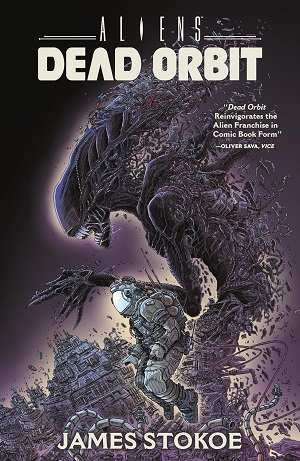
Aliens: Dead Orbit

Aliens: Dead Orbit

Dead Orbit is a one-man show, being written, drawn, and lettered by Canadian comic artist James Stokoe. It’s impressive when someone can handle all these roles as a comic auteur, but there are times when you think a division of labour might have helped. That’s the feeling I had here anyway. I love Stokoe’s art, which turns a space station into a giant, crumbling oatmeal cookie and sees Xenomorphs hiding in the wicker nests of wiring and machinery. I also liked the visual concept he had of turning the impregnated survivors who are “rescued” being burned to a crisp in their cryo pods so that it looks like rotting zombies are giving birth to chestbursters. That was a great touch, typical of the inventiveness found throughout this comic franchise.

The story, however, is hard to follow. I wasn’t sure of the time scheme, as most of the story is a flashback, but I don’t know how much because within the flashback there are a couple of flashforwards, though not as far forward as the story’s frame. This lost me completely the first time through because I got confused as to when Wascylewski was cocooned by the Xenomorphs. And what happened to the salvagers anyway? It seemed like that might be important, and then it wasn’t.

Things were just moving too fast. At one point there’s even a joke made about how quickly the creatures are growing, which is a poke at Alien that is often picked up on. The point remains however that everything here seems to happen in a rush and even at the end I was still wondering a bit about what was going on and in what order.

The supplemental materials describe Stukoe’s original pitch, which was a much more conventional Aliens story featuring space marines infiltrating a planet infested with Xenomorphs. But at some point he decided to go in a different direction, and this is definitely more like the first film than the second. The crew don’t even have any firearms and have to improvise with whatever tools they can find on the ship. Good luck with that!

Perhaps a little too scrambled in terms of its narrative for its own good, this is still another solid instalment in the Aliens franchise, and not to be missed by franchise fans.

Graphicalex

Demon Slayer Volume 2: It Was You

Demon Slayer Volume 2: It Was You

A mangaka is a comic artist who writes and/or illustrates manga. Demon Slayer’s mangaka goes by the name of Koyoharu Gotouge, which is a pseudonym. His self-portrait or avatar in the comics is an alligator that wears glasses.

I only mention this because Gotouge is both author and artist for Demon Slayer, which I don’t think is the norm. Even though manga is a more conventionalized artistic style than its form of storytelling. You can even buy books on “how to draw manga.” Meaning how to draw comics that look like every other manga comic. Anyway, what led me to bother pointing this out is that my response to this second volume of Demon Slayer has split into a good-bad dichotomy and Gotouge is responsible for both.

I like the story. Toshiro is still a young man on a mission to save his sister Nezuko from her infection with the demon virus. This leads him to fight a series of demons, beginning with the sad, fat demon he was in the middle of fighting in the previous volume, and a trio of demons who have been terrorizing Tokyo. This is all standard stuff, but there are some interesting twists, like the way the trio of demons keep popping in and out of a transdimensional bog. As he slices and dices his way through these bad guys Toshiro finds out the name of the chief demon, the one he has to locate if he wants to save his sister. This is some dude-ish fellow named Muzan Kibutsuji. When Toshiro finds Kibutsuji he’s disguised as a family man with a hip-cat sense of style. He sort of looks like a 1930s American gangster. Toshiro confronts him at one point, but Kibutsuji has a legion of demon obstacles to throw in his way. None of that is going to stop Toshiro’s commitment though. As he bracingly declares at one point: “I’ll follow you to the depths of hell and your neck will feel the edge of my sword!”

This all seemed good, or at least acceptable to me, and I managed (just) to keep up with all the new rules regarding demons and how to fight them that were being tossed out. I only wondered at why Toshiro had to fight the trio of demons with the box he’s using to transport Nezuko still strapped to his back. That was ridiculous.

But then there’s the art. I don’t like the way this comic is drawn. The action has already become repetitive and is confusing to boot. Unless you already know what the Seventh Form Drop Ripple Thrust-Curve is and can see that movement happening. In quite a few places the drawing seemed almost like rough preliminary sketches and I don’t know what Gotouge was doing with the eyes of some of the characters. I don’t think it was just the demons who had bug eyes, and even if it was I thought it looked bad.

Will I read any more of these? At this point I’m not sure. Looking ahead, I know that the series goes on forever. And while I liked the story well enough it’s not a comic I enjoy looking at. So I think I’ll take a bit of a break anyway before I continue.

Graphicalex

Druuna: Morbus Gravis I

Druuna: Morbus Gravis I

I still have the first appearance of Druuna in North America, an issue of Heavy Metal magazine that came out in 1986. More specifically, and regrettably, it’s a copy of that issue as it hit the newsstands in Canada, with several pages removed by state censors. Canada was very tight about sexy stuff back in the day.

Heavy Metal (a magazine that I believe has stopped print publication) had a reputation for publishing adult-themed SF comics, but even so Druuna pushed the boundaries. The brainchild of Italian writer and illustrator Paolo Eleuteri Serpieri, Druuna was a raven-haired bombshell pin-up living in a weird post-apocalyptic urban wasteland where people are mutating into tentacle monsters at the hands of a disease called Evil. It’s a dystopian world where everyone, even the mutants, is driven by sexual lust. Which is a fate of affairs that Druuna is both a victim of and that she exploits as she tries to save herself and her lover Shastar (who is now far gone with the disease).

In terms not only of the plot but the world-building the results are hard to keep straight. From Wikipedia: “During the more than thirty years of publication of Druuna’s adventures in Morbus Gravis, the plot has evolved through several stages, differentiated with numerous jumps in the storyline, with some attendant inconsistencies.” That’s putting it mildly. I was never sure what exactly what was going on, and I don’t think Sepieri was either. That said, I always thought there was more to it than just a futuristic setting for a string of hardcore sex scenes, many of which involved threatened or actual rape. There’s a dream (or nightmare) logic to the proceedings, and in the blurring of technology, sex, and body horror I think Serpieri saw a ways into our future. Druuna could be thought of as a virtual reality porn program that has gone viral in the worst way, blurring the line between love, lust, and sex addiction in ways that have come to seem more and more relevant. Druuna is both the ultimate object of sexual desire and someone who is turned on by that objectification, a male fantasy but also a transcendent figure who reigns over her fallen world of mechanical desires.

This is the ‘80s epic of SF T&A, and right from the start, with Druuna lolling in bed for three pages like a post-apocalyptic odalisque, you know where you are in terms of genre if not in the cosmos or space-time continuum. And forty years later it still works. It’s a comic that’s stuck with me, like being haunted by a sexy ghost. And I’m not going to complain about that.

Graphicalex

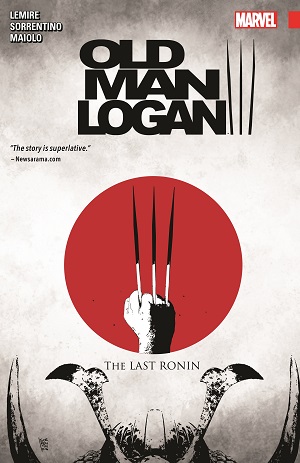
Old Man Logan 3: The Last Ronin

Old Man Logan 3: The Last Ronin

Ronin because we’re in Japan. Why? Because Logan/Wolverine is hunting down Lady Deathstrike, who he tore apart at the end of the previous volume, Bordertown. This is apparently “to settle the score for what she and the Reavers did in Killhorn Falls.” So why didn’t he kill her at the end of that book? I can’t say.

The story felt to me like it was falling apart. The first book set up the idea of a Logan from the future coming back to prevent the supervillain uprising, but then that idea was sort of shot down because how can you prevent anything in the multiverse, where all things are not only always possible but ever-occurring? So then Logan went north to a Canadian mining town and fought Lady Deathstrike and the Reavers. And this book kicks off with him having tracked Lady Deathstrike to Japan, in order to finish her off. I didn’t feel like there was any through narrative here but just Logan going from place to place and fighting different bad guys.

Well, as things turn out Lady D. was just being used as bait to lure Logan into a trap set by the Silent Order and their superpowered mutant level boss the Silent Monk (who is actually quite loquacious). They have a big fight and . . . Logan is on the road again. But perhaps all roads lead back to home.

You’ll be able to tell from this quick synopsis that I’m not a big fan of Jeff Lemire’s work on the story here. I think there is a larger narrative, but it’s hard to keep in focus and in the meantime these side alleys aren’t very interesting and just feel like they’re not going anywhere. On the plus side, however, Andrea Sorrentino’s art really does a bang-up job of carrying the load. I love the way he builds pages and images around text and sound effects that become important design elements, like the wallpaper of BRAT-AT-AT-AT machine-gun fire, the explosive THOOOM!s, the SNIKTs of Logan’s claws extending, and the FWIP labels that come with individual arrows sticking into him. Our hero really takes a shit-kicking in these comics, and you don’t just see it, you hear it. Which, in turn, helps you feel it, in a good way. One complaint I’d register though is Sorrentino’s bizarre way of rendering a muscular mid-section. Both Logan and Sohei have six-packs that go up almost to their necks, and their abs look like giant tumors. He does all his shirtless male heroes like this, and it looks sick.

In short, a visually brilliant and well-designed comic that brings the action but I really didn’t care too much about where the story might be going, despite the time spent trying to build up Logan’s relationship with Maureen and maybe starting a family. I guess I should give points for at least trying to do something in this direction, but given the shattered narrative it just wasn’t working for me. Maybe you have to be more up than I am on all the different timelines. Also there’s no bonus comic included with this volume so that was a bit of a letdown too.

Graphicalex

Titans Vol. 2: Made in Manhattan

Titans Vol. 2: Made in Manhattan

The Return of Wally West left off with Deathstroke wondering who Wally West was, but we don’t pick up on that here for some reason. There’s just another quick cutaway to Deathstroke spying on the gang’s flashy new headquarters, the Titans Tower, which rises out of the East (or Hudson?) River across from the Manhattan skyline. I don’t know how they got a building permit for that, but surprisingly they do acknowledge that this might have been problematic.

So . . . instead of Deathstroke what we have here is the return of Bumblebee, in a storyline that has an evil company called Meta, run by the Fearsome Five, offering to take superheroes’ powers away (they’re a curse as well as a blessing, you see) and then selling them on the black market. This was five years before Facebook turned into Meta, which for all anyone knows is up to something even worse. I don’t know if there was any connection there.

I wasn’t too happy that the Titans, despite ditching the “Teen” prefix, are in fact still a bunch of undergrads. Titans Tower is just the typical superhero dormitory, with a gym and a cafeteria and individual bedrooms with posters of rock stars on the walls. They spend a lot of time eating pizza and drinking pop. There’s boyfriend-girlfriend nonsense going on with Donna and Roy (Arsenal), and Wally and Linda. They get mad at each other, kiss and make-up, etc. I found this juvenile, but that shouldn’t be surprising. I think they were still going for an adolescent demographic.

It’s a decent comic. There are two storylines. The first is the one where they take on the Fearsome Five. In the second, which was a standalone that ran in Titans Annual #1, the four junior Titans are transported to a very dark site where they meet up with their four seniors. So there’s Wally West Flash and Barry Allen Flash, Nightwing and Batman, Tempest and Aquaman, and Donna Troy and Wonder Woman. It’s unclear who was behind the abduction, but the eight heroes come together and smash their way free of the prison they’re in, which turns out to have been in Alaska.

Both stories end abruptly. The Fearsome Five are sent packing, leaving the Titans to speculate as to who was fronting them. And the ghoulish guy who was running the extraordinary rendition scheme in Alaska disappears through a dimensional doorway, where he meets the sinister force who was pulling his strings. But that’s all we get, as we never see who was behind it all.

And as I say, Deathstroke is still waiting in the wings. I think it’s time for him to start getting more involved.

Graphicalex

Fighting MAD

Fighting MAD

I grew up with MAD Magazine. And much to my delight, I actually held on to a lot of them, including a bunch of these paperbacks. So re-reading them now is a real stroll down memory lane.

This particular book was published in 1980 but the content is drawn from magazines published from the 1950s to the 1970s. What a different world that was! What struck me as particularly strange was the target demographic. MAD was a satirical magazine, including a lot of political satire that I would have thought over the head of most young people. And while there’s not much in the way of politics on tap here, there are passing references to Harvey Matusow and Dave Beck. Give yourself a pat on the back if you recognize either of those names. Or if you get the joke about a subliminal ad in a bookstore telling people to buy a copy of The Hidden Persuaders (1957).

Maybe young people as well as the culture at large were just more aware back then. I mean, I didn’t get (and still don’t get) the 1873 on the pugilist Alfred E. Neuman’s belt buckle. “The Great Dumb Hope” is a spin on the phrase “Great White Hope,” which only goes back to 1911. But what happened in 1873?

A joke like “Great Dumb Hope” wouldn’t fly today for obvious reasons, but this isn’t the most politically incorrect cover among the Mad pocketbooks I have so get ready. Indeed, you should be braced for some of the content here as well. Things kick off with a parody primer for teaching tots how to read that describes the adventures of a brother who helps his grandfather run a stolen car ring and a sister who tortures and kills the family cat. Brother and sister (looking to be seven or eight-years-old) meet up with their buddy Bobby (a juvenile Marlon Brando from The Wild One) for some extracurricular activities:

Bobby sells reefers to the other children at school.

Sometime we buy a stick from Bobby.

We light up behind the garage.

Crazy, man.

Then, in a later piece, there are these final words of wisdom for anyone quitting playing golf:

Giving it up is easier than you think. Many former golfers find that drinking takes their minds off the game. For others, gambling provides a new outlet for that competitive spirit. Sleeping late is also a good substitute. Or beating up your wife.

What did I think of this, reading it as a pre-teen? Did it register at all? If the violence was scary, you could find solace on their being an ad for the “wife-of-the-month” club that promises domestic bliss: “How would you like to come home from the office on the first Monday of every month, and find a new wife cooking supper for you?” When you hear manosphere types talking about trad wives, remember this is the stuff they may have been raised on.

The references to smoking reefers and lines like “Crazy, man” also date things a bit. As does the modernized or “up-to-date” Shakespeare that translates the balcony scene from Romeo and Juliet into hep cat patter. “My ears have yet not drunk a hundred words of thy tongue’s uttering, yet I know the sound” turns into “My lobes have not yet dug a hundred notes of your jive, but, like, I’m woke to your sound,” and becomes less comprehensible in the process. Or take this exchange: “By whose direction found’st thou out this place?” “By love, that first did prompt me to inquire” becomes “Who finked on how to find my shack?” “Love, baby, love first bugged me to plea.”

That all sounds kind of lame today, but I still got a smile out of reading it again. And several of the pieces included here hold up very well. The parody of a Mickey Spillane novel is great, and the nursery tales retold as newspaper stories were nicely done. But really I found all of it enjoyable, however much it had dated and had slipped into an irretrievable past.

Graphicalex

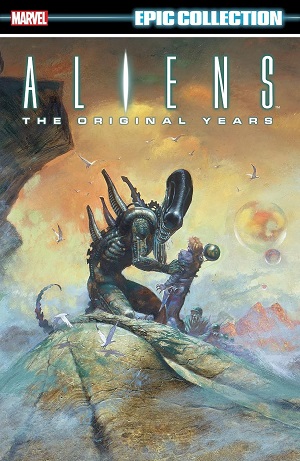
Aliens: The Original Years Volume 2

Aliens: The Original Years Volume 2

About the only bad thing I can say about this collection is that I didn’t think it was quite as good as Aliens: The Original Years Volume 1. Given how highly I rate what’s been done with the Alien franchise in comics, that can’t be taken as a criticism though. These are all great comics.

Specifically, what you get here are a bunch of stories that ran in Dark Horse publications in the early 1990s (the rights to the Alien comics line were sold to Marvel in 2020, so that’s why these Epic Collection anthologies are published under the Marvel logo). There are three main stories on tap, introduced by a few shorts. Here’s the line-up:

Countdown: a team of space marines tries to escape a planet with a Xenomorph infestation problem. One of the survivors has a little secret. I knew where this was going but it was still great.

Reapers: I did not know where this was going! A funny Aliens story from the great Simon Bisley. This is a quickie with a surprise gag ending that actually made me laugh. Not a twist I was expecting!

The Alien: the president has to go negotiate with one of the Xenomorph-hating Pilots, who is terraforming Earth for its species to colonize. The Pilot isn’t someone to be negotiated with, but the president has a nuclear-option bargaining chip.

Genocide: a pharmaceutical company that makes a super-steroid named Xeno-Zip needs to harvest a special chemical ingredient contained only in the “royal jelly” of a Xenomorph queen. A joint corporate-military mission is sent to the Xenomorph’s home planet, now riven by civil war, to grab some of the stuff. You may have sensed by now that all of these stories tend to play on basic plots and characters introduced in the first two films (the military-industrial complex seeking to mine or exploit other worlds, the kick-ass but ultimately out-of-their-depth marines, the slimy, soulless corporate hack, the question of who’s human and who’s an android, etc.). What’s odd is that the stories are all so fresh regardless. They add just enough stuff that’s new that every story has its own character.

Hive: a different team are looking for that royal jelly, now described as “the most sought-after consciousness-altering substance in existence.” Giving it a further gloss: “It gives some an intense feeling of well-being and competence. Others experience levels of their own being not normally perceived. Still others have an orgasm that seems to go on forever.” Sounds great! One of the scientists on this mission is addicted to the junk. The great new element here is that they’ve invented a robot Xenomorph to help them. Why hadn’t they thought of that before? I mean, if they can make human androids that nobody can tell aren’t real it wouldn’t seem too hard.

Tribes: this isn’t a comic but a novella with lots of art work. The art is great; the novella isn’t. I couldn’t finish it. Maybe it just wasn’t my thing.

Aliens: Newt’s Tale: this is basically a graphic version of the 1986 film Aliens, except told from Newt’s point of view. There’s some new material at the beginning giving Newt’s backstory but otherwise it’s a quick run through the highlights of the movie, including most of the main moments and memorable lines. Although Hudson’s “Game over, man. Game over!” is oddly missing. I guess it hadn’t become a meme yet.

So aside from “Tribes” this is a line-up of great, (mostly) original stories, each illustrated by a different artist in a distinctive style. I particularly liked the work of Kelley Jones in “Hive.” Another can’t-miss title then in the terrific Alien comic franchise. This is a series that, for decades now, has never seemed to miss.

Graphicalex

Daredevil: Chinatown

Daredevil: Chinatown

This comic constitutes the launch of the Back in Black series, a semi-reboot of the Daredevil character that was part of the “All-New, All-Different” Marvel branding exercise that kicked off in 2015. What I mean by a semi-reboot is that it isn’t an origin story but it does involve a universe jump as we’re now in a timeline where nobody knows that Matt Murdock is Daredevil except for his former law partner Foggy Nelson. Or I guess it’s the same timeline but one that’s been adjusted by the powers-that-be so that Matt has regained his virginity. How all this happened is explained later in the series. And yes, it’s lame.

That introduction aside, this is a decent story by Charles Soule that mixes the traditional Daredevil plot that has DD fighting gangs in New York (though it’s Chinatown this time, not Hell’s Kitchen), with the supernatural elements of the Hand joining the fun. Instead of a defence attorney Matt is now a prosecutor, and he has a suspicious Chinese cult in his sights that’s run by a guy named Tenfingers. So called because he has ten fingers (or nine fingers and a thumb) on each hand. To be honest, I thought this was really silly, and all the extra digits seemed more like a disability than a superpower, but it does make him stand out.

Anyway, Tenfingers stole some bad mojo from the Hand and now they want it back. This leaves Daredevil, along with his protégé Blindspot (don’t call him a sidekick, though “apprentice” may be OK), caught in the middle of a high-level gang war, with lots of innocent civilian lives in danger. Much fighting ensues.

Blindspot (apparently the fourth Marvel hero to go by that name) seemed like a character with some potential. He’s a young undocumented Chinese immigrant who’s invented a battery-operated invisibility suit. He knows some martial arts as well and is a handy guy to have around. Unfortunately, his mother works for Tenfingers so family dysfunction bites him in the ass. But you do get the sense that DD genuinely cares about him and is doing his best to be a mentor. That side of the comic works quite well.

The art by Ron Garney is more stylized and rougher around the edges than the generic Marvel house manner, and it fits here. I thought it really worked for the action scenes, of which there are a lot. I’m not a fan of Daredevil’s black costume though, or the flaming DD’s. Not an improvement on the all-red outfit, at least in my eyes. But maybe since they decided they were doing a reboot they figured they might as well spring for some fresh duds and see what people thought. Well, thumbs down from me.

Graphicalex