Asterix and the Banquet

Asterix and the Banquet

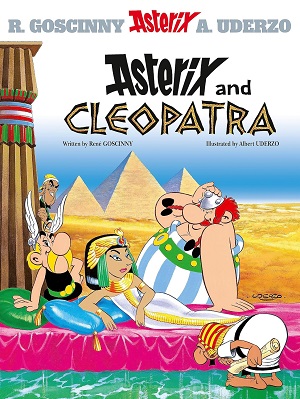
Or Le tour de Gaul d’Astérix, as it was first published in French in 1965. But either title works, as the plot has to do with Asterix and Obelix making a circuit of Roman-occupied Gaul to pick up foodstuffs from all the different cities they visit so that they can then take it back to their little village for a banquet. This is to win a bet with a Roman inspector (Lucius Overanxious) that a palisade built around the village would never be able to fence them in. I only mention the change in title to note the free hand translation can take. On a couple of occasions in the text this also came up. A version of a Roman tow-truck (a tow-chariot) arrives at one point and it’s called TOWSRUS TOWS, which I doubt the French said, even though Toys “R” Us had been a brand in the U.S. since the late 1950s. Then on the last page, at the banquet, Asterix launches Lucius Overanxious with what he calls “the village specialty,” which is PUNCH! I take it this was a reference to the ad “How ‘bout a nice Hawaiian Punch?” which first aired in the early 1960s, so again it’s possible. But I don’t have the original French-language versions to compare. I could probably find them in the library but I’m too lazy.

Anyway, as I said in my notes on Asterix the Gladiator, the template for these stories had already been set, “with Asterix and Obelix (the latter still without Dogmatix) leaving the village for some foreign adventures and then returning home for a banquet.” This is, as I’ve already outlined, the whole story here, with the difference being that it is in this volume that Dogmatix is introduced (though not named yet). Dogmatix decides to tag along with the two outside a deli in Lutetia, and is a silent presence throughout all the rest of the comic, always visible but completely ignored by Asterix and Obelix. That is, until the final page, where he finally lets loose a “Woof! Woof!” at Obelix, who notices him for the first time. Picking him out from the goings-on is a bit of fun throughout, and makes the point that you have to spend some time with Albert Uderzo’s art, seeing as there’s so much put into every frame. When they visit Nice, for example, they’ walking along the seaside promenade and, despite their being central, it’s easy to miss the two very modern and stylish blondes walking past in their miniskirts, but they have a little white dog that’s barking at Dogmatix while a Gaul twirls the ends of his long Gaulish moustache and looks at them. The final panel, now becoming a signature sign-off, also has a checklist of items to see: the banquet in the distance, Cacofonix bound and gagged so he won’t sing, a centurion trying to revive the punched-out Lucius Overanxious, and Dogmatix running away with a bone and winking at us.

There’s lots of action here, though I didn’t think this was one of the better Asterix stories and there are no interesting new characters, aside from Dogmatix. It’s still a good time though, and even as the series was becoming more familiar it was far from growing stale.

Graphicalex

The Island of Dr. Moreau

The Island of Dr. Moreau

During his real spurt of genius, when he was turning out classics like The Time Machine, The Island of Dr. Moreau, The Invisible Man, and The War of the Worlds all within the space of about three years, H. G. Wells showed himself to be a master at blending heady philosophical themes and scientific speculation with stirring action in a way that few writers have matched since. Now condensing The Island of Dr. Moreau into a 58-page graphic novel meant that something was going to be cut, and given the nature of the medium that something was likely going to be the more intellectual discussions that take place. Which is what happens here, throwing Wells’s balance of thought and action out of whack and leaving us with what is basically a straightforward adventure story.

You might have suspected as much just from the cover, with a heroic-looking Edward Prendick posing with machete while a muscular Beast Man looks down from the trees. Artist Fabrizio Fiorentino has a background in superhero comics, working for both DC and Marvel, and that’s really the style he’s working in here. Montgomery goes from being a pathetic, gay-coded alcoholic to a rough cowboy, while Moreau is Kingpin, or Marlon Brando. All of the big action scenes are included, and embellished, but the philosophical debates and moral of the story are dropped. While a more thrilling and better looking comic than the Classics Illustrated version, that book did preserve more of Wells’s ideas, kept the dark ending, and had I think a more credible Moreau. Or at least a hairier Moreau.

In other words, this is a comic that stands well on its own but is very limited if taken as an adaptation of Wells’s story. In fact, as a crib I think it could be quite misleading and get students who are looking for a shortcut into trouble. If you’re just here for the adventure part though it’s pretty good.

Graphicalex

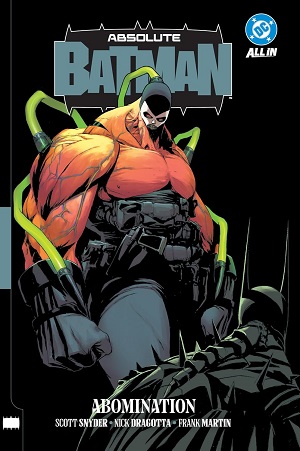
Absolute Batman Vol. 1: The Zoo

Absolute Batman Vol. 1: The Zoo

Another reboot, another universe? Well, yes. But credit Scott Snyder for coming up with something that’s very new and really good, at least for the most part.

So in this version of the Batman story, part of DC’s Absolute Universe (launched in 2024), Bruce Wayne isn’t a rich orphan but comes from a middle-class background (father a teacher, mom a social worker). His dad is killed when he was a kid but his mom’s still alive. He trains himself to be a one-man crime-fighting unit, and I mean unit because he’s a really big dude, and so strong he can knock the stuffing out of a heavy bag with a single punch. He’s also a mechanical engineer and so has designed an impressive suite of toys to go with his suit. In fact, the suit itself is a machine, capable of firing spikes and with a cape that has claws he can grab things with or even walk on.

Then there are the other familiar names and faces, not transformed. Alfred Pennyworth is a hard-nosed MI6 agent who basically adopts Bruce. He’s also the narrator of the story. Jim Gordon is now Gotham’s mayor. The Joker is some billionaire psycho, called Joker because he never laughs. And Bruce’s poker buddies are Waylon Jones (Killer Croc), Eddie Nigma (the Riddler), Oswald Cobblepot (the Penguin), Harvey Dent (Two-Face), and Selina Kyle (Catwoman). You see, they were all friends together back when they were kids and they haven’t turned into their alter egos yet.

The plot in this first volume of the series (collecting issues #1-6) has it that a new gang called the Party Animals is taking over Gotham. They wear these cool masks that make them look like the evil bunny from Donnie Darko. Their leader is Roman Sionis (Black Mask) and he has the usual mission of creating chaos and burning the town down Purge-style. When Batman stands in his way he at first tries to buy him off, but (and this is one thing that is consistent with previous versions of the character), Batman’s not the kind of guy who can be bought.

There was a lot to like, from the great design elements to Nick Dragotta’s clear art. The action is quite violent and the guiding concept refreshingly bold. I loved the new Alfred. You really feel like you’re getting something completely different here, not just a slight divergence in the timeline but a rebuilt Batman from the ground up.

On the downside, I really didn’t like the flashbacks to the pack of superfriends. Even though it’s an entirely new backstory I didn’t find it interesting and the new parts to it, like the way all the supervillains grew up together and are still buddies, seemed silly. Then, in the present day, I was disappointed to find that the Party Animals were just more of the usual chaos agents who want to see the world burn, as that cliché has it.

But the Party Animals are only bottom feeders anyway, a force to get the ball rolling. They’re also the lowest rung on the Joker’s criminal organization and as things leave off here he takes their loss with a shrug and tells his assistant that it’s time to call in Bane. I’m down for that!

Graphicalex

Alien: Paradiso

Alien: Paradiso

The Alien titles have become one of my go-to comics for a good time. There are basic recurring elements in each of them, but somehow the stories manage to keep things fresh. A lot fresher and more interesting than the horrible film franchise anyway! And it’s been that way now for forty years.

Reading Paradiso I had to ask (again!) why they don’t just film these storylines instead of the ones they do. What we have here would make, if not a solid feature, at least a very good episode in an Alien cable series.

Smuggler Ricky Valentine, the dude with the golden arm, has arranged a meet-up with another bad guy at the super-ritzy Paradiso resort, which looks like a cross between Dubai and Las Vegas (if those two places aren’t the same thing). A couple of space marshals have Ricky under surveillance. They’re about to make a big bust when this other smuggler Ricky had arranged to meet turns out to have killed the deal with Ricky in order to take on some other cargo. Specifically, a bunch of giant, leathery eggs . . .

And so hell comes to paradise, with Xenomorphs running rampage through the casino and the sauna and the dining halls, slaughtering good guys, bad guys, and guests indiscriminately. The setting is a good example of the kind of refreshing change that makes these comics so much fun. Xenomorphs running amuck on some shithole planet or mining asteroid was getting old. Seeing them at Club Med was great.

Another way these comics keep impressing me is in the reveal of a character who turns out to be a synth. You know going in that somebody is an android, and still every time I’m surprised when I find out who it is. Full credit to the writers (Steve Foxe in this case) for that. Then, for the parts of the story that are unavoidable and that every Alien fan knows and expects, they can just have fun. “It got bigger,” the one space marshal says after a full-size Xenomorph shows up just an hour or so after being hatched. “No shit,” his partner replies. Now as fans we know how fast these things grow, but the people in the comic don’t. “How did it grow so much in just a few hours?” a security guard asks. It doesn’t make sense!

About the only thing I wasn’t totally on board with here was when they switched over to the Xenomorph’s point of view. I guess they were going for a sort of Predator effect, but I thought it was unnecessary and a bit confusing. That said, it’s another example of how they keep trying to throw something new into the mix, and it did change things up visually (the POV parts have a different artist) and I can’t say I minded it that much.

So another great Alien comic! Really, at this point I’ll grab any new one that comes out. They started these back in the ‘80s and I think I’ve read almost all of them without being let down yet.

Graphicalex

Asterix the Gladiator

Asterix the Gladiator

The Romans kidnap Cacofonix the bard so that he can be fed to the lions as a present to Caesar. Much as everyone in the village is relieved that they don’t have to listen to Cacofonix’s singing, this can’t be let stand so Asterix and Obelix head off to Rome to get Cacofonix back.

The standard template for an Asterix story was already set, with Asterix and Obelix (the latter still without Dogmatix) leaving the village for some foreign adventures and then returning home for a banquet. I think the only recurring note that’s introduced here for the first time are the pirates. Otherwise there isn’t much about this that stands out, though I did remember the gladiators playing the word game. It’s funny what stays with you after all these years.

The art is brilliant as always, and the story strong and easy to follow. Though I did wince a little at the stereotype caricature of the Nubian gladiator, and I raised an eyebrow again at Obelix saying “Cool!” a couple of times (something I flagged previously in my notes on Asterix and the Golden Sickle). I can understand wanting to translate the language into contemporary American English for a new audience, but there should be limits.

Graphicalex

Classics Illustrated: The Island of Dr. Moreau

Classics Illustrated: The Island of Dr. Moreau

I’ve always felt a special connection to The Island of Dr. Moreau, at least ever since I picked up a movie tie-in paperback when I was a kid (I mean the 1977 Burt Lancaster-Michael York movie, not the 1996 Marlon Brando-Val Kilmer one). I don’t know how many times I’ve read Wells’s novel, but this was my second time through the Classics Illustrated adaptation, with text by Steven Grant and art by Eric Vincent. I recall not being impressed with it my first time around, but on this re-read I thought it held up slightly better. Even though I had to groan at the back cover, which proclaims: “Edward Prendick is . . . . LOST . . . and trapped on the Island of Dr. Moreau – the one island you want to be voted off of!” So there’s two timely references to American television that I don’t think will age as well as Wells’s book has.

I imagine it must be a difficult job cutting any novel down to less than a hundred pages of comic, so I don’t want to complain too much about what Grant did. I think he kept the story intact enough to make sense without leaving much of importance out. But zooming in a bit, I thought the dialogue was often quite choppy, with the flow of various scenes interrupted with breaks that had me thinking a page was missing or a cell had been dropped out of sequence somehow. It’s herky-jerky in several places and I thought that even though it was a tough assignment more could have been done to smooth things out. I’d also point out that changing Arica to Africa is a typo. Montgomery does not say he’s “out of Africa” but “out of Arica,” Arica being a port in northern Chile. And at least one point I wasn’t sure how closely Grant and Vincent were working together, as we never see the dead rabbit that Montgomery and Prendick discover and which provides proof that the Beast Men are reverting back to their carnivorous origins. The two men talk about it, but what they’re talking about is never shown and if you haven’t read the book I think you’d have a hard time understanding what is going on.

I liked the art, at least once it got beyond the cliché of Moreau and Montgomery decked out in their best colonial whites. Vincent has a distinct style and the faces are particularly memorable, with Prendick dissolving into a sweaty, stubbly anguish that made me think of Robert Crumb and Moreau’s moustache and sideburns making him seem like King of the Beast Men. I also felt the final panel nailed the ending, highlighting the now clean-shaven Prendick’s alienation from the urban, civilized world he has returned to. This is the key point in the novel, close akin to Marlow’s recognition at the end of Heart of Darkness that London is not just one of the dark places in the world but the darkness’s beating heart. Of course it’s an idea that’s presented in stronger terms in the novel, but enough of the conclusion is kept intact here to make it a clear enough takeaway.

Graphicalex

Wolverine: Call of the Adamantine

Wolverine: Call of the Adamantine

Most of the comic volumes I review here collect five or six issues in a particular run following a single story arc, which is what I was expecting here with issues #6 through #12 of author Saladin Ahmed’s Wolverine. I thought this was going to continue the story of the mission of the Adamantine, “a buried power older than men, older even than the gods . . . the primordial spirit of metal itself,” to rid the world of the bastard adamantium (an alloy which the Adamantine “considers to be something between blasphemy and identity theft”). But that story actually ends (somewhat abruptly, I felt) halfway through issue #8, after Wolverine plugs Romulus’s pie-hole with his claws. Which leaves the Adamantine to skulk off with a muttered threat to Wolverine (“Our contest will come soon enough. But not this day.”). From there we’re whisked away to one of Arcade’s deadly game shows, which at least cures the Wendigo of his curse. Then there’s a standalone episode with a different writer of what I guess is one of Wolverine’s ancestors in samurai-era Japan. And from there someone (spoiler alert: it’s Jason Wyngarde/Mastermind) gets inside Wolverine’s head and lures him back to his old family estate where he is tormented by the spirit of his dead mother and gets into a fight with Sabretooth. Yeah, they’re both dead (Wolverine’s mom and Sabretooth) but they’re not really here so whatever. I actually thought there was some potential with this Wolverine-in-a-haunted-house business, but again it falls back on the idea of Wolverine just having to dig deep until he can get the upper hand. And to be honest, I’m tired of explorations of the tortured psyches of superheroes. Wolverine can dish out the punishment, but this is always followed by a downer: “the doubt and the loss and pain come callin’ again like old drinkin’ buddies you just can’t shake.”

I’m not going to be too negative on this one. I thought Ahmed had some good ideas even if they did sort of peter out or got cut short. And the art, especially in the later issues, didn’t let things down. But there’s not much of a payoff. The Adamantine will be back, someday. Arcade escapes. And even Mastermind can throw a final taunt at Wolverine, asking him if he knows if any of this is real. All of this is par for the course for most comics, which are always running to stand still, but I thought it seemed a little more obvious here, the conflict a little too familiar. And I really don’t find the inside of Wolverine’s head all that interesting a place. I get it: dark places, man. Find a therapist and don’t bore me with the rest of it.

Graphicalex

Wolverine: In the Bones

Wolverine: In the Bones

So our hero Wolverine is off taking another one of his breaks from the X-Men, pondering what he’s done and what he’s going to do with his life in that usual “superhero having a reflective personal crisis” sort of way. He’s even running with a pack of wolves somewhere in Canada’s Northwest Territories. But then trouble, as it always does, comes knocking, in the form of his old enemy Cyber. And here’s where things start to get interesting. After Wolverine kicks Cyber’s ass (when they butt heads it makes a great CLONG sound) Cyber skulks away and gets possessed by a recently awakened primordial force called the Adamantine. Now you’ll probably know that Cyber’s skin and Wolverine’s skeleton and claws are made of (or, to be precise in the latter case, bonded with) adamantium, which is a virtually indestructible man-made alloy. Adamantine, by way of contrast, is a naturally occurring metal that is more the stuff of legend. Both are fictional substances, by the way.

The Adamantine doesn’t like adamantium, seeing it as a kind of blasphemy, so it has a mission to destroy it wherever it finds it. To do so it takes over Cyber and then goes around hunting other supervillains with adamantium in their body and possessing them. Names like Lady Deathstrike, Constrictor, and Romulus. Of course it also wants to possess and destroy Wolverine. To stop them, Wolverine has to team up with his daughter (X-23), Nightcrawler, and a teenage Wendigo that he is helping fight the cannibal curse.

I thought it was a good storyline from Saladin Ahmed, though in the end it falls back on the cliché about our hero just being made of stronger stuff and having personal reserves too great for the evil force to overcome. I get tired of that, and was actually hoping the Wendigo, as the anti-adamantium force in play, might have had a larger role. But I was still hooked enough to want to see what would happen next.

Graphicalex

Macbeth (illustrated by K. Briggs)

Macbeth (illustrated by K. Briggs)

In my notes on the Macbeth graphic novel illustrated by Gareth Hinds I mentioned some of the ways he’d cut and adapted the language of the play, concluding that it wasn’t a full-text Macbeth, nor should it have been.

This Macbeth, illustrated by K. Briggs, is a full-text version of the play, and while I want to give credit to Briggs for her ambition I came away thinking that this sort of thing isn’t well advised. I gave up on the graphic adaptation of Philip K. Dick’s Do Androids Dream of Electric Sheep? for much the same reason. The text gets to be too much, and if you know the novel or the play that’s being adapted well enough you tend to skim it anyway and just look at the pictures.

I also want to credit Briggs for her striking visuals. She’s got quite an original sense of style, playing a lot with the format of the pages and mixing in various novel bits of imagery, like tarot cards, into a collage. She’ll also flip images upside-down, or present scraps of text or medieval-themed design elements as background. You can spend quite a bit of time on nearly every page, pulling it apart. And there are other creative flourishes I enjoyed too. Macbeth is so often presented, at least today, as a heroic young man that I liked seeing him as a bald, professorial type. At least he looks a lot like professors I had. You could roll your eyes at Malcolm appearing as a Black woman, but given the spirit of the proceedings this barely stood out.

But then there is all the text, which Briggs does try to jazz up as much as she can but which still just feels like it’s getting in the way. To be honest, and not only because I do know the play pretty well and was skimming, I started wondering at one point if the book might have worked better as a strictly graphic presentation, with no text at all. I mean, they made a whole lot of silent films out of Shakespeare’s plays, so, as crazy as it may at first seem, the words really aren’t indispensable.

Graphicalex

Macbeth (illustrated by Gareth Hinds)

Macbeth (illustrated by Gareth Hinds)

Even though Macbeth is one of Shakespeare’s shortest plays (I think only The Comedy of Errors has fewer lines), most productions still make a fair number of cuts, and we shouldn’t be surprised that a graphic novel adaptation, coming in at 134 pages, would be any different. Gareth Hinds doesn’t go wrong in getting rid of Hecate’s appearance before the witches in Act III Scene v (which Shakespeare might not have written), as well as the long and (in my opinion, tedious) exchange between Malcolm and Macduff in Act IV Scene iii. This isn’t a full-text Macbeth, nor should it be.

Purists may take fairer exception to places where the language has been simplified or expurgated. Among the foul ingredients going into the witches’ cauldron, for example, there’s a “Finger of birth-strangled babe / Ditch-delivered by a drab.” That second line, identifying the strangled babe as having been birthed by a prostitute in a ditch, is omitted by Hinds. And at another point a notorious crux is done away with in Macbeth’s concern over washing the blood from his hands:

Will all great Neptune’s ocean wash this blood
Clean from my hand? No, this my hand will rather
The multitudinous seas incarnadine,
Making the green one red.

Should that final line read “Making the green one, red”? As in making the green ocean red? Or should it be read as saying “Making the green, one red”? Meaning making the entire ocean turn red? Hinds avoids the problem by changing the line to “No, this my hand will rather stain the great seas crimson.” Which is at least clearer, if you’re no fan of ambiguity.

As far as Hinds’s visual representation of the play goes, I think there’s good and bad. The good takes the form of a lot of interesting concepts like the witches first appearing as birds perched in a tree, Macbeth’s elongated shadow taking the form of a dagger as he sets off to kill Duncan, Macbeth and Lady Macbeth literally wading in blood after the scene with Banquo’s ghost (where Banquo’s ghost takes several different, monstrous forms), and Lady Macbeth’s obsessive hand-washing represented by multiplying sets of scrubbing hands. The not-so-good is mainly down to Hinds’s figures, which all look stiff and artificial to me. Adding to this effect is the lettering, which is just a regular font that doesn’t go well with the action and adds a layer to the generic feel. I wonder if comic lettering is a dying art now though. Too bad if it is. It’s something we often overlook, but it can make a difference.

Graphicalex