Bartman: The Best of the Best

Bartman: The Best of the Best

The Simpsons comics are like the TV show in that they keep things remarkably fresh despite the uniform nature of the product. This mini-anthology collects three Bartman stories. I can’t vouch for their being the best of the best, but all three are pretty good, with some funny jokes in the familiar Simpsons manner, a few smiles, and decent storylines. In the first, Bartman discovers that the delinquent crew (Jimbo, Dolph, and Kearny) have a summer-work scam of selling deliberately misprinted comic books. In the second, our hero takes on a vigilante rule-enforcer calling himself the Penalizer (one guess who that is). And in the best, longest, and last story the aliens Kodos and Kang release Itchy and Scratchy from televised reality and into the real world, which has various knock-on effects, including a nuclear explosion that turns the citizens of Springfield into superheroes/villains (Homer becomes the Indigestible Bulk, Krusty the Jokester, Moe = Barfly, and Groundskeeper Willie turns into the Plaid Piper). Bartman has to then release Radioactive Man himself to get everyone back in the box.

But while the writing is solid in the whimsical Simpsons house style, I thought the art (which is also very much in the house style of the show) the weakest of any of the Simpsons comics I’ve read. There were some really lazy panels, like one in particular of Mr. Burns jumping into the arms of Smithers, and Springfield occasionally looks as barren as Tintin-land without the ligne claire. You can almost see that as being an in-joke, as Bartman is a character that sends up comic culture and its industrial, franchise nature even more than usual for a Simpsons title. Almost, but not quite. I think they were probably just in a rush.

Graphicalex

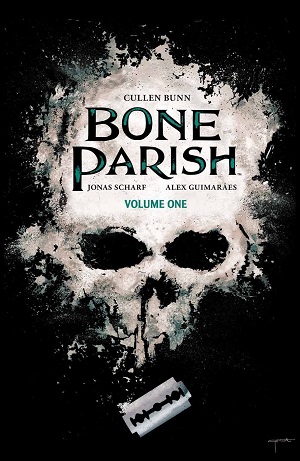
Bone Parish: Volume One

Bone Parish: Volume One

Breaking Bad meets American Horror Story. I’m sure I’m not the first person to describe it that way, but it was so obvious I managed to come up with it by myself.

The premise is nifty. A family in New Orleans is producing and selling a drug called Ash that’s made out of the remains of dead people. The high that it gives allows the user to be possessed by the spirit of whoever’s corpse they’re snorting. Or sometimes they just inhabit the dead person’s reality on an one-way trip. It’s not clear. But in any event, these altered states are evoked quite effectively in swirls of psychedelic pinks and purple haze. They can lead to epiphanic visions or go very bad.

Despite the risks in using it, Ash turns into a very popular drug and the family is soon faced with organized crime elements looking to muscle in on some of the action. Fighting back, the drug becomes weaponized, which leads to a satisfyingly gruesome conclusion.

A good story then, and one that kept me interested all the way through. I especially liked the blurring of the line between the living and the dead, and the way the family members have personal demons that are lovers. On the negative side, I thought Cullenn Bunn was a little too fond of hooking text over from one page to the next, and Jonas Scharf’s faces looked too much like masks. In fact, there was one page where I was sure Leon was wearing a mask and it took me a long time to decide that he wasn’t. Also, the big ‘gator scene seemed out of scale, which was distracting for a full-page spread. But I still enjoyed it and was definitely interested in seeing where things were going next.

Graphicalex

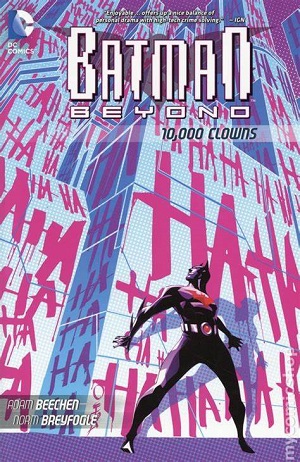
Batman Beyond: 10,000 Clowns

Batman Beyond: 10,000 Clowns

One of the defining characteristics of today’s comic book franchises is their employment of the multiverse concept. The way this works, there’s no one single Batman or Superman or Spider-Man but a host of alternative heroes of this name existing in different timelines and with different backstories and relationships. They might even die in a particular, short-lived universe and it makes no difference because all the other universes remain unaffected.

Batman Beyond is one such Batman universe, which had its beginning as a TV show and then branched into comics. The basic premise is that it’s sometime in the near future (mid twenty-first century) and Gotham is now filled with hovercars and there’s a new generation of crime-fighters and criminals afoot. Most notably, a kid (he’s 18) named Terry McGinnis, who is Bruce Wayne’s biological son, has taken over the role of Batman because Bruce is finally too old and beat-up a warhorse for the job. Meanwhile a gang of hoods dressed in clown costumes and calling themselves the Jokerz are basically a cult of you-know-who.

I liked the depth of the villains and anti-heroes here. Dana’s brother Doug is good as the violently bitter number-one son who hasn’t lived up to high parental expectations and so becomes the Joker King. The Vigilante is a bit of a bore in terms of his powers, but he’s a real person in his armoured suit. Mad Stan and his dog Boom-Boom were effective as semi-comic relief. The new Catwoman was the only real misfire here as she just looks like another robot and she wasn’t needed at all in this storyline.

So a good story then with some good new characters. I wasn’t as keen on the art, as there are some really lazy pages here, especially when the action flags. But I mainly just felt a little cool toward the whole project. In many ways it seemed like an essay on Wannabeism. Terry is a wannabe Batman and there’s a whole city full of wannabe Jokers. And in being a younger, wannabe Batman Terry basically becomes Robin, doesn’t he? I know he has to have a different look so he’s a lot skinnier and almost as rubbery as Plastic Man, but he just doesn’t have any of Batman’s weighty angst (though, to be sure, few comic-book characters do). The way he can fly now with his jet boots adds to the feeling of him just being something flightier than Batman should be. Again, it’s clearly a direction they wanted to go in, with Batman as battle tank being replaced by Terry as sleek speedster, and they try to even things out in this and other Batman Beyond titles by having Terry getting the crap beaten out of him fairly often. But in the end, and just to repeat my earlier point, he feels like Robin redux more than Batman reborn.

Graphicalex

Brave New World

Brave New World

Aldous Huxley’s Brave New World has been a popular book for nearly a century now, but its television and film adaptations haven’t been very successful. I blame the source material. While it’s a fascinating book it doesn’t lend itself to being filmed because it’s talky, and disjointed in terms of its action. Huxley himself seems to have changed his mind about some of the characters as he was going along.

I don’t think Fred Fordham overcomes any of these difficulties. A lot of illustrated classics have a bland and generic look and I didn’t think this was much different, though it sort of fit with the Fordian state itself being founded on principles of blandness and the mass production of a generic form of humanity. I also figure that the publishers probably wanted a PG rating, so the novel’s violent and pornographic passages are softened. This was kind of disappointing to me, not because of any prurient interest on my part but because I think it’s important to show how the brave new social order controls our still extant animal urges by indulging them through various surrogates.

Overall this is a very literal adaptation. Almost too literal in places. The series of conversations the World Controller Mustapha Mond (suggested to be gay, or bisexual now) has with Bernard Marx, Helmholtz Watson, and John the Savage just get transcribed in fifteen pages of dialogue bubbles. That much talk really needs some better packaging. But Fordham wasn’t given (or didn’t give himself) a lot of latitude. Though some items I didn’t remember being in the book, like Bernard and Lenina wearing full spacesuits with glass helmets when they visit the Savage Reservation in New Mexico. And I also found Lenina’s face to be disconcerting. Was she supposed to have a mask of freckles? Because it just looks like she has a really unfortunate skin rash. Meanwhile, the figure of Linda, who is grotesque in the book, is presented as being just a little overweight.

So it’s faithful and pretty thorough, but I don’t think I’d recommend it as a crib or alternative to reading Huxley. Even if many of the problems with any adaptation go back to him too.

Graphicalex


Avengers: Revelations

Avengers: Revelations

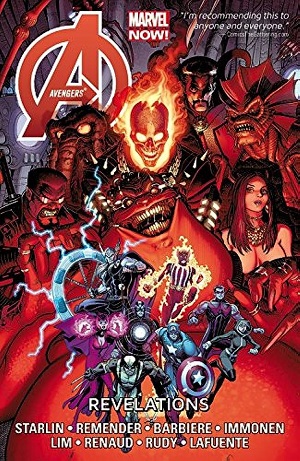
I’m not sure what the point was here, or what revelations are being referring to. What we have are four completely unrelated stand-alone comics. They’re each pretty good, but also different not only in the characters involved but also in the tone and art. So I really have to look at each separately.

Thanos Annual #1: the weakest story in the group has Thanos, just after being defeated in the fight over the Cosmic Cube, being visited by an avatar of the Thanos of the Infinity Gauntlet series who introduces him to his possible fate. Or a possible fate. Because anything is possible. Which means it’s not really fate. This was the lead-in to a new storyline but it’s all heavy breathing about infinity and eternity and the multiverse, with no action.

Uncanny Avengers Annual #1: a whole bunch of Avengers and X-Men (the Avengers Unity Division) and the Avengers of the Supernatural (their first appearance) are whisked off to the Mojoworld to be part of one of Mojo’s failing TV shows, this one with the show-stopping title “Martian Transylvania Super Hero Mutant Monster Hunter High School.” But then Ghost Rider goes off script. Lively and funny, but something about Mojo just doesn’t work for me.

New Avengers Annual #1: Dr. Strange saves a Tibetan princess who has been possessed by a demon, which he fights while having flashbacks to a past experience where he failed to save a man’s life in a brain operation. Marco Rudy’s art is the real draw here, as it gives the rather simple story an epic, phantasmagoric feel.

Avengers Annual #1: Christmas at Avengers HQ, and a loitering misfit girl starts making cos-playing doppelgangers of herself impersonating the rest of the Avengers. I thought this was the best story in the book, moving very quickly and being full of smart and funny twists. Captain America helping out at the soup kitchen was a bit hokey, but otherwise everything went down well.

Some good reading then, but a grab-bag because there’s nothing connecting any of the stories. It’s probably best taken as a sort of sampler to see if any of the titles appeals enough to hook you on them, and I think a couple might.

Graphicalex

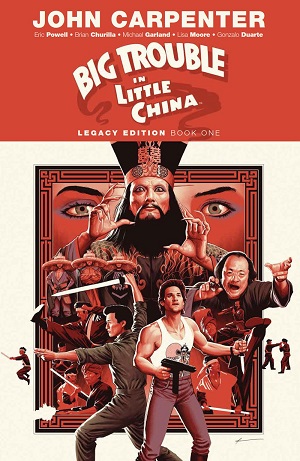
Big Trouble in Little China (Legacy Edition Book One)

Big Trouble in Little China (Legacy Edition Book One)

Ever since its cult status began to grow there’s been talk of a sequel to John Carpenter’s 1986 action flick Big Trouble in Little China. It’s never happened, but there were other spin-offs like various games (card, board, and video) as well as this comic-book series, which Carpenter himself had a hand in writing. Would a second movie, should it ever happen, be based on these comics? I don’t think so, though I’m sure they could (and likely would) do worse.

Fans of the movie will be pleased with what they’ve done here. I know I was. Things pick up literally right where the movie ends, beginning with Jack delivering his envoi from the cab of the Pork-Chop Express about what Jack Burton always says on a night when “the poison arrows fall from the sky, and the pillars of heaven shake.” Then the ape creature attacks but it turns out he’s actually bonded with Jack now. Jack calls him Pete and gives him a t-shirt and baseball cap to wear.

Before long all the rest of the original cast are in play as well. Jack’s buddy and his lady love Miao Yin (now revealed to be a kick-ass martial artist too). Egg Shen, dispensing various bits of arcane knowledge and smoke bombs. And of course Lo Pan as the evil wizard. The only character missing is Gracie Law, though she’s briefly shown to be in Tibet “campaigning for the ethical treatment of livestock” amongst some uncomprehending yak herders.

You may have figured that Lo Pan was dead at the end of the movie, and he was. But when you die in this universe you only go to one of many hells – in Lo Pan’s case it’s the Hell of Those Killed by Idiots – from whence you can be summoned back by various rites. So basically there’s a lot more supernatural action in these comics as Lo Pan and Jack shuttle back and forth from various infernal realms, bickering with each other all the way.

I think they did a great job with these comics. The art is fun, though I didn’t think Jack looked much like Kurt Russell. There’s an interesting plot filled with familiar jokes like the “Who?” “Me, Jack Burton!” exchange and lots of novel monsters and mythological beasts inhabiting the demonic realm, including a sidekick Jack adopts and names Slinky who looks a bit like Dave Sim’s Cerebus. The new wrinkles are mostly pretty good too, including some flashbacks to Jack’s disastrous early marriages (wives three and four were a vampire and a witch respectively), and a jarringly sentimental first Mrs. Burton who I didn’t think was needed. Finally, as things wind up a nice final panel introduces Jack to the twenty-first century and what are sure to be more great adventures. This wasn’t a series I was expecting much out of, but it left me looking forward to more.

Graphicalex

BRZRKR: Volume One

BRZRKR: Volume One

So this is the Keanu Reeves comic. That’s him prominently glowering on the cover, topped off with his John Wick hair styling (hey, it makes more sense, and is better marketing, than Neil Gaiman appearing as the Sandman). And that’s also Reeves with the lead writing credit. Though I don’t know how the duties were split between Reeves and co-writer Matt Kindt. This was Reeves’ first comic and Kindt is a vet.

Anyway, with Reeves being a hot property at the time it was a title that launched with a very successful Kickstarter campaign ($1.4 million) and it sold very well too. Of course, franchising wasn’t far behind and a film and anime series have both been announced. But that’s getting ahead of the story.

The Berserker (or Unute, which means weapon or tool in his ur-language) is a guy born 80,000 years ago, which is quite a ways back in terms of the evolution of modern humans. I mean, there’s no way he would have been born into an advanced tribal community like the one that’s shown here on that timeline, but I think we’re just playing around with Conan chronology. Anyway, if you’re wondering how the Big B has managed to live so long it’s because he’s the hybrid child of a human mother and maybe a god – a god who takes the form of a charge of electricity, with the moment of conception being a coital zap. When baby Unute grows up he becomes a killing machine, massacring all the enemies of his tribe and then continuing to be an ultimate, unkillable warrior down through the centuries. Or millennia.

Most of this book (collecting issues 1-4) is flashback, with the story being told by Unute to a doctor looking to unlock the secrets of the Berserker’s DNA and finding only “incongruous amino acids” and “quantum molecules” (science!). These flashbacks consist mainly of blood-soaked carnage. Unute has a thing for punching his fist right through people and tearing heads off. He even rips a horse’s head off at one point. Guts and gore are splattered everywhere, in battle scenes that recalled those in 300 only with more splatter. The Berserker himself even gets torn apart and shot up with arrows and spears and bullets, but his super healing power lets him recover quickly.

That healing power is just one of the clichés on display here, in what is a fairly conventional origin story that doesn’t have a lot of time for talk. And the character of the Berserker is also a bit dull: the warrior tired of violence who now only wants to die. 80,000 years is a long grind. Maybe they translated his name into a license plate for the title of the comic just to spice him up a bit.

But to give it its due, I thought this was a respectable kick-off. The art gets kind of slack when there’s no fighting (look at that drawing of the “undisclosed U.S. government facility”), but it really comes to life when Unute is kicking ass and tearing his enemies apart limb from limb or spattering their brain jelly all over his fists. I also got to the end thinking there was some potential here, especially if they could find a villain capable of matching Unute’s level of violence. The goal here was to leave readers wanting more, and in that respect they did their job.

Graphicalex

Batwoman: Volume 1 Hydrology

Batwoman: Volume 1 Hydrology

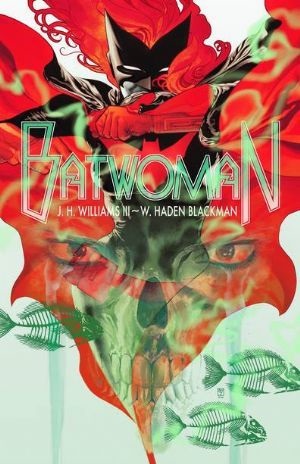
This version of Batwoman was part of DC’s New 52 reset that launched in 2011 (the “zero” issue that kicks this collection off came out in 2010, but details). As such it has to introduce us to a bunch of new versions of some old characters and define their relations to each other. This is always busy work that distracts us from any main storyline, which is what happens here. And that’s a shame because I was interested in the La Llorona plot and the whole merging of superhero and horror elements and I thought this got short shrift in the end.

Overall though I thought it was a really good comic. I did want more of the spooky La Llorona but all the world-building stuff was great. Kate Kane could have been a platform figure as a proud lesbian superhero but that part just plays as perfectly normal and not a big deal. She’s still a total sex bomb anyway, with an outfit that gives her torpedo tits with the high beams always on. The Department of Extranormal Operations feels like Hellboy’s B.P.R.D. rebranded and is a good fit for Director Bones. Batman remains a shadowy figure so he doesn’t take over, which was nice for a change. I thought the action scenes got confusing through shattered page layouts, but the fight between Flamebird and the Hook scored points for its brutal realism.

I didn’t know what to expect from this one since Batwoman isn’t a character I’ve ever followed much but Hydrology was a pleasant surprise and made me want to check out the next volume anyway. You can’t ask for much more from stuff like this.

Graphicalex

Joseph Conrad’s Heart of Darkness

Joseph Conrad’s Heart of Darkness

I don’t envy Peter Kuper taking on the challenge of adapting Heart of Darkness. It’s one of those classic works that every well-read person knows forward and back. Not only are there a half-dozen famous scenes and dramatic lines that readers will already have their own imaginative reconstruction of, but there’s also Coppola’s Apocalypse Now playing somewhere in the background. Even if Marlon Brando’s plus-sized Colonel Kurtz doesn’t correspond to the emaciated figure in Conrad, I think it likely that most people see Brando when Marlow finally gets to the Inner Station, the end of the line.

Put another way, everyone has their own Heart of Darkness and all you can really ask is that an illustrator not colour outside the lines too much. For example, Kuper takes a couple of what I think are minor items from the text and leans on them pretty heavily. First there’s Marlow’s pipe, which he’s seen handling throughout. There is I think only one reference to Marlow smoking a pipe in the Conrad’s book, and that comes in one of the moments that takes us back outside of the main narrative. At the beginning of the story he doesn’t have a pipe because both his hands are described as placed palms outward like an idol. The other image is that of crocodiles in the jungle. I believe Conrad mentions alligators (which must be wrong) only once. In any event, I didn’t think of them as having as big a presence as they do here.

There was only one point though that I strongly disagreed with. This is Kuper’s rendering of the ship shelling the coast. I think Conrad makes it clear that the shelling, like the fusillade of gunfire that the pilgrims launch into the riverside jungle later, is totally useless. The jungle is like a giant green sponge that absorbs cannon- and gunfire without being affected in any visible way. But Kuper includes a panel from the native point of view that has Africans in the jungle running away from the cannon shells. This made no sense at all to me.

The visual motif that stood out the most was that of the spiral. This is the way the sun is presented throughout, and it’s also used for people’s eyes to show madness (as with the doctor who examines Marlow before his setting out, and for Kurtz at the end). It’s also the spiral snake that is the Congo River, and so gives the impression of a vortex that’s swallowing Marlow just as it’s already consumed Kurtz. My favourite motif though was the way the jungle is presented as a tapestry of foliage of faces and figures. This wallpaper effect works especially well because there’s no sharp distinction between blacks and whites but only shades of grey, giving the forest an urban-camouflage effect.

But overall I have to say I felt a lack of punch to the proceedings. Giving “The horror! The horror!” two double-page spreads seemed like Kuper was trying too hard to make up for something he really wasn’t feeling. But then, as Marlow insists, Kurtz is a voice, and how can any narrator, or artist, render that?

So it’s a responsible adaptation, but I came away thinking Kuper wasn’t a great fit for this material, as he was for his Kafka adaptations. It seems to me that Heart of Darkness needs something like that fantastic, psychedelic note of expressionism that Coppola and cinematographer Vittorio Storaro brought to it. Conrad’s prose can be maddeningly vague and ambiguous, but (and at the same time) it can also be precise, emotionally fraught, lurid, and bombastic. I wouldn’t call Kuper’s approach conservative here, but there’s something in Conrad he wasn’t reaching.

Graphicalex

Swamp Thing: The Bronze Age Volume One

Swamp Thing: The Bronze Age Volume One

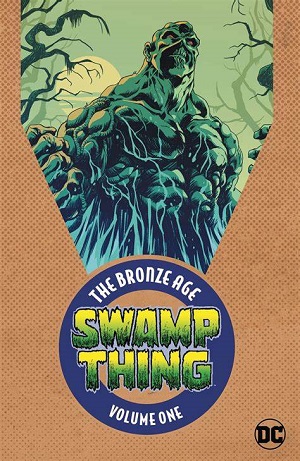
The roots of Swamp Thing, to make use of an appropriate metaphor, are in horror comics. This first Bronze Age collection actually gives us two origin stories though, with the creature’s first slightly hang-dog appearance in the DC horror/dark fantasy/mystery comic House of Secrets and then the reworked version when he was given his own series a little over a year later.

But even after rebranding as a superhero, the world he inhabited would continue to be that of genre horror. After the first issue of the regular series he’s immediately whisked away to a castle with “Caligarian corridors” that’s located in Transylvania (or Universal’s backlot, or somewhere thereabouts) where he meets the mad scientist Arcane, his Plasticine creations the Un-Men, and a Frankenstein’s monster called the Patchwork Man. Then it’s off to the Scottish moors and a date with a werewolf. Still to come are a killer robot, an alien, and even a Lovecraftian Ancient One called M’Nagalah. Somehow they skipped vampires.

That probably sounds terribly derivative, and it is, but I thought the stories were all pretty interesting, and Len Wein isn’t averse to lathering up some of that purple comic-book prose to paint a scene with. Get a load of this scene setting: “The darkness cries – a long mournful wail that writhes through the gnarled cypress branches like a breath of Hades’ wing, skipping over the placid surface of the stagnant mire below . . .” And Bernie Wrightson’s art also has a feel for the grotesque that sets the right note.

The Swamp Thing himself makes a great hero. At least he’s always been a favourite of mine. Blown up in a lab experiment, the Nobel Prize-winning scientist Alec Holland runs into the swamp, where his bio-restorative formula brings him back to life as an anthropomorphic moss-man, 89 inches tall and 547 pounds – “apparently all muscle!” Bullets don’t have any effect on him and if a limb gets sliced off it grows back in no time. I liked the idea of him not being able to communicate and so being mistaken as the monster that killed Alec Holland who then gets hunted by the series Ahab, Matt Cable, even though this later gets tossed away.

As for the wild, globe-hopping adventures, I don’t think sales were very strong and they may have just been trying to find something that would stick. There’s even a Batman cameo thrown in with one of the less fanciful episodes. You’ve always gotta work the crossovers.

In sum it’s a crazy and colourful mix of the surreal with a whack of different genre tropes, from horror to SF to dark fantasy to your standard superhero fare. You can see why so many different creators have been drawn to such a protean figure over the years, without ever being able to pin him down.

Graphicalex