Bone Parish: Volume Two

Bone Parish: Volume Two

Better than I was expecting. I’d enjoyed the first Bone Parish volume but had just recently read BRZRKR: Volume Two and it was a big letdown that I thought typical of the middle stretch of most series/trilogies. Meaning it was a bore where the story was just marking time. There’s some of that here, but Bone Parish: Volume Two mostly builds quite nicely on the original story, sort of like the second season of Breaking Bad (which is the obvious comparison to make), with the Winters family having to face ever greater threats to their drug business. I also really liked the idea of cooks for other gangs trying to reverse engineer their own brand of Ash and coming up with a bad batch that melts people into composite monsters reminiscent of The Thing. That was a great, and necessary, step up in the horror.

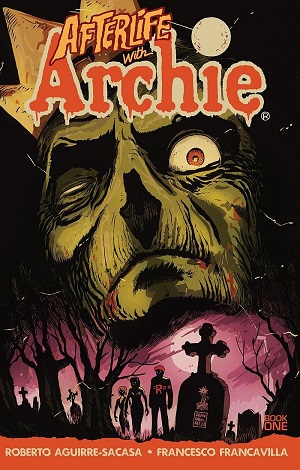
The cover is actually a variant cover for issue #3, as found in the bonus material for Volume One. It’s a good one, and pairs nicely with the cover for Volume One. The art still struck me as being hot and cold though. I still don’t like the faces, which seem further neutralized, at least in some ways, by geometric planes of shadow. But I did get a kick out of signature moments like the fly on Brae’s hand when he enters the mutant flophouse, or the biker’s face reflected in the pool of blood. Those get high marks.

A good story then, which moved things forward nicely if along predictable lines. I can really see this as a cable series now. I was only a little disappointed with how things broke off, with a series of cliffhanger moments. Again, that’s very cable series, but none of the plot points being introduced seemed very important, or were at all surprising. Still, I’m definitely on board for seeing how it wraps up.

Graphicalex

The Haunt of Fear Volume 1

The Haunt of Fear Volume 1
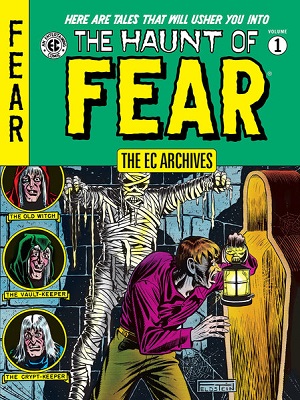
As the brief Introduction points out here, EC originally stood for Educational Comics, but they gave up on that pretty quickly in order to swap in “Entertaining.” In some of the ads included here demonstrate though, they were still selling their Picture Stories from the Bible series. I don’t know how popular those comics were, but I’m guessing somewhat less so than Tales from the Crypt.

This is the first EC Archives volume I’ll be looking at, but there will be many more. I love these stories, and the job Dark Horse has done in bringing them back in beautiful large-format packages. And now getting on with it, let’s dive in with The Haunt of Fear . . . #15?

The numbering had me confused, but gets explained in an instalment of “The Old Witch’s Niche.” Basically (if I have the story right) they started with #15 because there’d been a change of title from a previous magazine, The Gunfighter. Then, after issues #15-17 the U.S. Post Office (which ran these things) told them that their fourth issue (which would have been #18) had to be #4. So this collection includes issues #15-17 and then issues #4-6, in that order. Technically speaking, I guess The Haunt of Fear issues #1-3 don’t exist. Go figure.

There were three main EC horror imprints and they were entirely interchangeable as they used the same writers and artists and even crossed over a lot. At least I can’t tell any difference between them aside from their mascots: the Old Witch for The Haunt of Fear, the Vault-Keeper for The Vault of Horror, and the Crypt-Keeper for Tales from the Crypt. Even these three can be hard to distinguish, though the Old Witch, the last to be introduced, always looks sadder than the other two. But enough about our hosts.

Things begin with what would be an EC staple, which is ripping off classic horror tales. “The Wall: A Psychological Study” is a remix of Poe’s “The Tell-Tale Heart” and “The Black Cat,” with a hen-pecked husband walling a noisy cat up with his murdered wife. A later story, “Monster Maker,” revisits Frankenstein. Not the most original tales on offer then, but EC was pumping this stuff out on a deadline and they do at least attempt to add some new wrinkles. I’ll just comment now on a few of the stories that struck me as particularly noteworthy.

“Nightmare!”: a construction engineer keeps waking up from nightmares where he’s being buried alive. A “famous psychiatrist” named Dr. Froyd puts him on the couch and tells him these are manifestations of his feeling “buried under too much work.” Feeling cured, the engineer returns to his work site and is trapped in a frame when a bunch of cement gets poured onto him. Instead of fear he grins hysterically at what he is sure is just another dream. “Ha! Ha! Ha! Ha! C’mon! Bring on the cement!” He dies laughing.

“Television Terror!”: a reporter investigates a haunted house on a live TV broadcast, using a portable camera with a very long extension cord. Nearly the whole story (but for a bit of framing) plays out from the camera’s point of view, with things climaxing in a suitably mysterious disappearing act. October 1950, and the found-footage genre is born. The inspiration may have been a short story by H. Russell Wakefield called “Ghost Hunt,” but that was about a DJ broadcasting his night in a haunted mansion so this was the next step in the concept’s evolution.

“Horror Beneath the Streets!”: things get very meta as EC masthead figures “Al” (artist-writer Al Goldstein) and “Bill” (publisher William Gaines) are chased into the sewers by mysterious figures who turn out to be the Keepers of the Crypt and the Vault of Horror, looking for someone to publish their creepy stories.

“The Hunchback!”: he’s not really a hunchback, but a fellow who has been concealing a murderous Siamese twin. Shades of Basket Case and Malignant. Apparently the idea goes back to a Robert Bloch story from the 1930s though called “The Mannikin.”

So enjoy! Even if the lettering is crude, the stuttering and exclamation marks are overused, and the spelling has some surprising glitches. I mean, how could the writers of such material not know how to spell “cemetery”? It’s baffling. But there’s a lively spirit of gruesome fun at work throughout, with colours that really pop off the page and stories that never drag. Even the ads are worth a grin. You could subscribe to this mag for 75 cents, which got you six issues, including delivery! And who wouldn’t want to order a “Genuine Hollywood Wolf Ring” for $3.95: “Warns the girls (or boys) that you are OUT FOR NO GOOD, and they’ll LOVE YOU EVEN MORE FOR IT!” Ah-wooooo!

Graphicalex
Green Lanterns Volume 1: Rage Planet

Green Lanterns Volume 1: Rage Planet

I have to imagine the creative team at DC sitting in a boardroom pitching ideas for the new arch-enemy of Green Lantern and the Green Lantern Corps. I guess they knew he was basically going to look like Thanos, but what was his name going to be? Then someone blurted out “Atrocitus!” and there were wide smiles all around. Atrocitus! That’s gold.

Atrocitus is the leader of the Red Lanterns, who are sort of like the dark side of the Force in the Star Wars universe, running on rage instead of willpower. And, like Thanos, The Big A actually has an argument to make about why being the heavies is important: without them there would be no balance of justice in the universe and everything would just be chaos. To that end he has decided to plant a “rage seed” at the centre of the Earth that will turn into some apocalyptic rage beast when it germinates. Or something like that. As part of the same “Red Dawn” operation he’s also going to infect humanity with a “rage virus” that turns people into violent zombies. If that sounds like the rage virus in 28 Days Later, well, I guess that’s where they got it from.

Opposing Atrocitus are Simon Baz and Jessica Cruz, Earth’s two newest Green Lanterns. They’re newbies and they’ve got to learn to work together as a team because they’re forced to share the same lantern supply source. So taking on Atrocitus and the Red Lanterns is kind of a big first challenge, especially as the Justice League aren’t taking any calls.

I wish I could say I liked this more. The action art is good, and Atrocitus and his conflicted but sexy sidekick Bleez (spandex garters!?) make good villains. But I wish more had been made of the rage magma that they vomit out (another nod to 28 Days Later). If that’s the superpower of the Red Lanterns it doesn’t hold up well against the “constructs” of the Greens.

What really drags things down though is the amount of interior monologue, which is colour-coded but still hard to sort out and isn’t very interesting anyway. Jessica’s character arc is the main thing to follow, as she learns to overcome her fears and focus her willpower. This is something she takes a long time to do, and when she finally does get the hang of it it’s almost automatic.

I guess it’s OK. I liked Green Lantern when I was a kid, but this is part of the DC Universe Rebirth project and it’s a long way from what I grew up with. I thought the characters – heroes and villains – were more interesting and well-rounded than usual, but something about it left me feeling kind of cold. Maybe it was the whole “fighting to save the universe” thing getting played out again. It felt very MCU, complete with the Hell Tower functioning as a sort of portal that dragged in the usual army of mooks to do battle with. For a launch of some new heroes maybe they should have started out taking some baby steps.

Graphicalex

The Emperor’s New Clothes

The Emperor’s New Clothes

Folktales keep hanging around because the sorts of lessons they teach are timeless and universal. That said, some gain more relevance than others over the years, and I’ve always thought The Emperor’s New Clothes one of the most pertinent to our own time.

Do we still believe in the wisdom of crowds? I think it’s hard to in the present day and age. What this parable warns us against is the danger of mass delusion, or “pluralistic ignorance.” It’s a top-down phenomenon, first infecting the court, which turns out to be the easiest part. Courtiers, aware of how slippery the greasy pole of advancement is, will do anything to get along. As for the Emperor himself, the whole idea works out pretty well for him. It’s a sort of shit test for the courtiers: if they’ll go along with this, they’re likely to go along with anything.

The tailors, meanwhile, are our influencers. We know they must be good because they’re making so much money. And the scam finally takes on a life of its own. Because even when exposed (literally) the Emperor has to keep pretending. The show must go on. The kid can say what he wants; if there’s enough money at stake the illusion will continue to be propped up.

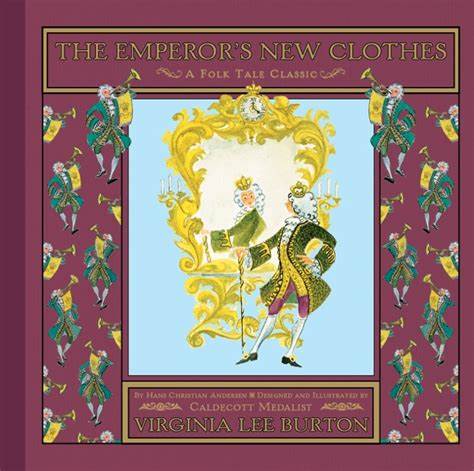
Virginia Lee Burton’s illustrations go back to 1949 but they stand up well in terms of how she conceived the story, emphasizing mirror effects. Because we don’t see ourselves as we appear in a mirror, in an accurate reflection, but only as others see us. Reality is a carnival or funhouse. And even if we know that everything about it is a lie, we’ll all still play along.

Graphicalex

The King in Yellow

The King in Yellow

The King in Yellow is a book by Robert W. Chambers first published in 1895 that is nearly as mysterious as the sinister work it takes its name from. It’s a collection of short stories, the first four of which are linked and have some connection to a fictional play, The King in Yellow, which has the effect of driving anyone who reads it crazy. In this graphic adaptation by I. N. J. Culbard it’s these first four stories – “The Repairer of Reputations,” “The Mask,” “The Yellow Sign,” and “In the Court of the Dragon” – that are represented.

I say it’s a mysterious book because despite being in the public domain and freely available on the Internet I don’t think it’s that widely read except by people interested in its influence on H. P. Lovecraft. But even Lovecraft had reservations about how good it was. As a side note of some interest, on the copyright page to this book we’re told that it’s an “Original story by H. P. Lovecraft / Adapted and Illustrated by I. N. J. Culbard.” That gives you some idea of how much cultural cachet Chambers has lost to his successor.

I don’t think much of Chambers’s book. To be honest, I never made it all the way through. So I was happy to come across this comic crib, which struck me as playing fair with the source material while having a vision of its own that nicely complements Chambers while making a fair job of stitching together the different stories. I liked the presentation of the pale, ghoulish figures who represent the King’s servants in our dimension, and could get behind the decision to switch from a first-person narrative. It’s a good comic, but at the end of it all I didn’t feel I had any greater understanding of what was going on and I still can’t say I think the original is a work of the first rank.

Graphicalex

BRZRKR: Volume Two

BRZRKR: Volume Two

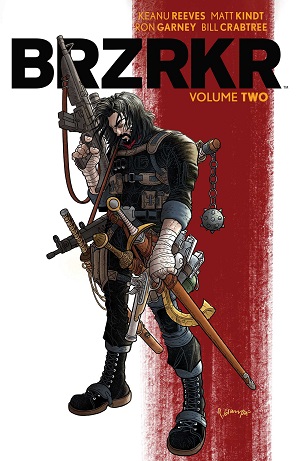
Wow, this was a big disappointment. I mentioned at the end of my notes on BRZRKR: Volume One that it set the hook well and left me wanting more, but I can’t even give the issues collected here credit for giving readers more of the same. It’s just less of the same, if that makes sense.

The main thing I was left wanting after the first volume was a supervillain who matched up against Unute’s awesome strength and unkillability. Well, that doesn’t happen. In fact, there is no villain at all in this part of the story, unless you count Caldwell, the shady (and very familiar) government scientist who is researching into the secret of Unute’s power so that he can clone an army of Berserkers. Or Brzrkrs. This is all what’s known as . . . wait for it . . . Project X.

That’s such a tired storyline, and there’s nothing interesting done with it here. Meanwhile, there’s nothing added to Unute’s backstory either aside from the suggestion that his powers didn’t come from a sky god but some alien intelligence. It’s all left pretty murky. Murkier even than it was in the first volume, which is part of what I mean when I say this is all less of the same.

There’s also less bloody action, and indeed the only action at all is in the first section. But it’s not as gory and over-the-top and the scene where Unute (or “B,” as he is more often referred to) is drawn and quartered, only to be inevitably reconstituted later, just struck me as silly. I don’t even want to go on. There’s no story here at all but only four issues of a comic spinning its wheels and getting nowhere – which is the usual middle stretch of any trilogy – with art that wasn’t selling me on the boring highlights. I guess you need a double-page spread for the explosion we’ve been counting down to from the opening frame, but . . . it’s just an explosion in the desert. We’re left with a “to be continued” but I don’t know if I’m in for any more as the whole thing seems to have run into a ditch.

Graphicalex

Gotham City Monsters

Gotham City Monsters

I really enjoyed this one, though not in the way I was expecting.

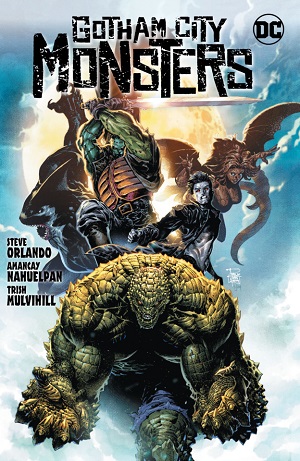
The set-up has an assemblage of anti-heroes/supervillains in Monstertown, which is a seedy part of Gotham inhabited by . . . you guessed it, monsters. The line-up has Frankenstein basically as the leader, Killer Croc (though he gets mad if you say “Killer”), Andrew Bennett (I, Vampire – yes, that’s his name), Lady Clayface (or just Lady Clay), Orca, and Red Phantom. Batwoman also joins forces with them in a marriage of convenience.

The menfolk are by far the most interesting characters here, as they have some depth and are to varying degrees possessed by inner demons and conflicted. Lady Clay seemed kind of unformed to me, Batwoman is just a cameo, and Orca I found absolutely ridiculous. Are those supposed to be boobs or pecs on her “chest”? I guess she’s the equivalent of King Shark from the Suicide Squad, and since this really feels like a slightly different version of the Squad – Croc, a member of that group, even says “Perfect, another squad!” at one point – I guess she fits in. But she’s just more muscle.

The group dynamics are nothing special. And the plot is that old stand-by of a villain – here it’s Melmoth the Magician and his army of magma Martian mandrills – using an ancient tome (the Undying Crime Bible) to destroy the multi-metaverse. Can the Monster Squad stop him in time?

Well of course they can, and they do. But getting there is still lots of fun, and gory fun at that. Things get off to a good start with Frankie cutting I, Vampire in two with his sword. Then later, in a face-off between the good monsters and the Monster League of Evil (yet another squad, from another part of the multiverse), we see Red Phantom exploding out of the body of a bad-guy vampire while Frankie decapitates bad Frankenstein with a killer punch. This is what they mean, I think, when they talk about comics becoming more adult. They’re not adult in any dramatic or literary sense, nor do they deal with sex frankly. Adult just means more gore.

So why did I like it? First off, Mephisto is a good villain: a showman and nutty as a fruitcake. I couldn’t be sure why he wanted to destroy the multi-metaverse, or even if that was what he was really aiming for, but he seemed to be having a good time ordering his monkey-men around and slaughtering the innocent. The other thing I liked was the overall atmosphere. Monstertown has a vibe all its own and I was grooving to it. I thought more could have been done along the lines of a sort of Universal Horror meets League of Extraordinary Gentlemen mash-up, but this was still a good time in a pulpy way that had me interested in seeing more of these guys.

Graphicalex

All New X-Men: Yesterday’s X-Men

All-New X-Men: Yesterday’s X-Men

I read this just after finishing the first Marvel Masterworks X-Men volume, which turned out to be a help. That’s because what happens here is that the original/classic X-Men are brought via time machine into the present day (post Avengers vs. X-Men storyline) by Dr. Hank McCoy, where they have to square off against the rogue Scott Summers/Cyclops. So having the X-Men’s origins fresh in mind helped me understand the teenage X-Men characters and their motivations a little better. Plus there’s actually a scene here set in an earlier comic (it’s from X-Men #8, which came out in 1964) that I only remembered because it was included in the Masterworks volume. I thought that was neat.

The old X-Men (who are, paradoxically, the “all-new” X-Men) facing off against the formerly new X-Men (or what’s left of them) makes for a showdown with lots of dramatic potential. How will the old X-Men deal with what’s happened to them? What will Scott Summers do when he confronts himself? How will Cyclops and Wolverine react to seeing Jean Grey (a teenage Jean Grey!) come back to life? You won’t have to wait long to find out!

A great concept then, and Brian Michael Bendis delivers a solid story with lots of interesting wrinkles, like young Hank McCoy trying to save old Hank McCoy’s life by way of a psychic link provided by Jean where the two McCoys can talk to each other. Alas, some stuff, like the young X-people who are introduced, aren’t as interesting, however necessary they may be to the story. But overall I thought this was a great launch for the “all-new” series. The only thing that really got on my nerves was the “AR” codes that appeared on several of the pages. Apparently these can be scanned on your phone using some Marvel app giving you bonus features. So sort of like Easter eggs on a DVD, except they’re marked for you. The AR stands for Augmented Reality (sheesh) and apparently it represents “the future of comics in action!” Spare me. And spare the comics being stamped with these annoying logos.

(As a footnote, it’s interesting that in X-Men #100, written by Chris Claremont and appearing all the way back in 1976, the story involved a showdown between old X-Men and new, though it was revealed in that comic that the old X-Men were actually X-Sentinel robots. The idea has a history then.)

Graphicalex

Batman: Cacophony

Batman: Cacophony

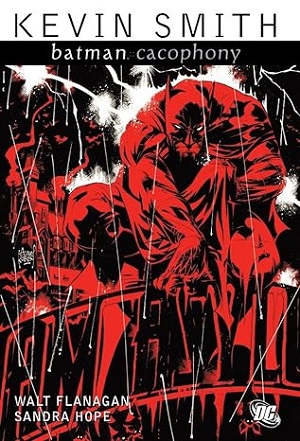
A banner across the top of the cover says KEVIN SMITH. This is in even bigger lettering than the title which is immediately beneath it. So you can call it a Kevin Smith production. Indeed, it demands you call it that.

There’s nothing wrong with a comic trying to cash in on a celebrity name (think of Keanu Reeves and BRZRKR), and since Smith is a sometimes able screenwriter and die-hard comic fanboy, I didn’t go into this one with any misgivings or, for that matter, particularly high expectations.

Smith himself is self-deprecating about his efforts in his Introduction. “By series’ end, I realized it wasn’t the best Batman story I could write; nor was it Walt’s finest hour.” Walt being Smith’s buddy and series artist Walt Flanagan. The most he’ll say for Cacophony is that it provided useful experience for his later efforts. So that’s setting a pretty low bar.

I thought it was just OK. Only three issues, so there wasn’t much there. The storyline has Onomatopoeia (a Kevin Smith supervillain creation) breaking the Joker out of Arkham Asylum so that together they can hunt down Batman. Or at least I think that was the plan. Ono doesn’t say much and needless to say things don’t work out.

If the story is a weak sauce at least the writing has some of Smith’s distinct personality and brand of humour. Which is either a good or a bad thing, depending on how big a fan you are. And so the Joker is a mouthpiece for various semi-obscure cultural references, and even a couple of Maxie Zeus’s security guards get into an argument over the original Clash of the Titans. For the most part I thought this stuff fell flat. When the Joker says at the end that “I’m Glover, Circle Jerk’s Mel, Broodin’-Ruben’s Busey, and this is the end of Lethal Weapon,” I just couldn’t figure the comparison out. Nor could I understand the Joker’s big line at the end about how “I don’t hate you [Batman] ‘cause I’m crazy . . . I’m crazy ‘cause I hate you.” These are just words. Then there’s also some politics thrown into the mix, mainly in the opening pages where a lack of funding has made Arkham Asylum even easier to break into and out of. I did love Maxie Zeus saying that he’s done a lot of good with “some of the profits” from his drug operation (a philanthropist very much in the modern mode), but the Joker’s fascination with Ayn Rand’s The Fountainhead was another joke that went over my head. And I wasn’t sure what to make about the television broadcast being presented out of its original order the second time it’s played. Was that a mistake or was I missing something?

The art too was just OK. It looks quite generic. Action is handled pretty well, but Flanagan has a lot of trouble with Bruce Wayne’s face the few times we see it. The Joker’s sad excuse for a beard though is memorable.

Not a write-off or a disaster then, but nothing very special about it either. I got the feeling Smith wanted to go a little deeper into the Batman-Joker connection, but that’s been done so many times now that he really doesn’t have much to add. As comics go it’s the sort of thing that might leave you curious to see more, but not necessarily eager. Nevertheless, Smith does promise that he was getting better and learning on the job so I’ll probably check in later to see how that turned out.

Graphicalex

Afterlife with Archie: Escape from Riverdale

Afterlife with Archie: Escape from Riverdale

This is the title that launched the Archie Horror imprint due to its boffo success both critically and with a wide audience. And I don’t find that success surprising as I loved it in almost every way.

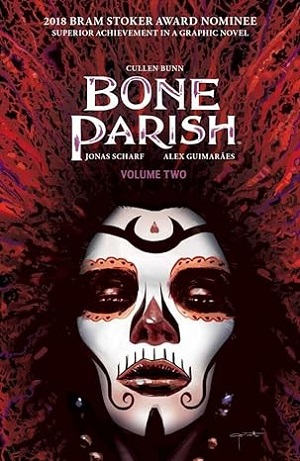
The idea grew out of a parody Life with Archie cover by Francesco Francavilla that had Archie being confronted with zombie versions of Jughead, Betty, and Veronica. This seemed like such a good idea, they decided to make a whole comic out of it. Because this was the time of peak zombie and zombies were going well with everything. Pride and Prejudice and Zombies (the novel) had come out a few years earlier and been a smash success, quickly followed up by a major motion picture. Such mash-ups thrive on the incongruity of high-culture being mixed with low, or in this case a wholesome American town turned into an abattoir. After a while, and really it didn’t take long, the joke got stale. But some really good work came out of it too.

Afterlife with Archie is really good. Things kick off naturally enough at Riverdale High’s Halloween dance, and just before the zombie outbreak begins we get a lot of insider jokes keyed to horror movies, which is very much in the manner of these things. Pet Sematary, for example, is referenced because the apocalypse is triggered by Sabrina the Teenage Witch raising Jughead’s beloved Hotdog from the dead, with predictably disastrous results. The seminal text Night of the Living Dead gets a nod in a flashback with Mr. Weatherbee horning after Miss Grundy. Dilton Doiley is the nerdy character from the Scream franchise who knows how horror movies are supposed to play out. And so it goes.

From here we’re taken through the familiar run of zombie incidents. The infected person who tries to brush it off as no big deal. The siege, this time in stately Lodge Manor no less, and subsequent breakout. The confrontation with transformed loved ones. Now you’d think, or at least I would have thought, that none of this was all that interesting or new, and on one level I guess it isn’t, but I still enjoyed it immensely. Writer Roberto Aguirre-Sacasa, who was the main force behind the TV series Riverdale, adeptly brings the Archie brand into a sort-of real world, fleshing out the main characters just before they start eating flesh. In terms of their appearance they’ve changed a lot from their traditional look – Archie in particular is unrecognizable but for his red hair, and Jughead but for his cap and “S” sweater – but you can actually buy into them as real teenagers. Some liberties are taken with the fringe Riverdalers – Ginger Lopez and Nancy Woods are romantically involved, and Cheryl and Jason Blossom have some kind of incestuous attachment hinted at – but I didn’t know these people anyway.

Poor Jughead: Patient Zero or “Jugdead” here and made into a werewolf in the Jughead: The Hunger series. It’s hard being the odd man out in any gang, and I guess he always was. Were these transformations his revenge? I think that’s something in the mix.

So yes, I loved it. Enjoyed nearly every page of it. And a special shout out for some great lettering by Jack Morelli. The only misstep that registered was the business with Archie’s dog Vegas (I don’t remember him from the comics). I thought they should have skipped that part. But even that might have had a purpose, making me wonder if there was maybe a connection being drawn between his doggy devotion to his master and the Lodge butler Smithers (an ancestor of Waylon Smithers in The Simpsons?) with his sense of duty toward his Mistress Veronica. I liked being drawn into these kinds of conjectures, and they weren’t what I was expecting from an Archie zombie comic. Well done!

Graphicalex