Birches

Birches

Robert Frost is one of my favourite poets. I think he’s a favourite poet for a lot of people. A few years back (well, I guess it was a quarter-century ago, because time does fly) the American poet laureate Robert Pinsky ran something called the Favorite Poem Project and Frost had a half dozen poems in the mix, with “The Road Not Taken” being the clear winner among the more than 18,000 entries.

“Birches” isn’t quite as well known, but it’s still popular among what the critic David Orr refers to as Frost’s two audiences: poetry devotees and the great mass of readers. To these two (obviously not mutually exclusive) groups I’d add a third: those versed (as Frost would put it) in country things. This seems obvious to me because I grew up on a farm, close to nature. This was both a good and a bad thing, as Frost himself knew, but more than that it’s also a very rare thing in today’s world. I think something like 5% of the current population of North America grew up on farms. So most people aren’t versed, or at least as versed, in country things.

When I read “Birches” I like what it gets right. Like when, after a storm, the trees are encased in an enamel of ice that melts in the next day’s sun, the “crystal shells / Shattering and avalanching on the snow crust.” Why the snow crust? Because there’d been an ice storm and that means the surface of the snow is a hardened carapace that the broken ice bounces off. Or take the whimsical evocation of “some boy”

As he went out and in to fetch the cows – Some boy too far from town to learn baseball,
Whose only play was what he found himself, Summer or winter, and could play alone.

Damn. That really was me growing up. Even walking out to fetch the cows.

I mention all this only as a way of bringing up the fact that I have never heard of anyone riding birches the way Frost describes the activity here. I even have trouble imagining how it would be possible. I looked on the web and couldn’t find any videos of it. And more to the present point, despite it being what the poem is, on the surface, “about,” Ed Young doesn’t illustrate any kids doing it. Perhaps he didn’t know what it looked like either.

What Young’s paintings do re-create is the peculiar forest camouflage of the distinctly patterned birch trees. The way their short horizontal stripes balance the long verticals of their trunks and the spangle of their canopy, a very dome of sky flecked with shimmering fire. And of course there are those country things, like bringing in hay and walking the dog. This is the landscape and poetryscape of memory, if you were there. The past is another version of the poem’s vision of heaven that we can climb toward, if only to be dropped gently back to earth. And I can’t say I’d mind being snatched away to such a place, not to return.

Graphicalex

Grass Kings: Volume One

Grass Kings: Volume One

Comics, with their serial publication, seem especially fond of self-contained communities containing a full slate of recurring characters. L’il Abner and his hillbilly cousins in Dogpatch. Archie and the gang in Riverdale. Asterix and the village of indomitable Gauls. Springfield and the Simpson family. The Grass Kingdom – so named, I assume, because of its location on the prairies rather than its status as a grow-op – is a similar sort of place. It’s a scrappy (built out of scrap, looking for a fight) village vaguely located somewhere in the American (or Canadian) West. In this first volume we’re introduced to all the locals: the three brothers who constitute the kingdom’s first family, the sniper in the tower, the author, the pilot, the guy who sells the booze, etc. I don’t see where or how there’s a functioning economy, or even how everyone manages to stay fed, but they seem to get by as a group of people living together apart: “a closed community, running of the grid,” armed to the teeth and apparently left to their own devices by the distant gubmint.

For all its familiarity, I found the setting quite unique. In a similar way, the story feels put together out of borrowed bits and pieces, but taken as a whole it’s something very different. A woman rises out of the lake and her husband, sheriff of a neighbouring town, wants to take her back. She is reluctant, and violence breaks out. While this is all taking place in the present there are flashbacks that build up a subplot involving a serial killer living in the kingdom, and deeper historical dives that make the place out to be a sort of temporal nexus for violence over the centuries, or indeed millennia. This in turn plugs the story into archetypal narrative forms like myth, romance, and folktale, and we needn’t be surprised that scenes like the woman rising from the lake will be followed up by fire-breathing dragons flying around. That’s one way of saying this is a timeless tale, with the battle between the kingdom and the town of Cargill being like an episode in the Trojan War.

So hats off to Matt Kindt for the concept here, and the artwork of Tyler Jenkins makes a good match with its sketchy outlines and washes of watercolour nicely evoking the dreamlike atmosphere. Jenkins also draws horses well. The only pictures I felt he was pulling up short on were the police car being riddled with bullets and the bomb being dropped on the town. I didn’t think those kind of big, explosive moments were a good match for his light, almost transparent style.

I thought the characters needed to be a bit fuller, and there’s really too much going on, but for its world-building and multi-layered plot I’d give this high marks and a hearty recommendation. It’s one of the few comics I’ve read recently that I immediately went back through and read again, and it left me interested in seeing where it would be going next.

Graphicalex

Plunge

Plunge

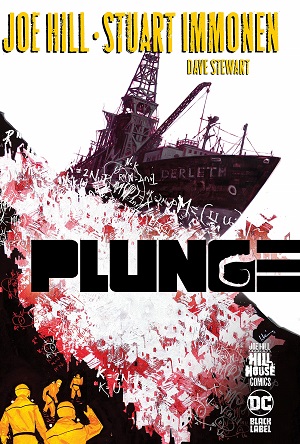
The back cover calls this a “surreal and gory celebration of ‘80s horror” but while I was picking up clear vibes of Deep Star Six and Leviathan (not to mention the more recent Underwater) the supplementary interviews with writer Joe Hill included in this edition make clear the story was mainly meant as an homage to John Carpenter’s The Thing crossbred with H. P. Lovecraft’s Cthulhu mythos.

There’s maybe too much going on here (a Walkman that reads minds?) and there’s a bit of a sense that the story was getting away from Hill at the end, but overall it’s pretty darn solid. Even stock characters like the treacherous corporate flunky (a stand-by in the films of the period) worked well. But I especially liked the fraternal relationships and how they played out. It’s a little thing, but an effective twist on the clichéd business of having the sexy marine biologist turn out to be a romantic interest. I was glad that didn’t happen (again). Also good was the way the alien worms scaled: they’re threatening at both the micro and the macro level. Finally, the art by Stuart Immomen gives us an authentic ‘80s horror vibe of practical gore effects but with its own dark and distinctive look. A comic that’s hard to find fault with then, and one that didn’t disappoint on any level. First-rate stuff.

Graphicalex

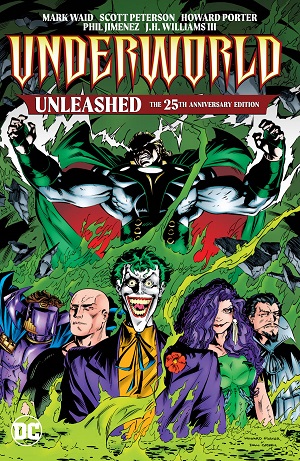
Underworld Unleashed

Underworld Unleashed: The 25th Anniversary Edition

I started out loving it. The first issue of the original three-issue miniseries was great, setting the table perfectly. We’re introduced to Neron, a demon lord who is going around collecting souls and taking them to hell. His plan is to power-up all the world’s greatest supervillains in exchange for their souls, which will lead to planet-wide chaos. Among his “inner council” are the Joker and Lex Luthor. It’s a great start and I was expecting great things from it.

I kept my hopes up even after the main storyline was derailed by the introduction of the four standalone issues. The first of which takes place on the planet Apokolips and required stuffing what felt like the entire history of Game of Thrones into a couple of pages of exposition. Unless you’re up to speed already on that whole bit of world building you may feel a bit discombobulated.

I didn’t mind these change-ups that much. I felt the crossovers might have helped to tell a coherent larger story. Only they don’t. There’s another inter-story that has Neron making more trouble in Arkham Asylum for Batman, but since he’d already broken Belle Reve Prison wide open in the first issue this seemed repetitive. This Arkham story was good as a standalone, but not as part of a through narrative. I was also really disappointed by the final issue, which had Barbara Gordon trying to figure out who was behind all the outbreaks of violence and being interrupted by Neron. Most of this issue was just profiles of all the baddies that Neron had recruited, and nothing was at stake since even Neron knew that Babs wasn’t going to go for his deal.

Then the climactic episode of the main story fizzled because it turns out that Captain Marvel/Shazam was the key to Neron’s plan but we hadn’t been prepared for this at all (Captain Marvel hadn’t even been seen anywhere in the series before this) and Neron ends up being defeated kind of easily, with no help from the army of souls he’d been acquiring. Indeed, after the first issue I think we only hear from the Joker and Luthor again briefly as they’re attempting to figure out the source of Neron’s power, which is another point that never pans out as being of any significance.

Still, if I had to give this an overall grade it would be pretty high. There’s so much good, original stuff in here, and I like the changes in art across the different stories, even if in the end things just don’t add up as well as I thought they should have and it felt like a lot got left on the table.

Graphicalex

Old Man Logan 1: Berserker

Old Man Logan 1: Berserker

I guess one thing to say first off is that while this series is said to have been an inspiration for the 2017 movie Logan, the two don’t have anything in common except for an aging Wolverine. So if you hated that movie, you still might like the comics. Or not.

Anyway, I’ve said before how the multiverse became what defines superhero comics in the twenty-first century, and Old Man Logan provides yet another instance. In this alternative universe (it’s bar-coded as  Earth-807128) there has been a “supervillain uprising” that has seen the good guys all but wiped out and the Red Skull become president of the United States. Logan/Wolverine is now a homesteader in a version of the Wild West where the Hulk Gang (the degenerate offspring of Bruce Banner and She-Hulk) are running roughshod over everyone. Then somehow Logan gets sent back in time to our present day, a timeline where he memorably died and where he now takes it as his mission to prevent the grim future state of the supervillains from occurring. But if we believe in the whole idea of a multiverse with an infinity of variant worlds and timelines, this strikes me as Quixotic. Which, to be fair, is a point that’s raised here.

I like the basic idea of the superhero as retiree. Older readers in particular will be able to relate. There’s also a sort of Watchmen vibe going on, with Wolverine representing the Marvel O.G. against new incarnations of familiar names. I was nodding in agreement with Logan’s complaint about the 50 shades of Hulk and how that character “changes more than the moon. Grey, green, dumb, smart.” I also thought Andrea Sorrentino’s art really handled the action well, with lots of original signature panels and a style that evoked a world burnt-out with violence. Logan’s face is lined with what may be as many wrinkles as scars, looking like a map scratched out on parchment.

What I didn’t like was the whole idea of being thrown into another weird timeline I didn’t feel connected to in any way. Still, Jeff Lemire’s story here was good and the characters interesting if motivated in a rather dull way (the film that Logan took its cue from was Shane, while this comic draws from The Searchers). Also included in this volume is a standalone story set in the alternate-universe West where Wolverine takes out the Hulk Gang and the Hulkster himself in a gory series of showdowns (which was the climax of the original Old Man Logan arc). But of course if he could have done that in the first place, why the need to go back into the past to hunt Banner down there? Or maybe he did. None of these temporal paradoxes make sense.

Having said all that, the strength of the multiverse, and precisely what made it so popular at this time, is its ability to spin tired franchises off in strange new directions, which it does again here. The result is something different, and a pretty good comic in its own right.

Graphicalex

Bartman: The Best of the Best

Bartman: The Best of the Best

The Simpsons comics are like the TV show in that they keep things remarkably fresh despite the uniform nature of the product. This mini-anthology collects three Bartman stories. I can’t vouch for their being the best of the best, but all three are pretty good, with some funny jokes in the familiar Simpsons manner, a few smiles, and decent storylines. In the first, Bartman discovers that the delinquent crew (Jimbo, Dolph, and Kearny) have a summer-work scam of selling deliberately misprinted comic books. In the second, our hero takes on a vigilante rule-enforcer calling himself the Penalizer (one guess who that is). And in the best, longest, and last story the aliens Kodos and Kang release Itchy and Scratchy from televised reality and into the real world, which has various knock-on effects, including a nuclear explosion that turns the citizens of Springfield into superheroes/villains (Homer becomes the Indigestible Bulk, Krusty the Jokester, Moe = Barfly, and Groundskeeper Willie turns into the Plaid Piper). Bartman has to then release Radioactive Man himself to get everyone back in the box.

But while the writing is solid in the whimsical Simpsons house style, I thought the art (which is also very much in the house style of the show) the weakest of any of the Simpsons comics I’ve read. There were some really lazy panels, like one in particular of Mr. Burns jumping into the arms of Smithers, and Springfield occasionally looks as barren as Tintin-land without the ligne claire. You can almost see that as being an in-joke, as Bartman is a character that sends up comic culture and its industrial, franchise nature even more than usual for a Simpsons title. Almost, but not quite. I think they were probably just in a rush.

Graphicalex

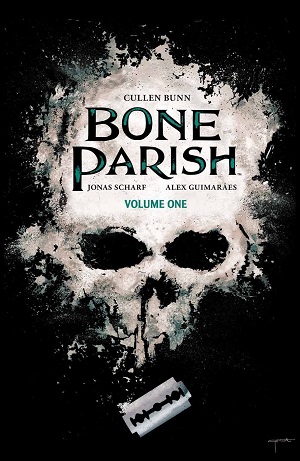
Bone Parish: Volume One

Bone Parish: Volume One

Breaking Bad meets American Horror Story. I’m sure I’m not the first person to describe it that way, but it was so obvious I managed to come up with it by myself.

The premise is nifty. A family in New Orleans is producing and selling a drug called Ash that’s made out of the remains of dead people. The high that it gives allows the user to be possessed by the spirit of whoever’s corpse they’re snorting. Or sometimes they just inhabit the dead person’s reality on an one-way trip. It’s not clear. But in any event, these altered states are evoked quite effectively in swirls of psychedelic pinks and purple haze. They can lead to epiphanic visions or go very bad.

Despite the risks in using it, Ash turns into a very popular drug and the family is soon faced with organized crime elements looking to muscle in on some of the action. Fighting back, the drug becomes weaponized, which leads to a satisfyingly gruesome conclusion.

A good story then, and one that kept me interested all the way through. I especially liked the blurring of the line between the living and the dead, and the way the family members have personal demons that are lovers. On the negative side, I thought Cullenn Bunn was a little too fond of hooking text over from one page to the next, and Jonas Scharf’s faces looked too much like masks. In fact, there was one page where I was sure Leon was wearing a mask and it took me a long time to decide that he wasn’t. Also, the big ‘gator scene seemed out of scale, which was distracting for a full-page spread. But I still enjoyed it and was definitely interested in seeing where things were going next.

Graphicalex

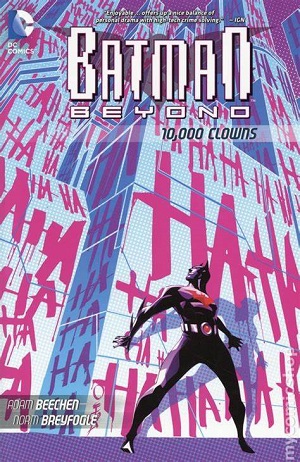
Batman Beyond: 10,000 Clowns

Batman Beyond: 10,000 Clowns

One of the defining characteristics of today’s comic book franchises is their employment of the multiverse concept. The way this works, there’s no one single Batman or Superman or Spider-Man but a host of alternative heroes of this name existing in different timelines and with different backstories and relationships. They might even die in a particular, short-lived universe and it makes no difference because all the other universes remain unaffected.

Batman Beyond is one such Batman universe, which had its beginning as a TV show and then branched into comics. The basic premise is that it’s sometime in the near future (mid twenty-first century) and Gotham is now filled with hovercars and there’s a new generation of crime-fighters and criminals afoot. Most notably, a kid (he’s 18) named Terry McGinnis, who is Bruce Wayne’s biological son, has taken over the role of Batman because Bruce is finally too old and beat-up a warhorse for the job. Meanwhile a gang of hoods dressed in clown costumes and calling themselves the Jokerz are basically a cult of you-know-who.

I liked the depth of the villains and anti-heroes here. Dana’s brother Doug is good as the violently bitter number-one son who hasn’t lived up to high parental expectations and so becomes the Joker King. The Vigilante is a bit of a bore in terms of his powers, but he’s a real person in his armoured suit. Mad Stan and his dog Boom-Boom were effective as semi-comic relief. The new Catwoman was the only real misfire here as she just looks like another robot and she wasn’t needed at all in this storyline.

So a good story then with some good new characters. I wasn’t as keen on the art, as there are some really lazy pages here, especially when the action flags. But I mainly just felt a little cool toward the whole project. In many ways it seemed like an essay on Wannabeism. Terry is a wannabe Batman and there’s a whole city full of wannabe Jokers. And in being a younger, wannabe Batman Terry basically becomes Robin, doesn’t he? I know he has to have a different look so he’s a lot skinnier and almost as rubbery as Plastic Man, but he just doesn’t have any of Batman’s weighty angst (though, to be sure, few comic-book characters do). The way he can fly now with his jet boots adds to the feeling of him just being something flightier than Batman should be. Again, it’s clearly a direction they wanted to go in, with Batman as battle tank being replaced by Terry as sleek speedster, and they try to even things out in this and other Batman Beyond titles by having Terry getting the crap beaten out of him fairly often. But in the end, and just to repeat my earlier point, he feels like Robin redux more than Batman reborn.

Graphicalex

Brave New World

Brave New World

Aldous Huxley’s Brave New World has been a popular book for nearly a century now, but its television and film adaptations haven’t been very successful. I blame the source material. While it’s a fascinating book it doesn’t lend itself to being filmed because it’s talky, and disjointed in terms of its action. Huxley himself seems to have changed his mind about some of the characters as he was going along.

I don’t think Fred Fordham overcomes any of these difficulties. A lot of illustrated classics have a bland and generic look and I didn’t think this was much different, though it sort of fit with the Fordian state itself being founded on principles of blandness and the mass production of a generic form of humanity. I also figure that the publishers probably wanted a PG rating, so the novel’s violent and pornographic passages are softened. This was kind of disappointing to me, not because of any prurient interest on my part but because I think it’s important to show how the brave new social order controls our still extant animal urges by indulging them through various surrogates.

Overall this is a very literal adaptation. Almost too literal in places. The series of conversations the World Controller Mustapha Mond (suggested to be gay, or bisexual now) has with Bernard Marx, Helmholtz Watson, and John the Savage just get transcribed in fifteen pages of dialogue bubbles. That much talk really needs some better packaging. But Fordham wasn’t given (or didn’t give himself) a lot of latitude. Though some items I didn’t remember being in the book, like Bernard and Lenina wearing full spacesuits with glass helmets when they visit the Savage Reservation in New Mexico. And I also found Lenina’s face to be disconcerting. Was she supposed to have a mask of freckles? Because it just looks like she has a really unfortunate skin rash. Meanwhile, the figure of Linda, who is grotesque in the book, is presented as being just a little overweight.

So it’s faithful and pretty thorough, but I don’t think I’d recommend it as a crib or alternative to reading Huxley. Even if many of the problems with any adaptation go back to him too.

Graphicalex


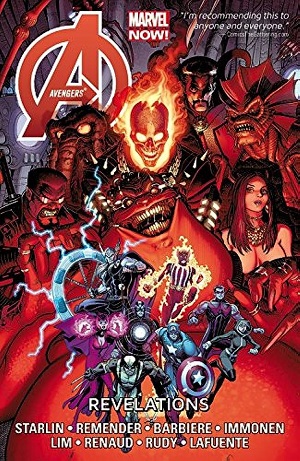
Avengers: Revelations

Avengers: Revelations

I’m not sure what the point was here, or what revelations are being referring to. What we have are four completely unrelated stand-alone comics. They’re each pretty good, but also different not only in the characters involved but also in the tone and art. So I really have to look at each separately.

Thanos Annual #1: the weakest story in the group has Thanos, just after being defeated in the fight over the Cosmic Cube, being visited by an avatar of the Thanos of the Infinity Gauntlet series who introduces him to his possible fate. Or a possible fate. Because anything is possible. Which means it’s not really fate. This was the lead-in to a new storyline but it’s all heavy breathing about infinity and eternity and the multiverse, with no action.

Uncanny Avengers Annual #1: a whole bunch of Avengers and X-Men (the Avengers Unity Division) and the Avengers of the Supernatural (their first appearance) are whisked off to the Mojoworld to be part of one of Mojo’s failing TV shows, this one with the show-stopping title “Martian Transylvania Super Hero Mutant Monster Hunter High School.” But then Ghost Rider goes off script. Lively and funny, but something about Mojo just doesn’t work for me.

New Avengers Annual #1: Dr. Strange saves a Tibetan princess who has been possessed by a demon, which he fights while having flashbacks to a past experience where he failed to save a man’s life in a brain operation. Marco Rudy’s art is the real draw here, as it gives the rather simple story an epic, phantasmagoric feel.

Avengers Annual #1: Christmas at Avengers HQ, and a loitering misfit girl starts making cos-playing doppelgangers of herself impersonating the rest of the Avengers. I thought this was the best story in the book, moving very quickly and being full of smart and funny twists. Captain America helping out at the soup kitchen was a bit hokey, but otherwise everything went down well.

Some good reading then, but a grab-bag because there’s nothing connecting any of the stories. It’s probably best taken as a sort of sampler to see if any of the titles appeals enough to hook you on them, and I think a couple might.

Graphicalex