BRZRKR: Volume Two

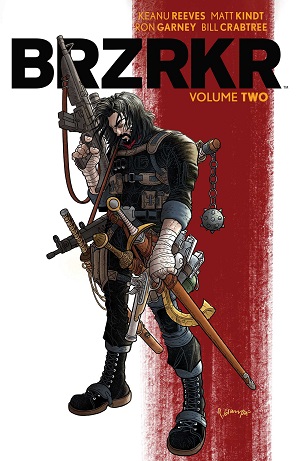
BRZRKR: Volume Two

Wow, this was a big disappointment. I mentioned at the end of my notes on BRZRKR: Volume One that it set the hook well and left me wanting more, but I can’t even give the issues collected here credit for giving readers more of the same. It’s just less of the same, if that makes sense.

The main thing I was left wanting after the first volume was a supervillain who matched up against Unute’s awesome strength and unkillability. Well, that doesn’t happen. In fact, there is no villain at all in this part of the story, unless you count Caldwell, the shady (and very familiar) government scientist who is researching into the secret of Unute’s power so that he can clone an army of Berserkers. Or Brzrkrs. This is all what’s known as . . . wait for it . . . Project X.

That’s such a tired storyline, and there’s nothing interesting done with it here. Meanwhile, there’s nothing added to Unute’s backstory either aside from the suggestion that his powers didn’t come from a sky god but some alien intelligence. It’s all left pretty murky. Murkier even than it was in the first volume, which is part of what I mean when I say this is all less of the same.

There’s also less bloody action, and indeed the only action at all is in the first section. But it’s not as gory and over-the-top and the scene where Unute (or “B,” as he is more often referred to) is drawn and quartered, only to be inevitably reconstituted later, just struck me as silly. I don’t even want to go on. There’s no story here at all but only four issues of a comic spinning its wheels and getting nowhere – which is the usual middle stretch of any trilogy – with art that wasn’t selling me on the boring highlights. I guess you need a double-page spread for the explosion we’ve been counting down to from the opening frame, but . . . it’s just an explosion in the desert. We’re left with a “to be continued” but I don’t know if I’m in for any more as the whole thing seems to have run into a ditch.
Graphicalex

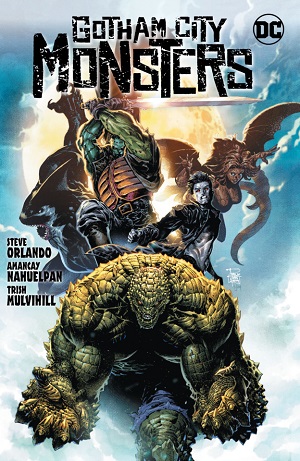
Gotham City Monsters

Gotham City Monsters

I really enjoyed this one, though not in the way I was expecting.

The set-up has an assemblage of anti-heroes/supervillains in Monstertown, which is a seedy part of Gotham inhabited by . . . you guessed it, monsters. The line-up has Frankenstein basically as the leader, Killer Croc (though he gets mad if you say “Killer”), Andrew Bennett (I, Vampire – yes, that’s his name), Lady Clayface (or just Lady Clay), Orca, and Red Phantom. Batwoman also joins forces with them in a marriage of convenience.

The menfolk are by far the most interesting characters here, as they have some depth and are to varying degrees possessed by inner demons and conflicted. Lady Clay seemed kind of unformed to me, Batwoman is just a cameo, and Orca I found absolutely ridiculous. Are those supposed to be boobs or pecs on her “chest”? I guess she’s the equivalent of King Shark from the Suicide Squad, and since this really feels like a slightly different version of the Squad – Croc, a member of that group, even says “Perfect, another squad!” at one point – I guess she fits in. But she’s just more muscle.

The group dynamics are nothing special. And the plot is that old stand-by of a villain – here it’s Melmoth the Magician and his army of magma Martian mandrills – using an ancient tome (the Undying Crime Bible) to destroy the multi-metaverse. Can the Monster Squad stop him in time?

Well of course they can, and they do. But getting there is still lots of fun, and gory fun at that. Things get off to a good start with Frankie cutting I, Vampire in two with his sword. Then later, in a face-off between the good monsters and the Monster League of Evil (yet another squad, from another part of the multiverse), we see Red Phantom exploding out of the body of a bad-guy vampire while Frankie decapitates bad Frankenstein with a killer punch. This is what they mean, I think, when they talk about comics becoming more adult. They’re not adult in any dramatic or literary sense, nor do they deal with sex frankly. Adult just means more gore.

So why did I like it? First off, Mephisto is a good villain: a showman and nutty as a fruitcake. I couldn’t be sure why he wanted to destroy the multi-metaverse, or even if that was what he was really aiming for, but he seemed to be having a good time ordering his monkey-men around and slaughtering the innocent. The other thing I liked was the overall atmosphere. Monstertown has a vibe all its own and I was grooving to it. I thought more could have been done along the lines of a sort of Universal Horror meets League of Extraordinary Gentlemen mash-up, but this was still a good time in a pulpy way that had me interested in seeing more of these guys.

Graphicalex

All New X-Men: Yesterday’s X-Men

All-New X-Men: Yesterday’s X-Men

I read this just after finishing the first Marvel Masterworks X-Men volume, which turned out to be a help. That’s because what happens here is that the original/classic X-Men are brought via time machine into the present day (post Avengers vs. X-Men storyline) by Dr. Hank McCoy, where they have to square off against the rogue Scott Summers/Cyclops. So having the X-Men’s origins fresh in mind helped me understand the teenage X-Men characters and their motivations a little better. Plus there’s actually a scene here set in an earlier comic (it’s from X-Men #8, which came out in 1964) that I only remembered because it was included in the Masterworks volume. I thought that was neat.

The old X-Men (who are, paradoxically, the “all-new” X-Men) facing off against the formerly new X-Men (or what’s left of them) makes for a showdown with lots of dramatic potential. How will the old X-Men deal with what’s happened to them? What will Scott Summers do when he confronts himself? How will Cyclops and Wolverine react to seeing Jean Grey (a teenage Jean Grey!) come back to life? You won’t have to wait long to find out!

A great concept then, and Brian Michael Bendis delivers a solid story with lots of interesting wrinkles, like young Hank McCoy trying to save old Hank McCoy’s life by way of a psychic link provided by Jean where the two McCoys can talk to each other. Alas, some stuff, like the young X-people who are introduced, aren’t as interesting, however necessary they may be to the story. But overall I thought this was a great launch for the “all-new” series. The only thing that really got on my nerves was the “AR” codes that appeared on several of the pages. Apparently these can be scanned on your phone using some Marvel app giving you bonus features. So sort of like Easter eggs on a DVD, except they’re marked for you. The AR stands for Augmented Reality (sheesh) and apparently it represents “the future of comics in action!” Spare me. And spare the comics being stamped with these annoying logos.

(As a footnote, it’s interesting that in X-Men #100, written by Chris Claremont and appearing all the way back in 1976, the story involved a showdown between old X-Men and new, though it was revealed in that comic that the old X-Men were actually X-Sentinel robots. The idea has a history then.)

Graphicalex

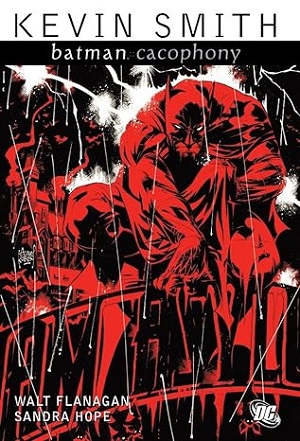
Batman: Cacophony

Batman: Cacophony

A banner across the top of the cover says KEVIN SMITH. This is in even bigger lettering than the title which is immediately beneath it. So you can call it a Kevin Smith production. Indeed, it demands you call it that.

There’s nothing wrong with a comic trying to cash in on a celebrity name (think of Keanu Reeves and BRZRKR), and since Smith is a sometimes able screenwriter and die-hard comic fanboy, I didn’t go into this one with any misgivings or, for that matter, particularly high expectations.

Smith himself is self-deprecating about his efforts in his Introduction. “By series’ end, I realized it wasn’t the best Batman story I could write; nor was it Walt’s finest hour.” Walt being Smith’s buddy and series artist Walt Flanagan. The most he’ll say for Cacophony is that it provided useful experience for his later efforts. So that’s setting a pretty low bar.

I thought it was just OK. Only three issues, so there wasn’t much there. The storyline has Onomatopoeia (a Kevin Smith supervillain creation) breaking the Joker out of Arkham Asylum so that together they can hunt down Batman. Or at least I think that was the plan. Ono doesn’t say much and needless to say things don’t work out.

If the story is a weak sauce at least the writing has some of Smith’s distinct personality and brand of humour. Which is either a good or a bad thing, depending on how big a fan you are. And so the Joker is a mouthpiece for various semi-obscure cultural references, and even a couple of Maxie Zeus’s security guards get into an argument over the original Clash of the Titans. For the most part I thought this stuff fell flat. When the Joker says at the end that “I’m Glover, Circle Jerk’s Mel, Broodin’-Ruben’s Busey, and this is the end of Lethal Weapon,” I just couldn’t figure the comparison out. Nor could I understand the Joker’s big line at the end about how “I don’t hate you [Batman] ‘cause I’m crazy . . . I’m crazy ‘cause I hate you.” These are just words. Then there’s also some politics thrown into the mix, mainly in the opening pages where a lack of funding has made Arkham Asylum even easier to break into and out of. I did love Maxie Zeus saying that he’s done a lot of good with “some of the profits” from his drug operation (a philanthropist very much in the modern mode), but the Joker’s fascination with Ayn Rand’s The Fountainhead was another joke that went over my head. And I wasn’t sure what to make about the television broadcast being presented out of its original order the second time it’s played. Was that a mistake or was I missing something?

The art too was just OK. It looks quite generic. Action is handled pretty well, but Flanagan has a lot of trouble with Bruce Wayne’s face the few times we see it. The Joker’s sad excuse for a beard though is memorable.

Not a write-off or a disaster then, but nothing very special about it either. I got the feeling Smith wanted to go a little deeper into the Batman-Joker connection, but that’s been done so many times now that he really doesn’t have much to add. As comics go it’s the sort of thing that might leave you curious to see more, but not necessarily eager. Nevertheless, Smith does promise that he was getting better and learning on the job so I’ll probably check in later to see how that turned out.

Graphicalex

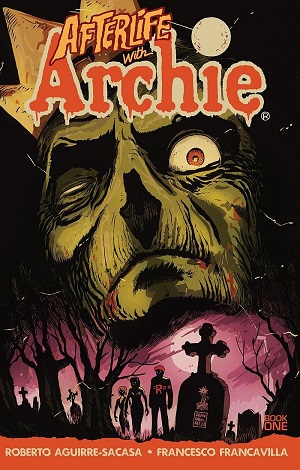
Afterlife with Archie: Escape from Riverdale

Afterlife with Archie: Escape from Riverdale

This is the title that launched the Archie Horror imprint due to its boffo success both critically and with a wide audience. And I don’t find that success surprising as I loved it in almost every way.

The idea grew out of a parody Life with Archie cover by Francesco Francavilla that had Archie being confronted with zombie versions of Jughead, Betty, and Veronica. This seemed like such a good idea, they decided to make a whole comic out of it. Because this was the time of peak zombie and zombies were going well with everything. Pride and Prejudice and Zombies (the novel) had come out a few years earlier and been a smash success, quickly followed up by a major motion picture. Such mash-ups thrive on the incongruity of high-culture being mixed with low, or in this case a wholesome American town turned into an abattoir. After a while, and really it didn’t take long, the joke got stale. But some really good work came out of it too.

Afterlife with Archie is really good. Things kick off naturally enough at Riverdale High’s Halloween dance, and just before the zombie outbreak begins we get a lot of insider jokes keyed to horror movies, which is very much in the manner of these things. Pet Sematary, for example, is referenced because the apocalypse is triggered by Sabrina the Teenage Witch raising Jughead’s beloved Hotdog from the dead, with predictably disastrous results. The seminal text Night of the Living Dead gets a nod in a flashback with Mr. Weatherbee horning after Miss Grundy. Dilton Doiley is the nerdy character from the Scream franchise who knows how horror movies are supposed to play out. And so it goes.

From here we’re taken through the familiar run of zombie incidents. The infected person who tries to brush it off as no big deal. The siege, this time in stately Lodge Manor no less, and subsequent breakout. The confrontation with transformed loved ones. Now you’d think, or at least I would have thought, that none of this was all that interesting or new, and on one level I guess it isn’t, but I still enjoyed it immensely. Writer Roberto Aguirre-Sacasa, who was the main force behind the TV series Riverdale, adeptly brings the Archie brand into a sort-of real world, fleshing out the main characters just before they start eating flesh. In terms of their appearance they’ve changed a lot from their traditional look – Archie in particular is unrecognizable but for his red hair, and Jughead but for his cap and “S” sweater – but you can actually buy into them as real teenagers. Some liberties are taken with the fringe Riverdalers – Ginger Lopez and Nancy Woods are romantically involved, and Cheryl and Jason Blossom have some kind of incestuous attachment hinted at – but I didn’t know these people anyway.

Poor Jughead: Patient Zero or “Jugdead” here and made into a werewolf in the Jughead: The Hunger series. It’s hard being the odd man out in any gang, and I guess he always was. Were these transformations his revenge? I think that’s something in the mix.

So yes, I loved it. Enjoyed nearly every page of it. And a special shout out for some great lettering by Jack Morelli. The only misstep that registered was the business with Archie’s dog Vegas (I don’t remember him from the comics). I thought they should have skipped that part. But even that might have had a purpose, making me wonder if there was maybe a connection being drawn between his doggy devotion to his master and the Lodge butler Smithers (an ancestor of Waylon Smithers in The Simpsons?) with his sense of duty toward his Mistress Veronica. I liked being drawn into these kinds of conjectures, and they weren’t what I was expecting from an Archie zombie comic. Well done!

Graphicalex

Torso

Torso

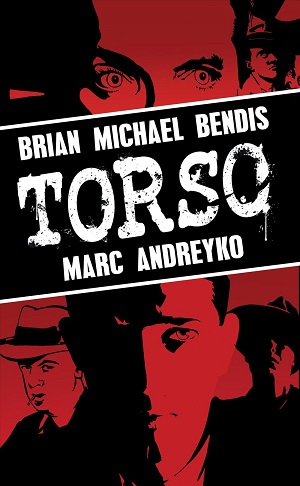
Torso is a six-part series based on the Cleveland Torso Murderer investigation. Though the killer was never apprehended, it’s assumed that he killed and then dismembered some 12 victims in the 1930s, leaving their body parts scattered around Cleveland (for fuller accounts of what happened, see here and here). So we’re definitely in true-crime noir territory here, as if you couldn’t tell from the stark black-and-white art inking every face half in shadow.

There’s also a documentary feel to the proceedings, underscored by cityscapes backlit with vintage photos. And for the most part, at least in the early going, creators Brian Michael Bendis and Marc Andreyko stick fairly close to the record, even including a gallery of newspaper archive clippings and pictures with this edition (though there’s no bibliography or suggested further reading; even 300 had suggestions for further reading!). On the other hand, some names have changed and made-up characters have been introduced. The drama is heightened and compressed. And at the end a climactic shootout in a burning human abattoir that is very Hollywood is wholly invented. But overall it’s not bad on that front. Just remember that it is a fictionalization, a historical graphic novel.

The presentation plays off different tensions. The separate chapters begin by taking us in and out of focus and commercial stippling. As with the shadow – and there is a lot of shadow in this book! – it seems the harder we look the less we see. Another tension is between static and dynamic. Stencil-like figures are repeated identically throughout the book, sometimes throughout entire scenes of dialogue and sometimes reappearing in different scenes in different chapters. But this stationary feeling is given a spin by a layout that zigs and zags around the page, or that requires you to turn the book on its side to read. One scene, Eliot Ness’s interview with the killer “Gaylord Sundheim,” even forces you to turn it all the way around as it’s written in a spiral.

That spiral page (or double-page spread) will annoy some people, but I thought it had a thematic point and worked well playing off the circling movement with the way figures are repeated over and over. Plus, it’s a one-off.

This is a stylish but not artificially artsy book that I rated very highly, though I’ll concede that it’s probably not for everyone. Don’t get hung up on it being an accurate account of the Cleveland torso murders and just enjoy it for the dark entertainment that it is.

Graphicalex

Plants vs. Zombies: Zomnibus Volume 1

Plants vs. Zombies: Zomnibus Volume 1

Sometime around about the year 2000 it became clear that videogames were taking over the movie business. You could say comic books were too, and in many ways it comes to the same thing. Lots of CGI and narratives structures built around the idea of progressing through various levels before facing off against a main bad guy at the end, then resetting or rebooting and doing the whole thing over again on an endless loop.

Plants vs. Zombies is a popular and very simple videogame that basically has the player using various weaponized plants to beat back an outbreak of zombies. Somehow they figured there was a comic book in there. And not just one book, but a whole series!

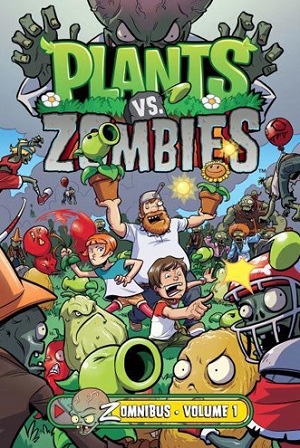
It’s all very bright and colourful, but as you could probably guess it’s spread pretty thin. A pair of eleven-year-old chums, Nate Timely and Patrice Blazing, team up with Patrice’s inventor-uncle Crazy Dave to stop the zombie army of Dr. Edgar Zomboss (he’s a doctor of thanatology) from taking over the town of Neighborville. Seeing as this is for kids there’s no real violence aside from the odd zombie limb falling off, and the day is always saved.

This “zomnibus” edition collects three story arcs, Lawnmageddon (an introduction to the basic storyline), Timepocalypse (using a time machine to collect various pieces of one of Dr. Zomboss’s evil inventions) and Bully for You (the best of the bunch, with a gang of college zombies getting revenge on Dr. Zomboss for having bullied them years earlier).

A comic for kids who would rather be playing a videogame doesn’t offer much for the rest of us. The standard zombie refrain of “brains” quickly gets tired, but not quite as quickly as Crazy Dave’s gibberish, which has to be translated throughout by Patrice. Meanwhile, the story just sort of jerks around with little in the way of connecting tissue between the various episodes, to the point where several times I had to check to see if any pages were missing. I guess it was worth sticking my head in the door, but it’s not a series I’ll be bothering with anymore.

Graphicalex

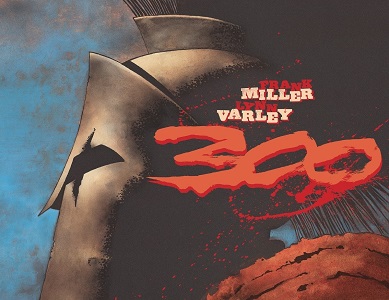
300

300

The first thing that strikes you about 300 (the collection of a five-part series that was originally published in separate volumes) is its physical appearance. There’s the shape of it: a stretched out format that allows each page to be a double-page spread that emphasizes strong horizontals in the art and an overall sense of epic, CinemaScope visuals. But at the same time it’s actually quite a slender book, under 100 pages, which underscores how efficient the text is. It is, after all, an action comic without a lot of interest in historical accuracy, and the hero (the Spartan king Leonidas) is suitably laconic in his words. The text is all very bombastic in a hokey way – as we’re back with the defence of Western Civilization against the evil Eastern empire – but at least there isn’t much of it to roll your eyes at. And besides, this is a comic book.

You could read it as vaguely homophobic and as foreshadowing the later trouble Frank Miller would get into with the anti-Islamic comments he’d go on to make. But in Miller’s defence, while the knock on those boy-loving Athenians makes no sense, as there was even more of this in Sparta, where it was even more deeply embedded in the culture, it’s also true that being on the receiving end of homosexual sex was still seen in Classical times as something shameful, and could be cast as a military metaphor. See, for example, the Eurymedon vase and compare it to what is said here about the Persians showing the Greeks their backsides at Marathon. And as far as the cultural angle goes, the view of Persians (or are they orcs?) as being pleasure-loving and decadent (politically as well as morally) goes back at least as far as Herodotus, and insofar as Miller addresses the subject of religion here, in the form of the Spartan ephors, it’s clear he has no time for any of it.

Acclaimed when it first came out in 1998, it’s a work that’s only grown in stature after the release in 2006 of Zack Snyder’s mostly-faithful film adaptation (which Miller served as a consultant and executive producer on). I think it misses a chance to be something more than just a rousing, boo-yah adventure story, but as an action comic I think it’s exceptional, with the art in particular balancing motion with stasis (those galloping horses suspended in air) and visions of chaos with discipline and order. There are also surprising perspective shifts (mixing in lots of overhead “shots”), and the motif or visual punctuation of forests of bristling spears and arrows that thrust us forward, stand at attention like exclamation points, or lie scattered and broken in the chaos of a battle’s aftermath. So while it’s a story that doesn’t occupy me very much it’s still a book I can return to fairly regularly just to admire the unique style of its presentation.

Graphicalex

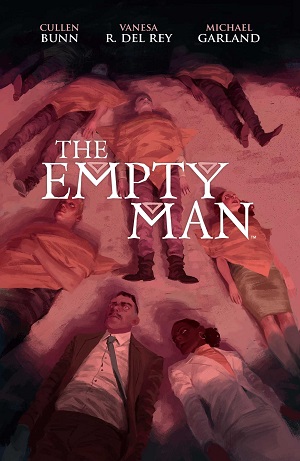
The Empty Man

The Empty Man

This one left me with mixed feelings.

The main problem I had with it is that it’s murky. What I mean by that is two things. In the first place, Cullen Bunn’s story is so vague (not to mention unresolved at the end) that I honestly had no idea what was going on. There’s an outbreak of suicidal dementia that gets dubbed the Empty Man virus because that’s something the victims are heard to mention. There’s a preacher who thinks this might be a sign from or manifestation of God. Or it might be aliens. Or it might be some actual psychic virus, one that began with a possessed patient zero who the Empty Man cult is keeping alive. I don’t know. I’m not sure anyone in the comic understands either. A pair of FBI agents are investigating, and so is the CDC. They have visions and receive messages, but are these just hallucinations? Again, I don’t know. And we’re never told.

(I should add as an aside here that they made a movie “based on” this comic that was released in 2020. From what I’ve heard, it only has the loosest connection to the comic.)

Then there’s the art by Vanesa R. Del Rey. It’s very sketchy and rough. Which you could say makes it a perfect complement to Bunn’s story: you can’t understand what’s going on and you can’t see what’s going on either. What the hell is happening to the woman’s husband in the first issue? Explosive diarrhea? There’s no amount of looking at that picture that makes it clear to me. In other places the drawing is so crude and the colouring so dark I literally couldn’t locate faces, much less read them. No question Del Rey has her own style, but it wasn’t my thing even if it did give the book a really distinctive feel.

These caveats entered, I still found myself enjoying it, or at least committed to reading along. Bunn and Del Rey do, somehow, conjure up an effectively grimy vision of madness, and if it’s all a mess, well, that could just be the way things fall apart in the end times. But don’t ask me to explain any of it.

Graphicalex

Batman: His Greatest Adventures

Batman: His Greatest Adventures

Batman: His Greatest Adventures is a collection of standalone titles from Batman Adventures, which was the tie-in comic to the Batman: The Animated Series show. That’s where the style of artwork comes from, which you either love or hate. Personally, I love it. It’s highly stylized, with exaggerated but simplified forms. Batman’s face is represented as a flat plane like the side of an office building, and the Penguin (who in one story arc becomes mayor of Gotham) has the appearance of an Art Deco paperweight. Even Cat Woman, who looks more like a cartoon mouse with giant ears than a cat, is lots of fun.

The Joker and Riddler also show up, as well as Spellbinder in the final story, which is set in the Batman Beyond universe. Two villains you won’t see though are Two-Face and Poison Ivy, who are the two figures standing behind Batman on the cover. Talk about false advertising! How do comics get away with this?

Things start off great, with the first story being the best. It seems the Penguin has taken over Gotham Zoo with a flock of radio-controlled birds. I didn’t care as much for the other episodes. The Cat Woman story was good and the rest were only so-so. I thought the Batman Beyond episode had too much going on to fit into one comic, and the Scarecrow comic was just weak. All of the stories tend to wrap up quickly, but that’s the format.

Neither as dark as Batman too often gets, nor overly complicated in plot terms, this is just a bit of throwback comic fun. I haven’t read widely enough in the Batman Adventures to know if the stories collected here are the best in that series, but I had a real good time.

Graphicalex