The Uncanny X-Men: Red Wave

The Uncanny X-Men: Red Wave

Another franchise reboot. Krakoa, the living island of misfit toys, has fallen and the X-Men have disbursed around the globe. Beast and Cyclops are looking for new digs in Alaska while Rogue, Gambit, and Wolverine get together to toast wieners and drink beer in the Louisiana bayou. Charles Xavier’s School for Gifted Youngsters has been turned into Graymalkin Prison, a penitentiary for mutants run by Dr. Corina Ellis, which is where Professor X is currently being held. And Charles’s old flame Sarah Gaunt, after being turned into a Javier Botet/J-horror demon called the Hag, is out hunting for more mutants to add to Dr. Ellis’s collection. The Hag’s next stop is the bayou, where a foursome of young mutants, along with Jubilee, have found Rogue and company and are looking for protection.

I’m guessing none of that synopsis will mean anything to most people reading this. Suffice it to say that this is all about Gail Simone setting things up for a new X-Men run, with the usual generational dynamic. Right from the start with the X-Men there’s been the idea of educating and training young people in the responsible use of their powers. That looks set to continue, and the newbies seem like a fun bunch to follow. Especially emo-manga boy.

Also to the good is the character of the Hag. I didn’t like her backstory of romancing with Charles back in his Oxford days, but after her transformation in a hurricane that kills her kid she turns into a pretty fearsome foe, even taking down Wolverine handily. The way Rogue stops her though was corny as hell.

The romance between Rogue and Gambit was a little more advanced than I was expecting, but I guess comics are growing up. What I found hardest about having the two of them together so much was their silly accents. Rogue, a child of the Mississippi bayou, is all folksy (“I mighta coulda got a mite overconfident”), while the Cajun Gambit is all “dat” and “dem” and calling Rogue “chère.” A little of this goes a long way. Or, put another way, it soon gets annoying. Not quite as annoying as that silly script they started putting Thor’s speech into in his comics, but getting there.

Overall then a decent way of kicking off a new story cycle, with some good stuff and a few hiccups. Worth seeing what comes next anyway.

Graphicalex

The Vault of Horror Volume 1

The Vault of Horror Volume 1

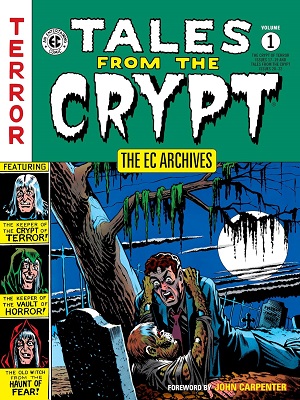
The Vault of Horror was one of three main horror comic titles put out by EC in the 1950s before they got shut down by the government. The others were Tales from the Crypt and The Haunt of Fear, and as I said in my review of The Haunt of Fear Volume 1 the three were basically interchangeable, with the same writers and artists and no difference in the kinds of stories included. They even did crossovers, so that the Old Witch (host of The Haunt of Fear) and the Crypt-Keeper (from Tales from the Crypt) will sometimes show up in these pages to introduce stories. The Vault-Keeper is the guiding force here, and he’s indistinguishable from the other two. To the point where I honestly thought he was an old woman, until he started shooting down rumours about his being romantically linked with the Old Witch.

OK, so what are you getting? Well, for starters it’s issues #12-17. Does that mean that Volume 1 is skipping anything? Not really. As with The Haunt of Fear, EC started publishing stories from The Vault of Horror in another comic called War against Crime. Then, when War against Crime became The Vault of Horror they didn’t change the numbering, for business reasons I don’t fully understand. So issue #12 is really the first issue of The Vault of Horror (something similar happened with The Haunt of Fear, which had started with issue #15 because previously it had been The Gunfighter, and Tales from the Crypt, which had been Crime Patrol).

The stories themselves don’t win any awards for originality. As I’ve previously noted, ripping off classic horror tales was an EC staple, so that’s on the menu again here. The first story is a version of The Wax Museum. “Doctor of Horror” is just the story of Burke and Hare. “Island of Death” is “The Most Dangerous Game.” “Voodoo Horror!” is The Picture of Dorian Gray. Throw in several werewolf stories (set, as always, somewhere on the English moors), a vampire, a couple of practical jokes that backfire, some premature burials, and you’ve got a pretty musty vault indeed.

Not that there’s much wrong with that. I always get a kick out of these comics even when they’re just playing the greatest hits. And there’s at least one story here, “Baby . . . It’s Cold Inside!” that I thought was quite original. Though if you showed me the source for it I wouldn’t be surprised. It was getting to the point where I was feeling that even the stories without an obvious inspiration had to be coming from somewhere. But in any event, I’d probably rate it the best.

Other features include short stories by editor Bill Gaines, some random chortlings by the Vault-Keeper, and a mail bag. With regard to this latter department, I always wonder how many of these letters were actually sent into EC’s (or Marvel’s, or DC’s) offices and how many were made up. Some of them are clearly fictional, but others might have been legit. It was a time when people actually did write letters. They sure don’t anymore.

There’s a sort of manic energy throughout, not just in the typical comic style of throwing exclamation marks at the end of every sentence (even something as banal as “They seat themselves on roughly hewn chairs!”), but in the crazy laughter on almost every other page. There are the “Heh-heh-heh”s of the Vault-Keeper, of course, but also some hee-hees, haw-haws, and lots and lots of “Ha-ha-ha-ha-ha-ha!”s. In a Foreword to this volume by R. L. Stine he writes that “What attracted me to these comics was that they were so hilarious. Has anyone ever concocted such a mix of horror and humor before?” I don’t know about that. It’s not like the stories here are all that funny. But they do trade in a kind of dark humour and even in the most extreme situations it all seems like a lot of fun. Not that that helped them any when the censors came calling.

Graphicalex

Cemetery Beach

Cemetery Beach

With that title, and a bleak if indeterminate cover, I went into this thinking it was a horror comic. It’s not. It’s an SF-action title set in some future with an alternate history where interdimensional travel was discovered a hundred years ago. Our hero is a “pathfinder” named Mike Blackburn who has been sent to explore an off-world dystopia that we set up back in the early twentieth century. Whatever the idea behind the place was in the first place, it’s now basically a fascist state run by a Baron Harkonnen figure.

Mike begins the story being interrogated in one of the state prisons, but he quickly escapes along with a rebel chick named Grace and they spend the rest of the book running away from the army/police and trying to get to Cemetery Beach, which is where Mike’s transport back to Earth (a place natives call “oldhome”) is parked.

There are things to like here. Artist Jason Howard does action well and there is a lot of action on tap here. It’s really just one long chase scene, with lots of explosions and vehicle crashes. There are series of pages with no dialogue, or even sound effects, at all. And I was intrigued by some of the hints at world building by Warren Ellis. There’s a germ pool on the planet that keeps people alive forever but has the side effect of turning them into “mushroom cancer soldiers.” The relation between Earth and the place Mike goes to reminded me a lot of Frank Herbert’s Dosadi. And I liked the way the fashion sense of the natives has stayed stuck in the 1930s, which fit the fascistic tone.

But these are all just hints that something bigger is going on. As noted, the plot doesn’t allow any time for expository dialogue beyond quick descriptions of the different zones Mike and Grace are traveling through. And the series itself, which ran for seven issues, breaks off abruptly, as though there was more to come. But I don’t think it’s been continued in the years since it came out in 2019.

So it’s not bad for what we’ve got, but it still feels a bit like half a comic. It’s frustrating that some of the interesting avenues for exploration that are opened up remain unexplored. If you just like the shoot ‘em up and blow ‘em up stuff though I’d recommend it.

Graphicalex

Mighty Marvel Masterworks: Daredevil Volume 3

Mighty Marvel Masterworks: Daredevil Volume 3

Say what you will about Stan Lee as a writer, he certainly knew how to work at speed. This was especially the case during the 1960s, when he was churning out copy for a whole series of Marvel titles. Each of the comics collected here, published in 1966-67, was written by Lee and illustrated by Gene Colan, and on the masthead of issue #32 they even ask “How do they do it, month after month?”

Well I don’t know how they kept up such a pace, but they managed surprisingly well, despite some obvious lulls. One such low point being issue #28, where Daredevil has to take on aliens looking to strip-mine Earth: “Thou Shalt Not Covet Thy Neighbor’s Planet!” This comic begins with a six-page intro that is quickly dismissed as “one of the longest prologues on record” in the playfully self-referential style that Lee favoured at the time (“Stan” even has a Batman-style cameo when Daredevil says hi to him as he’s climbing past an open window).

On the other hand, the volume concludes with a great four-parter that has DD taking on Mr. Hyde and Cobra, a pair of bickering supervillains. Mr. Hyde splashes a “potent chemical” in Daredevil’s face that’s meant to blind him, which of course doesn’t mean anything because he’s already blind. But, for some unexplained reason, “since the man without fear is already blind, Hyde’s formula affected his super senses instead – making them totally useless!” So until he finds the antidote, Daredevil is pretty much totally helpless, though he does make a fair run of things for a while, pretending at times to have gotten his sight back. This is a lot more difficult than pretending to be Matt Murdock’s twin brother Mike, a cool “hipster” (the word meant something different back then) that Matt invents to confuse Foggy and Karen as to Daredevil’s secret identity. This makes for a decent storyline as well.

Otherwise what we get here is what fans of the comic had come to expect. First and foremost there’s a blind superhero whose other senses are so advanced he can identify people by their heartbeats (or, in the case of the Owl, “his powerful birdlike emanations,” whatever that means). In fact, Daredevil can even fly a jet, a point that has to be dealt with by “Sly Ol’ Stan” thusly:

To save you the trouble of writing scathing letters to us, we’ll explain here and now how the sightless D.D. can pilot a plane! He feels the vibrations of the needles and dials within the instrument panel, and his own natural radar sense takes care of the rest!

The second feature common to most Daredevil comics is a B-list supervillain, or pair of B-list supervillains who never seem to get along that well. I’ve already talked about Mr. Hyde and Cobra. Among the other baddies teaming-up here are Leap-Frog (he’s got springs in his flipper-style footwear!) and Stilt-Man, and the Masked Marauder and Gladiator. That we find out the Masked Marauder is really just the landlord of the office building that Nelson and Murdock operate out of feels right. He’s found his niche.

The third recurring feature is the guest appearance by another Marvel superhero. Here we get Ka-Zar, Spider-Man, and Thor. They’re all stronger than Daredevil so he mainly has to just survive the scraps he gets into with them by jumping out of the way.

The final thing to note is the self-reflexivity and self-deprecating humour I mentioned earlier. For issue #26, “Stilt-Man Strikes Again!” a note right on the cover admits “It’s one of our least-inspired titles, but the story’s a blast!” At several points in the volume sound effects are drawn attention to. Daredevil bouncing off the top of a car with a “BTANNG!” for example, gets this notation from “Scrupulous Stan”: “Special note for those who may read this story aloud: in the sound BTANNG, the second N is silent!” This will come in handy for the Leap-Frog character, who jumps around with a PTANNG!, a SQUANNG!, and a FTINNG! And later we’re told of a “PTOW!”: “In reading this story aloud . . . the first letter in the above sound effect is presumed to be silent!” That’s from “Stickler Stan.”

Overall then, an entertaining collection that I’m sure gave fans everything they wanted, or at least were expecting. And maybe a few things they didn’t. As usual, Lee is just embarrassingly bad with anything to do with romance. At one point we see Matt alone in his apartment with a framed photo of Karen. Why a blind man has a photo of the girl he has a crush on is hard to figure, but he picks it up to address her thusly: “Karen, my darling . . . even though I cannot see you . . . your beauty is like a living thing to me! In my mind’s eye I’ve devoured your features hungrily . . . greedily . . . like a starving man!” Which is a lot of what the Little Rascals used to call mush. But the fact that he says these lines while “looking” at a photo of Karen feels almost like camp.

Graphicalex

Alien: Descendant

Alien: Descendant

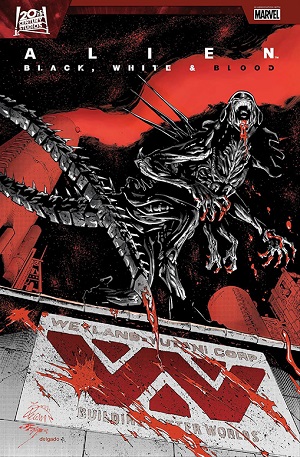
What do Xenomorphs eat? You may think the answer is “Everything.” As apex predators it’s probably safe to assume they’re omnivores. But thinking back over the films and the comics I’ve seen and read I don’t remember seeing or hearing of them actually eating anything. They kill everything that moves, or use other species as baby ovens, and goodness knows they grow at an astonishing pace, going from infants to full-size adults in minutes, but where do they get the energy to sustain such a metabolism?

This book is a sequel to Alien: Thaw, and even though it takes place thirteen years later with a mostly different set of characters it’s  probably best to read Thaw first. Basically Zasha, the little girl who was the only survivor of the Xenomorph outbreak on the ice moon of LV-695, has come back with the usual gang of space marines, synths, and Weyland-Yutani jerks. And, again as per usual, the mission has something to do with W-Y grabbing some Xenomorphs. I don’t know why they’re so obsessed about this, but it’s a core part of the franchise mythology.

Things kick off here though with a backstory that has no dialogue (beyond Hssssss! Skreee! And Whrrrr!) explaining the genesis of a new strain of Xenomorph that was created when the Xenos first arrived on LV-695 and crossbred with some insect-like species. These new descendants are white Xenomorphs and now they spend most of their time battling with the regular Xenomorphs. At least until the fresh meat arrives.

This wasn’t my favourite Aliens comic. As with Thaw, Declan Shalvey handles the writing and Andrea Broccardo most of the art. Broccardo does well enough with action but I don’t like his human figures and faces at all. Shalvey’s story, meanwhile, doesn’t really go anywhere. There’s a flashback structure that isn’t very clear the first time through and I’m not sure if I understand the ending. Nor is very much done with the civil war between the different Xenomorph clans, despite all the time spent setting it up in the first issue. Because the series has set such a high standard, Descendant was probably the first Alien comic that I felt disappointed by. It has its moments though, particularly with regard to the underwater salvage operation, and is still a decent read.

Graphicalex

Saga of the Swamp Thing Book Three

Saga of the Swamp Thing Book Three

I really liked this volume of Alan Moore’s Saga of the Swamp Thing run, I think mainly because Moore stayed grounded. In his Introduction, penciller Stephen Bissette mentions the “steady hand of editor Karen Berger” on the series and I don’t know how much she helped curb some of his excesses, but especially after the swamp-sex issue that ended the previous volume there was a need to get back to basics.

And by back-to-basics I mean the X-Files-style “monster of the week” storylines on tap here. There’s a frame that isn’t explained but that introduces us to the character of John Constantine (whose looks were modeled after Sting). Constantine just drops by to tease at some coming darkness and then sends Swampy around the U.S. on a series of adventures Moore thought of as American Gothic. The first story, not part of this series, has a toxic homeless guy named Nukeface who actually kills Swamp Thing. Temporarily. After Swampy reconstitutes himself, Constantine drops by to tell him that he’s the world’s last plant elemental and that he has the power to die and be born again anywhere in the U.S. Or presumably the world. Or, as we’ll later see, the cosmos. This struck me as weird, because (1) Swamp Thing is born of science (Alec Holland’s biorestorative formula), he’s not some fantasy elemental, and (2) why does Constantine think it’s so obvious that Swampy can do this instant-teleportation thing? He seems shocked at how slow Swampy is to understand, but how does the teleportation work on any sort of level that makes sense? Yes, this will be explained later with the concept of “The Green,” but I hate The Green and if this is the thin edge it came in through then to hell with it.

Anyhow, from the Nukeface story we return to the drowned city of Rosewater, site of an earlier battle with vampires, to find out that they haven’t gone away but have instead become far creepier aquatic vampires. Then we’re on to “The Curse,” which is a werewolf story that links lycanthropy to women’s menstrual cycles. Not what I was expecting and I was kind of surprised they went there in such a bold way. Apparently it was controversial at the time. And finally we’re back in Louisiana and a film being made on a former slave plantation that has Swampy fighting voodoo zombies.

That pretty much covers what a pull quote on the back cover from National Public Radio calls “A cerebral meditation on the state of the American soul.” We get the environment, gender issues, and race. Today any comic handling these topics could be expected to be annoyingly preachy, but Moore somehow pulls it off. We get the message, but he’s not afraid to give an extra half-turn of the screw. Swampy is the straight man or conscience in every case. Paradoxically, as he’s now all plant he’s also become more human. He’s understanding, and almost reluctant to lower the boom on the baddies, but at the same time he’s less passive than he was earlier in the series.

So on brand with “sophisticated suspense” and contemporary horror stories. And best of all, at no point does Moore go spinning out into the ether, where he all too often crashes and burns. This is basically meat-and-potatoes stuff, served up with Moore’s signature poetic sauce. The meditation on what the buried dead dream at the beginning of the plantation story has him at his best: “When the summer earth swelters, when roots press against their backs like creases in the bedsheets . . . When sleep won’t come, what notions do they entertain in those frail parchment bulbs that once were skulls?” And there are also some great sign-offs, like Nukeface getting ready to say hello to America and one of the zombies going to work as a ticket collector at a grindhouse cinema. This may not be the splashiest work Moore did on Swamp Thing, but I’d rate it among his best.

Graphicalex

DCeased

Dceased

The first thing to note about this series is that it was late to the party. When Marvel Zombies started in 2005-2006 they were hitting the market at what I’ve called the moment of peak zombie. I was actually a bit surprised to see that DCeased (or DC Zombies) didn’t come out until 2019, long after the point when zombies had gone out of fashion. Though that didn’t stop the series from becoming a huge bestseller and spawning several sequels.

OK, technically these aren’t zombies. They’ve been infected with the Anti-Life Equation, which arrives on Earth as a sort of computer virus and starts turning people into undead creatures who go around biting chunks out of the living and so infecting them and turning them into . . . zombies. Apparently the equation spreads just as well by digital imagery as it does by infected blood. “I always suspected we’d have to destroy the Internet to save the world,” Green Arrow says. “I just didn’t know it would be like this.”

Batman figures all this out, and just to clear up any confusion gives us this quick fact check: “They’re not zombies. They’re not consumed by hunger. They’re not feeding. They’re spreading death. They’re stealing life. These are the anti-living.”

Oh, just stop already. This is DC Zombies. The zombie pathogen is a hybrid, both being a blood infection and spread through our phones like in the Pulse films or Stephen King’s Cell. We might almost say the virus is undergoing a cultural mutation, evolving from gene to meme.

Batman himself only figures all this out after he’s been infected, and later he’ll turn into one of the (ahem) “anti-living.” As will most of the rest of the DC pantheon. Yep, Batman, Green Lantern, Superman, the Flash, Wonder Woman. It’s up to the B-listers and a bunch of successors and superkids to save the day, which they do by loading the Earth’s uninfected onto space arks and heading out to Earth 2. Where the adventure will continue . . .

While I’ve called this DC Zombies, it’s actually hard to compare to Marvel Zombies. They’re both quite dark, obviously, but they feel different. Tom Taylor’s writing has less of Kirkman’s black humour, but I thought the storyline was more coherent. Which means that taken as whole I enjoyed the series a bit more. Though that isn’t a full endorsement, as I thought Marvel Zombies disappointing. I should also say that I read this in a “compact comic” edition. These are smaller format reprints (like the Marvel Masterworks volumes) so the art doesn’t have the same pop or impact and I sometimes had to strain to read the text. Even so, I liked the dark palette and Trevor Hairsine’s penciling.

Graphicalex

Indestructible Hulk: Agent of S.H.I.E.L.D.

Indestructible Hulk: Agent of S.H.I.E.L.D.

The Hulk is perhaps the most basic, meat-and-potatoes superhero you can imagine, and the Indestructible Hulk series is, in terms of its narrative structure, as basic and meat-and-potatoes a contemporary comic as you’re likely to see.

The frame story has it that Bruce Banner is tired of working in the shadow of such genius benefactors of humanity as Reed Richards and Tony Stark. As he complains to Maria Hill, Director of S.H.I.E.L.D.:

Tony Stark and Reed Richards use their genius to save the world every other week. That’s how they’ll be remembered in history. Meanwhile, I . . . I who, forgive me, have just as much to contribute – will be lucky if my tombstone doesn’t simply say “Hulk smash!”

So here’s his pitch to Hill: if S.H.I.E.L.D. will fund him and set him up in a lab with a team of scientists to work under Bruce Banner, then they can have the use of the Hulk whenever they need him. And it’s a deal.

What follows is a series of comics where Hulk is let loose on baddies like the Mad Thinker, the Quintronic Man (both of these guys are basically evil geniuses operating battlebot suits), and Attuma the Lemurian. There’s nothing subtle about how the Hulk goes about these missions. The bad guys just blast him with everything they’ve got, which they reckon should be more than enough to destroy him, but guess what? He’s the Indestructible Hulk. So he ends up smashing them.

Like I say, meat and potatoes. But what made this a winner for me was the art by Leinil Francis Yu. This guy can really draw, delivering the goods whether it’s two people talking in a diner or a bunch of sea monsters taking out a fleet. And with great art you can never go wrong.

Graphicalex

The Pitiful Human-Lizard: Far from Legendary

The Pitiful Human-Lizard: Far from Legendary

There’s a sort of Holy Grail not just of superhero comic writing but of superhero and monster movies and basically any story where the emphasis is on action and effects. The Grail I mean is making the rest of the story, if not compelling on its own, then at least not dead weight. Are you just interested in Spider-Man, or do you really care about Peter Parker and what’s going on in the rest of his life? If you are interested in Peter Parker, or Bruce Wayne, or the scientists and military men trying to stop Godzilla, then that’s a huge win.

I thought Jason Loo, doing double duty as author and artist of The Pitiful Human-Lizard, aced this part of the test. Lucas Barrett may be a bit of a stereotype of the young urban male who’s stuck in a nowhere job doing data entry and looking for love on the side (i.e., the Internet), but I still found him a likeable, relatable figure. He dresses up in a strange costume with sticky gloves he uses to climb walls. This wall climbing is (1) a habit he inherited from his father, who was the original Human-Lizard, and (2) the only thing vaguely lizard-like about him. I actually didn’t think Human-Lizard was a very appropriate name, and the “Pitiful” part really mystified me. He’s just an average Joe, not pathetic.

Anyway, one day Lucas, looking to make some extra money, volunteers to be a guinea pig for a drug company. They give him a serum that endows him with super restorative powers. Basically he’s like Deadpool: no matter what sort of injury he suffers his body will always heal itself back to normal. So now he really is a superhero, even if he’s out of his depth taking on most of the bad guys he faces. Which means he needs the assistance of other heroes like the powerful Mother Wonder (“a working woman and the finest superhero in Toronto”) and the psionic Lady Accident, who doubles as his would-be girlfriend.

Yes, I said Toronto. Loo really enjoys hitting all the landmarks, with fights being staged at the Royal Ontario Museum, the Eaton Centre, and Honest Ed’s. I think these comics were first published in 2015 and Honest Ed’s closed in 2016, but I still remember it. In fact, I still remember when there was an Eaton’s store in the Eaton Centre. I’m getting old. Also part of the Toronto spirit are the “Terrorno Girls” who get dressed up like the Toronto Raptors team mascot so that they can whale on people with their dinosaur tails. They despise Human-Lizard and his loserish superhero buddy Majestic Rat. This latter fellow is a sort of Jughead figure who can control the city’s rodent population.

I liked all these characters, and the oddball plots hatched by the bad guys, including a mastermind influencer who sets up a team of villains called the Frustrated Four and a team of scientists who are creating Kirby-esque monsters underneath the city. Where I thought the comic fell down a bit is in the action scenes. Loo does the hard parts well in creating a bunch of fun and original characters, but then the meat and potatoes of a superhero comic, the fisticuffs and explosions, aren’t as impressive. He has trouble rendering figures in motion, for one thing.

So one’s usual expectations when coming to a superhero comic, even one as ironic as this, are inverted. I got so I was actually looking forward more to seeing Lucas hanging out with Barb, or Mother Wonder wrestling with her kids, than to another monster eruption. But there’s enough of both to enjoy.

Graphicalex

Chew Volume Four: Flambé

Chew Volume Four: Flambé

Are things coming together, or breaking further apart? I’m not sure. The previous Chew volume, Just Desserts, ended with strange letters in flames being written in the sky, presumably by aliens. In this book a couple of people seem to have a vision of what the letters mean, but one of them is a voresoph – someone capable of superhuman mental feats after consuming vast quantities of food (so the more he eats, the smarter he gets) – and he basically eats himself to death, while the other is the mysterious Mason Savoy, and at this point in the story nobody knows what he’s up to.

Some old characters are back doing their thing, like Poyo the killer cockerel, the busty lethal ladies of the USDA, and the murderous Vampire, while we’re finding out more about others, such as the fact that Tony’s sister, Toni, as well as his daughter Olive, are cibopaths as well. One very fringe figure comes back from an earlier comic, reborn as the high priestess of a chicken cult, while other characters that were fairly central (Tony’s girlfriend Amelia Mintz and Ray Jack Montero, the guy who was trying to make frogs taste like chicken) are MIA.

In short, more weirdness. But I liked it and respected that it felt like Layman and Guillory were still stretching the limits of what they could do with all this.

Graphicalex