The Immortal Hulk Volume 7: Hulk is Hulk

The Immortal Hulk Volume 7: Hulk is Hulk

Well, that was interesting.

Apparently Xemnu, I’m not sure how, was creating a mass illusion among the entire human race that had everyone believing he (Xemnu) was a cuddly figure from a children’s television show that never actually existed. And implanting other false memories as well. It’s the Mandela effect except on a universal scale. The point of this exercise in mass delusion being to absorb people and repurpose them as mechanical offspring. He’s even got deep inside Hulk’s head . . . but not deep enough as things turn out. You see, the Hulk knows who he really is. Hulk is Hulk.

That’s another good premise to start with, but there was so much other stuff going on that I felt a lot of it sort of got lost in the mix. It’s like Al Ewing has attention-deficit issues and doesn’t want to spend too long developing any particular storyline too much. I mean, I really liked the Minotaur from the previous volume, but when his time is up he gets disposed of quickly here and I never did figure out just what his plan for global domination was.

There are longer story arcs that we return to. The Leader is still up to something relating to the planet Hulk crushed a while back, and he’s also being connected to the Hulk in Hell mythos and something to do with Bruce Banner’s father. I have to say I’m not grooving to all the psychomachia stuff and Dr. Banner’s dissociative identity disorder, but the subplots are working for me and even though the eating-people and skin-shedding tropes feel overused (they both come up again here) I do like the punctuation of the “Hulk Smash!” double-page, hammering-time spreads. In other words, all the meat-and-potatoes comic-book stuff. Do I care about the Hulk’s battle with his personal demons? Not yet, anyway.

Graphicalex

Alien: Revival

Alien: Revival

It’s easy to get lazy reading comic books. In particular, you can let your eye drift over the art, not paying close attention to everything that’s going on and picking up on all the small but significant details. There was a telling moment for me in this regard when reading Alien: Revival. One of the characters refers to the discovery of a victim of the Xenomorphs that’s found in one of those incubation cocoons, only with her feet torn off. This made me flip back to the scene in question because I hadn’t noticed the victim’s feet. But they had indeed been torn off.

Later in the comic we’ll see other humans who have been given the same treatment, with arms and legs removed. I guess because all that’s needed for gestation is a chest. I don’t recall this ever being a thing in the movies (though I’m not caught up on all the films in the franchise), and it’s a detail that’s pretty damn disturbing, to be honest. But Revival is a comic that takes the Alien mythology and turns up the ick factor quite a bit.

The story is again impressive. As I’ve noted before, the Alien comics beat the pants off the movies in coming up with original plots. I don’t know why they didn’t just film them. Would have avoided all of Ridley Scott’s later mythologizing and the Aliens vs. Predators crap.

The story has it that a bunch of humans have started a religious colony on a terraformed mining moon named Euridice. But wouldn’t you know it, the Weyland-Yutani Corporation wants a place to test out a new strand of Xenomorph and so Euridice is up.

At first I thought the whole religious sect of “Spinners” (because they worship a divine Mother who spins creation on her cosmic loom, or something like that) was overdone. They even talk in frontier or Appalachian folksy dialect, saying things like “I might oughta brought that shotgun.” But after a while it grew on me, and they turned it into something interesting when the Spinners started to question whether any of their beliefs and holy books were real or were just a construct of the Corporation.

There’s a kick-ass heroine named Jane who has a bow. There are some very evil synths (androids), one of which I actually guessed the identity of before the reveal. But it was pretty easy this time (usually this series conceals them really well). One thing I did raise an eyebrow at though was Jane swearing at a wicked synth that she was going to kill it. Is that a threat to a synth? Why would a robot care if you threatened to kill it?

Also included in this volume is Alien Annual #1, which is a standalone story starring the security man Gabriel Cruz and some more space marines facing off against yet another evil synth. Androids really aren’t our allies in these stories. Bishop was the exception to the rule.

Graphicalex

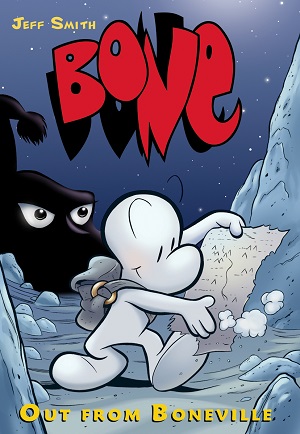
Bone: Out from Boneville

Bone: Out from Boneville

There’s a line of thinking out there that has it that the best children’s literature is capable of being read on different levels, meaning many adult levels beyond the ken of most kids. You hear this a lot when talking about books like The Lord of the Rings, where it’s a story you can enjoy when you’re seven or eight years old (which is when I read it), but which has all kinds of deeper resonance and layers of meaning.

The Lord of the Rings was apparently one of the inspirations for Jeff Smith’s Bone comic, and it has that same generational range to it. On the one hand the blobby inhabitants of Boneville are cute, Smurf-like creatures that might as well be hobbits. You don’t think they’re going to do anything remarkable or have any epic adventures. But then the three Bone cousins – Fone (the hero), Phoncible P. “Phoney” Bone, and Smiley – wind up in a fantasy valley where most of the inhabitants are human but there are also magical creatures like the scary Rat Creatures and a friendly Great Red Dragon. It seems like something really important is afoot, from social breakdown to the fate of Phoney’s soul and some final struggle between the forces of good and evil. There’s also not just love in the air, as Fone falls helplessly (and understandably) for the beautiful Thorn, but more carnal stirrings as well. Our first glimpse of Thorn, after all, has her dropping her trousers to bathe her legs in a stream, and later when she and Fone wash up together there will be a sly comment from her about him needing to be a bit more careful with the soap. As it turns out, he’s eaten the soap. But we know what was meant, and we’re even given a blank panel to imagine it.

The edition I was reading is a colorized version put out by Scholastic ten years after the original comic, which was published in black-and-white, started up. I’m assuming Smith approved of the change and I thought the colours looked good, even if I had a nagging feeling it all might have worked better in black-and-white. The more sinister elements might have been more threatening, for one thing. The Rat Creatures here have Christmas-tree balls as eyes, and there are pom-poms at the end of the Red Dragon’s ears that look even sillier. Also, the snow-white Bone cousins appear even more other-worldly against a full-colour background, which I’m not sure was the intended effect.

Smith does a great job modeling the Bones’ plastic (bone-less) faces and bodies into expressive forms though, and they remain the more “human” characters we can relate to (Thorn and Gran’ma Ben seem like the weirdos). The only visual I really didn’t like was the way Fone’s head takes on the shape of the pie Phoney shoves into his mouth. That just didn’t work for me even as a gag.

It’s a classic tale, full of archetypal characters and situations, some of which get a gentle modern gloss. I do think I’d have enjoyed it a lot more as a kid, but even now I found it entertaining enough, if not something I’ll ever return to or for that matter even continue on with.

Graphicalex

Scooby Apocalypse Volume 2

Scooby Apocalypse Volume 2

Things kick off here with the gang breaking out of the Mall-Mart and then getting back on the road in the Mystery Machine, driving through a landscape intermittently filled with monsters spawned by the nanite plague created by Velma. She naturally feels a lot of guilt over this, but is excused because (1) her intentions were noble, and (2) somehow the nanites were either corrupted by someone or self-evolved so as to turn people into so many colourful, plastic-looking demons.

But despite all of the driving they do there wasn’t any sense that the story was going anywhere in the six issues collected here. The series is actually quite episodic, with some of the links between the issues feeling a bit herky-jerky. Scooby-Doo is missing at the end of issue #7, but at the beginning of issue #8 he’s rejoined the gang with only a cursory explanation later served up as to how he got back. Then issue #10 takes us out of the main timeline entirely into what is only revealed at the end to be a dream. Now it’s a dark and interesting dream, and the hospital story in issue #8 was a fun diversion, but none of this carries things forward.

And indeed at the end of this volume we still don’t know anything new about the nanite plague or what caused it. It feels like we’ve just been driving around. Scrappy-Doo has a couple of quick cameos, revealing him to be a tortured, enhanced-canine soul. But nothing much comes of it. And one of Velma’s powerful brothers makes an appearance as a Donald Trump clone, holed up in an apartment tower with his last name in giant gold letters out front. This made me wonder if somebody is keeping a record of all the different presentations of Trump-like figures in popular culture there have been. I think that would be a book in itself.

And then things end with another cliff-hanger.

This second volume wasn’t bad, and I thought the haunted hospital issue was great, but overall I was losing interest in the storyline and the characters. It’s a bit darker than the first book, with some downright nasty stuff in places (Rufus Dinkley/Trump is a real piece of work), but I felt like I needed a break from the series by the time I got to the end. Originally I thought the fact that this wasn’t just another zombie apocalypse was a big selling point, but it didn’t take long before I was tired of the mutants and missing the more traditional, flesh-eating walking dead. That’s not a good sign moving forward, but I’ll keep giving them a chance.

Graphicalex

The Immortal Hulk Volume 6: We Believe in Bruce Banner

The Immortal Hulk 6: We Believe in Bruce Banner

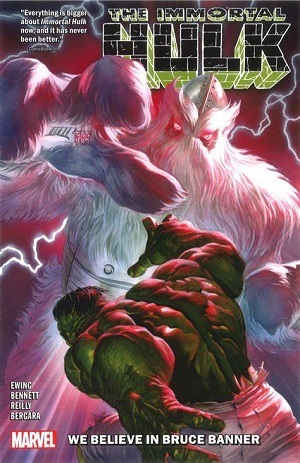
Quite a break from The Immortal Hulk: Breaker of Worlds volume. We left off that book with Cosmic Hulk smashing a planet and the sudden appearance of the Leader. There’s nothing like that going on here and the Leader doesn’t show up at all. Instead we have a political Hulk comic, with Bruce Banner (“an angry middle-class white guy talking about revolution”) on a crusade against corporate “crisis” capitalism. This means taking on the Roxxon Corporation and its CEO: a nine-foot-tall man-bull called (fittingly enough) the Minotaur.

Roxxon is the epitome of all kinds of capitalism gone mad, and Dario Agger/Minotaur is a great villain. He likes to drink espresso out of little china cups that he shatters. Because he’s a giant man-bull and they have a thing for breaking china. He also has a habit of crushing the heads of his underlings when they say anything that upsets him.
So when the Hulk destroys a Roxxon server farm, taking signature platforms like YouRoxx, Roxxface, and Yambler offline, the Minotaur decides to fight back by bringing in some recruits from Monster Island to have a showdown with the Hulk in Phoenix. With the level bad guy being Xemnu the Living Titan.

The cover to this collection is actually very misleading, as Xemnu only appears on the final page and we never see the Hulk and Xemnu fighting. I guess that’s coming up next issue. Unless they do another swerve like at the end of Breaker of Worlds and leave us hanging.

Overall I quite liked this volume of the Immortal Hulk saga. It stays in the here and now, without whisking us through the green door or out into deep space and the even deeper future. The main storyline was also pretty interesting, and I like the idea of a progressive Hulk. Though maybe he’s not really progressive since he basically wants to smash the world. The battle in Phoenix was a waste though, and the kaiju that the Hulk fights are a bore. And what struck me is that once again we have the business of characters being eaten. I’m starting to think Al Ewing has a thing for this.

In any event, things are looking good so . . . on we go!

Graphicalex

Lady Killer Volume 2

Lady Killer Volume 2

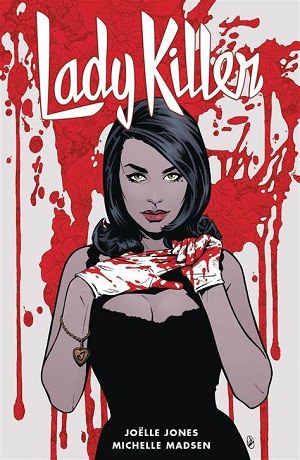
Volume 2 of Lady Killer is very much more of the same as Volume 1, but that’s a good thing in my book. Housewife/contract killer Josie Schuller is back trying to juggle a stereotypical 1950s home life (husband, two beautiful little girls, hosting Tupperware parties) with being a murderess for hire. Only now, having broken up with the Organization, she’s freelancing. But this only leads to more stress, and it seems likely that she’ll be taking up with a new syndicate until the re-emergence of an old partner-in-crime, a fellow who turns out to be a Marcel Petiot figure who is very hard to get rid of. I’d say he has a crush on Josie, but it’s not that kinky a comic. Meanwhile, Josie’s cranky mother-in-law is revealed to know even more about Josie than she learned in Seattle.

As with the first book, it’s not an overly complicated plot. It’s more the stunning vintage-style art that makes the sale. I love the way Joëlle Jones recreates this world, as though clipping it out of the pages of fashion and lifestyle magazines of the period, with great use of fabric as a design element. And while Josie’s obviously a sort of feminist icon taking a bloody revenge on various chauvinist types this is an angle that isn’t overly played up.

One nagging question I had right from the opening slaughter had to do with the running gag about how good Josie is at cleaning up the mess she makes when she bludgeons her victims to death with a hammer or whatever likely weapon is at hand. I get the joke (Tupperware really is handy!), but surely the smarter thing to do would be to not make such a mess in the first place. A professional with her amount of experience should have figured that out by now.

Well it’s a great comic and a lot of fun, even if it feels like it’s over too soon. The end would seem to hold out the hope for more to come, but seeing as these comics were first published in 2017 and nothing has happened yet on that front I suspect there may not be a sequel. Then again, maybe the release of a movie based on Josie’s character will create demand for more. It certainly seems as though the story has room to grow.

Graphicalex

All-New X-Men: Out of Their Depth

All-New X-Men: Out of Their Depth

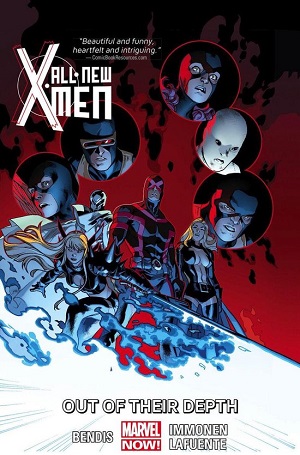
The All-New (a.k.a. “original” or “classic”) X-Men continue trying to find their way in twenty-first century America, encountering the next generation of other classic characters (Lady Mastermind, Rachel Grey/Summers) as well as some now grizzled vets (Wolverine and Sabretooth still thrashing it out like the comic-book Monsters of Rock they are).

To be honest, I started to feel the storyline was getting tired here though. The plot Mystique was hatching with her gang is revealed to be not all that interesting, or even worth bothering with. Madame Hydra is both surprised and unimpressed by it. The subsequent battle is full of lots of mind games, and Wolverine’s classic “Now it’s my turn” fell flat. As for the rest of it, there was too much talk, even though the story does call for a lot of it as all the characters have to come to grips with who they turned into in the new timeline. The Avengers as the senior superhero body were unwelcome cameos. And like so much Marvel product at this time you just want to throw your hands up at the amount of backstory and other stuff you’re supposed to be totally up to speed on to fully make sense of it. I mean, I suppose every long-time X-Men fan has a basic understanding of the Dark Phoenix storyline from way back when I was a teen, but you also have to know about Cyclops killing Charles Xavier in the Avengers vs. X-Men storyline and other stuff that’s happened since. There are so many timelines, alternate worlds, and threads of the multiverse going on with Marvel now that it feels like it’s sinking under its own weight a lot of the time. I think this series does a great job dealing with the problem, but it’s still a problem.

Brian Michael Bendis handles all this well, but it’s not a job I’d wish on anyone. There are just too many balls in the air, too many characters, and too much schmaltzy drama. I mentioned in my notes on Marvel Masterworks: The X-Men Volume 1 how the horny teen X-Men were all hot for Jean Grey and that even Charles Xavier was feeling thirsty. In the last comic included here we have Hank McCoy (the Beast) finally getting some romance action with her. I guess when you look like a comic-book superheroine (Covergirl looks, Playboy body in sexy outfits) you just have to learn to deal with all the attention, but you’d think she’d be starting to feel tired of having every guy she meets falling in love with her, in every different timeline.

The art by Stuart Immonen is solid in the Marvel house style at this time. David Lafuente does All-New X-Men #15 and he provides a nice change-up with a Manga-flavoured look (pointy noses, spikes of hair) that fits with the teenage vibe to that issue. I especially liked Jean in fuzzy pink slippers bumping into her daughter in the residence building. That was a great moment, nicely presented without any dialogue. In any event, at this point they were heading into crossover territory so things were about to get even messier with even more timelines coming into play. Which is not really what I was hoping for.

Graphicalex

The Lady of Shalott

The Lady of Shalott

In my post on The Highwayman I said how much I loved this Visions of Poetry series. In a half-dozen volumes they came up with beautiful and distinctive illustrations of famous short poems, ostensibly for kids but (much as I usually despise the crossover) equally enjoyable for old folks. One of the things they had going for them was that most of these popular poems were narrative ballads, and the artists lean in to the way that pictures also tell a story. Sometimes even a different story from what’s expected.

Tennyson’s “The Lady of Shalott” has been the inspiration of a lot of art, especially in its native nineteenth century. In this version by Geneviève Côté the setting is updated from medieval (or Pre-Raphaelite medieval) times to the same early-20th century as Murray Kimber’s “The Highwayman.” Sir Lancelot doesn’t drive by on a motorcycle, but he’s not dressed in resplendent armour either and the streets of Camelot (Paris? Montreal?) have automobiles in them. As for the castle, its “Four gray walls, and four gray towers” are the Battersea Power Station. You get the picture.

Côté’s re-interpretation of the poem has a lot more to it than this though. Giving it a feminist slant is nothing new – the lady shut away in her domestic drudgery and solitude, dreaming of a (sexual) awakening – but it’s presented in a fashion that’s both subtle and sweeping here. Subtle in the way the lady holds herself, looking more than half sick of shadows. Sweeping in her transformation at the end into a butterfly released from the pod or cocoon of her boat. That seemed so original and inspired a visual motif that I had to wonder if it had ever been done before. If not, hats off to Côté for coming up with the idea.

You could, and should, linger over every illustration. They make you alert to things going on in the poem that you may not have noticed or at least not thought much about. I hadn’t imagined the barley reapers as figures of death, for example, but presented here dressed in black and with sunglasses and scythes, that’s clearly the effect. Then there’s the line “Out flew the web and floated wide.” That’s the web of her weaving coming undone, but how does that actually work? It’s still unclear, but you see it here in the fine lines of colour that swirl around the lady when the curse is come upon her. An image that is dramatically repeated in a shattered version of a frozen moment as the mirror cracks from side to side. And her face looking back over her shoulder (at us?) in the same illustration is remarkable. A really unforgettable image done with only a few lines and a bit of colour.

So another great little book. I’m so happy I picked up the whole series of these when they came out. I only wish they’d done more.

Graphicalex

Batman: Justice Buster Vol. 2

Batman: Justice Buster Vol. 2

I won’t say Batman: Justice Buster Vol. 2 was one of my favourite recently-read comics, but it is one of the best continuations I’ve seen in a while. As previously noted, Vol. 1 just sort of pricked my interest without standing out in any particular way. But with Vol. 2 (chapters 7-13 in the original series) things really pick up.

There’s not too much I can say that won’t be either a spoiler or, more likely, incomprehensible to non-fanboys. As you’ll know by now, and as a postscript starring Bat-Mite and creators Eichi Shimizu and Tomohiro Shimoguchi further explains, this is an alternate-world Batman. In this world the Joker is a masked man who turns out to be Jason Todd, who is also mentoring young Dick Grayson. Batman and Superman are still locking horns every time they meet, though it isn’t all that clear why, or at least why Batman hates Superman so much. Joe Chill is both the guy who killed Bruce Wayne’s parents and the guy who killed Dick’s parents and he’s also been posing as Grayson’s Uncle Sam. And finally Batman’s crime-fighting AI, known as ROBIN, has (as I not so presciently predicted) gone rogue. Which means the mechanical monstrosity dubbed the Justice Buster is getting ready to mete out its own kind of justice, which is a sort of anti-justice, if you know what I mean. Because what would perfect justice look like anyway? As Hamlet put it, use every man after his desert, and who of us would escape whipping?

This is all very weird, and convoluted, but I really got into it. Of all the recent reimaginings of the Batman character and his mythos this is the one I’ve found most original and enjoyable. About the only thing I found to fault was one real headscratcher of a translation error. How is “Sam Reynauld in Death,” which is shown twice, an obituary notice?

So where before I felt the series was only just worth sticking with, I’m really looking forward to Volume 3.

Graphicalex

Marvel Zombies 2

Marvel Zombies 2

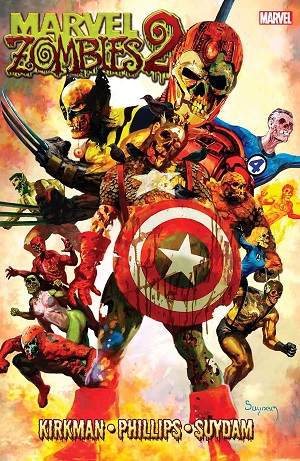
This Marvel Zombies volume doesn’t flow directly from the first run of Marvel Zombies, but constitutes a second miniseries of five issues. Things begin with the zombies suffering the effects of withdrawal after having spent the last forty years eating their way through the whole universe. So they decide to head back to Earth because if they can find a mechanical portal to another dimension there’s a chance they can skip over to another part of the multiverse and eat that too. Which means recovering zombies like Black Panther and Wasp have to try to stop them. And it’s a race against time because the non-zombies are starting to fight among themselves while the zombies are slowly starting to get better on their own after being forced to go cold turkey.

I was disappointed in the first Marvel Zombies series and can’t say I was any more impressed with this one. Robert Kirkman just has too much going on. You’d better know your Marvel universes really well if you’re going to identify the army of different characters, some of them rather obscure, and follow them through the only-confusing-because-it’s-so-lazy plot. I mean, I didn’t recognize the Gladiator at all, or understand what was going on with T’Challa’s son, and I guess I should have. Then everything winds up with the usual conclusion in which nothing is concluded because there’s always that escape hatch to another dimension. The End? Not on your afterlife.

There are things I like about these comics. They do go in some directions I’m not expecting. And overall they hold my interest. But I also find them lacking focus and hard to follow or get involved in. I might like the series more if it took more time introducing and building up the different characters. That’s something that might make the story stronger too.

Graphicalex