The Raven

The Raven

Edgar Allan Poe’s “The Raven” is a poem that has followed me around most of my life. At least that’s the way it feels. When I was a kid I had a Mad magazine adaptation, from which I memorized it. Today I can only recite a few stanzas by heart, but I still remember the Mad illustrations, like the saintly (and husky) Lenore pressing the laundry.

There are no end to the illustrated Poe works now available, with “The Raven” being one of the most popular of his titles to get that treatment. This version, part of the terrific Kids Can Press Visions of Poetry series, has art by Ryan Price, who appeared at a local art gallery when the book came out. At the time I had the chance to buy prints of the illustrations for this book but I didn’t because money was tight and all that.

What a great illustrator does is illustrate the poem or story while at the same time using the pictures to tell another story, not in opposition (though that’s always possible) but in parallel. I think Price does a wonderful job of that here. The pictures really evoke a mood, with the narrator and his Lenore both having vast expanses of forehead that help suggest how mental, how interior, a poem this is. So much of what we see, perhaps everything, is going on inside the narrator’s head. His madness is the result of isolation: both bereft of Lenore and stuck out in his cabin in the woods, and so agoraphobic that the sound of a knock at the door is enough to terrify him. But then, the bird’s footprints are there in the house before he hears the knocking. So why is he so frightened at the gentle tapping? Because he’s already breaking down. It’s not the repetition of “Nevermore” that drives him crazy; that only tips him over the edge.

Details like the bird’s footprints, or the aces and eights left lying on the tabletop, are worth noticing on every page. And there’s a modern horror atmosphere at work too. We are in semi-modern times, for starters, as the cabin has an aerial and a television set. But what’s on TV? Are they playing Night of the Living Dead? It looks like a cemetery on the screen, and we know Romero’s film is in the public domain, from whence it is constantly being pulled and referenced in modern horror films. Then, keeping with this modern motif, there’s the way the narrator starts scribbling graffiti on the walls, and Lenore’s ghostly appearance as a J-horror avatar. I was almost expecting to see her climb out of one of her picture frames, if not the TV.

Another triumph then from this short-lived series. The spelling of “visitor” as “visiter” was the only blemish I registered, and I hope kids who are the age I was when I first read the poem in Mad don’t get the wrong idea from that. But if they commit it to memory and learn to recite it like I did, that typo won’t make a difference.

Graphicalex

Gideon Falls Volume 3: Stations of the Cross

Gideon Falls Volume 3:  Stations of the Cross

I really shouldn’t have liked this at all. We’re now deep into the free-fall of crazy and splintering of timelines into various universes that I usually can’t stand. All too often this strikes me as just being lazy storytelling, a way of giving up on creating a coherent plot and pulling the rug out from the reader whenever you want to introduce some new element.

But I thought this volume of Gideon Falls the best yet. Yes, our heroes are skipping around in time and space, but instead of everything breaking apart the sense that’s given is of things coming together, and doing so in interesting and visually striking ways. It seems Andrea Sorrentino was being given more freedom to open things up as things went along, and he’s using that freedom in a fiercely creative way.

The first few issues collected here introduce us to a slightly new character: Father, then Bishop, Burke. I say slightly new because he’d been previously glimpsed in the background. Here he gets a lot more development as he’s shown to be on the trail of Norton Sinclair, who is possessed or being controlled by the Laughing Man/Bug God. And it’s a trail that’s so crooked, branching through different dimensions and timelines, that Burke even has to grab a pen and paper at one point to draw a map. Though I had to wonder what use that might be.

As Bishop Burke he also has a team of priests to help him out. This was the only part of the story where I still felt out of the loop. If the Bug God is some alien force of evil, what is its hang-up with Christian symbolism? Why does he crucify people, and why are the people who are fighting him so fixated on having God on their side? Maybe this will all be explained, but for now it left me scratching my head.

What we do know, now, is that the Bug God needs a human body to function as a master key to unlock a gateway to other dimensions, including our own. He figured Danny would fill this role but as things leave off here he’s found a substitute in Danny’s dad. Creepy stuff! I’m enjoying this series quite a bit and looking forward to what’s next.

Graphicalex

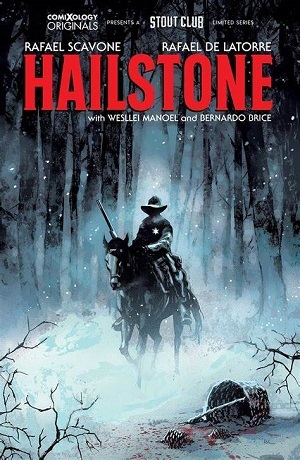
Hailstone

Hailstone

A neat little idea. We’re in the town of Hailstone, Montana sometime during the American Civil War. This was before there was a state of Montana, and possibly even before it was a territory, but we’ll let that slide. In any event, Hailstone is a company town, with the company in this case being the U.S. Army, which runs a giant munitions factory. Meanwhile, the good citizens of Hailstone are starving and living off of grudgingly bestowed government handouts.

Then people start disappearing from the woods around Hailstone, and there are sightings of a strange beast. Sheriff Denton Ross and his half-native deputy Tobias investigate and uncover a dastardly plot engineered by the commanding officer of the army factory, who turns out to be a mechanically-inclined Doctor Moreau. I won’t give too much more away, as they leave off revealing the monster until fairly late in the day and if I tried to explain it I’m afraid it wouldn’t make much sense anyway. It’s all steampunk science mixed with bits of fantasy, as steampunk often is.

It’s a pretty good comic though. It builds a bit slowly and I thought the native stuff was superfluous. But on the plus side there’s a stirring climax and the monster was quite an original invention. Also the twist at the end was unexpected, and not just for being so dark and downbeat. Like a lot of comics in this genre you can’t help thinking of the movie they could make out of it, but setting that aside I think it stands on its own as a thrilling read.

Graphicalex

Batman: Justice Buster Vol. 3

Batman: Justice Buster Vol. 3

Since Volume 2 of this series ended with Batman facing off against his rogue AI-controlled battlesuit (named the Justice Buster) you’d be forgiven for thinking that we’d be kicking things off here with a no-holds-barred showdown.

Not so. Instead Batman just wakes up after being knocked out with some sleeping gas to find that the Justice Buster has disappeared (which is kind of remarkable, even the police admit, given how large a unit it is). And that’s it for the Justice Buster in this volume! It isn’t mentioned again in the rest of the book, and indeed I think it’s only seen later brooding over the city on a couple of pages that are just filler.

So instead of that, what do we get? More on the unlikely partnership between Batman and Joker (who is Jason Todd, and a good guy, in this Batman universe). More on Dick Grayson and his relationship with Joe Chill, or Uncle Sam, or whoever this guy is. It seems he’s been hypnotizing young Dick and been orchestrating scenes of violence around Gotham while wearing a bucket on his head.

Interesting stuff, with a dark “death in the family” ending that still leaves a lot of loose ends. I’m still impressed with this series as it goes places I haven’t been expecting and these swerves are usually pretty interesting. So on we go!

Graphicalex

Old Man Logan

Old Man Logan

I’ve dumped on the Marvel multiverse concept quite a lot over the years, so I think it’s only right to give them credit when it works. And if you wanted perhaps the best example of that you need look no further than this storyline by writer Mark Millar and artist Steve McNiven.

The world-building here is exceptional. The world in question is (checks notes) Earth-807128, which is about as rotten a hellscape as you could imagine. There’s been a battle between superheroes and villains and the bad guys won. America has been divided up among various boss-level villains and Old Man Logan, no longer Wolverine because of a tragic incident in his past that we only find out about later, is living as a rancher with his wife and kids in a burnt-out version of Sacramento. It looks like the Wild West.

This part of the U.S. is run by the Hulk Gang: the original Hulk/Bruce Banner, who has gone insane, and his degenerate and bullying green descendants. They even beat Logan up. Anyway, in need of money, Logan agrees to accompany a blinded Clint Barton/Hawkeye on a cross-country trip to deliver some secret contraband to D.C.

This is where the hellscape and world-building I mentioned really kicks in. As the two former superheroes pass through parts of the U.S. run by Kingpin, Doctor Doom, and finally the Red Skull (now the president of the United States) they are witness to scenes of incredible violence and desolation. They see the Punisher and Daredevil fed to a pair of dinosaurs in an arena. They meet up with Barton’s daughter, but she’s gone full Spider-Bitch and tries to kill him after overthrowing Kingpin. They’re chased by a T-Rex that has bonded with the Venom symbiote. They meet up with a sort-of resistance underground headed by the White Queen. And finally they get to D.C. where Barton gets killed and Logan is captured by the Red Skull. He escapes after decapitating the Skull with Captain America’s shield and returns to Hulkland only to find that the Hulk Gang has killed his family. He takes a spectacularly bloody revenge before riding off into the sunset with Baby Hulk, on their way to more adventures.

This is all hard, hard, hardcore stuff, especially with all the heroes and villains being cruelly tortured and destroyed. Logan himself takes several severe beatings, but of course he’s immortal so no matter how badly he gets disassembled or destroyed he’s always going to come back. But with that warning for the faint of heart, I came away impressed with what Millar and McNiven managed to accomplish. This is a fast-paced, wild ride that keeps upping the ante with every turn in the road (a road that I was grateful to follow with the map provided of Logan’s and Barton’s route across the no longer United States).

The road trip framework isn’t open-ended but makes this a self-contained story, with a beginning, middle and end, or departure, journey, and return. I’ve read few series with such a satisfying sense of completion, even if Marvel (as always) decided to keep the Old Man Logan storyline going. The way it all works is mainly through a kind of narrative edging: we keep waiting for Logan to snap and “pop his claws,” and Millar keeps denying us, even finding ingenious workarounds for Logan’s fight with the Red Skull. But when he gets back to Sacramento and finds what’s happened we finally get it, an orgasmic double-page spread of SNIKT! and then, claws finally extended “The name isn’t Logan, Bub . . . It’s Wolverine.”

Old Man Logan isn’t a deconstruction of the superhero mythos any more than the spaghetti western blew up the traditional Hollywood oater (and that’s a connection that’s very much in play here). But, like the spaghetti western, it’s a more violent and dirtier rendering of that mythology. So not for everyone, but in its own way a contemporary classic.

Graphicalex

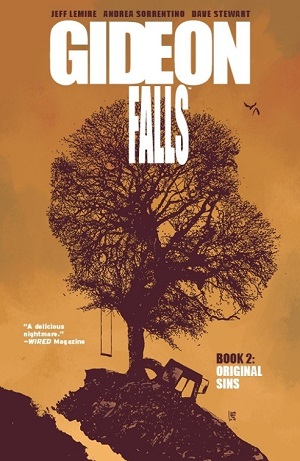
Gideon Falls Volume 2: Original Sins

Gideon Falls Volume 2: Original Sins

This second volume of the Gideon Falls comic feels like marking time. Even the structure repeats that of The Black Barn, with the same slow build to another psychedelic final issue that takes us through the looking glass (or the reassembled doorway) before pulling out and dropping us off in the same desolate locations. Only now there’s been a switcheroo and Father Fred and Norton (really Clara’s missing brother Danny) have crossed over into each other’s worlds. Which really doesn’t feel like it’s moved us forward at all.

There are no new characters aside from the real Norton Sinclair. He’s the Victorian tinkerer who built the thingamajig in his barn that seems to have opened a portal into an evil dimension. There’s still no idea what Norton Sinclair or the Laughing Man or the Bug God or whatever the hell it is might be up to though. If I had to guess I’d say he, or it, is just into doing evil stuff.

I still enjoyed what was going on, but at the same time it felt a bit early for the series to be running out of gas. As I’ve said, they weren’t adding much new here. There are a bunch of elements that felt tired, like seeing the episodes of a couple of the characters as frightened children, Norton strapped into a straitjacket and locked in a padded cell, Doc’s wall of newspaper clippings, and the insect monster breaking out of a human body. Sorrentino’s art didn’t even feel like it was adding much either, aside from the great double-page spread of Gideon Falls turning into Times Square. Maybe the Bug God is an urban developer then. That would actually make a kind of sense. Because if you invented a time machine wouldn’t you want to use it to make some smart investments in real estate?

Worth sticking with then, but at the same time: get on with it!

Graphicalex

Demon Slayer Volume 1: Cruelty

Demon Slayer Volume 1:  Cruelty

Most of the manga I’ve read is of a particular kind, characterized as being full of videogame-style action where the hero proceeds through different challenges or levels, with his adversaries (or level bosses) becoming more powerful as he goes along. That’s the impression I got again here, and I’m not sure how long I’ll stick with the series as these things just tend to go on. They’re not like American comics where you follow individual story arcs through a half-dozen issues or so. It’s more like counting the cars in a long train while you’re waiting for a crossing to clear.

I used to live on a farm that had a freight line running through it. I counted cars a lot when I was a kid.

The setting here is Taisho era Japan, which was in the early twentieth century. I thought we were sometime a lot earlier than that. A kid named Tanjiro who lives in the woods has his family killed by demons. The only survivor is Tanjiro’s sister Nezuko, but she’s been infected by the demons. Tanjiro wants to save her (I guess you have to believe in something) so he sets out carrying her on his back in a basket, with a bit stuck in her mouth so she won’t bite anybody. His goal is to join the elite Demon Slayer Corps, but to do so he has to first go through samurai boot camp.

This combines physical training with a lot of hard-ass hectoring that carries a message I’ve also noticed a fair bit of in the manga I’ve read. This is the presentation of life as an endless and brutal Darwinian struggle, a battle to the death where only the strong survive. So you’d better get tough and not waste time being sentimental or thinking about the meaning of life too much.

I wonder if this is a big thing in contemporary Japanese culture. Is it something picked up from their super-competitive school system? It’s not a theme I’ve noticed reading Japanese novels or watching many Japanese movies (though Battle Royale comes to mind as an exception).

I did find the set-up a bit interesting though, and the line about how “When happiness ends there’s always the smell of blood in the air” stuck with me. I thought the story predictable trash but I may stick with the series for a few volumes anyway. If nothing else, it seems to be a cultural artefact of some weight and so worth taking a look at. From Wikipedia:

By February 2021, the manga had over 150 million copies in circulation, including digital versions, making it one of the best-selling manga series of all time. Also, it was the best-selling manga in 2019 and 2020. The manga has received critical acclaim for its art, storyline, action scenes and characters. The Demon Slayer: Kimetsu no Yaiba franchise is one of the highest-grossing media franchises of all time.

I mean, they made a TV series out of it and then a movie in 2020 that had a budget of $15 million and took in over $500 million! So far I haven’t seen anything to explain that level of popularity, but I’ll try to let it grow on me.

Graphicalex

5 Days to Die

5 Days to Die

Version 1.0.0

A hard-as-nails cop named Ray Crisara is in crisis mode. He has a marriage that’s on the skids, and when his car is smashed into by a big rig, killing his wife and seriously injuring his teenage daughter, he becomes obsessed with getting revenge on the drug lord who he thinks is responsible. Also, because of a brain injury he received in the same crash Ray only has five days to live, so the clock is ticking.

You’d be excused for thinking you knew where this was going. The cover has Ray looking like a dead ringer for Marv from Frank Miller’s Sin City, and that neo-noir atmosphere where it’s always night, or it’s raining, or both, is very much the visual style. But there are two wrinkles Andy Schmidt throws into the mix. The first is that Ray, due to his injury, may be hallucinating some of what’s happening. The second is that Ray has to learn something about being a better parent from this experience, and in fact his quixotic mission of vengeance may just be a kind of coping mechanism.

These are interesting ideas to put in play, but in the end I didn’t feel like enough was being done with them. The hallucination angle had horror potential that was unrealized. As for the parenting stuff, maybe I’m being cynical, but noir is nothing if not cynical and the way things wrapped up here struck me as too sentimental. Even the drug lord gets some redemption. I expected, and wanted, something a lot bleaker than that.

Graphicalex

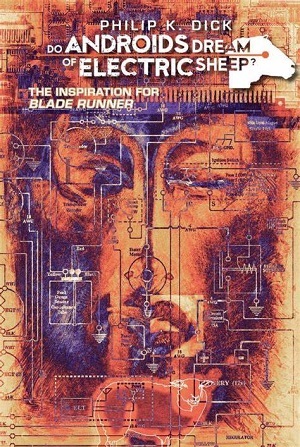
Do Androids Dream of Electric Sheep? Volume 1

Do Androids Dream of Electric Sheep? Volume 1

I signed this one out of the library after just glancing through it, thinking it might be an interesting take on Philip K. Dick’s classic novel. As the front cover tells us Do Androids Dream was the “inspiration” of Blade Runner, “inspiration” being a word that’s used whenever an adaptation is only very loosely based on its source. So instead of a graphic novel version of the film, what this promised to be was a return to the story’s roots.

I should have flipped the book over and read the back cover, where it says this is the “complete text” of Dick’s novel. When I started reading I was struck by just how much text there was. This was to be expected (I’d noticed the same thing in Fido Nesti’s adaptation of Orwells’s 1984), but complete text is on another level. And since I’d just recently re-read Do Androids Dream I found myself skimming a lot and focusing more on the pictures.

Pictures that weren’t that inspiring. Not bad, but I didn’t get the feeling Tony Parker (a Warhammer artist primarily, and someone whose name doesn’t appear on either the front or back cover) was offering a really creative new vision of the text. There’s nothing at all like the cubist style of the cover. Instead, and not surprisingly, I detected a lot of influence from the iconic look of Ridley Scott’s film. Even down to the movie-star appearance of the bounty hunter (don’t call him a “blade runner”) Rick Deckard. In the novel he “seemed a medium man, not impressive. Round face and hairless, smooth features; like a clerk in a bureaucratic office.” I see him as a bit of a schlub. But here he’s more a plastic sort of movie star, smoother than Harrison Ford but well-built and obviously a tough guy. Not an office worker.

Obviously this volume doesn’t contain the entire comic, though there is an omnibus edition out there that weighs in at over 600 pages. What we have here is the first four issues of a 24-issue series that ran in 2009. According to the back cover these first four issues are “hard-to-find,” which struck me as odd since this collected volume was also published in 2009. So why would the individual comics be hard to find, unless they just didn’t print very many of them? Then there are also some supplementary essays that are worth a look.

But the bottom line here is that I don’t think I’ll be reading any more of these. And I’m not even sure what the target audience is. Hardcore fans of the book will probably still prefer to read the book, and find lots to carp about in the adaptation. Hardcore fans of the movie will probably be disappointed it isn’t more like Blade Runner. Personally, I would have liked it if Parker had taken a freer hand visually, and that they’d cut a lot of the text, while maintaining the original story. I can’t fault them too much for what they’ve done here, but at the same time I don’t think it was necessary.

Graphicalex

Superior Spider-Man Team-Up: Superior Six

Superior Spider-Man Team-Up: Superior Six

A pull quote on the cover says “This comic is a must read.” Meh. That’s generic praise. But then the source is a website called Unleash the Fanboy. What? Well, I’d like to tell you something about that site but when I went and checked it wasn’t there. So some pop-up blurb farm I guess.

I wouldn’t call Superior Six a must read but it is very good, continuing the high level of superhero action and storytelling chops on display in Versus. I think the character of the Superior Spider-Man was probably a lot of fun to write, given how he’s such a super-intelligent snob. But the different adventures he gets into are also well crafted and had me hooked.

There are three mini-stories in this volume. In the first Spidey has somehow gained mind control over the Sinister Six, rebranding them as the (you guessed it) Superior Six. Together they get in a fight with the Wrecking Crew and when Spidey’s control over his gang comes undone it looks like he’s in real trouble until a MacGuffin blows up and saves the day. In a coda, Superior Spider-Man wonders if maybe his arrogance is getting him into trouble and putting innocent people at risk. But a meeting with Namor (no slouch in the arrogance department himself) soon has him believing in himself again. That is, being an asshole. Thank goodness!

In the second story Spidey teams up with the Punisher and Daredevil to take on the Green Goblin’s crew, which has infiltrated the Spider-Base. This was just OK. It didn’t seem to go anywhere (because it’s part of a larger storyline), but I liked seeing the Punisher and Daredevil. Then in the final part we get a bunch of backstory about Doc Ock (as he then was) and Norman Osborn. This story ends up with the personality (soul?) of Peter Parker reasserting itself and Doctor Octopus fading away, leaving us with the original “Amazing” Spider-Man. And I think that was it for this series.

So good writing by Chris Yost and Kevin Shinick, but it’s kind of disjointed because with all the crossovers Marvel was running you feel you’re only getting pieces of other, larger arcs. Which sort of defeats the purpose of having these collected volumes in the first place.

Graphicalex