
I hadn’t thought of it before in quite those terms

In a recent opinion piece appearing in the Washington Post, Andrew J. Bacevich points out that Syria is the fourteenth country in the Greater Middle East that the United States has “invaded or occupied or bombed, and in which American soldiers have killed or been killed” just since 1980.

Bacevich thinks this latest intervention is only likely to bring about more of the kind of political instability that has led to so much Islamic militancy in the first place. Once these things get started it’s very hard to get out without leaving a mess behind. As General Sir Philip Chetwode remarked in 1921, referring to British imperial policy in what was then Persia, “the habit of interfering with other people’s business and making what is euphoniously called ‘peace’ is like buggery; once you take to it, you cannot stop.”

After the party

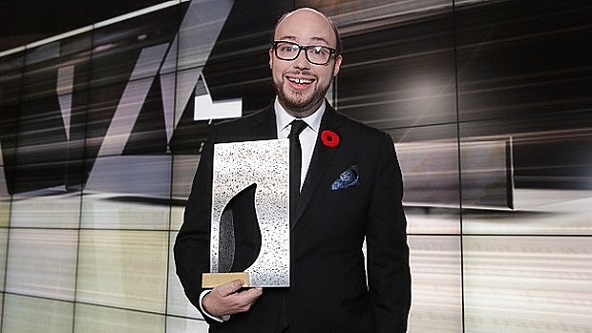
Perhaps not the Sean Michaels you were thinking of? (CBC -- David Donnelly)

Perhaps not the Sean Michaels you were thinking of? (CBC — David Donnelly)

Did you watch the Gillers last night? Me neither.

It’s a bit discouraging. Last year I wrote a 20,000-word essay on the Gillers that required me to read the entire long list (thirteen books). This year I was just a spectator, and without that incentive I read only one of the twelve books on the long list, and that because I had been paid to review it. (The book was Rivka Galchen’s American Innovations, by the way. It was pretty good, but didn’t make the shortlist.)

The biggest news, really the only “news” surrounding this year’s award, was extra-literary. The scheduled host, Jian Ghomeshi, had been relieved of duty (more on his downfall here), to be replaced by Rick Mercer. In addition, the prize purse had been doubled to $100,000.

I’m not impressed by the big pile of cash. It strikes me as desperation. The only thing the Giller people can do to attract attention to their award is to throw more money at it. But how many eyeballs did it buy? This has to have been one of the most under-the-radar Gillers ever. Clearly it is now a fading brand. I didn’t even recognize the names of any of the “celebrity presenters.”

Of course, Scotiabank has no end of money to put into events like this. Banks, as we all know after 2008, are the masters of our universe. Whether today’s banks are effective cultural custodians, however, is another matter. The prize money here is more than most of these authors can ever expect to make from selling their books. Is that a good thing? Meanwhile, Scotiabank announced 1,000 Canadian job cuts just last week, despite making billions in profits. The few-big-winners/lots-of-losers economy continues apace.

Congratulations to Sean Michaels, author of Us Conductors, who walked away with the prize. He was given the longest odds, and in a poll conducted by the Globe and Mail not one of the “experts” picked him to win (the only author on the shortlist so undistinguished). In the lead-up to last night’s gala All My Puny Sorrows by Miriam Toews was reported to be the clear bestseller on the shortlist, with David Bezmogis’s The Betrayers in second place. I confess that before the announcement of the long list I hadn’t heard of Us Conductors, despite it being published by a major press. Indeed, the only “Sean Michaels” I knew of was a porn actor from the 1990s.

Michaels is the third debut novelist to win the award, following Vincent Lam (OK, his debut was a linked short story collection) and Johanna Skibsrud, a pair of authors who did not set the world on fire as sophomores (bonus points if you can name their follow-up efforts). This makes one wonder how accurate a predictor the Giller is of future success, or whether winning Canada’s most prestigious and richest literary prize, which began as something of a lifetime achievement award, is good for younger authors.

We’ll find out after the party.

This is the way we rise and fall

Haters gonna hate? (Sarah Zucca)

Haters gonna hate? (Sarah Zucca)

Every now and then a story crosses the digital wire that seems to be about something more. They stick in your head with resonant factlets, or are representative of some larger meaning. Past examples that I have filed away include the announcement that the videogame industry has become larger than the film business, and the effect that social media has had on porn usage (Facebook taking over as the preferred mode of self-gratification).

Here’s the latest: Taylor Swift’s most recent album, 1989, accounted for one in every five American record sales (physical or digital editions) last week. As reported in the New York Times, the 24-year-old sold more copies of her No 1 album than the combined sales of singles at No 2 to No 107 in the Billboard chart. At Slate.com, Chris Molanphy tried to explain just how striking this was:

Basically, in the postmillennial, digital-first music business, you can divide artists into a small handful of elite megablockbuster acts and the 99 percent. And this is fundamentally different from the music world of the ’80s and ’90s. The Michael Jackson of Thriller may have been in a league of his own, but the ’80s acts just a half-tier below him—Bruce Springsteen, Madonna, Prince, Whitney Houston, Michael’s sister Janet, George Michael—were minting tens of millions in sales, and medium-tier acts like REO Speedwagon or Mötley Crüe did fine. In the ’90s, the album chart was dominated overall by Garth Brooks and Mariah Carey, but dozens of other artists were genuinely competing with them, dropping 5- and 10-million-sellers, from Pearl Jam to TLC to the Spice Girls. What we have now, on the other hand, is an extreme case of haves and have-nots. Swift may be quite a bit bigger than Lil Wayne, Justin Timberlake, and Lady Gaga. But really, when it comes to chart performance, this small handful of artists (plus consistent chart-toppers like Jay-Z and Beyoncé) is hobnobbing together in a very exclusive luxury box behind home plate while every other act is squinting from the bleachers.

Or if you don’t like baseball metaphors, consider football—and television. DVRs and online streaming have decimated TV ratings for the last decade; top-rated series of today like Modern Family and The Big Bang Theory wouldn’t even make the Top 50 in the age of Seinfeld and ER. And yet somehow the NFL keeps commanding ever-larger TV audiences for its live games. This year’s Super Bowl ranked as the most watched television program in U.S. history. It beat the ratings record set two years earlier by … the Super Bowl. And that 2012 game was the third time in three years it topped itself for the all-time record. The gap between live events, like the Super Bowl and the Oscars, and everything else on television is too large to even consider them the same kind of televisual entertainment at this point. In TV ratings as in music, it isn’t just winner-take-all. It’s winner-moves-to-a-private-island-and-secedes.

There’s nothing new about the trends at work. The growing gulf between the one-percenters and the rest of us, between the haves and have nots, is common knowledge. We also know that this is something that has been happening in all sectors of the economy and not just finance or industry. In her book Plutocrats, Chrystia Freeland even describes how it works in the music business. The world only needs one “world’s greatest cellist,” and so Yo-Yo Ma is rich and famous and all the other cellists in the world . . . well, they still have their music. Culture has become a zero-sum game, with great rewards for the winner and oblivion for the rest.

When it comes to culture, I can think of two possible outcomes that might have redeemed the digital revolution. In the first, the tearing down of any barriers to distribution might have led to a new cultural economy, one that had some big winners but which also raised all boats. Alas, trickle-down economics always was voodoo. As the Taylor Swift story indicates, it’s not just that Swift is doing so well, it’s that the rest of the field is collapsing. The same thing has happened in publishing, as a story that appeared in the Guardian several months ago explained:

Earlier this week, the Authors’ Licensing & Collecting Society released a survey of almost 2,500 writers which found that the median income of a professional author last year was £11,000, down 29% since 2005 – a period in which median earnings for UK employees have fallen by 8%. By this year, according to the survey, just 11.5% of professional authors said they earned their income from writing alone, compared with 40% in 2005.

I note in passing the full title of Chrystia Freeland’s book: Plutocrats: The Rise of the New Global Super-Rich and the Fall of Everyone Else.

But there was another avenue open for the new cultural economy to redeem itself. Perhaps not everyone would succeed, but those who did would be the best of the best, the most innovative and creative, the strongest competitors in an increasingly hostile environment. If 99% of everything is junk anyway, then only the efforts of the vital 1% deserve to exist. The market has spoken. If you can’t sell your books or music then you should be doing something else with your time.

Has that happened? Has the Internet led to a cultural renaissance?

I don’t see it. The rags-to-riches stories of self-publishing on the Internet have mainly been of formulaic, mass market fiction. Indeed, I’m unaware of any experimental or “literary” author who has found success taking this route. Instead, the one-percenters have been names like E. L. James, author of the Fifty Shades of Grey series. Generic fiction rules. A global monoculture spreads its kudzu-like vines everywhere, squeezing out the rest of the literary ecosystem.

And as for music, there is Taylor Swift.

I’m not “hating” Taylor Swift at all. You can look for her on YouTube and judge her talent for yourself. But for me the news of her rise and everyone else’s fall is depressing. You have to look at the trends that are developing and be concerned about where they are taking us.
Must we burn Jian Ghomeshi?

Hic est locus Marini Faletro decapitati pro criminibus. (CP -- Chris Young)

Hic est locus Marini Faletro decapitati pro criminibus. (CP — Chris Young)

I don’t know Jian Ghomeshi, have never met or corresponded with him, and the only time I ever listened to his Q Radio Show was when I was writing commentary on the Canada Reads program. I knew of him, but he wasn’t really on my radar. Since his firing from the CBC, however, his celebrity star has gone supernova, attracting daily headlines in the national news media for over a week.

From poster boy of the new CBC to whipping boy of “rape culture,” it’s been quite a fall, of the kind that celebrity-watchers delight in. His humiliation has been exquisite. We’ve learned about his Big Ears Teddy, and the foulness of his body odour (that he apparently tried to conceal beneath baths in cologne that stank up the Ceeb’s elevators). We’ve put him on the couch, analysed his “pathological narcissism” (Michael Smyth, writing in The Province), and been told of how he represents an entire culture’s “narcissistic male rage” (Gabor Maté in the Toronto Star). On Salon.com Andrew O’Hehir even came up with “Ghomeshi syndrome,” a label for “delusional creeps” with an inflated sense of alpha-male entitlement. Finally, by the end of his week from hell, another media station of the cross was reached when a male friend made the claim that Ghomeshi had fondled his junk in an elevator. The man has become a cliché as well as a pariah.

All of which is fair enough. The charges are serious, and celebrity is cruel. (That Ghomeshi even counted as a celebrity tells you something about Canadian culture today.) This is a point I brought up in my review of Paula Todd’s book on Internet bullying, Extreme Mean:

Rebecca Black is Todd’s poster child for [the use of YouTube as a public pillory for prospective celebrities], but despite becoming “the most hated person on the Internet” at the tender age of thirteen when her music video “Friday” was cybermobbed, she is not a sympathetic case. Black was a celebrity wannabe following a script that, after all, had made a global star out of Justin Beiber. But fame is a harsh game — as many a talent-show contestant taken from the stage in tears can testify – and this is as it should be. Our attention comes at a price.

When you play the fame game in the digital age you’d better have a skin of steel or a very well-developed case of narcissism, the kind that makes you totally oblivious to what anyone else thinks. The state has no place in the bedrooms of the nation (Ghomeshi’s initial defence, on Facebook), but celebrity isn’t politics, it’s pop culture. Ghomeshi was a personality, of the kind that has taken over much of the radio dial. That personality was, in turn, a brand. When you become a brand, everything is in play. You’re selling yourself, and the public feels entitled to inspect the goods.

All of the coverage has led to some unseemly piling on (it appears no one really liked Jian very much), as well as unfortunate collateral damage. One can’t be surprised any more by the haters who post on YouTube threads (just ask Rebecca Black), but Moxy Fruvous weren’t a bad band. Come on, people: they wrote silly, satirical pop songs, a couple of which have managed to stay in my head. Of course they look and sound stupid now, but making fun of them is anti-Jian overkill.

More serious collateral damage will be felt by the CBC. The scandal hits them at a bad time (not that any time would be very good). But the impact may be even broader, what with the “rape culture” debate getting re-energized as media gasoline is tossed on the flames. After Ghomeshi’s original Facebook post there was a flood of support for his pro-kinky sex stand. Now the kinksters are running scared. Under Canadian law, we are told, there is no such thing as consent to harm. An investigation has begun into who knew what at the CBC, and when they knew it. Early reports don’t look good. Heads may roll. Carl Wilson, writing for Slate, suggests that because a lot of people in the Toronto scene knew Ghomeshi was a creepy perv, they were “complicit in his abuse.” That is, “you didn’t know, of course. But you knew. There was doublethink, a split consciousness” (Wilson’s piece is written in the second person). Is that a defence that will hold up in court?

Ours is a society terrified of personal responsibility, and for good reason. Responsibility means liability, and you really, really don’t want to go there. Ghomeshi’s case has made a lot of people anxious, and for that alone he’ll probably have to burn.