Suicide solution?

Last week I read a news story about an apparent murder-suicide that had happened in the U.S. Except it wasn’t reported as being a murder-suicide. Instead, the police chief was quoted as referring to it as possibly being “a murder-[expletive].”

I have to admit that when I first read this I did a double take. I couldn’t figure out what the police chief had said. It took a couple of moments for the penny to drop.

Was this an example of the “language police” riding again? Apparently it’s been considered wrong for a while now to say “committed suicide” because “commit” implies or suggests that suicide is a sin or a crime, as this is how it’s been looked on in the past, albeit not recently. And by “not recently” I mean probably not in many people’s memory.

There’s still some stigma attached to suicide, but this has more to do with the act itself than the language. But let’s stick with the word. As the medical director for The American Foundation for Suicide Prevention puts it: “We wouldn’t say commit cancer or a heart attack. It implies something that’s willful and morally reprehensible.”

This sounds fair, though I still don’t think I’d want to ban the use of the expression outright. And thinking about it more deeply, I’m not sure the analogy holds. Cancer and a heart attack aren’t acts. People don’t do a heart attack or cancer. Saying that suicide isn’t a “willful” act is also problematic. Surely in some cases, like medically-assisted suicide in this country, it is profoundly willful. To say otherwise would be to deny personal agency in what is an agonizing decision over how to end one’s life.

But the news story went further, choosing to see the word suicide as an “expletive.” This is where things got interesting for me. Let’s take a couple of dictionary definitions of “expletive”:

Merriam-Webster:

a syllable, word, or phrase inserted to fill a vacancy (as in a sentence or a metrical line) without adding to the sense

an exclamatory word or phrase, especially one that is obscene or profane

Wikipedia:

An expletive is a word or phrase inserted into a sentence that is not needed to express the basic meaning of the sentence. It is regarded as semantically null or a placeholder. Expletives are not insignificant or meaningless in all senses; they may be used to give emphasis or tone, to contribute to the meter in verse, or to indicate tense.

The primary definition comes from the Latin expletivus, meaning to fill out or take up space. The secondary meaning defines it as a word considered to be offensive, a profanity or curse.

Now I’ll be honest and say I didn’t even know the primary meaning of expletive as a placeholder. For people my age I think the word expletive first came into public consciousness with the release of the expurgated transcripts of the Oval Office tapes of Richard Nixon, which made famous the phrase “expletive deleted.” My father had a political cartoon of Nixon swearing his oath of office with one hand on the Bible and the oath itself peppered with “expletive deleteds.” I’ll never forget it.

So what has happened is that the word “suicide” has been redefined as an expletive, something offensive to be deleted from reported speech. Not just “committing suicide,” but the suicide itself. Unfortunately, what this has resulted in, at least online, is an awkward grasping for euphemisms or circumlocutions to fill the gap. Most of these have been, frankly, ridiculous. Self-deletion? Or, even worse, “unalive”?

In 2024 Seattle’s Museum of Pop Culture actually got in trouble for rewriting a Nirvana exhibit to say that Kurt Cobain had “un-alived himself” rather than “died by suicide.” There was a public backlash to that and it had to be corrected, but the fuss underlined what has become a digital-age phenomenon. The thing is, digital media platforms, most prominently YouTube, can and do demonetize content that runs afoul of speech codes. Which is why, watching some videos or listening to podcasts, you’ll hear certain words blanked out or else substituted for something less likely to trigger the algorithm.

This has become so prevalent that the resulting language even has its own name: algospeak. This refers to the code words that are used to evade automated or human moderation. “Unalive” is one such example.

Algospeak has its critics. Some people in the suicide prevention community, for example, see it as potentially confusing individuals who may be looking for help and who can’t decode the new slang. But it’s interesting to see the forces at work that push language to evolve.

Are we better off today than when I was a kid? In public and high school kids in my generation listened to songs like Ozzy Osbourne’s “Suicide Solution” and Queen’s “Don’t Try Suicide.” I can still remember in grade 7 or 8 hearing the latter come on at a dance:

Don’t try suicide, nobody’s worth it
Don’t try suicide, nobody cares
Don’t try suicide, you’re just gonna hate it
Don’t try suicide, nobody gives a damn

A teacher who was standing nearby turned to one of his fellow teachers and laughingly remarked: “Nobody gives a damn? That’s not being very positive.” And that’s as far as things went back in the day. Were we made stronger by listening to such lyrics? Or damaged by them? Osbourne was actually sued after someone listening to “Suicide Solution” killed himself but the claim failed at trial. On the broader question of the role language plays in such cases, the jury’s still out.

Numbers Game 3: Fraud Alert

There were 3,866 investment fraud victims reported in 2024, who collectively suffered a financial loss of $310.6 million, according to the Canadian Anti-Fraud Centre (CAFC). These numbers include all types of investment fraud, not just online scams.

So far in 2025, Maude Blanchette, chair of the Canadian Securities Administrators (CSA) Investment Fraud Task Force, estimated that there have already been about 3,000 cases reported. The official tally will be released by the CAFC in 2026.

Blanchette said the number of reported cases has levelled off since 2022, but added that scams tend to be severely underreported to begin with. According to the CAFC, just five to 10 per cent of fraud incidents are reported.

“It’s very scary because it means that it is only the tip of the iceberg,” Blanchette said.

I found this news report upsetting for a number of reasons. Assuming only 10 per cent of fraud incidents are being reported, the total annual losses would be over $3 billion. And perhaps double that if 10 per cent is too high. That’s a lot of money, and victims, for one country without a large population.

The thing is, as much as we can shake our heads at the foolishness of people who fall for some of the more obvious scams, I think we are all vulnerable. I even got scammed by one online retailer about fifteen years ago, but it was only for $10 so I didn’t feel too bad. And while most frauds are pretty transparent, I’ve known a couple of people who were fooled by operations that were really quite sophisticated. And with AI these scams are apparently getting even better. The bottom line is: even if you think you’re much too smart to fall for an online fraud, you probably aren’t. You just haven’t been caught yet.

What also bothers me is the inability, or unwillingness, of law enforcement to do much of anything about the problem (I won’t even mention the platforms who are basically accomplices in all this). It’s just too much work for authorities, or too difficult. I knew a lawyer who worked in the field twenty years ago and back then he told me that the police wouldn’t even investigate a complaint that was under $75,000.

I think we should take this kind of thing a lot more seriously, and while there may be jurisdictional issues I don’t see why it should be so hard to crack down on these people. As it is, they all know they can get away with it so it’s a problem that keeps getting worse. And as the numbers indicate, it’s a big problem now.

Numbers Game 2: Poutine-a-Palooza

Dig in!

For those who don’t know, poutine is a French-Canadian dish consisting of french fries covered in cheese curds and gravy. This past weekend the World Poutine Eating Championship was held in Toronto, an event sanctioned by Major League Eating (yeah, I’d never heard of it either) and sponsored by Smoke’s Poutine at their annual Smoke-a-Palooza festival.

Two years ago the contest was won by a guy who ate 20.4 pounds of poutine in 10 minutes. That number was crushed the next year though by competitive-eating legend Joey Chestnut, who swallowed 28 pounds of the stuff in the same time. This year Mr. Chestnut won again but only ate 26.5 pounds. Maybe he pulled up seeing how far ahead he was.

Needless to say, I couldn’t imagine eating 28 (or 26, or 20) pounds of anything in ten minutes. I will say that Mr. Chestnut is very good at what he does, and he trains hard for these events (yes, training is involved). This is a guy who can (and has) eaten 76 hot dogs in twelve minutes. But this kind of thing, in addition to looking gross, isn’t healthy. Most deaths from these stunts occur due to choking, but even assuming you get everything down it seems to me like you’re ravaging your body. I think you could get clogged arteries just from watching this amount of poutine being consumed.

Still . . . 28 pounds. Disgusting, sure. But you have to be impressed, just a little.

Numbers Game 1: Back to School

According to a 2024 report by the charity Kindred2, which was based on a poll of 1,000 primary school staff in the UK, problems are increasing with school-readiness among the cohort of students entering Reception (which is what they call the first year of primary school, for kids around the age of 4 or 5).

Nearly half (46%) of pupils are unable to sit still, 38% struggle to play or share with others, more than a third (37%) cannot dress themselves, 29% cannot eat or drink independently and more than a quarter (28%) are using books incorrectly, swiping or tapping as though they were using a tablet, according to the survey.

The numbers give some indication of how much extra work teachers are having to do, and they are surprising. I’m not sure what it even means that a kid age 4-5 can’t eat or drink “independently.” But it’s that last statistic that got me. Over a quarter of these kids don’t even know what a book is? That’s scary. Apparently it’s also where the biggest gap in the survey showed up between what parents’ expectations were and the reality of where most kids were at, as over half of all parents thought children should be able to use books correctly upon entering the program. This gives some indication of how under the radar the problem is.

Called it!

Over at the New Yorker the columnist David D. Fitzpatrick has just done a much-discussed forensic accounting (“How much is Trump pocketing off the Presidency?”) calculating the amount of money Donald Trump has made out of being president. The total he comes to, and this is presented as a conservative estimate, is $3.4 billion. Already.

Many payments now flowing to Trump, his wife, and his children and their spouses would be unimaginable without his Presidencies: a two-billion-dollar investment from a fund controlled by the Saudi crown prince; a luxury jet from the Emir of Qatar; profits from at least five different ventures peddling crypto; fees from an exclusive club stocked with Cabinet officials and named Executive Branch. Fred Wertheimer, the dean of ethics-reform advocates, told me that, “when it comes to using his public office to amass personal profits, Trump is a unicorn—no one else even comes close.” Yet the public has largely shrugged. In a recent article for the Times, Peter Baker, a White House correspondent, wrote that the Trumps “have done more to monetize the presidency than anyone who has ever occupied the White House.” But Baker noted that the brazenness of the Trump family’s “moneymaking schemes” appears to have made such transactions seem almost normal.

When thinking about numbers like this I think it’s helpful to remember just how much a billion dollars is. A million seconds is approximately 11.5 days, while a billion seconds is about 31.7 years. The scale of Trump’s corruption isn’t just unparalleled, it’s nearly unimaginable.

Who knew this level of profiteering was going to happen? Everyone! Including yours truly, in my immediate post-election post in November 2024:

The main thing I feel confident predicting though is that we are going to see kleptocracy run mad. The looting of the American state is about to begin, on a scale (to borrow a favourite Trumpism) never before seen in the history of the world. Back during his first term Sarah Kendzior characterized the Republican plan for America as being to “strip it for its parts,” and Trump presided over an administration more corrupt and indeed criminal than any the U.S. had ever experienced. Well, expect that to ramp up bigly. The copper wires are going to be ripped from the walls, the plumbing fixtures torn out, and the lead taken from the roofs. Switching metaphors, the cookie jar is going to be wide open and sitting out on the table for at least the next two years.

As the corruption has mounted, here are some other voices (all emphases in bold added). Just to anticipate a couple of complaints in advance:

These are all liberal media sources. If you define liberal as any voice speaking out against Trump, yes they are. But the facts are out in the open.

It’s just the same as what Democrats did (and do) when they’re in power. Not like this! To be sure, corruption is very much part of modern politics. But nothing has been done on the scale of what Trump is doing.

So without further ado:

From “Trump’s Corruption” by Jonathan Rauch (The Atlantic, February 24 2025):

Patrimonialism [the form of government Rauch identifies Trumpism with] is corrupt by definition, because its reason for being is to exploit the state for gain—political, personal, and financial. At every turn, it is at war with the rules and institutions that impede rigging, robbing, and gutting the state. We know what to expect from Trump’s second term. As Larry Diamond of Stanford University’s Hoover Institution said in a recent podcast, “I think we are going to see an absolutely staggering orgy of corruption and crony capitalism in the next four years unlike anything we’ve seen since the late 19th century, the Gilded Age.” (Francis Fukuyama, also of Stanford, replied: “It’s going to be a lot worse than the Gilded Age.”)

They weren’t wrong. “In the first three weeks of his administration,” reported the Associated Press, “President Donald Trump has moved with brazen haste to dismantle the federal government’s public integrity guardrails that he frequently tested during his first term but now seems intent on removing entirely.” The pace was eye-watering. Over the course of just a couple of days in February, for example, the Trump administration:

gutted enforcement of statutes against foreign influence, thus, according to the former White House counsel Bob Bauer, reducing “the legal risks faced by companies like the Trump Organization that interact with government officials to advance favorable conditions for business interests shared with foreign governments, and foreign-connected partners and counterparties”;

suspended enforcement of the Foreign Corrupt Practices Act, further reducing, wrote Bauer, “legal risks and issues posed for the Trump Organization’s engagements with government officials both at home and abroad”;

fired, without cause, the head of the government’s ethics office, a supposedly independent agency overseeing anti-corruption rules and financial disclosures for the executive branch;

fired, also without cause, the inspector general of USAID after the official reported that outlay freezes and staff cuts had left oversight “largely nonoperational.”

By that point, Trump had already eviscerated conflict-of-interest rules, creating, according to Bauer, “ample space for foreign governments, such as Saudi Arabia and the United Arab Emirates, to work directly with the Trump Organization or an affiliate within the framework of existing agreements in ways highly beneficial to its business interests.” He had fired inspectors general in 19 agencies, without cause and probably illegally. One could go on—and Trump will.

From “The Trump Presidency’s World-Historical Heist” by David Frum (The Atlantic, May 28 2025):

Nothing like this has ever been attempted or even imagined in the history of the American presidency. Throw away the history books, discard people, comparisons to scandals of the past. There is no analogy with any previous action by any past president. The brazenness of the self-enrichment resembles nothing seen in any earlier White House. This is American corruption on the scale of a post-Soviet republic or a post-colonial African dictatorship.

The Trump story . . . is almost too big to see, too upsetting to confront. If we faced it, we’d have to do something – something proportional to the scandal of the most flagrant self-enrichment by a politician that this country, or any other, has seen in modern times.

From “Follow the money: Trump’s corruption hits shocking heights” by Juan Williams (The Hill, June 2 2025):

Right now, it is hard to miss what looks like a deluge of pocket-lining as private money swirls around this president. And let’s not mention the free airplane he is ready to accept from a foreign power.

The money grab is so breathtaking that it has left Trump’s critics muttering expletives while the normally reliably loud critics of government corruption, especially congressional Republicans, appear in stunned silence.

Even as Trump’s administration seeks to regulate crypto more loosely, his jaunt into crypto — his $TRUMP and $MELANIA meme coins, plus his stake in World Liberty Financial — has reportedly increased his family’s wealth by billions in the last six months and now accounts for almost 40 percent of his net worth.

New York Times reporter Peter Baker posted on X last week, “Trump and his family have monetized the White House more than any other occupant, normalizing activities that once would have provoked heavy blowback and official investigations.”

Presidential scandals of the past seem quaint by comparison — Hillary Clinton’s cattle futures, Eisenhower’s chief of staff resigning over a coat, Nixon stepping down over a “third-rate burglary.”

The magnitude of Trump’s self-serving actions to enrich himself exceeds anything in our history. Nixon sought distance from wrongdoing, telling Americans that he was “not a crook.” He wanted to be clear that he did not personally gain money from any abuse of power that took place in his administration.

Trump makes no effort to proclaim his innocence as he pursues wealth while in public office. And while Nixon held power during a time of relative economic calm for the middle class, Trump is acting against a backdrop of economic anxiety for most Americans.

From “This is the looting of America: Trump and Co’s extraordinary conflicts of interest in his second term” by Ed Pilkington (The Guardian, June 16 2025):

Trump and his team of billionaires have led the US on a dizzying journey into the moral twilight that has left public sector watchdogs struggling to keep up. Which is precisely the intention, said Kathleen Clark, a government ethics lawyer and law professor at Washington University in Saint Louis. . . .

“People talk about ‘guardrails’ and ‘norms’ and ‘conflict of interest’, which is all very relevant,” she said. “But this is theft and destruction. This is the looting of America.”

Trump returned to the White House partly on his promise to working-class Americans that he would “drain the swamp”, liberating Washington from the bloodsucking of special interests. Yet a review by the Campaign Legal Center found that Trump nominated at least 21 former lobbyists to top positions in his new administration, many of whom are now regulating the very industries on whose behalf they recently advocated.

Eight of them, the Campaign Legal Center concluded, would have been banned or restricted in their roles under all previous modern presidencies, including Trump’s own first administration.

Final thoughts: the one thing that surprised Fitzpatrick the most in his investigations is the frantic pace at which Trump and his family are exploiting the office of the presidency to line their pockets. So keep in mind we’re only 8 months in and the number is going to keep going up, perhaps at an even accelerated pace. Also: the guardrails against corruption have been entirely torn down and with all the bodies meant to keep an eye out for such behaviour and even call it to account either disbanded or staffed with figures whose only loyalty is to Trump, it’s now become a free-for-all. In terms of high-level graft and corruption the U.S. is effectively a lawless state, already experiencing a level of profiteering, in terms of the dollar amounts involved, unparalleled by any modern government, with the possible exception of what happened after the breakdown of the Soviet Union and the rise of the Putin-era oligarchs. America’s oligarchs took notes on that, and are on board for the same ride. I mean, they already got a $3 trillion dollar-plus tax cut (conservatively estimated) in the Big Beautiful Bill. That’s trillion. Or, to use my earlier analogy, 31, 689 years. The mind boggles.

And now they have crypto to play with too.

So my next totally predictable prediction: the looting of America is going to get worse.
Dry storm

Not all of the words I feature here are ones I come across when reading. This one struck me when I was at the gym, watching the Weather Channel. Which is actually one of the more interesting shows on cable these days.

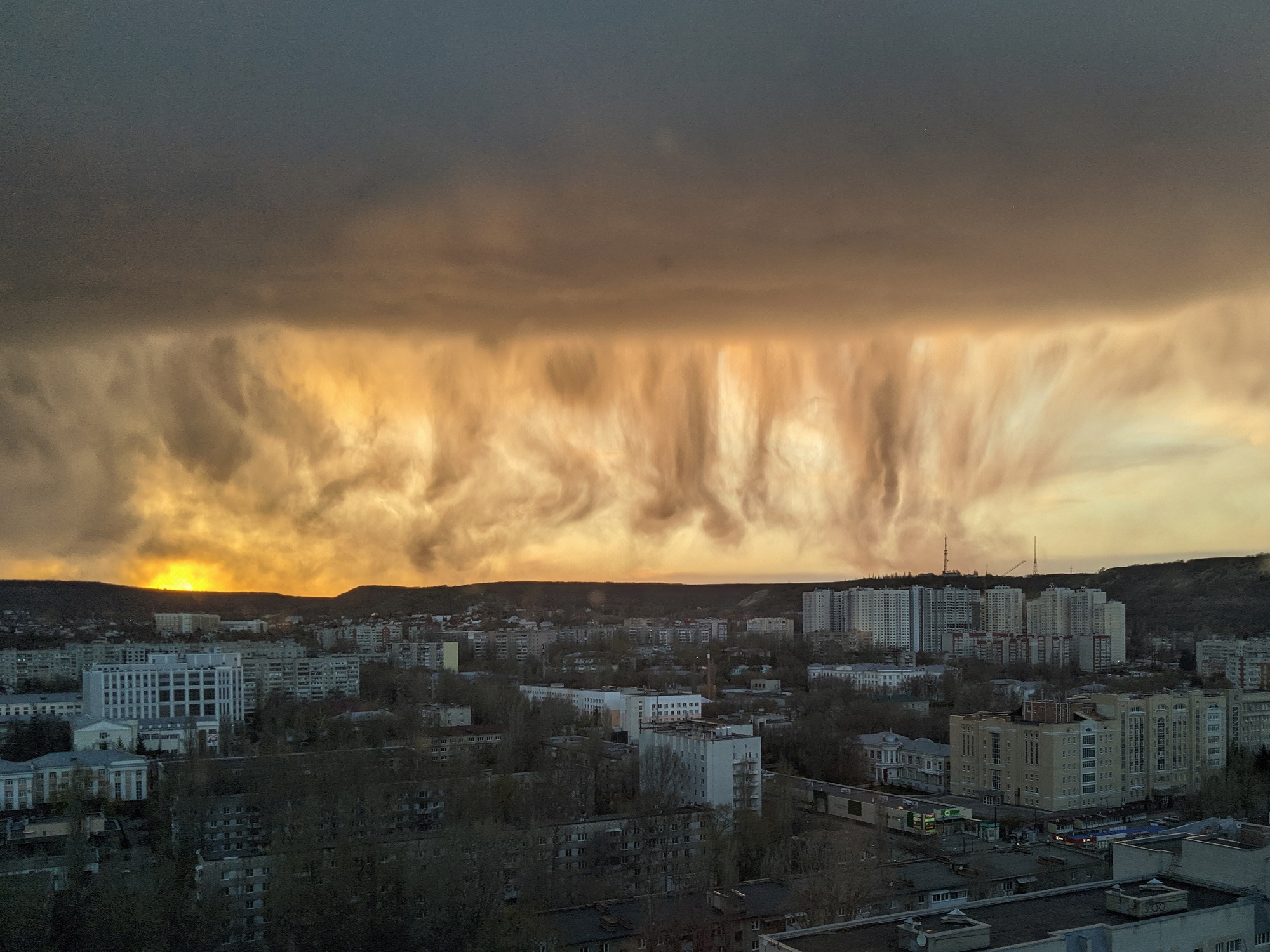
A virga (plural virgae), also known as a “dry storm,” is a streak or shaft of rain that evaporates before it hits the ground. As I read up a bit about virgae I found it necessary to understand the concept of a “precipitation shaft”: a highly localized precipitation event. It’s not a whole front of rain then but a sort of column, which ties into the Latin root of virga: a rod, staff, sprig, or twig.

This is not a word I can imagine myself using, ever. I don’t think I’ve ever seen a virga, so I’d have to employ the word as a metaphor. Looking it up online, however, I did come across this amazing picture of a virga in the sunset over the Russian city of Saratov. That in itself seemed worth a post. (You can click on the pic to make it bigger.)

Words, words, words

AIU

Almost as soon as stories about ChatGPT and generative artificial intelligence started breaking a few years ago there were people commenting on the impact it might have on education. It wasn’t hard to imagine even the earliest chatbots writing essays better than most students were capable of, and in a world where they were doing all of their essays and taking all of their tests on screens we were immediately tossed into a massive multiplayer Turing test, with teachers being challenged to see whether the work they were grading was real.

Students took to AI like fish to water, with one survey saying that within a year or two 90% of them were using the assistance of AI in writing papers. The one figure I found for Canadian students said that well over half were using AI to do their homework in 2024. I wasn’t surprised by this, or the speed of AI’s adoption, or by the way an increased use of AI led to questions being asked as to what the worth or even the point of an education was if it could so effectively be faked without any effort. There was always another side of the story, however, that I thought all of these reports were missing.

When news of the impact of AI on education started breaking I understood that students were going to make use of it. What I don’t think many people appreciated, because I didn’t see anyone talking about it, was that their teachers would too.

Even when I was at university it was clear to me that many of my professors’ lectures were basically just cribs of other people’s work. In some cases they were adding nothing to decades-old secondary literature that they were almost reading verbatim. Since I graduated I’ve listened to many lectures online, even ones that have been highly recommended by top profs from prestigious institutions, and thought that they could have basically been written by an AI. In an adult education program I’ve been involved in that creates lecture series on topics of interest one such course, on AI, was designed by AI as a sort of cheeky proof of concept.

The fact that professors were cheating didn’t surprise or upset me. Many academics don’t make a lot of money but work on short-term contracts. Why wouldn’t they use AI to prepare some of their lectures? And why would tenured faculty be above taking such shortcuts? In some cases I’m sure that using AI might even make their lectures better.

I recently had lunch with a professor friend where I mentioned this and he seemed surprised and a bit horrified at the thought. I thought he was naive. And a couple of weeks ago a news story that caught my eye gave me some support. According to the story a student at Northeastern University in the U.S. had requested a refund of her tuition after discovering that her professor had been using ChatGPT to prepare his lessons.

Wondering if it was just an isolated incident, she found more signs of AI usage in previous lessons, including spelling mistakes, distorted text, and flawed images.

Because of this, she decided to request a refund for the tuition she paid for the class, since she was paying a significant amount to receive a quality education at a prestigious university. For that course alone, she was paying $8,000 per month.

She pointed out that the same professor had strict rules regarding “academic dishonesty” by students, including the use of artificial intelligence. However, shortly after graduating, Ella was informed that she would not be reimbursed.

Speaking to The New York Times, Rick Arrowood, Ella’s professor, said he had uploaded the content of his classes into AI tools like ChatGPT to “give them a new approach.” While he explained that he reviewed the texts and thought they looked fine, he admitted he “should have looked more closely.”

Arrowood also said he didn’t use the slides in the classroom because he prefers open discussions among students, but he chose to make the material available for them to study.

Meanwhile, a spokesperson for Northeastern University stated that the university “embraces the use of artificial intelligence to enhance all aspects of its teaching, research, and operations.”

Several U.S. universities are adopting similar positions, arguing that the use of AI tools is seen as useful and important by faculty. But not all students are convinced.

On websites like Rate My Professors, a platform for evaluating instructors, complaints about professors using AI are also on the rise. Most students complain about the hypocrisy of teachers who ban them from using AI tools while using them themselves.

Furthermore, many question the point of paying thousands of dollars for an academic education they could get for free with ChatGPT. The topic remains under debate, but most students and faculty agree that the main issue is the lack of transparency.

I don’t agree that the main issue is lack of transparency. I think the main issue is that AI may be better at this than the professors who are using it not just as a time-saving technology but as a crutch or surrogate already, with their numbers “on the rise” given that it’s such a “useful and important tool.” And it’s not just being used in the preparation of lectures. Another story I found in The Byte online talks about a program called Writable that “is allowing teachers to use AI to evaluate papers, which the company says saves ‘teachers time on daily instruction and feedback.'” As the story concludes:

It’s a bizarre new chapter in our ongoing attempts to introduce AI tech to almost every aspect of life. With both students and teachers relying on deeply flawed technology, it certainly doesn’t bode well for the future of education.

Bizarre indeed! The future of education may have AI programs grading essays written by AI, based on lectures prepared by AI, with nobody being any the wiser. In fact, that may not even be the future. It’s almost certainly happening already.

We should be concerned about where we’re heading. But my point is this: don’t just blame the kids.

Managed decline

Out on delivery. (CP — Christinne Muschi)

My grandfather was a village postmaster, and my mother had fond memories of working at the post office with him when she was a kid. My father was a stamp collector, and while this wasn’t a hobby I stuck with I did have stamp albums as a boy that I’ve held on to, along with the boxes filled with my father’s highly eclectic (and I’m afraid not very valuable) collection.

When it comes to my affection for all things mail related, however, what stands out the most is the fact that I lived on a farm most of my life and we received rural mail delivery. I was always impressed by the job these people did, even in bad weather on what were the worst of roads. Living in rural isolation, the arrival of the mail was an event that meant a lot to family and neighbours.

But times change. When I was young there were few courier companies and no Amazon delivery vans (much less drones). There was no Internet and email. There were no flyers or junk mail. People sent Christmas cards. In other words, everything came to you through the mail, and if it wasn’t always something you wanted it was at least something you knew was important.

This is no longer the case, which is why Canada Post, the Crown corporation that handles the mail in this country, is facing such a host of problems. Chief among these problems is their high labour costs and the fact that a lot of what made the mail not only useful but essential is gone. The result is a corporation that is, according to one recent study, bankrupt. Apparently they lost $300 million in just the first quarter of 2025. That’s not sustainable.

Last year the Canadian Union of Postal Workers (CUPW) went on strike for a month before being ordered back to work in the hope of finding a solution somewhere down the road. That solution hasn’t materialized and as I write this another strike is expected.

I don’t think anyone on either side, workers or management, is under any illusions as to how grim the future is for Canada Post. That said, I do think the mail has a future. I don’t mind that such a valuable service is operating at a loss. I still think a country, especially one as big as Canada, needs a public, national mail system. What has to be faced though is that a dramatic restructuring of the mail, what it does and how it does it, is going to be required.

And when I say restructuring what I mean primarily is contraction. I probably get more mail than most people. But I don’t need daily mail delivery. If they even cut delivery back to once a week I think I’d be fine.

I don’t know how workable this is, but there have been various studies done and other recommendations made that can be picked from. The bottom line though is that in order to avoid collapse some contraction in service will be necessary. I can’t see the current postal service with its over 70,000 employees surviving long.

There’s a lesson here for other sunset sectors of the economy. I’m thinking in particular of universities. These grew at an unreasonable rate during relatively good economic times, but even back in the 1990s there were reports on how necessary some contraction was. In a period of declining enrolments and now caps put on foreign students (the lifeline that was keeping a lot of higher education afloat in this country) I don’t see a bright future for many of these institutions. And again, the alternative to contraction is collapse: just keeping on doing things the way we have until the whole system breaks down. I know it’s become an expression that’s meant to trigger a fierce reaction, but at this point we have to learn how to manage the decline.

Federal election 2025: After

Normally with one of my after-the-election posts I’d be looking back on what happened. But with the results of yesterday’s vote being so close it looks as though the story of the 2025 federal election is just getting started.

Some observations can be made. As expected, both the NDP and Green Party did very poorly, though the Liberal margin of victory as of this writing is tight enough that the NDP may still have some role to play. They’ll do so, however, without Jagmeet Singh, an articulate and intelligent fellow who never broke through and ended up outstaying his welcome. He lost in his own riding and his political career, I suspect, is over.

Also as expected the Liberals found Ontario, and specifically the Toronto area, to be a rock of support. Whenever that block begins to shift, and it will, that will be the end for their remarkable run.

In a first-past-the-post electoral system it’s always going to be hard for third or fourth parties to make an impact outside of specific regions. Despite slipping badly, the Bloc Québécois may have an outside influence in what happens now. Which leads me to confess that I don’t pay any attention during elections as to what their platform is as they don’t run candidates outside of Quebec. Essentially I see them as being a party of the right, though it’s an old right in a lot of ways and there were parts of their platform, when I started digging into it, that I found myself agreeing with. I’ll never give up on the dream of abolishing the Senate, for example.

It looks as though Pierre Poilievre wants to stay on as Tory leader (assuming he manages to win his own riding, which was still very much in doubt the morning after). I don’t know if this is a good idea, as he seems like one of those politicians with a hard ceiling due to his personality and campaigning style. On the other hand, Mark Carney doesn’t strike me as a skilled politician and he lacks any common touch, but he made an effective foil to Trump, which is all he needed to be in the present moment. He got a boost from being able to present himself as an outsider and a responsible steward of the economy due to his banking background, but I don’t think that’s going to last long. The default impression he gives is of an arrogant establishment technocrat. In any event, what mandate he’s been given will be to manage the economy through what I think is going to be the stormy weather. I wish him the best of luck, which I think he’ll need.

Update:

Poilieve did in fact lose his home riding, complicating his plans to stay on as Conservative leader.

Political punditry potpourri

Political punditry potpourri

Over the years I’ve done a number of posts on Canadian federal elections. This is an index to my penetrating reportage.

Just as a heads-up, I would describe my own political leanings as leftish. But I’m  what’s known today as the “old left,” which leaves me without a stable home in terms of a political party. In any event, I think most political systems in the West, if not broken, are in a bad state of disrepair and almost certainly not up to the challenges we face in the twenty-first century.

Federal election 2015: Before

“I sense a growing divide between public (unionized) and private sector workers both in Canada and the U.S. that could make for a coming split between a party of the state and a party of everyone else. If there is a future for the right it may be here.”

Federal election 2015: After

“It didn’t have to be this way. Canada is, in many ways, a conservative (small “c”) country. But the party’s leadership has been hijacked in the twenty-first century by angry freaks. Stephen Harper like Tim Hudak in Ontario, or even Rob Ford in Toronto could have been a more successful, effective political leader if he’d just been moderately reasonable. But being reasonable isn’t what any of these guys signed on for. They preferred to play ideologues and idiots (or actually were ideologues and idiots). Not one of them could be considered, and this is an important quality for a politician, normal. As I also indicated in my earlier post, the same thing can be said of the current Republican field in the United States. The right has spent years pandering to its base. That base now holds it hostage.”

Federal election 2019: Before

“We’re locked into a nineteenth-century political system, components of which were archaic in the nineteenth century. I don’t like it, but the system is never going to change itself, and indeed will do everything it can to resist any change happening.”

Federal election 2019: After

“One observation I’d make is that we are becoming a more regionally divided nation, which I see as being a sort of work-around of the archaic first-past-the-post electoral system.”

Federal election 2021: Before

“Heaven knows the environment should have been a strong issue to run on this year, but it hasn’t happened. I’m beginning to wonder if it ever will.”

Federal election 2021: After

“So there you have it. An election that nobody wanted ending with a result that will make nobody happy. Which will lead, I am sure, to more anger. A forecast of sunny days ahead.”

Federal election 2025: Before

“The way the election flipped on a dime (if that metaphor makes sense) represents one of the most dramatic turnarounds in Canadian political history. In fact, for its speed and for the size of the swing it probably is the most dramatic turnaround we’ve ever seen. ”

Federal election 2025: After

“But with the results of yesterday’s vote being so close it looks as though the story of the 2025 federal election is just getting started.”