Persuasion

Sunflowers and soup. (Juststopoil.org)

Recent demonstrations, or protests, or acts of vandalism, have been getting lots of media attention, particularly in the U.K. Activists have been throwing soup on famous paintings (which are behind glass and so remain undamaged) and gluing themselves to highways, shutting down traffic.

There have been various groups doing this in recent year, with names like Extinction Rebellion and Last Generation. The latest round has come courtesy of Just Stop Oil. As you’d guess, the broader cause has to do with saving the environment and fighting climate change.

I agree with the point being made. The environment is an important issue for me, and I try to live in such a way that reflects my concern for what’s happening. But I wonder about the value of these stunts.

I’m not questioning the point that’s most often made: that acting out like this only alienates the people one is hoping to persuade. Instead, I question whether the basic premise behind such activism is valid.

That premise is that what’s needed is more attention and publicity given to environmental issues. This is the whole point behind throwing soup at a painting or blocking traffic: getting the media to notice. We live in an attention economy, and it’s felt that the environment is being ignored. If people only knew the nature of the crisis we face they’d act differently.

I don’t think any of that is true. In the first place, there’s a certain segment of the population — not a majority, but a significant number — who have made up their minds and will never believe the lying fake media or the consensus of a scientific elite no matter how loud the warning. Demonstrations will have no effect on them whatsoever.

A much larger cohort are already aware of the problem but don’t think there’s much they can do about it, or care enough to bother trying. George Monbiot starts off his column defending the protestors like this: “What does it take? How far must we go to alert other people to the scale of the crisis we face?” Again: I don’t see being alert to the scale of the crisis as the problem. We know there’s a problem. The media does report on it. It’s not an issue of attention and publicity, attracting eyeballs and getting clicks, but of persuading people to make changes to the way they live.

As I said twelve years ago in a review of Annie Leonard’s The Story of Stuff:

To say that Leonard is right in pointing out the dangers of not doing anything, of just continuing to live the way we live now, is almost beside the point. We know smoking is bad for you – a major cause of cancer and heart disease – but people still smoke. We know fast food will kill you, but that hasn’t stopped billions of people from eating it.

And these are examples where the ill effects of our behaviour are personally and (relatively speaking) immediately felt! The fact of the matter is that we are not a rational species, and we’re even worse when it comes to planning for the future.

Look: Unless they’re hiding their heads in the sand, everyone knows about climate change and global warming. They know the basics of how it works and they have a general idea of the steps that have to be taken to stop it. They just don’t want to take those steps and make the sacrifices that will be necessary.

Maigret: Maigret’s Childhood Friend

He’s not really Maigret’s “friend.” Though it’s interesting that everyone calls him that, assuming that he is. In fact, as Maigret constantly has to correct them, Léon Florentin was only a classmate, and one he looks on now with a mix of pity and resentment.

Given that weak personal connection, I was left a bit confused as to why Florentin would come to Maigret in the first place to get him to investigate a murder that he had some involvement in. This was much the way Maigret’s Pickpocket kicked off too, and I didn’t really understand it there either. Just laziness on Simenon’s part? I have to ask given the way the novel starts, with Maigret working at his desk with the window of his office open. He notices a fly buzzing about before “all of a sudden, as if it had had enough, it took flight and passed through the open window before losing itself in the warm air outside.” Maigret returns to annotating his reports when Florentin’s visit is announced and we’re told that he had “forgotten the fly, which, perhaps offended, must have flown out the window.” Well of course it flew out the window! We were just told so on the previous page! That’s lazy.

I’ve remarked before (in my notes on Maigret’s Patience) how often the character of the concierge in these novels is presented as a negative presence, though never an out-and-out villain. That’s the case again here, with a really ugly concierge who turns out to be the key that reveals the killer. She’s obese and scheming and resentful, possessed only of a sense of low cunning that Maigret has to work around in order to get at the truth. Were there any nice concierges in Paris or were they all this bad?

Maigret finds the whole thing so exasperating he breaks a pipe stem in his teeth at one point. This made me wonder how common an occurrence this is. Are pipe stems easily broken? I’d ask somebody, but I don’t know anyone who smokes a pipe. They seem to be very much a niche these days.

Not a great Maigret story, but it has some dramatic interest. Especially the way Maigret gathers all the deceased’s clients together so he can observe them interact. That was a nice bit of Poirot business. Though at one point Maigret’s philosophy on crimes of passion is expressed, and I think it’s a bit different than that held by Poirot:

He nearly told them that there are no such things as crimes of passion. And yet that was more or less what he believed. He had learned in the course of his career that the spurned lover or the abandoned wife will kill less out of love than out of a wounded pride.

Of course, wounded pride might lead to a crime of passion. It depends how sticky we’re going to be with definitions. Love and pride live next door to each other anyway.

Maigret index

Maigret: Maigret in Vichy

I don’t know if it’s because Simenon liked writing about them or because I like reading about them more, but his Maigret novels with wicked women as the villains are my favourites. It works (for me) again here as Maigret and his wife are on vacation taking the waters at Vichy, which is where a mysterious woman he had noticed as always dressed in lilac is found strangled one morning.

The heavies are the dangerously independent, and “self-satisfied,” Lange sisters. What a pair of schemers they are! We feel it’s only right that the elder Lange is killed, and Maigret even hopes the guy who did her in is acquitted. I can hear him muttering “What a bitch!” as he did at the end of Signed, Picpus.

It’s not much of a mystery, as there’s only one suspect and Maigret is led to him quickly through some rather random deductions. For example, that the phone caller needs time to arrange a meet-up is attributed immediately to the fact that he “must be married,” which isn’t an obvious connection to make. The back story is interesting though, playing like Who’s Afraid of Virginia Woolf? for grifters, and it moves along in a tight, suspenseful manner. On the copyright page it says it was first published serially (in Le Figaro), which I don’t think was usual up to this point. At least I didn’t see any notes to that effect in the other books I checked. Given that there were two or three Maigret novels being published every year, serial publication wasn’t really necessary.

Perhaps a week at the spa was just what the doctor ordered in more ways than one, as this was the first really good Maigret story in a while, and I think stands as one of the better in the series. Bad women really brought out the best in our man.

Maigret index

Apathy in the U.K.

Meet the new boss.

The two signal political events of 2016, at least in the English-speaking world, were the often-paired British vote for Brexit and the election of Donald Trump in the U.S. With six years’ worth of hindsight, I think it’s pretty clear that both votes were disasters. Ever since, much ink has been spilled trying to understand why and how they happened.

I’ve read more books on Trump than I can count, and I think I can say I have a general understanding of the Trump phenomenon. A bunch of different factors, including some long-term and others more immediate, played into his election, and continue to keep his name in the news. America is in a bad place, with political polarization leading to a dangerous level of extremism, including violence and the more-or-less open disavowal of democracy and the rule of law by one of the country’s two main parties.

I haven’t read as much about what’s been going on in the U.K., which is probably why I’m having trouble understanding what’s happening over there. In many if not most ways Britain is in even worse shape than the U.S. Economically I think this is certainly the case, and it may be politically as well. In a recent piece in The Atlantic, “Britain’s Guilty Men and Women,” Tom McTague points a finger at the country’s leadership and its ruling party: “For the past 12 years, Britain has been led by a succession of Conservative prime ministers — each, like Russian dolls, somehow smaller than the last — who have contrived to leave the country in a worse state than it was when they took over.”

To this list has now been added one Rishi Sunak, a very rich guy who used to work for Goldman Sachs and who voters apparently trust to be able to manage the economy. Because that’s something rich people just understand.

Given how bad things have gone in the U.K. over the course of the last six years, what I can’t figure out is why the Tories haven’t sunk to basement-level polling numbers. On some level I “get” the Trump voter, but the Tory voter is a beast I know nothing about. In my review of The Lost Decade 2010-2020 by Polly Toynbee and David Walker (one of the few books I’ve read on the subject) what stood out for me was the level of voter apathy and the effect of a generational split. And I suppose the forces that are driving anger in America — social inequality and the rage machine of social media — are also at play. I’ve heard the British news ecosystem is bad, but as bad as it is in the U.S.? This I don’t know.

I just find it remarkable that after over a decade of misgovernance, incompetence, and outright failure the Conservative Party has any defenders left at all. The shock of 2016 was one thing, but at least in 2020 the U.S. tried to correct course (for how long we still don’t know). Why are the Brits still digging?

My chess is improving

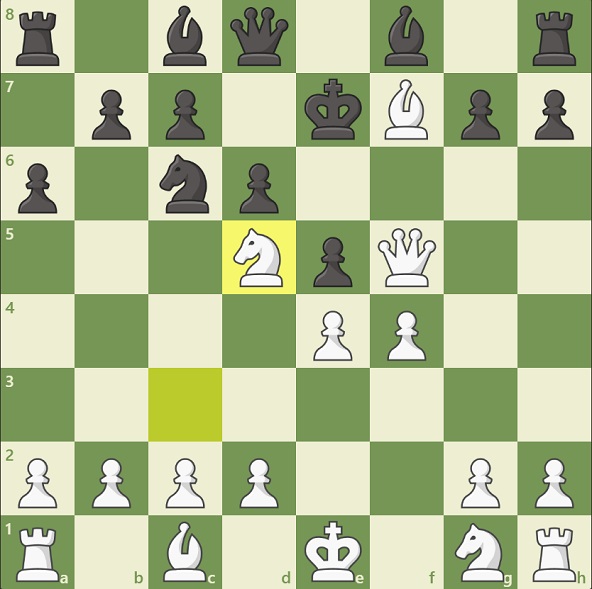
My long, slow climb to becoming a chess Grandmaster continues. A couple of years ago I posted a screenshot of one of my games that showed just how bad I am (and how unserious I am about chess). But today I played what I think may be my best game yet, delivering checkmate in only 9 moves and without losing a piece. According to the computer analysis I did make a mistake, but pfft.

No escape for my opponent!

If the glove fits

I went to the Dollarama yesterday to pick up a pair of oven mitts for my mother’s kitchen. Nothing complicated about that. Or so I thought.

There were, I discovered, no “pairs” of oven mitts. What they had for sale instead were two-packs of oven mitts. That’s not two pairs, but two mitts sold together. Which sounded odd to me, since that’s how you usually buy gloves. You want two of them because you have two hands. But these weren’t pairs of oven mitts, but two mitts for the same hand.

Now, for a lot of oven mitts there is no righty and lefty because both sides are the same. But these mitts were cloth on one side and a silicone surface on the other (the side you grip with). So I couldn’t buy a “pair” of gloves — that is, a right and a left-handed glove — but only a two-pack of right-handed gloves.

Am I missing something? What sense does this make? If you’re going to make oven mitts that like this and package them together, shouldn’t there be a right and left-handed glove in each package? And what if you’re left-handed? Some things I just can’t figure out.

Many books in tiny rooms

As I’ve mentioned before (see my write-ups for 2016 and 2019) I’m a big fan of the annual book sale — formerly known as the Giant Used Book Sale — put on by the Friends of the Guelph Public Library. Because of the COVID-19 lockdown this event was cancelled the last two years, but this past week it was back on, and I was waiting in line to enter on opening night.

I knew going in that I was going to be disappointed, which helped. In the past the sale took over a small warehouse, but this year they were in the same building but had been shunted aside into some office space adjoining the warehouse proper. The result being that the floor space was reduced from 30 000 to 8 000 square feet. That was too tight, and there simply wasn’t enough space for all the books, or all the people. They had a limit of 375 people they could let in at one time, and there were that many waiting in line when the doors opened on the first night (which was also the only day there was an admission fee). Then there were so many people packed together when I got inside that I had to give up on the fiction room entirely as I literally couldn’t move through it.

As an aside, I came away from the experience figuring that, having escaped getting COVID thus far, if I missed getting it this week I could feel confident I had achieved some kind of immunity. So far, all clear! I remain a NOVID, or COVID virgin.

Not having enough room for all the books wasn’t quite as bad as the restricted mobility, since it meant the tables had to keep getting replenished with books from the storage area as the sale went on. So it made sense to keep going back. I attended on three separate days and found a big difference in the selection each day.

All-in-all it was a pleasant enough experience, though when I filled out the feedback form online I told them they needed to find a bigger venue (something I’m sure they already knew). The volunteers were great, and all the people were friendly despite the crowding, semi-competitive atmosphere, and lingering COVID anxieties. I figure around 20% of the people attending were wearing masks. But nobody was yelling at anyone, which was nice.

I was lucky in not wanting to shop for fiction. As it is, I’m always impressed at the kinds of books that people seem to flock to the most. The people who buy bales of books were mainly buying genre fiction: thrillers, mysteries, romance, SF/Fantasy, and YA. You can say what you want about those kinds of books, but the people who read them read a lot. Meanwhile, the rooms I was interested in — history, biography, criticism — were only lightly attended, and the books weren’t moving quickly. Which was nice for me, anyway.

All politics is . . .

Municipal elections are coming up in Ontario. These are not well attended by the voting public. According to the stats I found online, in my current hometown’s last municipal election in 2018 the voter turnout was around 33-36%, which I think is about average for the province.

Commentators in the U.S. have been remarking on how, in recent years, the old adage that “all politics is local” has been turned on its head, and that all politics is now national. I find something similar happening in Canada, where people tend to get excited about the big issues and personalities that play out in parliament, while not caring much about how their cities are run. The fact that Toronto tends to get a higher voter turnout than the rest of the province is part of the same dynamic. Add to this the disappearance of local media (my hometown newspaper shut down a few years ago after a run of over a century) and municipal politics outside of Toronto has become a kind of vacuum. Who’s covering City Hall? In many municipalities, no one.

I think this is dangerous, as a lot of the things that will affect people the most directly are precisely the local issues that people don’t seem interested in. Where I live, I suspect the current mayor will be re-elected. Before I sat down to write this post, I didn’t know the name of anyone running against the incumbent. I certainly haven’t seen signs for anyone else (though one mayoral candidate has made the principled decision not to have any, and even argues that the “environmentally destructive eye-sores” should be banned).

That said, when I checked I was surprised to find that there are actually six people running for mayor! And a couple of them had really slick web-pages, so maybe that counts for something.

I confess I don’t know what the driving issues are. Affordable housing seems to be the hottest button, but that’s a provincial and national issue as well that’s getting a lot of attention. Otherwise, the candidates seem to want to boil everything down to a few key words. One mayoral candidate’s web-page lists “Accountability, Transparency, Participation, and Inclusion.” Sounds good. Among the signs for candidates running for Council I saw one in my neighbourhood that said “Innovation and Diversity.” Another said “People Planet Prosperity.” This may mean something more than “Elect Jane Doe,” but I’m not sure. In any event, I can’t say they’re words that excite me, or that make me want to get out and vote.

Maigret: Maigret Hesitates

It was in my review of Maigret Sets a Trap that I first remarked on how much significance Maigret puts on married couples sleeping in separate bedrooms. It’s something that the detective chief inspector often finds himself taking note of in these books, and when we find out here that Émile Parendon and his wife aren’t sleeping together we can only take it as a red flag. It’s the flip side of how much time Simenon spends describing Maigret and Madame Maigret together in bed, which is obviously something he holds up as a kind of domestic ideal.

I liked reading Maigret Hesitates, though it’s representative of most of the later books in this series in that the ending was a lot less interesting than the build-up. The premise here had a lot of potential, with Maigret receiving an anonymous note in which a murder is announced. He investigates the grand old house from which the letter came and finds the usual family of rich eccentrics. It all seems building up to something neat, but then the murder itself is more of an accident and all the preliminaries, like the emphasis on Article 64 of the Penal Code, are made irrelevant. At least they seem irrelevant to me. Maigret apparently thinks Article 64 has some application to the murder, though I’m not sure what.

More than that though, Simenon just isn’t creating interesting psychological types anymore. Even a couple as weird as the Parendons are strange without being relatable or compelling. Nor is there anything interesting in the family relations. So what you get is an entertaining read, but the odd elements (like the letters and the Article 64 obsession) don’t add up and there’s no big payoff.

Maigret index

Crummikub II

Decisions, decisions.

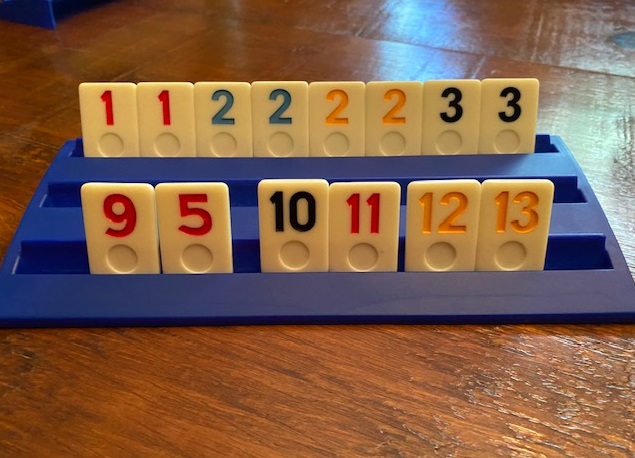
I posted a really bad selection of Rummikub tiles a couple of years ago and thought I’d add another from last night. If you play Rummikub you know that the numbers 1-3 and 11-13 are a sort of dead zone because they’re harder to play. And having doubles is another hurdle. Put them together and you get a case of what I call “doubles in the dead zone.” This selection is about as bad as it gets, and it was my initial draw of 14 tiles! Ugh!

But there’s a happy ending to my tale of woe. I actually ended up winning this game!