TCF: A Deal with the Devil

A Deal with the Devil: The Dark and Twisted True Story of One of the Biggest Cons in History
By Blake Ellis and Melanie Hicken

The crime:

Maria Duval was the name and face behind one of the biggest mail frauds in history. People (usually the elderly and vulnerable) sent money to her hoping that her psychic powers would bring them good fortune. But when a pair of CNN reporters tried to track down Ms. Duval they found that she was just a front for a much deeper scam being operated by a variety of mysterious and shady characters.

The book:

I don’t say this very often, but this is one of those books I couldn’t put down. It sucked me in and I kept reading it all in a rush.

I think it helped that it was a mystery, and no less satisfying for being a mystery without a full solution. Ellis and Hicken are intrepid reporters, and seem to have been having a lot of fun along the way while trying to track Duval (or “Duval”) down, but as with any great conspiracy story we only get past one wall (or e-mail address, or shell company) to find another standing behind it.

This is what I found so fascinating about A Deal with the Devil. I think everyone agrees that we live in a time that’s rich with magical thinking and dense with conspiracy theories. What doesn’t get enough attention are the background cultural factors that contribute to this.

In some ways it all goes back to the way the world itself has become more complicated through science and technology, making us feel increasingly alienated from and powerless in the grip of tools that we use and depend on every day but don’t understand a thing about. But there is a political and economic side to this as well, as we feel both left behind and in the dark by governments and big corporations that operate so much in the shadows that there’s often no way even investigative reporters working for major news outlets can figure out what it is they do.

This leaves A Deal with the Devil reading a bit like a Pynchon novel for the Google Street View age. All the indeterminacy and mystery in our everyday lives naturally leads to unexpected lapses into credulity and conspiracy mindsets. Near the end of their investigations the authors are even entertaining one tip from Romania suggesting that a cult of Satanists might be behind the whole thing. Shades of QAnon! But the truth, though less sensational, is even more unnerving: a cabal of international money people and crime bosses running a global scam taking in hundreds of millions of dollars. If this is so, might there not also be some truth to ESP and the power of magic crystals? Given the existence of such real conspiracies, wouldn’t it be a kind of survival technique to just believe everything?

The one part of the book I felt resistance to came at the end where the authors finally get to meet Maria Duval and find the perfect image for the wall of unknowingness they’ve come up against in the blank eyes of an old woman afflicted with dementia. There is a suggestion made of this being a final irony, in that Duval herself might be seen as a victim of the fraudsters who bought her name and monetized it by attaching it to their scam. That may be, but I had zero sympathy for Duval. She cashed out and was in no way a victim in all of this.

Noted in passing:

Is it the case that native speakers can’t hear themselves speaking with any kind of accent? That they just see their own accent as “normal”? I think this might happen, which is why I was surprised when the authors (both born and bred in the United States) described the Canadian characters they meet as having “a charming Canadian accent” or “a distinctly Canadian accent.”

According to Wikipedia, most North Americans “cannot distinguish the typical accents of the two countries [that would be Canada and the U.S., though Mexico is also in North America] by sound alone.” Of course there are regional differences. People from Texas, Boston, or Newfoundland have easily recognizable accents. But I don’t think there’s any difference between the speech of someone from Toronto and a native of Cincinnati. The old joke from South Park where Canadians are heard pronouncing “out and about” as “oot and aboot” always baffled me. We don’t sound like Scots.

When I went and watched some videos about Canadian accents I was just as confused. The way words were being pronounced in a “Canadian accent” didn’t sound like anything I’d ever heard. I don’t think I’ve ever heard “sorry” pronounced as “sore-ee.” There are some Canadianisms, like the particle “eh?” that I guess are a tag, but to be honest I don’t even hear “eh?” very much anymore. Certainly not as much as it was used thirty or so years ago, when you did hear it all the time. Place names are a specialty in any language, so I don’t know how many people from elsewhere pronounce Toronto as Trahn-toe (which is how we do it). Probably as many as pronounce New Orleans as New Orleens or New Orlee-ans, when I think it’s supposed to be New Orlins or New Awlins (but not Nawlins, which I’ve heard is a myth).

In any event, Ellis and Hicken don’t give any examples of what makes the Canadians they talk to sound so charmingly or distinctly Canadian, so I don’t know what it was they were responding to.

Takeaways:

It’s lucky the Duval mail fraud was shut down, though I doubt it has been shut down so much as it’s just been diverted into other channels. These operations know how to stay two or three steps ahead of the law. It’s exasperating reading about scams like this because they’re like junk mail, telemarketers, and spam: at any point the government could step in and put an end to all this but they won’t because there’s too much money involved.

What’s worse, in accepting, as I think we do, that so much of normal capitalist activity is a fraud or a scam, or something very like it, we tend to valorize the scammers as heroes and see their victims as clueless suckers who are, in the words of one of the people involved in the fraud here, “too dumb to live.” Taking the life savings of these people is a sort of cull. And this is old school mail fraud we’re still talking about. The Internet takes this heartlessness to a new level.

True Crime Files

Maigret: The Grand Banks Café

I read The Grand Banks Café out of order, coming to it after I’d nearly finished the Maigret series. It’s an early novel, one of nine (!) in the series that were published in 1931. Simenon was just getting started, and still writing in a white heat. Apparently he only took eleven days to write a Maigret roman, because if they took any longer he felt like he’d burn out.

I should have liked this more, as I was coming off reading the later, less distinguished entries and part of the action here is about as close as the series came to Canada. A trawler returns from fishing cod off Newfoundland, but the captain is murdered as soon as he leaves the ship. A wimpy young man who was radio operator on the trawler is arrested and Maigret, who is technically on holiday and only “working in a private capacity” is asked by a friend to look into the matter. Madame Maigret raises some objections because they’d planned to stay for a week with her family in Alsace, while “the thought of staying in a hotel by the seaside with a lot of other people from Paris filled her with dread.” But that’s all we hear in the way of complaining, and immediately she’s packing her sewing and crocheting. How obliging she is!

The idea here is pretty good, with Maigret trying to piece together, largely through intuition, what happened on this “voyage of the damned.” Unfortunately, I couldn’t understand the motivation of any of the principals, and by the time the wireless operator (literally) spills his guts I thought it had all become implausibly melodramatic in a way Simenon usually avoided. Even the femme fatale, if you can call her that, is a blowsy caricature, her seductiveness limited to offering up “fragrant flesh in a trawler that stank of fish.” Madame Maigret had a point about holidaying in such a place, especially given that this is another story where her husband lets the perp walk. They should have gone to Alsace.

Maigret index

Stupid aliens

Nope.

I’ve been watching a number of videos online recently that have addressed the popularity of the Netflix series Ancient Apocalypse, written and hosted by Graham Hancock. These online “debunking” videos, produced with little or no budget, criticize Hancock’s show for advancing highly speculative theories on the basis of little or no evidence.

Hancock has been at this for a while, following in the footsteps of Erich von Däniken’s smash bestseller Chariots of the Gods (Hancock even gave his books titles like Fingerprints of the Gods and Magicians of the Gods). I wanted to get some more insight into the attractiveness of this kind of fantasy history so I checked out a DVD from the library called The Best of Ancient Aliens: Greatest Mysteries. This was a two-disc collection of eight episodes from the popular television series Ancient Aliens. I’d heard of this show, and was of course familiar with the face of Giorgio A. Tsoukalos and his famous meme, but I’d never actually watched any of it. So I stuck it in the machine.

I don’t think I’ve ever given up on a show faster. I made it maybe 15 or 20 minutes in to “Aliens and the Third Reich.” The intro kicks off with some talking head telling us that “a lot of the information we’ve been told about the Second World War is wrong.” Well, no doubt. Especially if you include shows like this. Then we cut straight to the lede: “Did, as some believe, Adolf Hitler base his plans for world domination on secret extraterrestrial knowledge?”

No. No he did not. Nor do I think Nazi rocket technology came from reverse engineering a downed flying saucer.

I then tried to watch a bit of “Alien Tech,” which had to do with the alien influence on the building of ancient megastructures. I think. It just seemed like more bullshit to me. None of the claims being made had much if any evidence to back them up but it was all put across with slick production skills and in documentary style, including interviews with experts whose credentials I didn’t think amounted to much.

Two thoughts came to mind.

First of all, why is this bullshit so popular? It’s been big since at least the ’70s so it’s not a recent phenomenon, but it’s still tempting to tie it in to our contemporary rage against experts and elites who seem to know it all and our appetite for the craziest conspiracy theories imaginable. If you believe that Democrats are shape-shifting lizard people I suppose none of this seems that far-fetched. This brought me back to the well-known passage from Hannah Arendt’s The Origins of Totalitarianism:

In an ever-changing, incomprehensible world the masses had reached the point where they would, at the same time, believe everything and nothing, think that everything was possible and that nothing was true. . . . Mass propaganda discovered that its audience was ready at all times to believe the worst, no matter how absurd, and did not particularly object to being deceived because it held every statement to be a lie anyhow. The totalitarian mass leaders based their propaganda on the correct psychological assumption that, under such conditions, one could make people believe the most fantastic statements one day, and trust that if the next day they were given irrefutable proof of their falsehood, they would take refuge in cynicism; instead of deserting the leaders who had lied to them, they would protest that they had known all along that the statement was a lie and would admire the leaders for their superior tactical cleverness.

Whenever I come across this sort of “reject authority” babble I find myself agreeing, at least somewhat, with the skeptics and doubters in their questioning of the evidence, but being baffled as to their own alternative theories. Put another way, I can sort of understand why they don’t believe what they don’t believe, but I can’t figure out why they believe what they do. Cynicism shouldn’t have its end in such blank credulity. But Arendt’s observation only brings home what Chesterton said: “When men choose not to believe in God, they do not thereafter believe in nothing, they then become capable of believing in anything.”

The second, and more depressing if of less immediate concern, point is the fact that television used to be good at putting together quality documentary series that were entertaining and educational. I wrote about this a couple of years ago and tried then to think of some reasons for how and why we’d lost our way. I was only concerned then with what we’d lost, not with what had taken its place.

Of course what drives all this is ratings, and stories about lost civilizations and ancient aliens do attract eyeballs. But it does make you wonder just how much stupider we will get if we continue on this course. I’m heartened by the popularity of some of the debunking videos, but they’re still coming nowhere near the cultural reach of the (underline this!) mainstream media messaging of pseudoarchaeology. It’s almost like there really is a conspiracy afoot to keep us from the truth . .

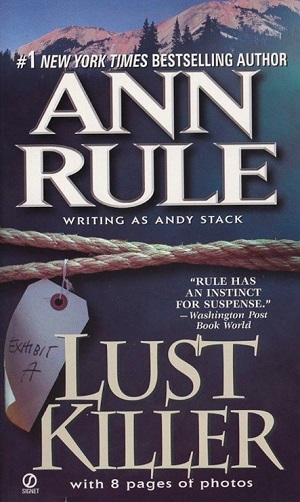
TCF: Lust Killer

Lust Killer
By Ann Rule

The crime:

In the late 1960s, Jerry Brudos killed four young women in Oregon. A closet transvestite with a particular obsession for high heels, his method involved strangling the women and then having sex with their dead bodies. He was apprehended and pled guilty to three counts of first-degree murder. In 2006 he died in prison.

The book:

I’ll start at the end. Lust Killer was one of Ann Rule’s earlier efforts, written under the pen name “Andy Stack” and first published in 1983 (The Stranger Beside Me, a work of memoir-true crime that drew on Rule’s acquaintanceship with Ted Bundy, came out in 1980). Later editions included an Afterword published in 1988, where Rule speculates on the possibility of Brudos getting early release. We now know that didn’t happen, and indeed Brudos was told by authorities that he was never getting out.

It’s also in the 1988 Afterword that Rule talks about how Brudos stands as “one of the classic examples” of a lust killer, but at the time even the label “serial killer” was something new (Rule herself has credited its first use to Pierce Brooks, the creator of the ViCAP system, in 1985, though others have found earlier instances). Today Brudos is a familiar type, with sexual fetish escalating into violence and necrophilia (in Rule’s account, a “constantly accelerating process – a juggernaut of perversion”). Apparently Ted Levine based his performance as Buffalo Bill in the film The Silence of the Lambs on Brudos, and it’s possible author Thomas Harris had him in mind as well when writing his 1988 novel.

What was different about Brudos? What first jumps out is that he was a married man, with two young children. This was seen as being so odd at the time it led to his wife Darcie being charged as an accessory, mainly on the suspect evidence of a busybody neighbour. She (Darcie) was found not guilty, and at least as Rule tells the story her complicity in the murders seems a stretch.

This isn’t unheard of with serial killers. Dennis Rader, the BTK Killer, was another lust killer who was married with two children (not to mention president of his local church council). Russell Williams, who also had a fetish for taking pictures of himself in women’s clothing, was married. So it does happen, even though I think it’s considered rare. Everyone compartmentalizes their life to some extent, but being a married serial killer, not to mention sexual deviant, is a hard act to maintain.

Noted in passing:

It was 1968, and Brudos had shag carpet (colour: blue) in his garage workshop. He said he needed it to keep his feet warm.

I’ve mentioned the process of escalation in Brudos’s criminal career, and it’s clear he was well on his way to becoming another Ed Gein at the end. When Rule mentions Gein, however, she says of him that “he hated his mother so much that he had killed her and other women and made vests of their dried flesh.”  This is actually a myth, reinforced by Hitchcock’s film Psycho. In fact, Gein seems to have doted on his mother, who died of a stroke and whose body he left intact and undisturbed in its grave.

Takeaways:

Rule emphasizes the key point: if you’re being abducted, even at gunpoint, you might as well take your chances and fight it out, because things aren’t going to get any better for you once you’re tied up in someone’s basement.

True Crime Files

Et tu, Brute?

Aside from that, Mrs. Lincoln . . .

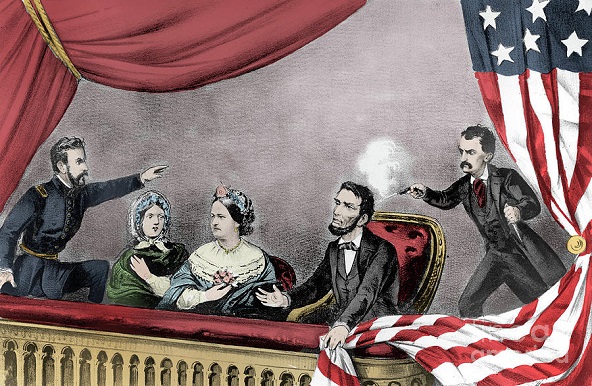
Recently, while reading Heather Cox Richardson’s How the South Won the Civil War, I came across the following passage:

The process of constructing a new nation based on the idea that all men — and possibly women — were created equal would require the deft hand of someone like Abraham Lincoln. But on April 14, at Ford’s Theatre in Washington, the actor John Wilkes Booth shot him in the back of the head in one last, desperate attempt to protect the oligarchic world of the Old South. As he jumped to the stage from the president’s box, Booth shouted, “Sic semper tyrannis” (thus always to tyrants) — Virginia’s state motto and the line Brutus speaks in Shakespeare’s Julius Caesar to justify his murder of the emperor.

This made me blink in surprise. While I knew Booth said these words after shooting Lincoln, I was pretty sure Brutus hadn’t used them in Shakespeare’s play. I turned to my bookshelf and a few seconds of flipping pages took me to Act 3 Scene 1 where I found what I suspected: Brutus doesn’t say anything when he strikes Caesar down.

Given that Julius Caesar is one of the better known works in the canon, remaining a staple even in high school, it seemed odd to me that a highly-regarded book by an academic historian published by Oxford University Press would have allowed such a mistake to get by.

Curious, I decided to dig a little deeper. At Wikipedia I found this:

John Wilkes Booth wrote in his diary that he shouted “Sic semper tyrannis” after shooting U.S. President Abraham Lincoln on April 14, 1865, in part because of the association with the assassination of Caesar. In the scene of Shakespeare’s Julius Caesar where Marcus Brutus assassinates Caesar, he yells the phrase, and the entire Booth family was well-known for their theatrical roles, Booth and his brothers having played roles in past productions of Julius Caesar.

Some of this is true. There’s no question Booth identified with the character of Brutus, and saw his killing of Lincoln to be an event on a par with the assassination of Caesar. After killing Caesar he said that he had only done “what Brutus was honored for.” And such a role was almost a birthright. His father, also a Shakespearean actor, was even named Junius Brutus Booth, and his brother Junius Brutus Booth Jr.

But again there is the assertion that “In the scene of Shakespeare’s Julius Caesar where Marcus Brutus assassinates Caesar, he [Brutus] yells the phrase.” This is the same thing Richardson says, and it’s not true.

Apparently no one is sure where the words originally came from. Again having recourse to Wikipedia we are told that “it has been suggested” that an ancestor of Marcus Junius Brutus said them upon expelling the current tyrants of Rome and thus establishing the Republic, “but the suggestion is not based on any literature of the time.”

Historical support for Marcus Junius Brutus using the expression upon killing Caesar is also slim. Wikipedia says this Brutus is “sometimes credited with originating the phrase” but an editorial note asks “by whom?” Not Plutarch, anyway. Or Shakespeare, who was using Plutarch as a source.

I’m not beating up on Wikipedia here. I love Wikipedia and it’s often the first resource I turn to when looking into questions like this. I also liked how they included the speculation of a Classics professor named Mike Fontaine that Sic semper tyrannis might be a Latin translation by an American in the eighteenth century of what Scipio Aemilianus said when he heard of the assassination of Tiberius Gracchus. That’s interesting.

What I raise an eyebrow at here is that Richardson may have accepted Wikipedia as her source with too great a degree of trust, and that nobody else caught it, either upon her book’s first publication or two years later when it appeared in paperback. Come on, Oxford!

Feel the burn

Last week we had a bit of a pre-heat wave in these parts, giving us an early taste of summer. Winter jackets came off and people were walking around in tank tops and shorts. Or less. This leads me to offer the following public service announcement.

People: the sun is not your friend. First off, it leads to skin cancer. Tan a luscious dark brown every summer and you’ll be spending your senior years suffering the death by a thousand cuts of having bits and pieces of yourself sliced off by a skin specialist. And some of those pieces won’t be small!

Even if you avoid cancer, the effect of the sun is to age your skin considerably, causing greater wrinkling and sagging and the growth of thick (non-cancerous) warts and lesions on the skin.

And even if you don’t notice those effects right away, you will feel the burn of having fried your and having it peel for the rest of the week.

Meanwhile, what is the upside? You think you look a little better? I think even here the tide is finally starting to turn against tanning. I anticipate a return to the beauty standards of the 18th century (or earlier), where women cultivated a “moon look” of ivory skin. A tan was the mark of a peasant, someone who spent a lot of time working outdoors. I don’t approve of the class distinctions, but I’m on board for the aesthetic.

Nor is there any need today for outdoor laborers to burn all summer. Wear a shirt! You won’t die! Every summer I see roofers working shirtless all day. When I was having my own roof done five or six years ago I was talking to one of the crew and mentioned my concern, telling him he’d be better off with a shirt on. He said he was aware of the danger but put on sunscreen. I had to shake my head. What is a safe sunscreen these days? SPF 50? 70? And it doesn’t last all day. If you’re doing a job like working on a road crew or roofing you’d have to be slathering it on every couple of hours. Something I very much doubt many workers are doing. So just wear a shirt.

Personally, I always wear a shirt with a collar whenever I go out in the summer now. The collar to keep the rays off my neck. That sun is just too strong. And yet last week I passed yard workers working outside in tank tops with arms so red you could practically hear their flesh sizzling. I winced seeing them. I also passed by a house being rented by a bunch of university kids who were sunbathing on the roof in shorts and bikinis. And as hard as it is for me to say this, I was wishing the girls in bikinis would have covered up.

In the future, and this is something I’ve admittedly been saying since the early ’90s, tanning is going to be looked on as the equivalent of smoking today. Meaning not just stupid and unhealthy but downright dirty. Now I know there are plenty of people out there who will object because they love tanning, or they own a tanning salon, or whatever. But leaving matters like that aside, it seems to me that the health considerations are irrefutable. Exposing your skin to a lot of sun is just plain bad for you. Don’t do it!

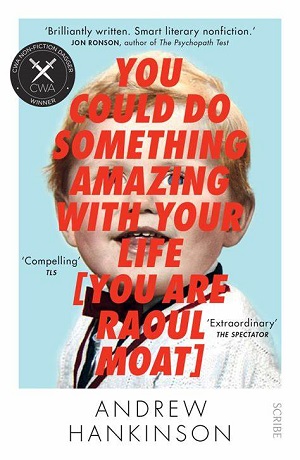
TCF: You Could Do Something Amazing with Your Life [You are Raoul Moat]

You Could Do Something Amazing with Your Life [You are Raoul Moat]
By Andrew Hankinson

The crime:

A couple of days after being released from prison (on July 1, 2010) Raoul Moat shot his estranged girlfriend and shot and killed her new boyfriend. The next day he shot a police constable in the face, blinding him (the constable would later take his own life). A massive manhunt for Moat ensued, ending with his killing himself.

The book:

You Could Do Something Amazing with Your Life [You are Raoul Moat] announces itself as literary non-fiction by being written in the highly unconventional second person. Despite all the rave reviews, I was on edge, thinking this a bit of a stunt.

It isn’t, and it works.

There’s a boldness to proceeding in this way. The stated “aim was to stay in Raoul Moat’s mind,” which presupposes an ability to inhabit that mind, to directly state what Moat was thinking at any given time. What allows Hankinson to go this route is the documentary evidence available. Moat left a record that speaks to us directly in his own voice:

The main source for this book was Raoul Moat, who left behind spoken and written material including audio recordings he made on the run, a 49-page confession he wrote on the run, recordings of this 999 calls before and after shooting PC David Rathband, recordings of phone calls he made while in prison, audio recordings he made during the final years of his life, training diaries, a psychological questionnaire, his correspondence, and six suicide notes he left in his house.

For all its literary qualities then, it’s also a very simple book, being a sort of Raoul Moat Reader or even oral history, with slight editorial asides inserted in square brackets instead of footnotes. But it makes for a great read and effectively delivers on the promise of taking us into Moat’s head by serving him up in his own words, even down to his employment of obscure local slang (“micey” being a word the exact meaning of which I’m still not sure of). The comparison most often made by reviewers was to the work of Gordon Burn, who did something similar in his immersive account of the Yorkshire Ripper, Somebody’s Husband, Somebody’s Son. That both authors are natives of Newcastle upon Tyne is only a coincidence, but one that probably carries some meaning. On some level our language, even if it’s just a dialect or regional voice, reflects a type of consciousness, and for an author wanting to get inside his subject’s head in particular, I think being steeped in that language and being a native of that place makes a difference. (As an aside, I’d mention Michael Winter’s attempt to do something similar in his “non-fiction novel” The Death of Donna Whalen, though the results there weren’t as successful.)

We shouldn’t be surprised, however, that nothing remarkable is revealed. Moat wasn’t so much a monster as just a dull brute. He was a big guy – 6’3” and around 240 pounds – and took various supplements as a bodybuilder to turn himself into a hulk. This came in handy when he worked for a while as a doorman or bouncer at local clubs, but the thing about big guys like this – or any athlete, or young beauty – is that you have to be able to manage the decline. Your physique is a diminishing asset. Moat was deeply depressed at no longer being as big or strong or tough as he was as a younger man – “I’m well aware that I’m past my prime” – and saw the best years of his life as over. At 37 he was “too old to start again.” “I’m not 21 and I can’t rebuild my life,” he remarked after coming out of jail. “I’ve got no life left,” he told the police operator after shooting PC Rathband. The suicide note or recording was his obsessive genre. He was paranoid too, to the point of delusion, and could be downright whiny when it came to how he was being “bullied” and “stitched up” (framed) by the police, but taking his own life was always where this was heading.

Hats off then to Hankinson’s largely editorial skill in making such a depressing and limited figure so interesting. I guess I could call it “revealing” too, but it’s a case where little is revealed that you probably wouldn’t have figured out after reading a quick news report on the case. Instead it’s exactly what it sets out to be, which is a trip into Raoul Moat’s mind. Not a place you may want to go, but one that it’s worth knowing about.

Noted in passing:

The level of self-pity even among the worst members of society has few limits. This was brought home to me years ago when reviewing Stevie Cameron’s On the Farm: Robert William Pickton and the Tragic Story of Vancouver’s Missing Women. Pickton was the B.C. pig farmer who confessed to killing 49 women. After being arrested he referred to himself as being “crucified” by the police (apparently he also found God behind bars). I can’t recall now if Moat ever referred to himself as being crucified, though I think he does at some point. He uses a more unconventional image in saying “I feel like King Kong when he’s at the top of that flaming building, you know.” Jesus, King Kong: both persecuted martyrs hounded to death by the authorities. It’s a weird way killers have of justifying themselves, while also plugging into the contemporary cultural imperative (that’s not too strong of word) of always casting yourself as a victim.

Takeaways:

Suicide can be a wrecking ball – just think of the prevalence of “murder-suicides” – and once someone’s course is set on self-destruction you should leave them to the professionals to deal with. Especially if guns and a history of violence are in the mix.

True Crime Files

Re-reading Shakespeare: Measure for Measure

(1) If, as has been said, Hamlet is the Shakespearean play for the nineteenth century and King Lear for the twentieth, is Measure for Measure a good pick for the twenty-first? It certainly chimes with the kinds of moral obsessions that dominate social media. Angelo as sexual predator, and telling Isabella that nobody will believe her if she publicly accuses him, would have put him near the top of the Renaissance version of a “Shitty Media Men” list. And his ghosting of Mariana after destroying her reputation also seems very contemporary. But more than that I’d focus on the matter of virtue signaling.

What we mean by virtue signaling isn’t the public display of virtue, which I don’t think anyone would object to. People acting in a noticeably brave or idealistic manner is fine. What makes it fair game for calling out is when such behaviour is meant to draw attention and applause, and more specifically when it is directed at the judgment and policing of the rest of us. It’s the public grandstanding of moral principles that the virtue signaler wants to see applied to other people. Or at least other people first. It calls on other people, usually those most directly affected, to make sacrifices for our own moral principles. Claudio sees straight to the heart of the matter upon his arrest. It’s “for a name” that Angelo is now coming after him, “’Tis surely for a name.” I can’t think of a more succinct definition of virtue signaling.

Angelo is again the main culprit here, but the importance of appearing to be virtuous is just as important to the Duke. He affects not to care about the adulation of the masses, and indeed says he doesn’t trust the kind of man who does affect it, but his whole justification for giving Angelo the job of whipping Vienna into line is because he doesn’t want to risk having the public turn against him. Everybody wants to seem virtuous without putting in the work. Which I think suggests that they don’t really believe in virtue in the first place.

This gets at something that always gets my back up about this play: the idea that Angelo somehow changes, falls, or breaks bad. Given the way he treated Mariana, he was clearly a total shit from the start. He doesn’t become a hypocrite after being tempted into sin by Isabella, but has always been a hypocrite. As most hypocrites are. Then he proves himself not just to be vicious but a coward, reneging on his deal with Isabella and signing off on Claudio’s execution because he’s afraid Claudio might come after him. That’s not his lust talking. Finally, I don’t think he’s in any way redeemed at the end. He’s just willing to take his lumps after being caught.

(2) Who is this Lucio fellow anyway? Tony Tanner calls him “something of a Mercutio, something of a Parolles, and something all himself.” The list of Dramatis Personae gives him the title of “a Fantastic,” which one edition glosses as an “extravagant, showy dresser/person with fanciful ideas.” No help at all. Are his clothes ever mentioned in the play? And what are his ideas?

I’ve seen him described as one of Shakespeare’s “border-crossing” characters, but that’s not quite right since unlike Viola or Hal he doesn’t need to disguise himself or even change his character to travel between worlds as different as the court and the stews of Vienna. He belongs in both places, and in a play full of “seeming” and disguises he is what he is.

He’s also often referred to as being a demonic figure, with his name meant to recall Lucifer, but role in the play doesn’t seem at all the same. He’s only like Lucifer in having so many good lines.

Samuel Johnson found Lucio’s punishment (“Marrying a punk, my lord, is pressing to death, whipping, and hanging”) a bit heavy, but thought it reflected how “men easily forgive wrongs which are not committed against themselves.” Yes (and this has always been the case), but it also reflects how serious a crime slander was considered in the Renaissance, something we have a hard time relating to today.

Personally, I sort of like Lucio. He’s a witty and flexible character with his heart seeming to be in the right place most of the time. He really does put some effort into helping Claudio, proving himself a friend in need. Furthermore, what he says about the Duke isn’t much worse than what Falstaff says about Hal, is it? And can we really say his estimation of the Duke is that far off the mark? Perhaps the Duke has been a scapegrace. That’s certainly the way he’s presented in the 2006 film version anyway. And as Northrop Frye observes, “while the bulk of what he [Lucio] says is nonsense, one phrase, ‘the old fantastical Duke of dark corners’ is the most accurate description of him that the play affords.” Note: there’s that word “fantastic” again.

(3) You often see Measure for Measure described as a tragicomedy, dark comedy, or problem play. It was lumped in with the comedies in the First Folio, but it always sat uneasily with that label. Everyone gets married at the end, for example, but you could argue nobody is happy about it. Marriage is more like penance than a joyous sacrament.

Personally, I read it as a very dark play. There’s no “green world” to retreat to, but only the prison-house (“circummured”) world of Vienna. But, and I think this is the important point being made, the stews and the dungeon are as natural as the Forest of Arden. Isabella, for example, wants repression, “wishing a more strict restraint” than the already strict convent she’s joining. “Blood, thou art blood.” That’s a law of nature, and it’s not a good thing. Or really it’s beyond good and evil. Rats pursue their nature as we do ours: they “ravin down their proper bane, / A thirsty evil.” Evil here meaning nothing immoral but only self-destructive.

If you think that freedom or liberty (the latter a more loaded term for Shakespeare than for us) are natural human desires, and good, that’s fine, but so are their opposites: cruelty and oppression. And not only natural, but desirable. And not only desirable, but fair and just. This is not a lower order of nature, since it’s primarily identified with the city, commerce, and law. Read the ending here however you want, but the point is, happy or sad, comic or tragic, it’s meant to represent an equitable resolution. Equity not as grace, but as just desserts. Like the rats, everyone has to drink their poison. It’s in our nature.

TCF: Obsessed

Obsessed
By M. William Phelps

The crime:

Sheila Davalloo had a crush on her co-worker Nelson Sessler so she killed Sessler’s girlfriend Anna Lisa Raymundo. This meant she now had Nelson all to herself, but she hadn’t told him that she was already married. So Davalloo then tried to kill her husband, Paul Christos, but he managed to survive her attack, which led to Davalloo finally being connected to the Raymundo murder, for which she was convicted a decade later.

The book:

A great read, and very well paced given how long it is and the fact that not much actually happens. But Phelps’s description of Davalloo’s attempt at killing Christos offers up a master class on how to use point of view to slow down the subjective experience of time. It’s a scene that goes on for nearly fifty pages, and feels like it could have been written by Stephen King.

Another pacing problem that a lot of true crime books fall into and that Phelps avoids is expanding the trial to the point where it become tedious. I think this is just because trials throw up so much material it’s too easy to just transcribe the transcripts. But here the fact that Davalloo represented herself (rarely a good idea) made it more entertaining, and let Phelps give free play to a lot of judgmental asides. Phelps walks a fine line with getting too chatty on occasion (“Oh, how the guy should have listened to his inner voice!” “That, my friends, is the description of a desperate woman . . .”), and during the trial this is something he really indulges, sometimes overdoing the sarcastic play-by-play. But overall I think the tone he adopts works.

The pitfall that Phelps doesn’t avoid is that of larding praise on the police. Again, the reason this happens so often is pretty obvious: the police are the good guys and in most cases have been generous in providing access and interviews to the author. But this sort of guff too often turns into hero-cop boilerplate. For example:

Richard Conklin . . . is a top-notch cop. There’s nothing Hollywood about Conklin. He’s sharp and does things by the book. If Anna Lisa could have chosen the cop she wanted to manage the investigation of her murder, she could have never chosen a better investigator than Conklin to lead the task . . .

. . . there was no mistaking the tenacity and drive or compassion that motivated [Greg Holt] to solve crimes perpetrated against the people of the town he worked in. Hold was a doer. He believed in working cases the old-fashioned way: Hit the bricks. Track down sources. Bang on doors. Ask questions repeatedly. Allow his gut to guide him. And when he thought he’d exhausted every possible lead, every palpable clue a case had to give up, he would dig even deeper, go over it all again, and find that missing link –that one needle sending him running toward an entirely new haystack. For Holt, a cop didn’t stop because the answers were hidden. He persevered and made them emerge.

Alison Carpentier is one of those no-nonsense cops. She hardly took any crap from anyone. . . . Carpentier is one of those officers never satisfied with a case until it is looked at closely and all the questions answered. She doesn’t accept what is generally the norm: Most cases are what they seem, and are nothing else. Carpentier is one of those hungry cops, motivated by her instincts. During her ten years on patrol, Carpentier had done two years of undercover drug work, where she learned how to rely on her gut.

How could any perp hope to beat this team of all-stars? Holt is even presented as a human lie-detector: “Hold had interviewed countless suspects and witnesses. When a professional does that for years and years, he develops a sixth sense about people in general. He’s able to read human beings fairly accurately.” You’d think this would be true, but apparently it’s only a common misconception. Even experienced police interrogators apparently do no better than anyone else in being able to tell when someone is being truthful or not.

Well, I can certainly tell you who wasn’t going to beat these supercops, and that’s the blockheads in this case. I’ve read true crime books with stupider villains, but rarely one with so many outright dummies. You have to just shake your head at how dense Paul was in not picking up all the red flags and air-raid warning sirens that Sheila was sending out. What Nelson thought he was doing in playing games with the police is anybody’s guess. And Sheila herself was just a trainwreck, though she did almost get away with Anna’s murder. It was her attempted murder of Paul that undid her, leading the detectives to conclude that “as much education as she’d had, she was not at all intelligent.”

I don’t think this final point is fair though. I think it just goes to show that nobody is smart, or dumb, all of the time. We all have our areas of expertise, and other areas where we can’t function at all.

Noted in passing:

At one point Phelps refers to Davalloo as Sessler’s “mistress.” This is not how I use that word. I would have said “girlfriend” or “lover.” Isn’t mistress reserved for a lover outside of marriage? Yes, Davalloo was married, but Sessler’s relationship with Raymundo at the time was on the backburner so I don’t think his girlfriend would count as a mistress.

Something that never ceases to surprise me, no matter how many fresh instances of it I’m exposed to, is the inability of people younger than me to write (or even read) cursive. I realize it hasn’t been taught in school for a while, but I guess I’ve always figured that kids were still picking it up somewhere, somehow.

They aren’t.

Sheila Davalloo was a highly-educated woman – private school, university, post-graduate work at a medical centre – and was “a manager of medical coding and thesaurus administration, a select group within Biostatics and Clinical Data Management” at Purdue Pharmaceuticals. (I should say here that “thesaurus” in this case doesn’t refer to the helpful reference book I have on my desk, but rather “a form of controlled vocabulary that seeks to dictate semantic manifestations of metadata in the indexing of content objects.” I looked it up.) So when Phelps describes her handwriting as he does I was expecting something pretty special:

Sheila’s handwriting is something to take note of. It is nothing short of perfect. Not good, but flawless. It’s like staring at a specific font a computer has generated. She could write letters after letters, without any margins or lines on the page, straight and methodical, in this highly stylized penmanship of hers, which is so clear and precise that any recipient is inclined to think she had used a computer. Beyond the perfection of the letters, what emerges is how calm the hand is writing out the words. One would have to have a perfectly steady hand, along with an abundance of composure within, to achieve the precision Sheila does in these letters.

Whew! I was thinking to myself this must be some pretty fancy handwriting! Like expert-level calligraphy with its “highly stylized penmanship.” At the end of the book Phelps will get a letter directly from Davalloo and remind us of how he’s “incredibly fascinated by her penmanship. I have never seen anything like it.” Wanting us to feel as impressed as he was, Phelps even includes a sample of it in the photos section.

It is very neat and meticulous.

It is also all block caps. Back in the day (my day) that wasn’t even considered to be “writing.” We called it “printing.”

On top of that, of the nine words shown in the sample, one of them has a howler of a spelling error, with Davalloo writing “solider” for “soldier.” Which is the sort of mistake you make all the time when typing but rarely when you’re holding a pen.

Takeaways:

Sessler was one very lucky young man. Even given strong exculpatory evidence, like the fact that he was known to be at work at the time of the murder, being Raymundo’s boyfriend made him a prime suspect (or “person of interest”). The availability heuristic is powerful in criminal investigations, and he was all the police initially had. And if you only have one suspect then you get tunnel vision.

Then you can add to this the fact that he rubbed everybody the wrong way. And if you don’t trust someone you start looking for evidence that implicates them. The lead detective thought he was hiding something right from the start and took an instant dislike to him. And one of the jurors at Davalloo’s trial said that all of the jury members “hated him” and “thought he was a scumbag and a dirty liar.”

If the police only have one suspect then they get tunnel vision. If they don’t like him, and don’t trust him, they start looking for evidence that implicates him. Yes, things could have gone south for Mr. Sessler very quickly.

True Crime Files