
This little guy is always the first out of my garden in the Spring. But it’s only March 4 and though it’s 20C today that’s too early. Like every year, he’ll soon be buried in snow.
This little guy is always the first out of my garden in the Spring. But it’s only March 4 and though it’s 20C today that’s too early. Like every year, he’ll soon be buried in snow.

The crime:
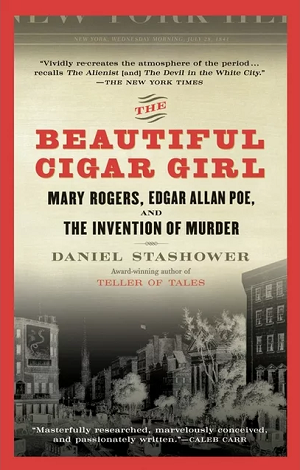
Mary Rogers was a 20-year-old woman, famous for her good looks, who worked in a tobacco store in New York City. Known as the “Beautiful Cigar Girl,” she disappeared on July 25, 1841 and her body was found floating in the Hudson River three days later. Autopsy results indicated she might have been strangled. Various explanations for her death were put forward, including a slightly fictionalized version by Edgar Allan Poe in his story “The Mystery of Marie Rogêt.” The case, however, remains unsolved.
 The book:
The murder of Mary Rogers is famous in the annals of true crime, though I don’t think that’s because of Poe’s story, which isn’t very good. There are two types of unsolved crimes that fascinate us, the ones that everyone has a theory about (Jack the Ripper, JonBenét Ramsey) and the ones that seem to frustrate every theory. The Mary Rogers case falls into the latter category. It’s a conundrum.
The chief explanations that have been put forward fall into the following three categories, and it’s worth noting not just how unlikely they all seem but how different they are from one another. That gives some idea of how much uncertainty there is.
In the first place there is the theory that Rogers was killed by a gang of ruffians. This is the scenario that Poe derides, and it seems unlikely for many of the reasons he gives. Just for starters, when you’re dealing with a group of criminals it’s far harder to cover all of your tracks.
The second theory has it that her fiancé Daniel Payne was the killer. This was reinforced by Payne’s suicide a couple of months later, and the ambiguous note he left behind: “To the World – here I am on the very spot. [His body was found near the spot where Rogers was thought to have been murdered.] May God forgive me for my misspent life.” Unfortunately, Payne had an alibi for the day Rogers was murdered, and he had no clear motive.
The final theory is that Rogers had sought an abortion that had gone wrong somehow, and her body had to be disposed of. There are variations on this, but again while there have been some interesting bits of evidence pointing in this direction it’s a stretch to make it fit with what we know and seems mostly to be an idea driven by a moralistic “wages of sin” political agenda.
I don’t think any of these theories are very good. The murder of Mary Rogers is just one of those cases that throws up roadblocks at every turn. Even the two suspects who were brought in for interrogation (a young sailor named William Kiekuck and the philandering operator of an engraving shop named Joseph Morse) ended up both being conclusively cleared. My own sense is that Rogers was probably killed by someone she knew, on a date that went bad. When she’d left her house the morning of the day she died she’d said she was going to visit her aunt, which she was not. But beyond that I’ve got nothing.
The book is subtitled “the invention of murder,” which was also the title of a book I reviewed back in 2011 by Judith Flanders. Now obviously people had been murdered long before 1841, but what I think Stashower is getting at (and it’s not a point he specifically addresses) is that this was a time when violent crimes were becoming media events, what we can now look back on as the invention of true crime as a genre. To be sure there has always been a lot of public interest in crime. Crime and execution broadsides were wildly popular in England in the 18th century, to go back just a bit. But in the mid-19th century things were really taking off. Indeed, as a headline the murder of Mary Rogers would be supplanted quickly by John C. Colt’s murder of Samuel Adams, an even more sensational crime and one that had legs given its well-publicized trial.
Keeping with the period detail, Stashower does a good job evoking a world before the advent of modern policing and the creation of an effective criminal justice system. Until the passage of the Police Reform Act in 1845 (some of whose provisions were made in response to the Rogers case) New York City’s policing could almost be described as medieval. Or, in Stashower’s accounting, law enforcement
had not progressed much beyond the seventeenth-century “rattle watch,” the brigade of uniformed men who patrolled the streets with noisemakers, calling out the hour and the latest weather report. At the time of the Mary Rogers murder, New York did not have a centralized, full-time professional police force. Instead, a pair of constables was assigned to each neighbourhood, together with roundsmen and marshals who cobbled together a living out of court fees and private rewards. Their efforts were supplemented by a patchwork corps of watchmen, made up of moonlighting day laborers and retired servicemen, who patrolled the streets and stood guard outside sentry boxes.
Poorly paid, some officers looked to pick up rewards for the return of stolen property, “which in turn led to charges of collusion between criminals and police over the spoils.” I’m sure something like this was going on, as it probably still is.
Given how amateur policing was, it’s no surprise that a general public not raised on CSI and Law and Order had a more relaxed attitude toward the importance of securing a crime scene. This helps explain the shocking – to a modern understanding – behaviour of the three men (Henry Mallin, James Boulard, and H. G. Luther) who discovered Rogers’ body floating in the Hudson:
Reluctant to touch the corpse, Mallin and Boulard snatched up a wooden plank from the bottom of the boat and attempted to use it as a hook to tow the body back to shore. After several attempts they managed only to strike a series of flailing blows, tearing at the white fabric of the dead woman’s dress. Tossing the plank aside, they managed at last to fix a length of rope under the corpse’s chin. The two men then rowed back to shore, trailing the body behind the boat. Unwilling to risk contact with the rotting flesh, they declined to drag their cargo out of the water. Instead they fastened their towrope to a heavy boulder and anchored the body to the shore, so it would not float back out into the river. This done, the pair spent several moments watching the battered corpse bob up and down at the end of its tether. After half an hour or so, Mallin and Boulard decided that there was nothing more to be done. Leaving the body anchored to the boulder, they rejoined their friends and wandered off along the water’s edge.
After a “large crowd” gathered along the shoreline to gawk at the floating corpse “a pair of stouthearted bystanders screwed up their courage and waded into the water to pull the body onto land.” But that wasn’t to be the end of things, as one reporter on the scene observed:
On shore, the body suffered further indignities as a long line of morbidly curious bystanders filed past. Some of them prodded the corpse with their feet while others poked at it with sticks. One “rude youth” went so far as to reach down and lift one of the legs, offering “unfeeling remarks” to his companions.
The local coroner appeared on the scene within an hour, but because he had to wait for the arrival of a justice of the peace before he could do anything with the body, it could only be removed from the water and placed in the hot sun, where it rotted away at an accelerated pace until after 7 o’clock that night. All things considered, it seems as though the coroner did a pretty good job with what he had to work with.
Stashower does a good job too with telling the story. Normally I’d be a little wary of the literary crossover; it turned out well in Margalit Fox’s Conan Doyle for the Defense but was made a hash of in Casey Sherman’s Hell Town. It mostly works here because Poe took such an interest in the case and it’s interesting to see what he made of it. Poe was a genuinely odd fellow, and that’s probably putting it far too mildly, but I never thought his detective Dupin’s method of ratiocination amounted to much and it doesn’t seem to have worked here. Basically Dupin just reads the same newspaper reports that Poe himself was reading, so what he came up with was a bit of armchair sleuthing and a set of conclusions that had to constantly be revised in the light of further evidence.
Poe is widely credited with having invented the detective story, and one of the curious things Stashower points out is that contemporary reviewers complained “that there could be no great skill in presenting a solution to a mystery of the author’s own devising.” What’s even more surprising is that Poe took this criticism to heart, and thought such stories only led, in his words, to the reader confounding “the ingenuity of the suppositious Dupin with that of the writer of the story.” This is one of the things that inspired him to have a go at the Rogers case. Of course, nobody thinks like that today, and the only ingenuity that a reader will attribute to a writer of detective fiction is their ability to create a clever and complicated plot.
Noted in passing:
When Poe attended the University of Viriginia in 1826 he “had to contend with the hardships of the university’s ongoing construction, including crowded, unheated buildings and questionable sanitation. There were, however, numerous compensations. Thomas Jefferson, then eighty-three, was very much in evidence as the university’s first rector. Poe would have dined with him on several occasions, and would have been among the mourners when the former president died on July 4 of that year.”
I’m no big fan of today’s resort-style university campuses, but I really don’t see how having an elderly celebrity like Jefferson hanging around on campus for part of the school year offers much in the way of compensation for the other shortcomings mentioned. How big a plus was it to get to mourn at Jefferson’s funeral, if Poe indeed did? And did Poe ever actually dine “with him,” or was he just sometimes in the dining hall at the same time?
It’s not entirely clear whether Payne was a suicide or if he mistakenly overdosed on laudanum. Or even if the laudanum he took was the exact cause of his death. The jury at the inquest delivered a verdict that was a true masterpiece of saying everything and nothing, declaring that death had occurred owing to “congestion of the brain, supposed to be brought about by exposure and irregularity of living, incident to aberration of mind.”
Takeaways:
Was C. Auguste Dupin not just the first detective (a word that might not have been in use before this time), but also the first fan of true crime writing? Poe was imagining his audience into being.
 Sometimes you get points for keeping it simple. There’s nothing complicated about Lady Killer. It’s the story of Josie Schuller, a suburban Seattle housewife in the early 1960s who is both a perfect wife, mom, and homemaker as well as a contract killer. Creator Joëlle Jones (who does the art and co-wrote with Jamie S. Rich) says she was inspired by advertising illustrations from the 1940s and ‘50s, so once again we’re ripping off the glossy, happy vision of the surface of American life in mid-century to show the violence and rot underneath. Josie can turn a kitchen into an abattoir and clean it up so it’s spotless afterward, standing as though she’s posing for one of the satire ads that appear at the start of each issue, pitching cars with enough trunk space for a dead body or stiletto heels that can be weaponized.
And that’s it. That’s the hook. Josie’s husband and kids don’t know anything about her double life, though her crabby mother-in-law has her suspicions. After spending some time in the business and achieving what must be a pretty impressive body count Josie might be turning domestic though, wanting out of Murder Inc. Her boss decides to terminate her employment. Will Josie be able to survive and still get dinner on the table?
Even if there’s not a whole lot here, I thought it was put forward brilliantly. Jones has the style down pat – and by that I don’t just mean the ad look but also Josie’s turn as fetish pin-up model – and it was also refreshing to read a story that didn’t feel it was necessary to throw a whole lot of crazy twists or tedious backstory into the mix. There are points that remain mysterious, but they were things I didn’t care much about anyway, like who was behind the Organization. Peck is only a killer Ken to set alongside Josie as psycho Barbie. So I just sat back and enjoyed the whole thing immensely, and it left me looking forward to Volume 2. I also hear there’s a movie in the works, but I’ll approach that with suspicion.

A pair of very nice Robert Hall originals, pewter and ribbon. I’m not sure if there’s any connection to be made between a bagpiper and an inuksuk, but for just this once you can see them lying side by side.
Book: History of Italian Renaissance Art by Frederick Hartt and David G. Wilkins
As was often the case, Poe was in need of money. I don’t think that’s why he dove into this lightly fictionalized investigation into the celebrated Mary Rogers case, but I do think it’s why he borrowed the authority of his freshly-minted detective C. Auguste Dupin for it. It made the story an easier sell.
At least I can’t think of any other reason for Dupin being here. This is the odd-story-out of the three Dupin mysteries Poe wrote, and by far the longest, but it’s also the least popular. And that for good reason. While of interest to true crime aficionados for the way it re-imagines a real criminal case — while telling us that this is exactly what it’s doing — it’s nearly unreadable for everyone else. I’d read it once years ago and it was a struggle getting through it again. It’s one of the dullest things Poe ever wrote.
Why is it so bad? For starters, it’s not so much a story as an examination of the evidence in the Rogers case, based on Dupin/Poe’s reading of various newspaper accounts. In this it’s not that big a leap from “The Murders in the Rue Morgue,” since in that story Dupin does a lot of his thinking about the case based on the news stories he reads. But what we have here feels more like an investigation of the reporting than of the murder itself, almost an exercise in explication de texte (the affection for mystery stories among literary critics might begin here). What’s more, there’s little frame to Dupin’s musings, with almost no reference to the narrator or Dupin as characters in a story. And what we do get is so enticing!
Upon the winding up of the tragedy involved in the deaths of Madame L’Espanaye and her daughter, the Chevalier dismissed the affair at once from his attention, and relapsed into his old habits of moody reverie. Prone, at all times, to abstraction, I readily fell in with his humor; and, continuing to occupy our chambers in the Faubourg Saint Germain, we gave the Future to the winds, and slumbered tranquilly in the Present, weaving the dull world around us into dreams.
Alas, after this promising introduction Dupin goes on to function as little more than Poe’s mouthpiece, giving us his amateur and not very convincing thoughts on the case. As some have observed, it’s really more of an essay that a work of fiction, and not a great essay at that.
Then there are none of the thrilling, even grotesque elements that made “The Murders in the Rue Morgue” stand out. There’s nothing of what Dupin called in that story the “excessively outré.” And indeed, that’s a point he underlines again here: “I need scarcely tell you,” he tells the narrator, “this is a far more intricate case than that of the Rue Morgue; from which it differs in one important respect. This is an ordinary, although an atrocious instance of crime. There is nothing particularly outré about it.” The point Dupin is making is a valuable one, about how reasoning fastens upon the unusual as something it can analyze. “I have before observed that it is by prominences above the plane of the ordinary, that reason feels her way, if at all, in her search for the true, and that the proper question in cases such as this, is not so much ‘what has occurred?’ as ‘what has occurred that has never occurred before?’”
How does one distinguish between or find meaning in what are everyday events? It can be hard. But in terms of pulp fiction we’d still rather have a razor-wielding orangutan in any face-off between the ordinary and the outré.
This leaves us with Dupin’s method and its results. As for the method, I have to say I’ve never made a lot of sense out of it. His analysis or ratiocination (reasoning) isn’t mechanical, because that would be the sort of game a chess-playing automaton might be good at. Instead, in Poe’s world human understanding, empathy, and imagination, will always trump mere intelligence. Dupin makes observations and inferences, and for all his arrogance his conclusions are always provisional. He’s also a bit of an artist, as explained in “The Murders in the Rue Morgue”: “It will be found, in fact, that the ingenious are always fanciful, and the truly imaginative never otherwise than analytic.” And so the Minister in “The Purloined Letter” will prove a worthy adversary for Dupin, being both mathematician and poet.
That’s all good, but does it constitute a method? Maigret would always express surprise at anyone trying to understand or emulate his method, because he didn’t think he had one. I think this was more honest. Maigret put in the work of investigating crime scenes and interrogating witnesses, but in the end his breakthroughs just sort of come to him. Dupin, on the other hand, likes to talk at length about his method, but only increases our confusion with stuff like his discussion of the importance of accident in discovery. While acknowledging that “to collateral, or incidental, or accidental events we are indebted for the most numerous and most valuable discoveries,” how do we “make chance a matter of absolute calculation”? How do we “subject the unlooked for and unimagined, to the mathematical formulae of the schools”? Even for physicists, wouldn’t this be like making the uncertainty principle certain? As with Poe’s explanation of how a poem like “The Raven” works, we get the feeling that Dupin is just putting us on.
Finally there is the matter of the method’s results. Did Dupin/Poe solve the Mary Rogers case? Not at all. We’re left with some speculations that are no more persuasive than many others that were floating around at the time. For a good backgrounder on the case, and Poe’s treatment of it, I highly recommend Daniel Stashower’s The Beautiful Cigar Girl. Then, like Dupin reading his newspapers, you can use your own method to come to your own conclusions.
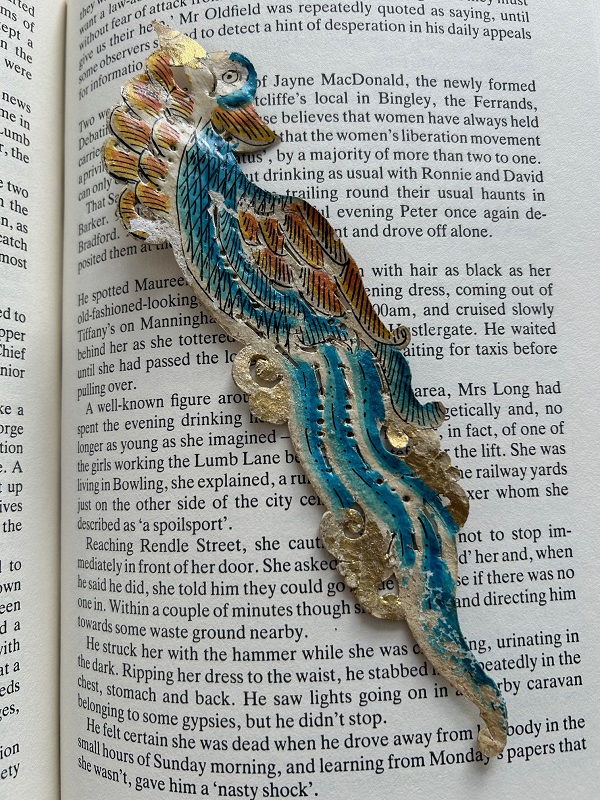
At least I’m pretty sure this is supposed to be a dragon. It’s Chinese.
Book: Somebody’s Husband, Somebody’s Son by Gordon Burn
The crimes:
“A Brutal Lynching: An Indifferent Police Force, a 34-Year Wait for Justice” by Wesley Lowery: the cold case murder of a Black man in Georgia is solved simply by following up reports of how one of the killers had been bragging about it for years.
“The Short Life of Toyin Salau and a Legacy Still at Work” by Samantha Schuyler: a Black activist is killed in Florida and the police don’t seem to care very much.
“‘No Choice but to Do It’: Why Women Go to Prison” by Justine Van Der Leun: some women may only be guilty of “acts of survival.”
“The Golden Age of White-Collar Crime” by Michael Hobbes: it’s never been a better time to be a corporate scofflaw.
“Picturesque California Conceals a Crisis of Missing Indigenous Women” by Brandi Morin: there’s a need for better reporting on and police investigation of MMIWG.
“How the Atlanta Spa Shootings – the Victims, the Survivors – Tell a Story of America” by May Jeong: pocket bios of the victims and survivors of the 2021 Atlanta spa shootings, who were mainly Asian immigrants.
“Who Owns Amanda Knox?” by Amanda Knox: after becoming an unwilling focus of the media as well as the Italian judicial system, Amanda Knox considers the alternate life of her celebrity.
“Tie a Tourniquet on Your Heart: Revisiting Edna Buchanan, America’s Greatest Police Reporter” by Diana Moskovitz: a Miami true crime writer turns out to have been more a person of her time than a pioneer.
“The True Crime Junkies and the Curious Case of a Missing Husband” by RF Jurjevics: a woman’s Facebook post about the disappearance of her husband triggers an Internet investigation that turns up a darker story.
“Has Reality Caught Up to the ‘Murder Police’?” by Lara Bazelon: the Baltimore homicide detectives who inspired David Simon’s creations Homicide: Life on the Streets and The Wire turn out to have had a less than stellar track record.
“Will You Ever Change?” by Amelia Schonbek: inside a program that pairs survivors of domestic violence with surrogate offenders for therapeutic dialogue.
“The Prisoner-Run Radio Station That’s Reaching Men on Death Row” by Keri Blakinger: a radio program is broadcast very locally out of a Texas prison.
“To the Son of the Victim” by Sophie Haigney: a reporter recalls her brief interaction with the son of a shooting victim.
 The book:
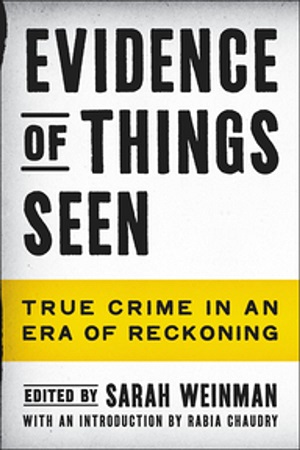
Well, if that “age of reckoning” didn’t give it away then I’ll give it you in a word: this is an anthology of woke true crime.
I don’t mean that in a bad way. What editor Sarah Weinman has wanted to do (here and in her earlier anthology Unspeakable Acts, to which she considers this to be “a companion volume and an extension”) is to expand on the popular understanding of “true crime” to bring in less familiar elements and storylines. In particular, she sees this collection as “a testament to the discomfort we live in, and must continue to reckon with, in order to hold the true crime genre to higher ethical standards and goals.” Whew! That’s setting a high bar. Does the book deliver?
Things get off to a bad start. The Introduction is by Rabia Chaudry of the podcast Undisclosed, and she duly brings the killing of Hae Min Lee up, patting herself on the back for clearing Adnan Syed. This is a case that still divides people though, and I personally lean toward thinking that Syed was at the very least involved in Lee’s murder. Chaudry herself has also been the target of some fair criticism for her advocacy and I can’t say she’s a voice I trust very much. Her Introduction also wrong-footed me from the get-go: “The debate about whether the true crime genre, across all forms of media, does more harm than good in society is long-standing and contentious.”
A long-standing debate? Sure there have been critiques of true crime, but Chaudry’s evidence for a debate is pretty thin, or what the grounds of such a debate might be. A couple of sources are quoted for the claim that consuming true crime content is bad for us, but then these are quickly dismissed. A tone is set of looking for an argument, even when none is available.
One point Chaudry brings up is worth flagging though because it plays an important part in several of the stories to come. This is the critique that “monsters like Ted Bundy and Jeffrey Dahmer have left permanent marks in pop culture while their victims have been forgotten.” There’s nothing new in this observation and it’s been given a lot more play in the demand for new perspectives not just in true crime reporting but in every facet of our culture, perspectives that seek to tear down the celebrity of (typically white male) villains while prioritizing the stories of their victims.
This is a moral position to take, and also one that very much feeds off of the priority given to victims, however broadly defined, in our culture. Perhaps the most prominent recent example of this in the context of crime reporting was New Zealand prime minister Jacinda Ardern’s refusal to name the perpetrator of the Christchurch mosque shootings and her urging others to “speak the names of those who were lost rather than the name of the man who took them. He may have sought notoriety but we, in New Zealand, will give nothing – not even his name.” This is a directive heeded by May Jeong in her piece here on the Atlanta spa shootings where the killer (Robert Aaron Long) is only referred to as “the suspect” while the reporting itself is almost entirely given over to pocket bios of the people he killed.
This is not just a moral position to take – most killers are monsters and their victims innocent – but it’s also one that has a political argument behind it as well. Should the media broadcast or even make available the manifestoes of mass killers like Elliot Rodger, Anders Breivik, and Brenton Tarrant? A fair question. In a culture like ours, where celebrity is the coin of the realm, there’s something wrong about using one fame or notoriety to promote hate. At the same time . . . it is the coin of the realm. This is something everybody understands. Theodore Kaczynski by his own admission became the Unabomber because he knew it was the only way he could get people to pay attention to his manifesto.
That said, I don’t think true crime writers, or the genre in general, make heroes out of wrongdoers. But the matter of celebrity and what gets our attention leads to a further point. We read true crime because it deals with the exceptional: the pathologies of human nature and behaviour. We don’t read about serial killers because we admire them but to learn something about them, like what went into making them and how they can be identified. Meanwhile, what can be learned from their victims, who are all too often simply people who found themselves in the wrong place at the wrong time? It’s not that we don’t care about them, it’s just that they’re normal, and we’re not that interested in normality.
But while defensible on some levels, I think there are serious caveats to be entered when reading true crime that comes at us from the margins, as woke or victim-based.
In the first place, and I’ll use Jeong’s piece as the test case, it’s writing that has an agenda and it can strain too hard to score political points, occasionally becoming tendentious in the extreme. Here, for example, is a description of Long’s hometown:
Woodstock, Georgia, was Cherokee country before its original inhabitants, who had been in the area for 11,000 years, were displaced by white settlers around the mid-1700s. On May 28, 1830, President Andrew Jackson signed the Indian Removal Act, codifying into law the forcible removal of 15,000 Cherokee people from what is today their namesake county. The white settlers panned for gold in nearby rivers, purchased Black people as slaves, and opened chicken processing plants, still in operation nearly two centuries later.
Woodstock today enjoys a median family income of $76,191, and is almost 80 percent white. It is the hometown of at least two notable figures: Dean Rusk and Eugene Booth. Rusk, who later became secretary of state, was responsible for splitting the Korean peninsula in two using a foldout map from a copy of National Geographic. The line “made no sense economically or geographically,” he later admitted, but it allowed American occupying forces to take control of Seoul, a decision that would divide families for generations. Booth was a nuclear physicist and core member of the Manhattan Project, which led to the bombings of Hiroshima and Nagasaki in Japan, killing as many as 250,000 civilians, according to some estimates. Woodstock is proud of their native sons, naming a middle school after Rusk.
What is the point of all this? Does Jeong not eat chicken? How personally responsible was Dean Rusk for the division of the Korean peninsula? Where was he supposed to draw the line on the map? Should Seoul have been given to North Korea? Was Booth wrong to work on the Manhattan Project? What does the dislocation of native tribes from Woodstock 200 years ago have to do with Long’s motives? Is it just meant to be taken as being all part, somehow, of the same racist, imperialist matrix?
Second, does the erasure of the killer’s name make this a better piece of reporting? Does it add something by subtraction? It’s hard not to feel like we’re reading an ideologically cleansed version of the first draft of history here. And it’s the sort of policy that goes beyond true crime reporting. There are no Wikipedia pages, for example, for Elliot Rodger, Brenton Tarrant, or Robert Long but only for the 2014 Isla Vista Shootings, the Christchurch mosque killings, and the 2021 Atlanta spa shootings respectively. I think that must be part of the site’s editorial guideline. Is it justified? And finally there’s the fact that Jeong’s article on the shootings is 25 pages long, providing biographical sketches of six of the seven women killed and of the one man, an immigrant from Guatemala, who was injured but survived the attack. Jeong also has a couple of pages where she talks about her own Korean-American family. The one man who was killed, along with the other woman, have their names mentioned briefly in a single paragraph together. They were the only two white victims. This isn’t a full story or accounting then. But what kind of a story is it?
Third: I don’t think it should make a difference where the author is coming from. I prefer most true crime writing that adheres to traditional standards of objectivity, and (as I’ve said before) there are few things I despise more than the trend toward “true crime memoir.” But this sort of writing, which often plays up group identity, invites authors to stake their writing in their own experience. And so Jeong adds that section I mentioned on her own family’s American experience as Korean immigrants, and Mallika Rao does the same while writing on an Indian family in Texas.
I understand Rao’s point, that Texas cops don’t understand something that she does just “by virtue of being born to Hindus in Texas,” but how far can we take this? Rao mentions how the defence counsel for the mother accused of killing her child was going to call an expert witness to say that the defendant “had all the markings of a truth teller, a woman in grief.” But Rao doesn’t “need an expert to tell me that. I felt it just by watching her.” Because of some cultural fellow feeling? Superior empathy? Then only two pages later she takes the trial transcript to task for using the word Hindu instead of the correct Hindi to describe the language the accused was speaking in. “As I saw that repeated typo, I wondered if the error had been the court reporter’s or if it had been spoken by those in charge of Pallavi’s fate, in that courtroom. I wondered how much of any case is built and tried on fact and how much on feeling, instinct. No one in the court had been of Indian origin except the defendant and her husband.”
Is this an injustice? Are the only feelings and instincts that can be trusted those of individuals from the exact same cultural background or ethnic identity? Should all true crime writing become a form of memoir, a personal identification between the author and the victim (never, of course, the perpetrator of violence)?
And what if the roles are flipped from the usual script? How are we to handle the “True Crime Junkies” story, where the villain of the piece is a predatory woman who destroys the life of an innocent man? Should we say her name? Should we be more interested in telling his story? What would we learn from that?
So I did have some caveats. But this is a nice anthology with some good stories in it and some fine writing. I found the piece on white-collar crime, the one by Amanda Knox, and the True Crime Junkies story, to be particularly thought-provoking. And even Jeong’s take on the Atlanta killings was quite good, only needing six or so pages taken out of it. But in the final analysis I’m not sure the case was made for this being representative of true crime writing that’s setting “higher ethical standards” or even providing more truthful (fuller? more objective?) accounts. Instead, what it highlights is the fact that every piece of writing, of whatever genre, comes from a particular point of view, if not with a full-blown agenda.
Noted in passing:
The essay by Lara Bazelon on how the writer and show runner David Simon presented an airbrushed picture of the Baltimore police in his 1991 non-fiction book Homicide: A Year on the Killing Streets (which in turn led to the NBC series Homicide: Life on the Streets and the HBO show The Wire) struck a familiar note with me. Simon had followed a group of Baltimore homicide detectives around for a year but hadn’t reported on any of their misdoings, a pattern of conduct that would lead to many ruined lives, overturned convictions, and tens of millions of dollars in judgments against the city.
Was this inevitable? A former head of the Baltimore Innocence Project calls the book “a cautionary tale for embedded journalism.” Simon’s collaborator Richard Price, in a foreword to a later edition of Homicide, asked “Are writers like us . . . who are in fact dependent in large part on the noblesse [what an odd choice of word] of the cops to see what we have to see, are we (oh shit . . . ) police buffs?”
I think Price is letting writers off easy by calling them fans in such a case. As journalists covering war zones have been pointing out for decades now (Robert Fisk was one of the most outspoken), being “embedded” with the military puts one in a hopelessly compromised position. Indeed, the whole point of embedded journalism, and I think the term was first used with regard to media covering the first Gulf War, was for the army, and the state more broadly, to control news coverage. What nobody (or at least nobody working for the military) wanted was “another Vietnam.” The army wasn’t letting reporters be embedded for altruistic reasons but rather as a way of co-opting their voices and controlling the coverage.
The reason this had a particularly familiar note to me though has regard to a different context. As I’ve written on at length in other posts (please see here, here, and here), reporters and biographers writing about living figures who are given special or exclusive access to their subjects are always compromised. Access comes with strings attached. If you’re going to write about the armed forces, or the Baltimore police, or some celebrity, no matter how minor, and they let you follow them around or give you an interview, it’s because they are looking to shape the narrative and are expecting you to follow their ground rules. It’s a symbiotic relationship, with the writers as parasites that are only allowed to function if they perform some useful task for the host.
Takeaways:
Perspective matters when it comes to the writing of true crime, and changing things up does add a lot to our understanding of matters relating to the criminal justice system. However, not all that a different point of view adds is helpful or instructive, and it’s also the case that sometimes something can be lost.
 I read this just after finishing the first Marvel Masterworks X-Men volume, which turned out to be a help. That’s because what happens here is that the original/classic X-Men are brought via time machine into the present day (post Avengers vs. X-Men storyline) by Dr. Hank McCoy, where they have to square off against the rogue Scott Summers/Cyclops. So having the X-Men’s origins fresh in mind helped me understand the teenage X-Men characters and their motivations a little better. Plus there’s actually a scene here set in an earlier comic (it’s from X-Men #8, which came out in 1964) that I only remembered because it was included in the Masterworks volume. I thought that was neat.
The old X-Men (who are, paradoxically, the “all-new” X-Men) facing off against the formerly new X-Men (or what’s left of them) makes for a showdown with lots of dramatic potential. How will the old X-Men deal with what’s happened to them? What will Scott Summers do when he confronts himself? How will Cyclops and Wolverine react to seeing Jean Grey (a teenage Jean Grey!) come back to life? You won’t have to wait long to find out!
A great concept then, and Brian Michael Bendis delivers a solid story with lots of interesting wrinkles, like young Hank McCoy trying to save old Hank McCoy’s life by way of a psychic link provided by Jean where the two McCoys can talk to each other. Alas, some stuff, like the young X-people who are introduced, aren’t as interesting, however necessary they may be to the story. But overall I thought this was a great launch for the “all-new” series. The only thing that really got on my nerves was the “AR” codes that appeared on several of the pages. Apparently these can be scanned on your phone using some Marvel app giving you bonus features. So sort of like Easter eggs on a DVD, except they’re marked for you. The AR stands for Augmented Reality (sheesh) and apparently it represents “the future of comics in action!” Spare me. And spare the comics being stamped with these annoying logos.
(As a footnote, it’s interesting that in X-Men #100, written by Chris Claremont and appearing all the way back in 1976, the story involved a showdown between old X-Men and new, though it was revealed in that comic that the old X-Men were actually X-Sentinel robots. The idea has a history then.)
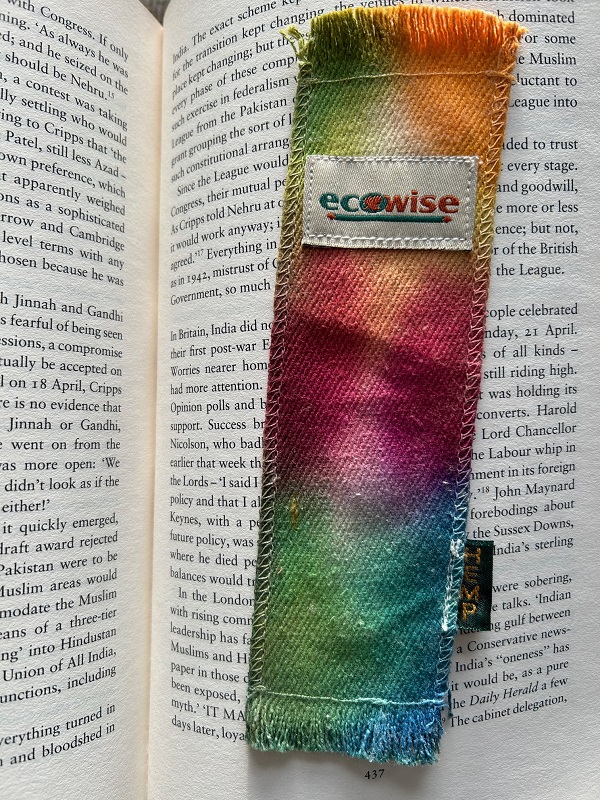
Picked this up at the Textile Museum of Canada in Toronto about twenty or so years ago. But hemp lasts forever.
Book: The Last Thousand Days of the British Empire by Peter Clarke
I think I first read this story when I was around 8 years old, in a paperback of Poe’s selected tales that I got from that company that let you order books at school. I still have that book. Memories . . .
What I remember the most are two things: not really understanding all the talk about the different operations of the intellect that Dupin indulges in, and being terrified by imagining the horrors of the Rue Morgue, and especially Mademoiselle L’Espanaye being thrust up the chimney feet first.
Even reading it again today I was struck by just how violent a story it is, albeit often with the violence reported in an indirect way. The body in the chimney with its face “fearfully discolored,” eyeballs protruding, and tongue “partially bitten through.” Madame L’Espanaye nearly decapitated before being tossed out the window (“her throat so entirely cut that, upon an attempt to raise her, the head fell off”). The clump of hair pulled from a victim’s head that’s “clotted with fragments of flesh of the scalp.”
What the story is probably best known for though is giving birth to the genre of detective fiction. Indeed, Poe was so fast off the mark in this regard that C. Auguste Dupin never calls himself a detective, and some sources suggest the word wasn’t even in use yet.
Much as H. G. Wells would later invent many of the standard tropes of science fiction, from alien invasion to time travel, Poe established the fictional detective for years to come with Dupin. As Conan Doyle would say, Poe’s detective stories provided “a root from which a whole literature has developed.” The obvious follow-ups were Holmes and Poirot, and with their success the mold was set. The detective would be a brainy and eccentric amateur who takes pleasure in the game of solving crimes. He would enjoy showing up the plodding police (“The results attained by them are not unfrequently surprising, but, for the most part, are brought about by simple diligence and activity”). He would have a homosocial relationship with an amanuensis sidekick. At the end of the novel or story he would enjoy dramatically revealing his discoveries to an amazed audience.
There are clues provided here, most notably the emphasis on how all of the different witnesses testify to hearing a shrill voice speaking a foreign language that a cross-section of Europe can’t make any sense of. There’s a red herring in the business of the 4000 francs. There are quotable bits of wisdom offered up by Dupin. Example: “There is such a thing as being too profound. Truth is not always in a well. In fact, as regards the more important knowledge, I do believe that she is invariably superficial.” And another: Remarkable coincidences “happen to all of us every hour of our lives, without attracting even momentary notice. Coincidences, in general, are great stumbling blocks in the way of that class of thinkers who have been educated to know nothing of the theory of probabilities.”
What struck me re-reading the story this time was how closely the living situations of Dupin and the narrator mirror those of Madame L’Espanaye and her daughter. Dupin and the narrator rent “a time-eaten and grotesque mansion, long deserted through superstitions into which we did not inquire, and tottering to its fall in a retired and desolate portion of the Faubourg St. Germain.” It’s Paris’s answer to the House of Usher! The L’Espanayes also inhabit a giant pile, living alone as recluses in a kind of shabby gentility. In the haunted house of the Faubourg St. Germain they close the shutters at the first hint of dawn. In the Rue Morgue house the shutters are seldom opened, and what will transpire will be an early instance of the “locked-room” mystery. Of course this is a motif we see again and again throughout Poe – introversion taken to the extreme of being buried alive – but it’s double-barreled presence here was something I’d never noticed before. Which, in turn, leads you to wonder how the obsessions of such an idiosyncratic, downright weird personality ever went so mainstream. I guess, like Kafka, Poe’s unique and eccentric qualities were what made him a universal type and not just for an age but for all time.
 Alex Good