
This is a general index page to my sub-indexes of reviews of mystery and detective fiction. I’ll keep adding to it as I go along.
Charlie Chan (and Charlie Chan on film)
This is a general index page to my sub-indexes of reviews of mystery and detective fiction. I’ll keep adding to it as I go along.
Charlie Chan (and Charlie Chan on film)

Playing outside really was a thing. I remember that. Not sure about this leaving babies on the porch business though.
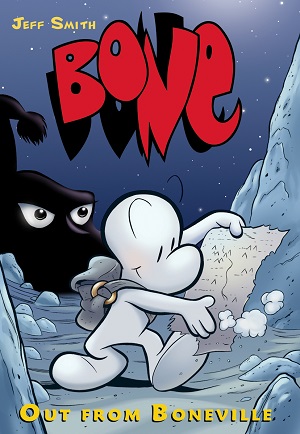 There’s a line of thinking out there that has it that the best children’s literature is capable of being read on different levels, meaning many adult levels beyond the ken of most kids. You hear this a lot when talking about books like The Lord of the Rings, where it’s a story you can enjoy when you’re seven or eight years old (which is when I read it), but which has all kinds of deeper resonance and layers of meaning.
The Lord of the Rings was apparently one of the inspirations for Jeff Smith’s Bone comic, and it has that same generational range to it. On the one hand the blobby inhabitants of Boneville are cute, Smurf-like creatures that might as well be hobbits. You don’t think they’re going to do anything remarkable or have any epic adventures. But then the three Bone cousins – Fone (the hero), Phoncible P. “Phoney” Bone, and Smiley – wind up in a fantasy valley where most of the inhabitants are human but there are also magical creatures like the scary Rat Creatures and a friendly Great Red Dragon. It seems like something really important is afoot, from social breakdown to the fate of Phoney’s soul and some final struggle between the forces of good and evil. There’s also not just love in the air, as Fone falls helplessly (and understandably) for the beautiful Thorn, but more carnal stirrings as well. Our first glimpse of Thorn, after all, has her dropping her trousers to bathe her legs in a stream, and later when she and Fone wash up together there will be a sly comment from her about him needing to be a bit more careful with the soap. As it turns out, he’s eaten the soap. But we know what was meant, and we’re even given a blank panel to imagine it.
The edition I was reading is a colorized version put out by Scholastic ten years after the original comic, which was published in black-and-white, started up. I’m assuming Smith approved of the change and I thought the colours looked good, even if I had a nagging feeling it all might have worked better in black-and-white. The more sinister elements might have been more threatening, for one thing. The Rat Creatures here have Christmas-tree balls as eyes, and there are pom-poms at the end of the Red Dragon’s ears that look even sillier. Also, the snow-white Bone cousins appear even more other-worldly against a full-colour background, which I’m not sure was the intended effect.
Smith does a great job modeling the Bones’ plastic (bone-less) faces and bodies into expressive forms though, and they remain the more “human” characters we can relate to (Thorn and Gran’ma Ben seem like the weirdos). The only visual I really didn’t like was the way Fone’s head takes on the shape of the pie Phoney shoves into his mouth. That just didn’t work for me even as a gag.
It’s a classic tale, full of archetypal characters and situations, some of which get a gentle modern gloss. I do think I’d have enjoyed it a lot more as a kid, but even now I found it entertaining enough, if not something I’ll ever return to or for that matter even continue on with.

The crime:
Alex Murdaugh, a prominent lawyer in South Carolina’s Lowcountry, shot and killed his wife and son just as the series of frauds he’d perpetrated on his clients over the previous decade was unwinding. He was found guilty of murder and sentenced to life in prison.
 The book:
The Devil at His Elbow is the second book I’ve read on the Murdaugh murder case. It came out exactly one year after John Glatt’s Tangled Vines, most of which was written before Murdaugh even went to trial. You have to get out of the gate pretty fast to beat John Glatt to press on a hot crime story! But even Glatt was behind the curve in our up-to-the-minute media environment. As reported here, two different Murdaugh podcasts launched within days of the murders, “along with multiple Reddit threads and Facebook pages on which amateur sleuths picked apart the case.” Those must have been some piping hot takes.
What Valerie Bauerlein offers is a more thorough and I thought better-written account of the events, with particular attention given not only to the family background but the broader cultural environment. The following scene-setting is an excellent example:
The Murdaugh law firm was an engine that ran on suffering, specializing in personal injury and wrongful death in a place with no shortage of it.
Rural South Carolina had shamefully dangerous roads, thousands of miles unspooling through the swamp with no tax base to support repairs. Poor folks with rusting clunkers and little insurance navigated narrow and crumbling roads with no shoulders. Those same residents often worked in industries like trucking and logging that survived on the workers’ willingness to do dangerous work for low pay. The wrecks, the on-the-job injuries, the multiplicity of other woes that defined the lives of so many people in a poor and rural area – all of it was distilled into lawsuits that enriched the firm.
Hampton County had a population of roughly twenty thousand people when Alex’s great-grandfather was elected solicitor in 1920. When Alex signed the Pinckneys on as clients in 2009, the population was exactly the same. Hardly anyone ever moved away. Hardly anyone ever moved in. The place existed in a state of suspended animation. Hampton had no department store, no Walmart, no bowling alley, not even a Ramada Inn, only a few mom-and-pop motels that had been hanging on since the fifties. The closest mall was in Charleston, more than an hour away. The tallest structures were two smokestacks from a shuttered factory. The only grocery for miles was a Piggly Wiggly that smelled like fried chicken.
I’ve never shopped in, or even been anywhere near a Piggly Wiggly. Do they all smell like fried chicken? Is that something they specialize in?
In any event, given those demographics you can imagine how jury selection went. With such a small pool, not to mention such a headline case, finding twelve people who you could expect to be neutral was a challenge. “Nearly all of the potential jurors had some connection to someone involved in the case, leaving Judge Newman to decide how close was too close.” Friends? Cousins? Co-workers? They all made the list. I wonder why, given the circumstances, a motion wasn’t made to move the trial to another jurisdiction, especially given the prominence of the Murdaugh family locally.
What I found myself most interested in, going through this case in more depth a second time, was the matter of motive. To be sure, Murdaugh’s life was spiraling out of control. His son Paul had recently been the cause of a boat crash that had led to a fatality, requiring the family to go into overdrive covering it up. There was his ongoing heavy drug use. There was the fact that his financial crimes, amounting to the theft of some $11 million from clients, were on the cusp of being exposed. There was the health of his parents: his mother with dementia and his father dying only days after the murders. This all must have been very stressful. But how did he jump from this state of chaos to the murder of his family? And in such a brutal manner? There doesn’t seem to be any evidence that he hated his wife and son or wanted them out of the way for any reason.
Here is Bauerlein’s account of the initial address to the jury made by Creighton Waters, the lead prosecutor:
Alex Murdaugh, the prosecutor said, was a person of singular prominence who had never been questioned about anything his entire life. When he stumbled into a series of very bad land deals and was pinched for cash to fund his extravagant lifestyle, Waters argued, it had been easy enough to start stealing. Alex was addicted, yes, but his addiction was to money, and he stole millions of dollars over the course of a decade to maintain the illusion of his own image.
His thievery had gone unchecked until the boat crash. Then Mark Tinsley had pushed for his financials and Jeanne Seckinger had asked for answers about the missing check. That evening, Waters said, Alex had killed Maggie and Paul to buy himself time. He had valued his family name more than his family itself.
He had killed Maggie and Paul to buy himself time? How would that even have worked? And buy time to do what? This was a crime so senseless I don’t know what to make of it. My conclusion is that for all his wealth and status, Murdaugh was just a drug-addled moron who had a breakdown that expressed itself in the worst possible way. And the thing is, he might have got away with it given how weak the case against him was. I mean, I think it was obvious to everyone that he was guilty, but there was surprisingly little proof. He managed to do a good job getting rid of any evidence, of which there must have been a lot. The main thing against him was the video proof that he had lied repeatedly about being at the scene of the crime around the time of the murder, which is something he couldn’t explain. Then he took the stand – rarely a good idea – and doesn’t seem to have handed in a convincing performance as an innocent man.
I thought Glatt’s book was fine, but early, and if you’re looking for what’s likely to remain the definitive account of the case then I’d definitely recommend this. There are some digressions that I thought were unnecessary, like all the stuff on the lawyer representing the family of the deceased girl in the boat accident, but most of the early background material reads well and the pace picks up nicely in the second half with the investigation and trial. There were a few places with novelistic flourishes that I couldn’t find any source for, but they were relatively minor and easy to skim. I don’t think this is a case that will last in the public memory long now that there are no more headlines and the Netflix and Lifetime adaptations have aired, but I’m glad we have this responsible and well-handled a record of it.
Noted in passing:
“The courtroom was kept at 67 degrees, prompting some in the audience to wear puffy coats.” Oh please. I keep my house at 60 degrees in the winter. At 67 degrees I’m wearing a t-shirt. And yet the bailiff here would give a blanket to certain jurors here “on days when the courtroom was particularly chilly.” Why didn’t they just bring sweaters, or wear jackets? Clothes they could put on or leave in the jury room?
For what it’s worth, a recent survey of 2000 Britons found that the ideal temperature to set your home at is 19.5°C (67.1°F). But a report from the World Health Organization recommends 18°C (64.4°F) as “a safe and well-balanced indoor temperature to protect the health of general populations during cold seasons.”
Takeaways:
Drugs and guns don’t mix with anything, and especially not with each other.
 Things kick off here with the gang breaking out of the Mall-Mart and then getting back on the road in the Mystery Machine, driving through a landscape intermittently filled with monsters spawned by the nanite plague created by Velma. She naturally feels a lot of guilt over this, but is excused because (1) her intentions were noble, and (2) somehow the nanites were either corrupted by someone or self-evolved so as to turn people into so many colourful, plastic-looking demons.
But despite all of the driving they do there wasn’t any sense that the story was going anywhere in the six issues collected here. The series is actually quite episodic, with some of the links between the issues feeling a bit herky-jerky. Scooby-Doo is missing at the end of issue #7, but at the beginning of issue #8 he’s rejoined the gang with only a cursory explanation later served up as to how he got back. Then issue #10 takes us out of the main timeline entirely into what is only revealed at the end to be a dream. Now it’s a dark and interesting dream, and the hospital story in issue #8 was a fun diversion, but none of this carries things forward.
And indeed at the end of this volume we still don’t know anything new about the nanite plague or what caused it. It feels like we’ve just been driving around. Scrappy-Doo has a couple of quick cameos, revealing him to be a tortured, enhanced-canine soul. But nothing much comes of it. And one of Velma’s powerful brothers makes an appearance as a Donald Trump clone, holed up in an apartment tower with his last name in giant gold letters out front. This made me wonder if somebody is keeping a record of all the different presentations of Trump-like figures in popular culture there have been. I think that would be a book in itself.
And then things end with another cliff-hanger.
This second volume wasn’t bad, and I thought the haunted hospital issue was great, but overall I was losing interest in the storyline and the characters. It’s a bit darker than the first book, with some downright nasty stuff in places (Rufus Dinkley/Trump is a real piece of work), but I felt like I needed a break from the series by the time I got to the end. Originally I thought the fact that this wasn’t just another zombie apocalypse was a big selling point, but it didn’t take long before I was tired of the mutants and missing the more traditional, flesh-eating walking dead. That’s not a good sign moving forward, but I’ll keep giving them a chance.

I’ve had a few cat bookmarks on display here but I think this may be my first doggy. From the shape of it I’d guess a Scottish terrier, which is one of the few small breeds I have an affection for. They have lots of personality.
Book: The Puritan Family: Religion and Domestic Relations in Seventeenth-Century New England by Edmund S. Morgan
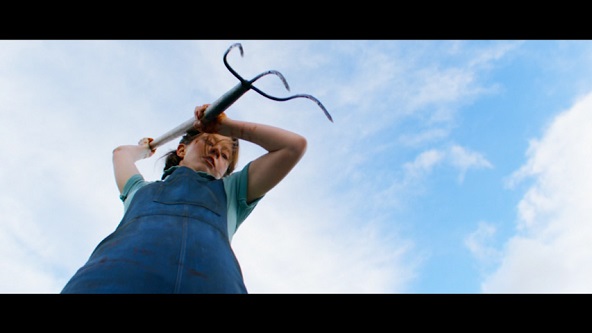
Over at Alex on Film I’ve added my notes on Maxxxine, which (likely) brings to a conclusion Ti West’s X trilogy. I liked the first film, X, and really liked the second, Pearl, but Maxxxine struck me as a weak way to wrap things up. Still better than most of the new movies I see, but a disappointment all the same.
Short and sweet. The story is presented as a monologue, with Miss Marple addressing Raymond (her nephew) and Joan (Raymond’s wife). This is because it was originally commissioned for radio, where it was read by Christie herself. I thought this broadcast version was available online somewhere, but the last time I checked I couldn’t find it. I’m sure it’s out there though.
What we’re presented with is a “perfect murder” or locked-room mystery. A woman goes in to her bedroom and is then found stabbed to death on her bed a few hours later, even though the doors and windows to her bedroom are all locked from the inside.
When talking about magic tricks that seem impossible, the rule is that if there’s only one way it could be done then that’s the way it had to have been done (I’m getting this from a video I watched by Penn Jillette). In this case there is an out that’s presented and as soon as it is then you can probably figure out how things must have been arranged. But I did like the way the solution turned on how we can all look at things and not see them. It’s the cocktail-party effect, as we filter out everything that we may be aware of but that our brains tell us isn’t important. In this case it also comes with a class argument, which made me think of how Paul Fussell in his book Class describes homeless people as being invisible even as they’re living on the street in plain sight.
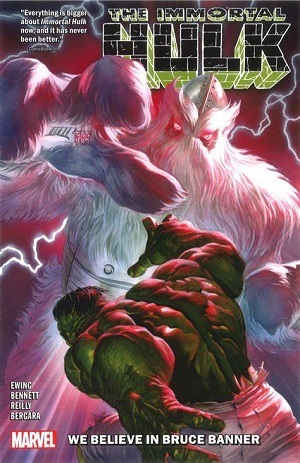 Quite a break from The Immortal Hulk: Breaker of Worlds volume. We left off that book with Cosmic Hulk smashing a planet and the sudden appearance of the Leader. There’s nothing like that going on here and the Leader doesn’t show up at all. Instead we have a political Hulk comic, with Bruce Banner (“an angry middle-class white guy talking about revolution”) on a crusade against corporate “crisis” capitalism. This means taking on the Roxxon Corporation and its CEO: a nine-foot-tall man-bull called (fittingly enough) the Minotaur.
Roxxon is the epitome of all kinds of capitalism gone mad, and Dario Agger/Minotaur is a great villain. He likes to drink espresso out of little china cups that he shatters. Because he’s a giant man-bull and they have a thing for breaking china. He also has a habit of crushing the heads of his underlings when they say anything that upsets him.
So when the Hulk destroys a Roxxon server farm, taking signature platforms like YouRoxx, Roxxface, and Yambler offline, the Minotaur decides to fight back by bringing in some recruits from Monster Island to have a showdown with the Hulk in Phoenix. With the level bad guy being Xemnu the Living Titan.
The cover to this collection is actually very misleading, as Xemnu only appears on the final page and we never see the Hulk and Xemnu fighting. I guess that’s coming up next issue. Unless they do another swerve like at the end of Breaker of Worlds and leave us hanging.
Overall I quite liked this volume of the Immortal Hulk saga. It stays in the here and now, without whisking us through the green door or out into deep space and the even deeper future. The main storyline was also pretty interesting, and I like the idea of a progressive Hulk. Though maybe he’s not really progressive since he basically wants to smash the world. The battle in Phoenix was a waste though, and the kaiju that the Hulk fights are a bore. And what struck me is that once again we have the business of characters being eaten. I’m starting to think Al Ewing has a thing for this.
In any event, things are looking good so . . . on we go!

Birthdays come and go. And so do birthday cakes. But when the people at my condo get together to celebrate a birthday there are always these amazing cakes made by one super cake-maker. Here are a couple of her recent ones. And keep in mind these are much bigger than they look in the pictures. Those are full-size plates and the cakes fed a table of six or seven with half the cake left over. I should also say that you can eat the flowers, but you’re not supposed to.


