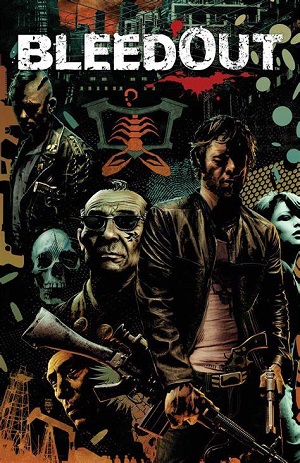
Bleedout

Bleedout

From the publisher: “Bleedout was created to provide back story for CrimeCraft, a free-to-play online video game in which players create characters, form gangs, and engage in fast-paced shootouts for cash and bragging rights.” The book came out in 2011, and when I checked CrimeCraft is no longer going. So what we have here is the back story for a game that doesn’t exist anymore. At the end of ten short chapters we’re told this is the “End of Book One,” but I don’t think there was ever a Book Two. And I think it’s unlikely there are any plans for one now.

I could leave it at that. Really, this is a nicely produced, hardcover (!) graphic novel that reminded me of the booklets that used to come with video games you bought in a box, giving players some fictional context for the world they were entering. Two things stand out about it. First: Mike Kennedy is the author of all the stories, but each chapter has a different artist. This was kind of neat, and while a few of the artists seemed similar, I thought the art was pretty good overall and there were some different styles on tap (albeit not radically different). Second: There is no dialogue. The story is told entirely through narrative exposition. And there is a lot of back story to get through, and quite a few major characters to be introduced: basically our hero and the various leaders of the different Sun City gangs.

Yes, Sun City. There’s a video game location if ever there was one.

There’s not much more to say. We’re in an urban environment after the collapse of civilization as we know it, due to a bacteria that ate up all the world’s oil reserves (which were quickly diminishing anyway). A bunch of criminal gangs have taken over. A mysterious guy called Pilot, who may be a genetically engineered super-soldier, is out for vengeance against one or all of the gang leaders, for something they did, sometime in the past. I guess all of this was going to be explained in Book Two, but now we may never know. Or maybe you figured out what was going on if you played the game . . . but if so then we may still never know.

It is a nice looking comic and I actually thought the world it created was kind of neat, but as things turned out it’s an orphaned world that nothing was ever done with.

Graphicalex

Froggy

I’m normally against lawn and garden ornaments, but (1) this was a gift from a neighbour who has since moved on, (2) later in the summer the “green wall” effect in my front garden covers him up completely, and (3) I think he’s a good looking fellow.

TCF: Vanished

Vanished: Cold-Blooded Murder in Steeltown
By Jon Wells

The crime:

Acting on a tip that came in on Easter weekend 1999, police found a garbage bag stuffed with body parts on steelworker Sam Pirrera’s front porch. The remains were later identified as belonging to Maggie Karer, a Hamilton sex worker. As police investigated the case it became clear that Pirrera might also have had something to do with the disappearance of his first wife, Beverly Davidson, eight years earlier. Charged with the murder of both women, Pirrera died of a drug overdose, almost certainly suicide, just before his court date.

The book:

While grisly, the crimes here were nothing out of the ordinary for tales of domestic abuse escalating to murder. Pirrera was a violent cocaine addict who spiraled out of control. In fact, the presumed murder of Beverly took place in a manner that I have alerted people to before on several occasions and I can only repeat my earlier takeaways: If the relationship is over, it’s over. You don’t arrange to meet up with your ex for a talk about whatever outstanding issues you may have, especially if there’s not going to be anyone else around. This is part of the value of reading true crime; you can learn something from it.

I suppose killers could learn some lessons as well. One of the chief among these is the disposal problem. Especially given the advances made in forensics, a killer has to be able to make all of the evidence disappear. And I don’t mean just tossing body parts in the garbage, or trying to flush them down the toilet (the latter method being how both Dennis Nilsen and Joachim Kroll were caught when the remains backed up the plumbing). Not even the wood chipper from Fargo is going to do the trick, since that will leave blood splattered all over the inside of the machine. It’s hard to make the evidence of a body disappear entirely. When Dellen Millard used a portable livestock incinerator (known as “The Eliminator”) to get rid of the remains of Tim Bosma there were still some of his bone fragments found in it.

No, if you’re going down this road you have to be able to make a victim literally disappear. When looking for evidence of Pirrera’s having killed his first wife, Beverly, police scoured the house they had lived in together eight years previously, and which had long been occupied by another family, scanning the basement and bathrooms for microscopic traces of blood. They didn’t find anything, but the very idea that they would undertake such a search gives you some idea of what is possible.

Unfortunately for the police, Pirrera is presumed to have disposed of the body of his first wife in a way that was practically foolproof. As noted, he was a steelworker, employed (fitfully, as his issues with cocaine addiction ramped up) at the local Stelco works. (To explain the title to those not familiar with the place: Hamilton, where the crimes took place, is known as “Steeltown” because of its history with that industry) The theory the police had was that he cut the body up and then threw the pieces into a vat of molten steel. That’s making a body disappear. It reminded me of how Robert “Willie” Pickton, the serial killer/pig farmer in British Columbia who killed nearly 50 women, may have got rid of the bodies of his victims by taking them to a rendering plant, feeding them to the pigs, or grinding them up and mixing them with pork he sold to the public. I think the rendering plant theory in particular almost as effective as the vat of molten steel. In any event, what caught Pickton out in terms of physical evidence was the fact that he held on to some personal items belonging to his victims. I think the only body parts they located were a few skulls.

This was a brutal case, with the brutality mostly being the consequence of Pirrera’s drug abuse. That sort of thing rarely ends well, though it doesn’t often blow up as badly as it did here. It’s a tribute to Wells’s ability to tell a story though that he turns these events into such an effective work of true crime reporting. I think two things helped. First, it isn’t a timely book. Karer’s murder took place nearly ten years before Wells wrote about it, which allows for a bit more perspective from all the people involved. Second, the specially commissioned photos by Gary Yokoyama add a lot. I like to complain about true crime books where the photo sections consist of poorly reproduced pictures that sometimes have only a tenuous connection to the story, so it’s nice to be able to give credit to a book that made an extra effort in this regard.

Noted in passing:

The house where Pirrera killed Karer turned into a local site of interest, so that people would even come and knock on the door asking the new owners if they could look at the basement (which had subsequently been refurbished). It got so bad that the owners “asked, and received, city permission to change the number 12 on the façade to a different number for a $130 fee.” Which is nice, but I didn’t understand how that would work. Legally the address would have to be the same for emergency services, so I guess this just meant they put a different number on the door or over the garage. But who would this fool? Anyone motivated enough could just count the numbers of the houses on the street and would notice a jump from 10 to 14, while everyone else would just get confused. How would deliveries work? This seems really strange to me.

Another point I wanted to flag has to do with the book’s preliminary material, being a couple of pages of blurbs of “Praise for Jon Wells.” One of these blurbs comes courtesy of Alex Good in a review of the book Poison that I did for The Record back in 2009. Two things struck me about this. One good: all too often these blurbs are just quoted and then the name of the publication given. It’s nice that I got credited by name. Thank you! Reviews don’t write themselves, you know. One bad: I looked and couldn’t find my review of Poison. I remember reading and reviewing it but I guess I never posted the review at Good Reports and it wasn’t anywhere else I checked. If I want to retrieve it now I’m probably going to have to fire up an old computer and see if it’s somewhere on the hard drive. I sure don’t have a print copy. Nothing lasts forever, people!

Takeaways:

Cocaine is a hell of a drug. Stay away from the stuff.

True Crime Files

Scooby Apocalypse Volume 1

Scooby Apocalypse Volume 1

I’m happy to say this was something I wasn’t expecting. Of course, by this point in history every bit of pop culture has been zombified, and our obsession with end times seems in no danger of letting up (for good reason, I might add), so why not give the Scooby-Doo gang their own apocalyptic saga? I was on board for it. I mean, I wasn’t counting on it being anything special but I was on board.

Well, as things turned out it was kind of special. First off, there aren’t any zombies. Instead, the apocalypse is brought about by those darn scientists with their lab coats and their desire to remake the world, and specifically humanity, into something better. Yeah, we know how that usually works out. We learn about this from Velma, who is the goggle-eyed brainiac in a lumpy orange sweater that we all know and love but who now has a much more complicated backstory. Rounding out the rest of the crew are Daphne and Fred as a pair of crusading “new media” citizen journalists (hey, they have a late-night show on the Knitting Channel) and Shaggy as a dog trainer who is helping out with a new program meant to create special dog soldiers at the same top-secret underground compound where Velma is working on her nanite plague. And the dog program has one washout of a recruit named Scooby-Doo. Rat’s right!

The characters are all easily recognizable, down to their signature lines. A refresher: Daphne says “Jeepers!”, Velma says “Jinkies!”, Scooby says “Zoinks!”, and Scooby says “Ruh-roh!” And they also have the same basic personalities you’ll remember from the classic TV show. Fred is the well-meaning but dense muscleman,  and he’s in love with Daphne. Daphne, in turn, is the professional woman warrior. Velma is the brains. Shaggy is a hipster. And they even get around in a revamped Mystery Machine, which is now a tricked-out war wagon. I’ll mention Scrappy-Doo too, but won’t give any spoilers for how he turns out.

The art is great and the colourful monsters a lot of fun. As I said, they’re not zombies. Velma’s corrupted nanites have turned the world’s human population into a motley assemblage of demons, vampires, and other freaks. How much of this was part of a deliberate plot is left undetermined, as is the extent of Velma’s involvement, but we still feel she’s on the side of the angels. Because who doesn’t have a bit of a nerd fetish for Velma?

If I had one complaint it’s that there’s too much going on. It’s a good story, and the characters are reimagined in a way that’s original but not degrading or overly political (this isn’t Mindy Kaling’s Velma). There’s no agenda to any of it. But there’s a lot of talk here. A lot. This is a comic that takes a long time to read, and I felt a good part of it was unnecessary. We’ve lived with the apocalypse long enough now for us to hit the ground running. We know the drill and it doesn’t take that long for us to be brought up to speed. I also had a hunch that whatever the mysterious Four were up to wasn’t actually that interesting. But that’s a question for the next volume to answer.

Graphicalex

Marple: The Thumb Mark of St. Peter

Miss Marple finishes up the six stories of the Tuesday Night Club with a tale of murder that she relates without even losing track of her knitting. I mean, she does have to work at it a bit (“One, two, three, four, five, and then three purl; that is right. Now, what was I saying?”), but she’s more than up to the task.

The answer to the question of who killed Geoffrey Denman is so obscure that Miss Marple doesn’t even give the other members of the Club an opportunity to suggest their own solutions. Because there’s just no way any of them would have come up with it even if she gave them a lifetime of guesses. Which in a way is too bad because the killer is one of the more delightfully wicked ones in the Marple oeuvre, and the insight that leads to her solution of the matter is an interesting one. An insight that comes through an act of divination, which I had to grin at because at the end of the day where does inspiration and insight really come from and how does it happen? You might as well posit a supernatural force.

In any event, the insight she has is that communication always has a context, and if we just look at the bare words that come out of people’s mouths then we’d be lost trying to understand their meaning. Indeed, they’d only be sounds. So Miss Marple takes the last sounds of Geoffrey Denman and manages to come up with something I don’t think anyone else on the planet would have come up with, but which is of course correct.

Underlying not just the method but the whole foundation of the series is Miss Marple’s declaration that “human nature is much the same everywhere, and, of course, one has the opportunities of observing it at close quarters in a village.” This is so close to something Jane Austen said about her writing that it made me wonder if Christie gave Miss Marple the first name of Jane as a kind of homage. Such a view is both expansive (seeing the whole world and all its rich variety in a small town or village) and limiting (because human nature tells us that most crimes are the result of only a few basic drives, the primary ones being sex and money).

Plus Randy and Joyce are engaged. But I think everyone had figured that out already. Aunt Jane doesn’t get any points for that.

Marple index

Bookmarked! #39: Bookstores No More III: World’s Biggest Bookstore

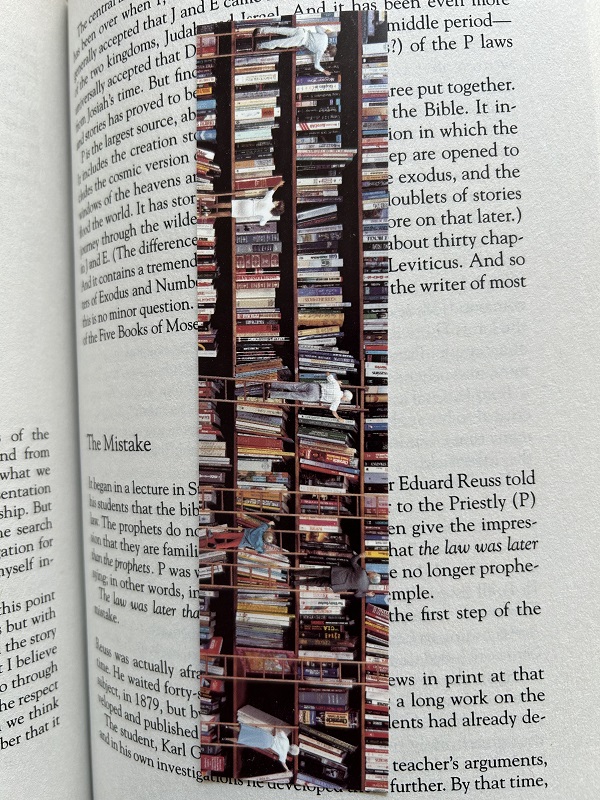
Another trip down memory lane with a bookmark from a vanished bookstore. And not just any bookstore, but the world’s biggest! I always thought the name World’s Biggest Bookstore was just a come-on, but according to Wikipedia (where the store has its own page) it really was the biggest bookstore in the world, at least for a while. It opened in 1980 and the bookmark here commemorates its tenth anniversary.

This post is also a reminder that if you’re grabbing free bookmarks always get several so that if you ever start posting pictures of your bookmark collection on the Internet — and I’m sure that’s something a lot of you are thinking about doing — you won’t have to post two pictures just to show the front and back.

I went to the WBB a lot when I was a student in Toronto. This is because it was located right downtown basically just across the street from the bus terminal, and I took the bus home a lot. But I always had time for a bit of browsing. So here’s to fond memories of the old book barn, which actually began life as a bowling alley. It closed doors in 2014 so you won’t be seeing any more of their bookmarks!

Book: Who Wrote the Bible? by  Richard Elliott Friedman

Bookmarked Bookmarks

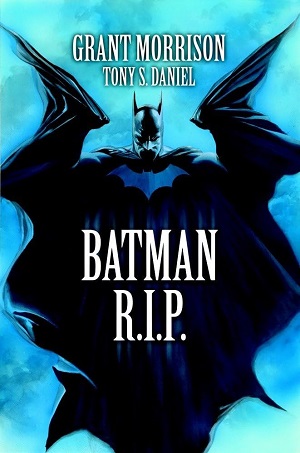
Batman R.I.P.

Batman R.I.P.

The back cover sells this as “the Dark Knight’s Darkest Hour.” I don’t know. There have been a lot of dark hours for Batman, haven’t there? I mean, at times it seems as though it’s a kind of competition to see how dark he can get, both on page and on screen.

So I can’t say if the storyline in Grant Morrison’s Batman R.I.P. is the darkest, or was the darkest at the time, but I did find it to be one of the most confusing – and confusion has been almost as big a selling point with Batman in recent years as darkness. The story here is very complicated, both in itself and in the way that it’s told.

It’s only when you get to the end that you have a more-or-less complete picture of what’s been happening all along. Basically (and I’m not going to try and unravel all of it because I don’t think I have all of it right), the criminal gang known as the Black Glove have a plan to drive Batman insane, and it mostly works but our hero is a step ahead of them and has a factory default setting called Batman Zur-en-Arrh that he’s able to reboot with after they break him down pretty much completely. Then the baddies catch Batman Zur-en-Arrh and bury him alive in a straitjacket – not to kill him, but to leave him underground long enough so that he’s brain damaged from oxygen deprivation. It’s that kind of comic! But as even the Joker knows, and tells them, you can’t keep Batman down. So then Bats rises from the grave and exacts his vengeance on the league of dirty tricksters.

This much may sound straightforward, but it’s messier than I’m making it sound. There’s stuff about Dr. Hurt trying to say he’s Bruce Wayne’s father (everyone in this comic knows Batman is Bruce Wayne, by the way). There’s an appearance by Bat-Mite, though he may be a hallucination. There’s a coda that’s also a prequel (“Last Rites”) that has Batman doing psychic battle with a creature known as the Lump.

The bottom line is that this is a comic that requires you to go back and start again as soon as you finish. Which is something that can be really irritating but I didn’t mind it here. Heaven knows we’ve been down similar Gotham streets before, with Batman as burned-out case, haunted by personal demons, so it probably took something as loopy as the plot here to sell it again. Personally I would have cut down on some of the clutter with all the people coming to help Batman at the end (Nightwing is a hero who just bores me), but I guess there was a lot of mess to get cleaned up. You could even say having the Joker involved was unnecessary, but I sort of liked how he was playing the role of an audience member at the Black Glove’s danse macabre.

Not a perfect comic then, but one that definitely stands out as above average and well worth, if not demanding of, a quick re-read.

Graphicalex

TCF: A Plot to Kill

A Plot to Kill: A True Story of Deception, Betrayal, and Murder in a Quiet English Town
By David Wilson

The crime:

Ben Field was a university student working toward a Ph.D. in English while also training to enter the ministry when in 2015 he murdered his then 69-year-old lover, the novelist and former academic Peter Farquhar. He was acquitted of attempting to also murder Farquhar’s elderly neighbour, but pled guilty to charges of fraud and burglary against both of them. He was sentenced to life imprisonment with a minimum term of 36 years.

The book:

If you want to learn about Field’s crimes then this isn’t the book for you. Channel 4 made a documentary on the case as part of the series Catching a Killer that will serve you better in this regard, and there was also a dramatized version of the events in the BBC miniseries The Sixth Commandment. For his part, David Wilson has very little to say about what actually went down, and barely even mentions Ann Moore-Martin, the neighbour, or Field’s friend Martyn Smith, who was accused of being his accomplice (charges he was later cleared of). There was a seventy-seven day trial (which included a whopping twenty-four days of jury deliberation) that Wilson breezes through in under 15 pages. So if you want all those kinds of details you’re out of luck.

This is frustrating. I really liked A Plot to Kill, but I have to register some disappointment at finishing it and not coming away with any clear understanding of what it is Field actually did or how he did it. Leaving that aside . . .

This is the sort of true crime book I normally dig my heels in against. It’s very much written in the first person, as the crime took place in what Wilson considers to be his hometown (Buckingham, or Maids Moreton to be more precise). But Wilson doesn’t make a big deal out of this, and uses it mainly as a way of introducing the question of why the members of a small community didn’t recognize what was going on and try to stage an intervention:

In Maids Moreton and in Buckingham – both the town and the university – no one publicly questioned, or challenged from a professional and ethical standpoint, what a student in his twenties was doing staying in the home of a man in his sixties, who was also at some stage responsible for that student’s instruction and supervision at the university. No one intervened. Perhaps it was discussed in private, but in public people minded their own business and simply got on with their lives.

This is an important point that and it’s one that Wilson worries over. It seems to have been clear that Field was “grooming” Farquhar but this didn’t raise any red flags. “I tried to make sense of how Peter’s murder could have happened in plain sight . . . If nothing escaped our gaze, why didn’t we notice that Peter was being groomed?” Or “Perhaps some did notice Field’s grooming of Peter, but simply chose to ignore what they saw. ‘It was their business,’ I was repeatedly told. That estrangement played a crucial part in how Field manipulated and then controlled Peter and us.”

Wilson goes on:

Should we blame Peter for what happened to him, like some people in Buckingham were keen to do, conveniently removing themselves from shouldering any responsibility? I really don’t think what happened to Peter was his “business,” by which was implied his “fault.” Haven’t we all done things on the spur of the moment, or against our better judgement, especially when we are in love? I know that I have.

Sure. But let’s be realistic. As I’ve pointed out several times already in these True Crime Files, there’s simply no talking to people who are in love. We all know this. This was my takeaway from She Wanted It All and the case of the murder of Steven Beard, whose murder was arranged by his gold-digging younger wife Celeste:

I mentioned how obvious it was – even to Steven, I believe – that Celeste was a gold-digger as well as a nut-job. But even the people around him, including close friends and family, realized it was useless saying anything to him about it. There’s no warning men (or women) in such situations. All you can do is hope for the best and prepare for the worst.

Well, in that case as in this the worst is what happened.

Broadening things out a bit, I don’t think the idea that Farquhar’s personal relationship with Field was nobody’s “business” implies that it was their fault for not stepping in. I think it’s just part of the way we deal with all such matters these days. We get angry at people who are quick to judge others. Why should a huge age gap, or a flaunting of professional boundaries upset you? If someone isn’t doing anything illegal, and the state should be kept out of the bedrooms of the nation anyway, then wouldn’t the good people of Buckingham, even Farquhar’s close friends and family, have been playing nosey neighbours if they’d gotten involved? Then there was the fact that, as Wilson puts it, Farquhar and Field lived in the community without really being part of it. They weren’t isolates, but didn’t seem that well connected either. Throw in that this was a gay relationship (though Field himself seems to have only been playing gay) and one can imagine any well-intentioned inquiries being met with accusations of homophobia or worse.

That said, I don’t want to shy away from the extent that what happened to Farquhar was his fault. Sure he was a lonely old gay man, living with “the fears of dying alone,” and yes Field was an accomplished “snake-talking” seducer, but Farquhar wasn’t a complete fool. And yet Wilson is torn.

Ultimately, I came to realize that I was actually asking the same question about both of these cases [the Maids Moreton murder and a murder Wilson wrote about in a previous book]. Who was responsible for the murder?

From the very outset, I detected that some people felt everything that had happened had simply been Peter’s “business” – by which they meant it was his fault he’d been killed.

After all, it was Peter, they reasoned, who had invited a much younger man to live in his home. Later on, when it became abundantly clear that all was not right with their relationship, Peter had nonetheless remained loyal to his younger partner. Why had Peter not done something when it was obvious, at least from the outside, that the relationship was failing? Wasn’t it inevitable that a young man couldn’t live with an older partner? This wasn’t “normal,” as one person explained it to me. Peter should have kicked Field out of his house and got on with his life.

This is a subtle form of victim-blaming, masked by the politest of concern, all wrapped up in the self-serving belief that they’d been respecting other people’s privacy. It seemed to me like weaponised gentility.

But is it really so bourgeois to respect other people’s privacy, especially in such intimate domestic matters? I would have thought it was close to a commandment in contemporary life. And how should we read that “normal” in scare quotes? Surely the person who expressed that opinion had a point. Personally, I feel a bit the same toward the relationship in this case as I do toward the men and women conned by romance scammers. They have my sympathy, and I respect the ones who come forward in the hopes of warning others by their example, but every time I see them being interviewed, and then look at the (usually fake) profiles of the people who have swindled them, I wonder what they could have been thinking. An obese middle-aged man, twice-divorced, falling for a photo of a girl in a bikini twenty or more years younger than him? A drab middle-aged woman in a dull office job who matches with a millionaire businessman who looks like a cover model from a men’s fitness magazine? A retired English prof seeing a good-looking fellow 35 years younger than him as his salvation from dying alone? Come on, people.

Shifting our gaze, A Plot to Kill also offers some interesting points of departure for thinking about Ben Field, or killers in general. The question I found myself pondering in particular here was this: do corrupt or slack institutions create bad men, or are bad men drawn to such institutions? In the case of Field the latter was clearly in play, as he saw, correctly, academe and the Church as being easily exploitable. Like many opportunists he realized it would be relatively easy to get into a position of trust and authority and then abuse both those perks of office. I still find it surprising how many people express shock at cases of police officers, doctors, or church ministers who turn out to be homicidal psychopaths. Why should psychopaths be less represented in any of these groups than they are in the general population? Indeed, given the advantages arising from their placement within such professions, like being regarded as above suspicion, wouldn’t they be more drawn to them? Wilson has his own thoughts on the subject, introduced by the results of a review made by the Church of England in the light of Field’s conviction even as he was preparing to enter the ministry. A comparison was drawn to the criminal career of Harold Shipman, a British doctor who may have killed as many as 250 people, making him one of the most prolific serial killers in history.

In many respects the review saw Field as someone similar to Harold Shipman, whose criminal career was treated in much the same way by the medical establishment. Killing over two hundred of his overwhelmingly elderly patients didn’t result in fundamental changes to the organization of medicine in this country. Instead, the medical establishment tinkered with the issuing of death certificates and tightened up the regulations related to doctors working in singleton practices. Could it stop someone like Shipman killing again? I think not. And that has essentially been the formal reaction to Field from the Church authorities too. Nothing to see here, they seem to be saying; move along now; don’t worry.

In the same way that we were asked to take comfort from the fact that most doctors are not murderous serial killers, so too we are in effect being assured that most people wanting to become priests don’t have their sights set on killing their parishioners. That’s manifestly true, and so perhaps we really should take comfort from that. However, we also need to acknowledge that the likes of Field and Shipman think very carefully about the weaknesses in the formal structures and the informal cultures of the institutions and professions they want to join, so they can exploit those weaknesses for their own ends. It’s not so important that they are exceptional and unique, but rather the role the very fact of their existence plays in degrading what we know to be true and predictable.

I think this is a point worth reflecting on. It connects with some of the stories Brian Klaas tells in his book Corruptible about how professions and institutions of power, trust, and authority attract some of the worst people in the world. Ben Field was on track to become both a professor and a minister. And he might have got away with it if he hadn’t been so greedy. It is up to these (often “self-regulating”) bodies to police themselves and be on the lookout for those who can identify “the weaknesses in their formal structures and informal cultures.” This is something they do a poor job of, in part because of their desire to defend their special status and privilege. There’s a funny example of this when Wilson pays a fee to get the post-mortem report on Farquhar but receives the run-around before having his request denied. As he concludes, “Denying me an opportunity to scrutinise their processes and procedures . . . allowed the coroner’s office to helpfully maintain their public appearance of infallibility, even though they clearly messed up in this case.” Weak institutions are always against public oversight, precisely to maintain that “public appearance” which gives them their power, influence, and credibility.

Wilson puts some extra spin on this when he comes to describe the University of Buckingham, where Field was studying, as embodying a new model of higher education in tune with the then emerging neoliberal revolution (Margaret Thatcher was an early booster). In this case, the values of the institution itself, if they didn’t “make” Field, were at least a good match for his personality:

I propose that, beyond Field’s personal responsibilities for the crimes he committed, he was influenced by the institution where he studied, and which was founded on the values of individual action and freedom; private entrepreneurship rather than state funding; and a neoliberal world view that prioritised, in the words of the university’s former vice-chancellor, following the market as a means to prosper. Field seems to have internalized these values completely and recognises this himself – he is “vulgarly commercial.” He may have started out as someone who wanted to espouse liberal arts values, but he quickly descended into the murderous equivalent of a vocational school.

Personally, I don’t think the University of Buckingham did much to shape, or “nurture,” Field, but it is an interesting connection to make, and has roots going back to that foundational text of neoliberal psychopathy, Bret Easton Ellis’s American Psycho.

I also don’t think literature or religion meant much, if anything, to Field. From what Wilson offers up, his work seems to have mostly consisted of just tossing the then-current jargon at whatever texts he happened to be reading. “Ergodicity” was the latest buzz word, and I have no idea what it means. In any event, Field wasn’t particularly smart, but he didn’t have to be. What he had to be was ingratiating, which he was. Because the Church, much like the Humanities, is a dying institution ridden with poor morale and ripe for infiltration by grifters, that’s all he needed.

Noted in passing:

This will be a long “noted in passing” section because it took me down a bit of a rabbit hole. It leads into the chief takeaway eventually though.

At the time of his arrest, Field was living with the woman who was supervising his thesis at the University of Buckingham, a professor named Setara Pracha. Was this proper? Wilson registers doubts: “To make an obvious point, it simply isn’t good pedagogic practice to start a relationship with a student that you are supposed to be supervising; frankly, at the very least it is an abuse of power.” What’s more, Field was just coming off being in a relationship with Farquhar, who was also his supervisor, not to mention a man. One would have thought this would raise some red flags with Pracha. If Wilson is surprised no one spoke out about Field dating (or even marrying) Farquhar – “no one publicly questioned, or challenged from a professional and ethical standpoint, what a student in his twenties was doing staying in the home of a man in his sixties” – shouldn’t his new supervisor have at least been put on the alert?

I’m not sure. When I was at university thirty-plus years ago (at the same institution where Pracha received her Master’s) it was an open secret that many of the faculty were in relationships with their students, to the point where I later referred, in print no less, to academia as “a happy-hunting ground” for such types (I think I may have even called them predators). I can’t exaggerate how common this was, and how openly it was flaunted. I think it’s less flaunted today, but just as common. Years after graduating I remember having dinner with someone in the upper reaches of university administration and talking about a then notorious scandal involving a professor who had been caught having an affair with one of his students. The point that came out of our conversation was that there were no rules against such behaviour. It was considered risky, but given that these were consenting adults, the university wasn’t going to sanction them in any way. In other words, what these people were doing may have been stupid, but nobody wanted to come out and say it was wrong.

Apparently Pracha was the third wife of someone named Terry Green, a guy who got rich from creating and providing the voice for an automatic queuing system in use around the world. According to one news report, “Along with car alarms, mobile phones and the ever-increasing roar of traffic, the dulcet tones of a smooth male voice saying, ‘Cashier No 3, please’ is an unavoidable part of the soundscape of modern Britain.” This surprised me a bit, as I had no idea what soundscape this was even referring to. How do you make a fortune out of something that sounds less efficient than just taking a number from a ticket-spitter and waiting until it’s called? This system of “consumer flow management” is apparently ubiquitous in Britain but I’ve never encountered anything like it here. It’s just another thing that makes me think there’s something odd about the British.

Anyway, the reason Green was in the news was because there was some nasty legal fight over his messy divorce from his second wife. Pracha’s involvement came up because she married Green in 1998. He divorced her in 2004. So she was available when Field came calling.

But this is the point I was working my way around to. Leaving the matter of professionalism aside: Pracha was 10 years younger than Green; Field was 44 years younger than Farquhar, and 20 years younger than Pracha. Folks, these age gaps don’t work. I know we can all think of exceptions, but they remain exceptions that prove the rule. You can call it victim-blaming for judging motives in such cases, but I didn’t come away from this book liking any of these people very much.

Takeaways:

Bad people are everywhere. But all too often the people who escape blame are their enablers.

I don’t mean by “enablers” people who look the other way, the ones Wilson criticizes for not getting involved because it wasn’t their business. It is not enough, to use the old line often misattributed to Edmund Burke, that for evil to succeed all that is necessary is for good men to do nothing. Evil needs a hand. Evil needs its suckers, dupes, and people who just want to be in on whatever the scam is because they think there’s something in it for them. Narcissistic psychopaths have a special sense for detecting the smell of weakness, cynicism, and ambition that will make someone useful to them. Such people, while they may not be accomplices, cannot simply be described as collateral victims.

True Crime Files
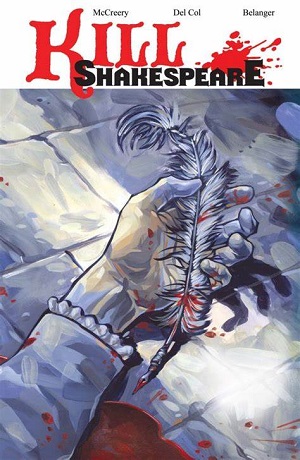
Kill Shakespeare: A Sea of Troubles

Kill Shakespeare: A Sea of Troubles

This is something very different from what I was expecting. Which is a good thing, because I wasn’t expecting much more than a comic version of some tales from Shakespeare, maybe done up with a bit of postmodern fillips.

Kill Shakespeare is a lot more ambitious than that. This is a wholly new story that kicks off with Hamlet being sent on a presumably one-way trip to England. That part’s in Shakespeare, but after being shipwrecked things go off the rails. The kingdom Hamlet finds himself in is run by wicked King Richard III, allied with Lady Macbeth, who is in turn carrying on an affair with Iago. This Injustice League of Shakespearean baddies is looking for the magic quill of Will, an artefact with the power to control the world. Opposing them are a team of good guys including Falstaff, Othello, and a kick-ass Juliet. Hamlet initially falls in with Richard, who’s hoping Hamlet is the “Shadow King” who will be able to find and kill Will (Shakespeare). But then the not-so-much melancholy as just confused Prince of Denmark joins up with the oppressed freedom fighters of the woodlands. Meanwhile, the duplicitous Iago is playing all sides, as you’d expect.

It’s quite a bold re-imagining of things, and I give creators Anthony Del Col and Conor McCreery high marks for coming up with the concept. But while the idea is great, I thought the writing itself pretty rough. There’s an attempt to have people talk in a sort of faux-Shakespearean fustian that never sounds right, and there’s way too much talk in the first place. There’s just no need for stuff like this: “Hamlet, do not think that I mean to intrude into your destiny – nothing would be further from the truth. But it seems to me that this maelstrom of events has left your brain heavy and your spirit distracted. Trust in your own abilities. I beg you to take a moment to rest your mind, your heart, your soul. Within you lies a great power to pierce Shakespeare’s veil of deceit, to find this monster. The fates would not lie.”

The art by Andy Belanger had the same effect on me. Some of it is quite well conceived, like poor Macbeth getting Fortunatoed by his wife, a scene that is genuinely horrifying. But most of the rest of the time it has a basic, generic look that made me think of some of the less inspired Classics Illustrated. The various characters have little personality in the way they’re drawn, and could be hard to distinguish at times. Hamlet and Juliet look dropped in from a rom-com, and Othello is the stereotypical hulking Black man, with a shaved head and a build like a defensive lineman.

The actual story itself felt like it was something simple that was being dragged out too much. Nothing seems to happen in this first volume, and it mostly just feels like we’re being introduced to the characters as they run around. This also made me wonder just what the target audience was. I suppose most high school kids will have some idea of who Hamlet, Othello, Richard III, and Lady Macbeth are. But . . . maybe not. Even believing (hoping) that some Shakespeare is still taught in high school, I think very few people will recognize the names of Don John (from Much Ado About Nothing) or Parolles (from All’s Well That Ends Well). Not that it matters much.

So it’s something different, and if you’re familiar with Shakespeare it makes for a cute diversion. But the execution of the various ideas in play didn’t strike me as all that great and I came away feeling that they, somewhat surprisingly, didn’t have enough here to make a whole series out of. I’m not sure when or if I’ll continue with it.

Graphicalex