On the hunt with Holmes

An index to my reviews of the Sherlock Holmes stories and novels by Sir Arthur Conan Doyle (and others).

A Study in Scarlet
The Sign of the Four
A Scandal in Bohemia
The Red-Headed League
A Case of Identity
The Boscombe Valley Mystery
The Five Orange Pips
The Man with the Twisted Lip
The Adventure of the Blue Carbuncle
The Adventure of the Speckled Band
The Adventure of the Engineer’s Thumb
The Adventure of the Noble Bachelor
The Adventure of the Beryl Coronet
The Adventure of the Copper Beeches
Silver Blaze
The Yellow Face
The Stockbroker’s Clerk
The Adventure of the Gloria Scott
The Adventure of the Musgrave Ritual
The Reigate Squires
The Crooked Man
The Resident Patient
The Greek Interpreter
The Naval Treaty
The Final Problem
The Hound of the Baskervilles

Deuterocanonical Works

The Army of Dr. Moreau by Guy Adams
The Breath of God by Guy Adams
The Case of the Man Who Was Wanted by Arthur Whitaker
The Counterfeit Detective by Stuart Douglas
The Darkwater Hall Mystery by Kingsley Amis
The Doctor’s Case by Stephen King
Dr. Jekyll and Mr. Holmes by Loren D. Estleman
Holmes and the Dasher by A. B. Cox
The Hound of the Baskervilles illustrated by I. N. J. Culbard
The Hound of the Baskervilles (pop-up book)
The Ripper Legacy by David Stuart Davies
Sherlock Holmes and the Christmas Demon by James Lovegrove
Sherlock Holmes: The Final Problem illustrated by Hannes Binder
The Sleuths by O. Henry
The Stolen Cigar-Case by Bret Harte
The Unique “Hamlet” by Vincent Starrett
The Web Weaver by Sam Siciliano

Mystery and Detective Fiction

The Zombie Night Before Christmas

The Zombie Night Before Christmas

Along with “peak zombie,” the early twenty-first century saw the mass zombification of classic literature, the seminal text being Pride and Prejudice and Zombies. The Zombie Night Before Christmas was published a year later, and what I was reading was the 10th anniversary edition, though I don’t know if they made any significant changes.

What we have here is most of Clement C. Moore’s classic poem – whose original title was “A Visit from St. Nicholas,” and which Moore may not have written – mixed in with some references to rotting corpses and flesh-hungry zombies. Basically the world has been overtaken by the zombie apocalypse and now everyone is a zombie, but still going about living their normal lives. For some reason, however, nobody has told Santa about this turn of events (he knows if you’ve been bad or good, but not if you’re still alive). So on Christmas Eve he’s in for a rude surprise, and soon finds himself on the run from the hungry dead.

To be honest, I felt kind of sorry for Santa in this one. He manages to avoid an initial zombie attack by landing on a roof, but then gets jumped by a zombie as soon as he comes down the chimney. Again, I don’t know why he’s bothering at this point, seeing as he knows the situation. But anyway, he’s bitten and then “A blink of his eyes / and twist of his head, / Soon let me know / he was now living dead.” And all his reindeer too.

It’s a cute little book and a bit of fun. But maybe they needed to take a freer hand with the poem to come up with something really new. Either that or just illustrate the original text with zombies. Mad Magazine used to do adaptations like that, and it’s an approach that might have worked here. This sort of tries to have it both ways, and the result is more a light work of whimsy than a deathless Christmas classic.

Graphicalex

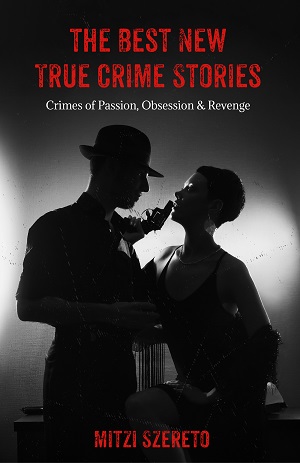
TCF: The Best New True Crime Stories: Small Towns

The Best New True Crime Stories: Small Towns
Ed. by Mitzi Szereto

The crimes:

“Snowtown” by Anthony Ferguson: a bank building in a dusty Australian town becomes the storage facility for the “bodies in barrels” serial killers, and subsequently becomes a dark tourism destination.

“A Tragedy in Posorja: When ‘People’s Justice’ Goes Horribly Wrong” by Tom Larsen: a lynch mob storms a police station in Ecuador, killing three people falsely believed to be child kidnappers.

“About a Boy” by C L Raven: in the 1920s a teenage boy kills a couple of little girls in a Welsh town.

“Twenty Cents’ Worth of Arsenic” by Edward Butts: a woman in a small town in Ontario is convicted of poisoning her husband.

“I Kill for God” by Mitzi Szereto: a mentally disturbed man goes on a shooting rampage in Washington state, killing six people and injuring several others.

“The Summer of ‘The Fox’” by Mark Fryers: a spate of home invasions and rapes terrorize the English town of Leighton Buzzard in the summer of 1984.

“Who Killed Gabriele Schmidt: The True Story and the Mystery Surrounding a Forgotten Murder” by Alexandra Burt: a young girl is killed in a town in central Germany.

“Bullets and Balaclavas: The Long, Cold Orkney Shooting” by Charlotte Platt: a teenager wearing a balaclava walks into a restaurant and kills the owner by shooting him in the head.

“The Black Hand and Glass Eye of Earlimart: A Killer’s Perspective” by Christian Cipollini: a hitman tells the story of his murder of a small-town drug dealer.

“Crime Has Come to Penal!” by Iris Leona Marie Cross: a brutal home invasion and murder in Trinidad.

“The Voodoo Preacher” by David Brasfield: in 1977 a minister is shot dead while attending a funeral in Alexander City, Alabama.

“La Bella Elvira: Murder in the Tuscan Hills” by Deirdre Pirro: a young woman is killed in postwar Italy.

“The Doctor, the Dentist, and the Dairyman’s Daughter” by Paul Williams: a young woman dies in a town in Wales and a local doctor is suspected of her murder in what might have been an abortion gone wrong in 1884.

“In the Home of the Cannibal” by Joe Turner: an aspiring cannibal advertises online for a willing victim, and finds one.

“Nameless in Van Dieman’s Land” by Stephen Wade: the 1996 Port Arthur massacre.

The book:

As with a lot of these themed anthologies you’re led to ask what the significance of the connecting idea is, and how it might influence the way we think about crime in general.

In the present case, are these stories of small-town crime just meant to show the “dirty fingerprint,” in the language of Mitzi Szereto, on the “postcard images of picturesque town squares, parades down Main Street, bake sales, [and] church socials”? To reveal the dark side of places where it’s assumed “people look out for each other” and a time when “neighbor helped neighbor and people and property were treated with respect, and no one had to worry about locking doors”?

Well, Miss Marple had a thing or two to say about how crime and the universality of human evil undermines that vision of small-town life. I think we have to dig deeper.

So for starters, what is a small town? Does it depend on where the town is located? To take the first two stories, the current population of Snowtown, Australia is 356. The population of Posorja, Ecuador is 15,000. From what I could gather, they are very different communities. And it’s also the case that a lot of the crimes described here didn’t take place in small towns. Snowtown, for example, was only a place the killers stored the bodies of their victims, and many of the other killers we meet lived in homes outside of towns, in semi-rural areas.

We also span the globe in this book, with what are Australia’s two most notorious crime stories providing bookends, a couple of trips to Germany, one to Italy, two stories from Wales, a few set in the U.S., and some exotic locations like Trinidad, Orkney, and Canada also in the mix.

And what of the passage of time? Is the myth of the idyllic small town inextricably linked to “the values of the past, [and] the ‘good old days’”? Here as well the stories cover a lot of ground, being culled from headlines drawn from anywhere in the last century and a half. What does a small town in Wales in the 1880s have in common with a small town in Trinidad in 2018? Are small towns everywhere and at any time that much the same?

It’s an interesting question, but to be honest I don’t think it’s one this volume is all that interested in addressing. Instead, this is pretty much just a pot-pourri of crime stories characterized mainly by its geographical diversity. And that is in turn one of the more interesting connecting threads. The first story introduces us to the idea of “dark tourism”: the international rubberneckers of the true crime world. For the most part the towns here are not regular tourist destinations. I think Port Arthur might be the only place normal people would care to visit. But if you’re a reader of true crime and don’t like to travel you should enjoy this sampling of off-the-beaten path locales. If nothing else, you’ll learn a bit along the way about places you might not know anything about. I know I did.

Is dark tourism wrong? Years ago I remember my father and I going for a drive to see where Albert Johnson Walker lived in Paris (Ontario), but I think that was mainly because it was near where my father grew up. Most such places don’t have much to tell us though, or relate very much to the crimes they witnessed. The only stories where I thought place was really relevant were the lynching in Ecuador (with the background of that country’s indigenous justice movement), the home invasion in Trinidad (an island paradise that has become “a crime-ridden hellhole”), and the walk-through tour of Armin Miewes’s dilapidated farmhouse — or rather mansion (43 rooms?) — with Miewes’s pornography still left lying around years later. That struck me as weird.

Another connecting thread, and one less welcome, was the first-person voice adopted by many of the authors. I’ve mentioned before how much I don’t like this development, and how the “true crime memoir” is a sub-genre I avoid like a case of the clap. These stories don’t go that far, but many have a memoir flavour. To give you some idea of what I’m talking about, here’s a sampling of first lines:

I remember a sense of eeriness and palpable shame.

In 1984, as a six-year-old child, I moved to a small town in the South of England, where I would remain for the next twenty years.

We all have a story to tell about the summer of 1983: I was on vacation; I visited my grandmother; I took the train to Paris. I have told my very own story numerous times over the past thirty-seven years, a story that has morphed into the very reason I write about crime.

I had been temporarily resident in London, England, for eleven years and was fearful of returning to my home country.

It was a roasting Alabama day in June of 1977. I was three years old and living in a house down the street from the House of Hutchinson funeral home at the moment a vigilante shot Reverend Willie Maxwell in the face in front of two hundred mourners.

I went to this place as a tourist. I came away from it a true crime writer.

I wish non-fiction writers didn’t do this so much. In some very special situations it works, but most of the time I just want to say to them “It’s not about you.”

That said, I really enjoyed this collection. The international flavour (something that Mitzi Szereto’s anthologies tend to specialize in) was a plus, as was the fact that aside from a few of the more notorious cases, I wasn’t familiar with the crimes being discussed. Also, the fact that several of the crimes were either unsolved or their resolutions still open to dispute, added a bit of an edge. There were a couple of real clunkers, as you’d expect from a collection of what are all-new pieces, but overall the quality of the writing was pretty high.

Noted in passing:

In the story “Crime Has Come to Penal!” a married couple, along with the husband’s mentally ill adult  brother, are brutally murdered (shot, throats slit) in their home. In the house at the time were the couple’s two children: a four-year-old girl and her infant (eight-month-old) brother. The rotting bodies of the adults were not discovered for four days, and in that time the little girl “cleaned the infant, changed his diapers, and bottle-fed him with milk from the open can that was found on the living room floor. She also gave him juice and snacks.” To be sure, both kids were in bad shape when they were discovered, but the girl did keep her brother alive.

That’s an impressive little girl! But the author points out that just a few months earlier a similar case had occurred in California, when a four-year-old girl cared for her two-month-old brother for three days following the murder-suicide of their parents.

Damn. Those are some resourceful four-year-olds!

Ranging as far afield as we do here, I picked up some proper geographical nomenclature. It is, for example, no longer considered correct to refer to the Orkney Islands as the Orkneys. The islands now simply go by the collective name of Orkney. I didn’t know that. I also didn’t know that residents of Trinidad and Tobago are known as Trinbagonians (or “Trinis” for short).

The bodies in the Snowtown case were put in barrels of hydrochloric acid, which didn’t have the desired effect of dissolving them but instead preserved them. Apparently what the killers should have used was sulfuric acid. The author chides them for being not too bright, but I would have probably made the same mistake. I’m not a chemist!

Takeaways:

When it comes to the violent expression of our basest emotions, human nature is pretty much the same everywhere.

True Crime Files

Archie Horror Presents Chilling Adventures

Archie Horror Presents Chilling Adventures

As you know if you’ve been reading any of my previous posts, I’m a fan of the Archie Horror imprint. I think they’ve done a lot of really creative work and been successful in expanding the Archie brand in ways I wouldn’t have thought likely. That said, Chilling Adventures is a total dud.

The idea here was to present a horror anthology, with a bunch of short stories from a variety of authors and artists. According to the editor’s introduction the model was supposed to be something like EC’s Tales from the Crypt, which I can see, but I think the more immediate reference might have been The Simpsons’ Treehouse of Horror. And if that’s the comparison being made I think Chilling Adventures suffers by it. In fact, I can’t think of any comparison it doesn’t suffer by.

The blame can be laid squarely at the feet of the writers. Normally in a variety-show effort like this you can expect a mix of good and bad. Here I had trouble identifying anything that was good. Pretty much everything on tap was either tired and clichéd or confusing. Sometimes both. There’s a gesture at a frame story as Madame Satan gets bored with ruling hell and takes up being a high school principal. Archie gets trapped in a killer video game. Veronica is possessed by a demon dress. Jinx (Sabrina’s “familiar”) rescues a bunch of stray animals from a sorcerer. Jughead (the werewolf version) fights Krampus. Shape-shifting aliens land in Riverdale. Some of this might have been interesting, especially given the talent assembled, but it’s just a dull mess that never got any better as it stumbled along. Were they in a rush? Uninspired? I don’t know, but nothing here worked for me.

Graphicalex

Books of the Year 2024

This year marks a bad milestone for me. Usually I mention three books for this annual round-up, in the categories of fiction, non-fiction, and science fiction. But for the past several years I’ve been reviewing fewer novels, to the point that this year I’m not sure if I read any new fiction that wasn’t SF. So I had to skip that category.

I keep saying how I have to try and read more new fiction. And every year it seems I read less. Maybe 2025 will see a change, but at this point I’m not optimistic.

Best non-fiction: there continue to be a lot of good political books coming out in these depressingly political times. But the one that stood out the most for me was Anne Applebaum’s Autocracy, Inc. I said in my review that it might have been the scariest book I read all year, and I think it might also be the one whose analysis has the most lasting power, which is unfortunate. Whatever name you want to give it — autocracy, oligarchy, kleptocracy, kakistocracy — the global condition she describes is one that’s only worsening.


Best SF: there were a number of books I really enjoyed this year. And I think enjoyment is the key word. These were fun reads, first and foremost, though they could be thoughtful too, and often were. Among the highlights I’d put Ray Nayler’s The Tusks of Extinction, The Family Experiment by John Marrs, Glass Houses by Madeline Ashby, and The Fabulist Play Cycle by Hugh A. D. Spencer. But sticking with the fun factor I guess I’ll say High Vaultage by Chris and Jen Sugden. A steampunk mystery thriller with all kinds of alternative-history madness to keep things whipping along. Not as deep as the other books I mentioned, but I had a great time with it.

Visions of Guelph: Covered Bridge

This bridge isn’t very old, as it was only constructed in 1992 by 400 volunteers from the Timber Framers’ Guild. According to some information I found online: “It was designed in the style of Ithiel Town’s patent from the 1880s, and is notable for the amount of light it allows into the interior. While the supports have metal bars and bolts, the interior sports handmade wooden dowels.”

It has become quite a landmark, and looked pretty on this foggy morning. (You can click on the pic to make it bigger.)

The Immortal Hulk Volume 7: Hulk is Hulk

The Immortal Hulk Volume 7: Hulk is Hulk

Well, that was interesting.

Apparently Xemnu, I’m not sure how, was creating a mass illusion among the entire human race that had everyone believing he (Xemnu) was a cuddly figure from a children’s television show that never actually existed. And implanting other false memories as well. It’s the Mandela effect except on a universal scale. The point of this exercise in mass delusion being to absorb people and repurpose them as mechanical offspring. He’s even got deep inside Hulk’s head . . . but not deep enough as things turn out. You see, the Hulk knows who he really is. Hulk is Hulk.

That’s another good premise to start with, but there was so much other stuff going on that I felt a lot of it sort of got lost in the mix. It’s like Al Ewing has attention-deficit issues and doesn’t want to spend too long developing any particular storyline too much. I mean, I really liked the Minotaur from the previous volume, but when his time is up he gets disposed of quickly here and I never did figure out just what his plan for global domination was.

There are longer story arcs that we return to. The Leader is still up to something relating to the planet Hulk crushed a while back, and he’s also being connected to the Hulk in Hell mythos and something to do with Bruce Banner’s father. I have to say I’m not grooving to all the psychomachia stuff and Dr. Banner’s dissociative identity disorder, but the subplots are working for me and even though the eating-people and skin-shedding tropes feel overused (they both come up again here) I do like the punctuation of the “Hulk Smash!” double-page, hammering-time spreads. In other words, all the meat-and-potatoes comic-book stuff. Do I care about the Hulk’s battle with his personal demons? Not yet, anyway.

Graphicalex

Breakfast with Audrey

Oh, I hated doing this puzzle. The big sections where the pieces were either all black or all white were bad enough, but the pieces didn’t fit together properly at all. It’s also really long so that’s why it’s on the floor. I actually thought it had been thrown out long ago, but my sister sent me this pic after she finished doing it this past weekend, in part I think to mock my exasperation with it. She said it was hard, but the trick was if a piece wasn’t a perfect easy fit then it was wrong. Pfft.

Puzzled

Alien: Revival

Alien: Revival

It’s easy to get lazy reading comic books. In particular, you can let your eye drift over the art, not paying close attention to everything that’s going on and picking up on all the small but significant details. There was a telling moment for me in this regard when reading Alien: Revival. One of the characters refers to the discovery of a victim of the Xenomorphs that’s found in one of those incubation cocoons, only with her feet torn off. This made me flip back to the scene in question because I hadn’t noticed the victim’s feet. But they had indeed been torn off.

Later in the comic we’ll see other humans who have been given the same treatment, with arms and legs removed. I guess because all that’s needed for gestation is a chest. I don’t recall this ever being a thing in the movies (though I’m not caught up on all the films in the franchise), and it’s a detail that’s pretty damn disturbing, to be honest. But Revival is a comic that takes the Alien mythology and turns up the ick factor quite a bit.

The story is again impressive. As I’ve noted before, the Alien comics beat the pants off the movies in coming up with original plots. I don’t know why they didn’t just film them. Would have avoided all of Ridley Scott’s later mythologizing and the Aliens vs. Predators crap.

The story has it that a bunch of humans have started a religious colony on a terraformed mining moon named Euridice. But wouldn’t you know it, the Weyland-Yutani Corporation wants a place to test out a new strand of Xenomorph and so Euridice is up.

At first I thought the whole religious sect of “Spinners” (because they worship a divine Mother who spins creation on her cosmic loom, or something like that) was overdone. They even talk in frontier or Appalachian folksy dialect, saying things like “I might oughta brought that shotgun.” But after a while it grew on me, and they turned it into something interesting when the Spinners started to question whether any of their beliefs and holy books were real or were just a construct of the Corporation.

There’s a kick-ass heroine named Jane who has a bow. There are some very evil synths (androids), one of which I actually guessed the identity of before the reveal. But it was pretty easy this time (usually this series conceals them really well). One thing I did raise an eyebrow at though was Jane swearing at a wicked synth that she was going to kill it. Is that a threat to a synth? Why would a robot care if you threatened to kill it?

Also included in this volume is Alien Annual #1, which is a standalone story starring the security man Gabriel Cruz and some more space marines facing off against yet another evil synth. Androids really aren’t our allies in these stories. Bishop was the exception to the rule.

Graphicalex