
I took the city bus recently. I support public transit, even though I’m not a big fan of taking the bus myself. But if every bus ride was as peaceful as this one I’d ride more often! For this part of the trip I was in heaven.

I took the city bus recently. I support public transit, even though I’m not a big fan of taking the bus myself. But if every bus ride was as peaceful as this one I’d ride more often! For this part of the trip I was in heaven.
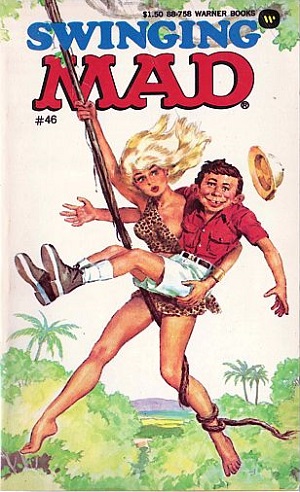 This MAD pocketbook was published in 1977 and I think all of the content is drawn from stuff that had previously appeared in the magazine in the 1970s. So we’re in a world where a mock publication called Occult Magazine looks forward prophetically to 1989, hippies weren’t a long-distant source of fun but a clear and present source of fun, and the tunes of songs like “Bless ‘Em All,” “On Wisconsin!” and “Stouthearted Men” were assumed to be so well known that readers would be able to sing along with parody versions. For the record, I know none of those songs but apparently they were very popular once upon a time. And I suppose “On Wisconsin!” is still familiar to Badgers.
This is a grab-bag collection with no one theme. Instead there’s just a little bit of everything that made MAD what it was. There’s the Don Martin Department. There are funny advertisements. There are two Dave Berg “Lighter Side of . . .” instalments. There’s a Spy vs. Spy cartoon (White Spy wins this one). And it all wraps up with one of MAD’s justly celebrated movie parodies, as drawn by the unforgettable Mort Drucker. What a line-up of talent MAD had during these years. It makes me wonder if a magazine like this would even be possible today. Since MAD itself isn’t possible today (they’ve stopped print publication) I think we know the answer to that. I’m not in love with the ‘70s, but for magazine culture you could look back on it as the end of a golden age.
 This was a pleasant surprise. Ant-Man, or Giant-Man (a role he grew into, later taking the name Goliath), has never been one of my favourite superheroes and I wasn’t expecting much from this collection of his first appearances in Marvel’s Tales to Astonish. (Most of the early Marvel superheroes didn’t start out with their own comics, so Iron-Man, as he then was, could be found in Tales of Suspense, Thor in Journey into Mystery, Doctor Strange in Strange Tales, etc.) But I had a great time tracking the very silly evolution of the character, and his sidekick “the wonderful Wasp.”
What I mean by silly is the way a hand keeps getting waved at any questions that might be raised as we go along. Explanations are trotted out, but they’re so flimsy you just have to shake your head. Scientist Hank Pym invents a potion, later made into a pill, that allows him to almost instantly shrink to the size of an ant. I mean instantly in that he seems to just disappear. You don’t see him get smaller. I wondered how that worked. But then I wondered about a lot of things. Luckily, the explanations keep coming. How does his costume change sizes along with his physical transformations? An editor’s note: “Clothes composed of unstable molecules are able to stretch and contract as the wearer’s own body does!” How does Ant-Man send and receive messages to all the ants everywhere all over the city? He has antennae on his helmet that can transmit, receive, and “decode” the electronic impulses that all ants use to communicate. And by “communicate” I mean they can even send live video! How does he travel instantly to any place he has to be? He has a catapult that fires him wherever he wants to go, and when he gets there his ant buddies form a cushion to give him a soft landing. How does he fight bad guys when he’s the size of an ant? He keeps the same strength he had as a full-size human even when he shrinks. But then when he learns how to make himself bigger, for some reason he maxes out at 12 feet and after that he gets weaker. I’ve no idea why that happens, but here’s the explanation they give: “It’s like a sculptor rolling the clay figure of a man between his hands until it grows longer and longer! But the longer it grows the weaker it becomes, until it finally snaps!” Uh-huh.
You get the feeling in all of this that they just needed a set of rules for Ant-Man/Giant-Man to operate by, and that they weren’t too concerned that readers would stop to ask too many questions. So when the whole idea of popping a pill to grow or shrink got a bit too awkward they simply had Hank come up with a modification to his helmet that allows him to change size by controlling his “mental energy” in “mentally activated cybernetic impulses.” In other words, he just has to think about getting bigger or smaller! And not only that, he can make the Wasp bigger or smaller with the same helmet (though otherwise he has to still rely on the pills).
This final point underlines what is perhaps the most jarring thing about these comics. Coming out during the height of the Cold War (1962-64), the bad guys are often looped into the Red menace. The commies even apparently killed Hank Pym’s first wife, a story quickly told in flashback. None of that dates the action as much though as the gender roles in the relationship between Hank and Janet van Dyne (who becomes the Wasp in part to avenge her father). Hank is protective of Janet, which is something she rejects in a pseudo-feminist way. “He treats me like a scatterbrained little girl,” she protests to herself, “and I want him to think of me as a full-fledged woman . . . a woman in love!” After all, “He may go for all that adventure jazz, but I go for big, wonderful, dreamy him!” This is awful stuff, and it’s everywhere. Even when Ant-Man and the Wasp discuss matters of international importance with a room full of officials her thought bubble off to the side only reveals “Mmmm, if there’s one thing I like, it’s being in a room full of men!”
There is a lot of this, and it’s representative of a real weak spot in Marvel’s imagining of female characters at the time, which I guess goes back to Stan Lee. Lee’s stories are wonderfully inventive and a lot of fun, but he had trouble with women and imagining real relationships. For all her feistiness, Janet is a throwback to a stereotypical female model. Even after becoming a superhero she revels in a role as fashion icon, and the Wasp with her “dainty wings” and “tiny, delicate antennae” is a modern-day Tinkerbell. The fact that Hank can control her size changes by his helmet, and that she can’t grow big but only smaller, reinforces this. He’s also the brains as well the brawn, and when he gives her an air-compressor weapon that he’s invented so she’ll have a bit more firepower it’s like he’s giving a toy to a child.
So that’s the downside here. What I loved is the way the reduced scale, at least of the early stories, gave us simpler stories that were all the more effective for not being about fighting wildly powerful archvillains. Sure there are some aliens and transdimensional interlopers here, but the guys I enjoyed more are the bitter losers with a grudge against the world, like Egghead (who even retires to a flophouse after first being bested by Ant-Man), the Human Top, Trago (“the man with the magic trumpet”), and the Porcupine. I was curious whatever happened to these guys, and wasn’t too surprised that (at least in these earlier iterations) both Egghead and the Porcupine died in action in later years, while the Human Top turned into Whirlwind. They’re B-listers, after all, but no less fun for all that.
Along with this goon squad we get a lot of low-tech action that’s also the perfect foil for today’s bloated cosmic, multiverse nonsense. On two different occasions first Ant-Man and then the Wasp tie the bad guy’s shoelaces together to make him trip! At another point Ant-Man unstrings a pearl necklace and rolls the pearls across the floor to send the Protector for a tumble. Then, when the Protector sucks Ant-Man up into a vacuum bag, our hero cuts his way free and uses a fan to blow the dust from the bag into the Protector’s face, blinding him and making him sneeze (“My eyes!! I can’t see!! Ah – Ah – Chooo!!!”). That’s good enough to allow the police to capture him and take him away.
Trying to catch Ant-Man leads the not-so-supervillains to some similarly modest stratagems. I just mentioned the vacuum cleaner. Fly paper? Sure. And here’s something really nasty: take away his growth pills and toss him in a half-full bathtub! How is he going to get out of that? Or, most devious of all, how about hunting him down with . . . an anteater! Now that’s playing dirty pool! And even that’s one-upped by the Magician, who has a killer bunny! “Only the Magician could have trained a rabbit to be an obedient beast of prey! Go, my pet . . . catch those two fools for your master!” That’s not quite Monty Python level of funny, but it’s getting close.
I hope that all gives some idea of the highs and lows in this volume. Like I say, it’s silly stuff but for the most part makes a refreshing change of pace from the later excesses of the Marvel multiverse. The 1960s shouldn’t seem so long ago, but much has changed, and in these pages you can really feel some of the distance between then and now.
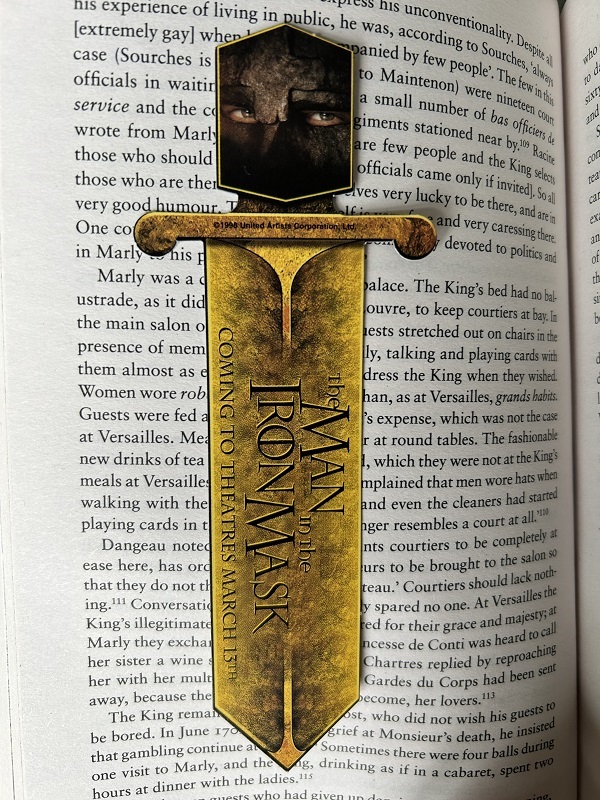
Who was the Man in the Iron Mask? Historians have suggested various candidates. According to the story by Alexandre Dumas he was Philippe Bourbon, the twin brother of Louis XIV. But most people today know he was really Leonardo DiCaprio, in this 1998 movie.
Thirty years ago there used to be a lot of bookmarks you could pick up for free that were promotional items for new books and movies. You rarely see them anymore. Which is one of the things that make them such great collectibles.
Book: King of the World: The Life of Louis XIV by Philip Mansel
First publication in The Strand Magazine June 1892. It was apparently around this time, which was still relatively early going, that Doyle wanted to abandon Holmes. But his (Doyle’s) mother came to him with the germ for this story so the great detective’s (false) demise was postponed. I mean, how can you turn down writing a story for your mom?
I don’t think it’s a great story, as it seems to borrow a number of basic elements from previous cases without adding much. And once again there is the business of removing obstacles blocking a pair of young lovers uniting. Solving a crime, or unwrapping a mystery, is of course fundamental to the way detective fiction works, but Doyle seems to have had an atavistic attachment to an even more basic plot. That the lovers in this case manage well enough on their own, leaving Holmes to clean things up with an explanation of what’s been going on, is only a slight wrinkle in the fabric.
If you’re a collector of Holmes’s words of wisdom though you get fair service. Beginning with the opening utterance:
“To the man who loves art for its own sake,” remarked Sherlock Holmes, tossing aside the advertisement sheet of the Daily Telegraph, “it is frequently in its least important and lowest manifestations that the keenest pleasure is to be derived.”
That’s an observation that I think can be extended far beyond where Holmes immediately takes it, which is to commend Watson for writing up his more “trivial” adventures rather than the “many causes célèbres and sensational trials” in which Holmes has taken part. By “low” Holmes means something intellectual, involving the processes (or art) of “logical synthesis.” I like the idea of the man who loves art for its own sake being a connoisseur of the “lowest manifestations” of entertainment the newspapers have to offer, but I realize that’s the opposite of what is meant. Unfortunately, Holmes’s lecture on high and low is mixed up quite a bit here, as he concludes that “Crime is common. Logic is rare. Therefore it is upon the logic rather than upon the crime that you should dwell. You have degraded what should have been a course of lectures into a series of tales.” The pleasure of the story is here lower than the operations of logic, which is more what you’d expect him to say.
Another interesting topic of discussion comes up on the train ride to Winchester. Watson admires the green and pleasant countryside they pass through but it fills Holmes with horror.
“It is my belief, Watson, founded upon my experience, that the lowest and vilest alleys in London do not present a more dreadful record of sin than does the smiling and beautiful countryside.”
“You horrify me!”
“But the reason is very obvious. The pressure of public opinion can do in the town what the law cannot accomplish. There is no lane so vile that the scream of a tortured child, or the thud of a drunkard’s blow, does not beget sympathy and indignation among the neighbours, and then the whole machinery of justice is ever so close that a word of complaint can set it going, and there is but a step between the crime and the dock. But look at these lonely houses, each in its own fields, filled for the most part with poor ignorant folk who know little of the law. Think of the deeds of hellish cruelty, the hidden wickedness which may go on, year in, year out, in such places, and none the wiser.”
I think in the 1890s this would have been seen as a perverse take, which is how Watson immediately responds to it. One can see Holmes’s reasoning, but even in Victorian England I’m not sure how persuasive it is. Rural isolation does leave people more vulnerable to crime. I’ve had experience of that myself. Call the cops and you may have someone come by later that afternoon. But urban living is in many ways more anonymous, which helps conceal a lot. As far as the psychological effects are concerned, again isolation may not be conducive to robust mental health, but then nothing degrades one’s love for humanity than being stuck in traffic or packed in a subway for hours every day, or living crammed into a tiny apartment alongside people who smell bad or make a lot of noise. I don’t think we can be as certain about these matters as Holmes is.
Things wrap up quickly. Holmes sees the solution as obvious, but it’s only obvious when seeing the events as a dramatic story, not as a logical system. Which sort of undercuts what he kicks things off by saying. Then Miss Violet Hunter is dismissed to head a private school, as Holmes “manifested no further interest in her when once she had ceased to be the center of one of his problems.” The young couple are hitched and sent to Mauritius. What I find most interesting is the fate of Mr. Rucastle, who survives “a broken man, kept alive through the care of his devoted wife.” And his “old servants.” And (though this isn’t mentioned) their demonic, cockroach-killing kid. I would have thought everyone would have abandoned the old miser after all he’d done. But I guess they had fewer options back in those days. People had to stick together.
Murderland: Crime and Bloodlust in the Time of Serial Killers
By Caroline Fraser
Page I bailed on: 28
Verdict: It might not be a bad book but it wasn’t what I was expecting or what I wanted. Given the title, which drops murder, crime, bloodlust, and serial killers, I was expecting something in the true crime vein. But it only comes at this indirectly.
More specifically, it’s a book that addresses the amount of serial killer activity in Washington State in the 1970s and ‘80s. Think names like Ted Bundy, Gary Ridgway (the Green River Killer), Randy Woodfield (the I-5 Killer), or any of the other bad people you’ll find in books by Ann Rule, who made a career out of covering this beat. Fraser gives these killers a context that is meant to give some explanation for their appearance at this time and in this place. It begins by talking about something called the Olympic-Wallow Lineament, but we’re immediately told that “Nobody knows what it is.” After reading Fraser I had to do an Internet search to find some better explanation. I came away just as confused. Then we get a chapter on the building of a couple of bridges: the famously doomed Tacoma Narrows Bridge and the Mercer Island floating bridge. Interesting if you’re into bridges, or engineering in general. I wasn’t sure what it had to do with serial killers. After this, skimming ahead, we turn to the smelting industry and the pollution it caused. I think this is where Fraser is hanging her hat, making a connection between lead poisoning and an increase in headline murders.
Maybe she’s onto something, but I’d lost interest and was just turning pages. Fraser’s prose is overgrown with literary flourishes, like the one that begins on page 28 (not coincidentally, the page I bailed on):
Let us linger for a moment in that frothy postwar fizz of euphoria, when people are eager to swallow the cost of progress. How bad can it be, after the world has gone to war? It is a time of celebration.
Just for a moment, if you will, let us float across the country in that effervescent bubble of champagne elation and planetary subjugation and heedless sexual entitlement to look down from our cloud somewhere above Philadelphia and witness the conception of a noteworthy child.
Wait, are we in a bubble or a cloud? Either way, no thanks.
Also, as a child of the region Fraser can’t resist introducing a memoir angle into the proceedings, which as you may know by now is something I despise in true crime writing. This needs to stop.
In any event, as far as explainers go, I think Rule addressed the same subject in her books and for a sharp analysis of why this period became a “golden age” of serial killers I’d recommend Peter Vronsky’s American Serial Killers: The Epidemic Years. Fraser’s speculations on pollution being partially at fault could have been the subject of a magazine article, but they feel lost in a grab-bag book of this size.
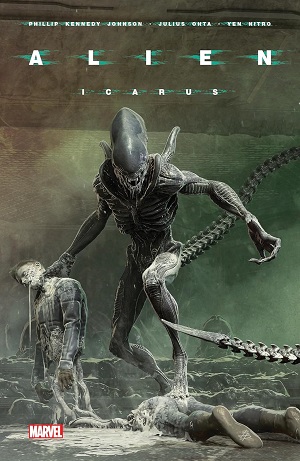 All of these Alien comics present self-contained storylines that ran for 5 or 6 issues. There’s a sort-of through line that’s covered in the opening to each, but it’s not necessary to read them in order. For what it’s worth, this volume is a sequel of sorts to Alien: Revival, as the events of that series are briefly mentioned here. But this is a wholly separate adventure. And like all of the Alien comics (at least all the ones I’ve read) it’s another interesting and original story that reimagines the familiar monsters in a new setting.
For reasons not worth getting into a team of super-synth soldiers are sent to a radiated planet overrun by Xenomorphs in order to retrieve a Xenomorph egg that contains an experimental genetic modification that the United Systems (that would be the U.S. government, rivals of the Weyland-Yutani Corp.) believes contains an antidote to radioactivity.
So it’s off to Tobler-9 and it looks like the Xenos actually have an opponent in their own weight class, since the synths are all trained mercenaries who use their plasma rifles, bows and arrows, and samurai swords to go toe-to-toe (or claw, or whatever) with the evil critters. One synth even tears a Xenomorph’s head off with his bare hands. And you don’t have to worry about the synths getting bred in the usual way since the Xenos can’t use them for that. Alas, there are only five synths in the team and as usual an unending supply of Xenomorphs to kill, including a giant Queen and then later an insect-human-Xenomorph hybrid thing.
So that’s something a bit new, though it had been foreshadowed in one of the stories in Aliens: The Original Years. And I thought there was a higher gross-out and gore level here than in previous comics. But like I say, I found the story compelling and original. Writer Phillip Kennedy Johnson also entertains a couple of ideas that I had to think about, even if I ended up rejecting both of them. First there’s the notion that the synths can be more human (meaning, they display more empathy and altruism) than the humans. Would that be the result of their programming? Something to make them a more effective team? Or are they evolving on their own? Then, speaking of evolution, there’s the way the Xenomorphs seem to take biological cues from their hosts, at least under lab circumstances. This is what leads to the insect-human-Xenomorph hybrid. I found myself wondering how much of this was Weyland-Yutani’s efforts to create a new bioweapon and how much was “natural.” Because why would the Xenomorphs evolve when they’re already perfect killing machines?
So great fun for fans, delivering on lots of brutal action and plenty more of what you came for. There’s a simple but effective story with all the usual elements worked in effectively alongside a couple of new wrinkles. There’s been no end of criticism of the Alien film franchise, and for good reason, but readers of the comics have had nothing to complain about.
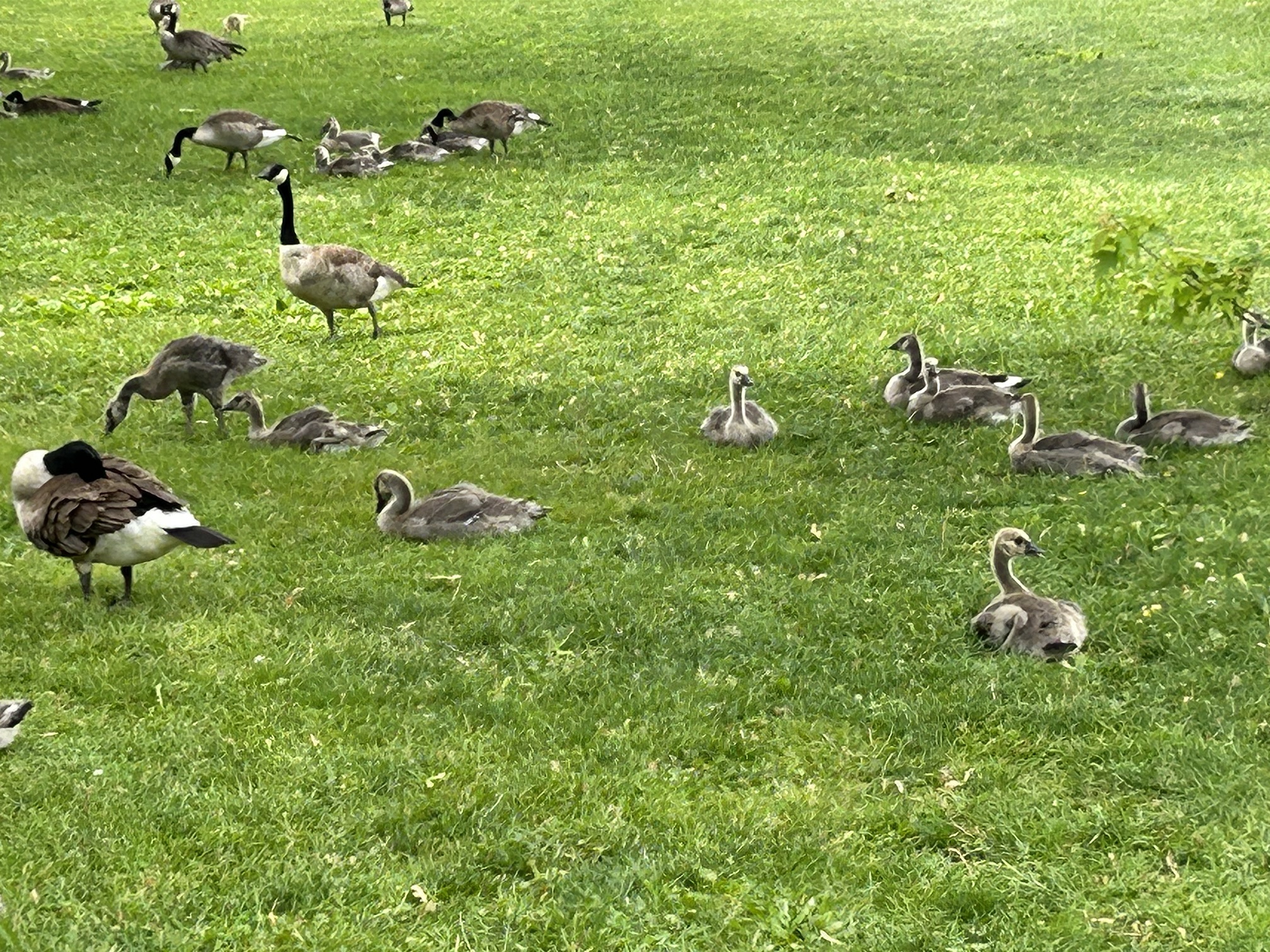
These young ‘uns grow up fast! (You can click on the pics to make them bigger. The pics I mean, not the goslings.)

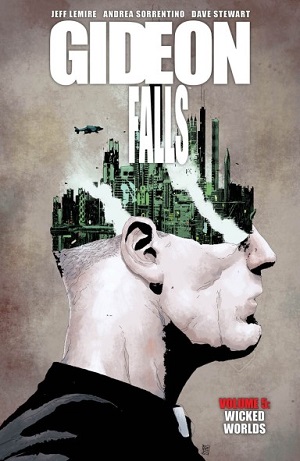 Sheer chaos. “Please . . . just slow down,” Dr. Xu begs of Danny when he tries to explain. “What does all of this mean? I am . . . I’m so confused.” Join the club, Doc.
Here it is in a nutshell. After the Black Barn got blown up at the end of the previous volume we’re told that it didn’t get destroyed but was instead “set free.” Whatever that means. What it seems to involve is the multiverse collapsing in on its center point, which is Gideon Falls. You see, “for some reason we can never know,” the “heart of it all” (that is, the heart of everything that ever has or ever will exist in space and time) is Gideon Falls. It was all that existed before the fragmentation into an infinite number of timelines, and now after that initial Big Bang reality is experiencing a Big Crunch back to its singular identity. Because of the darkness. Which is where the Laughing Man/Bug God comes in.
If it all sounds fuzzy that’s because it is. In this volume various characters in different parts of the multiverse (a Wild West environment, a dystopic police state) run away from zombie Laughing Men until they can regroup as the “New Ploughmen.” Which is an homage to the original bunch of Black Barn conspiracy nuts. There’s a lot of running around but it feels like running in place since you can’t even say they’re going in circles. We’re just left to understand that someone, somewhere understands what they’re doing and has arranged things to work out the way they’re meant to.
The plot itself doesn’t advance, but lots of things do happen. The main draw here though is again Andrea Sorrentino’s art. He was really off leash with this series and it’s a lot of fun seeing what he comes up with in terms of page design and layout. So enjoy that, because the story in this part is thin gruel and what there is will probably leave you scratching your head.
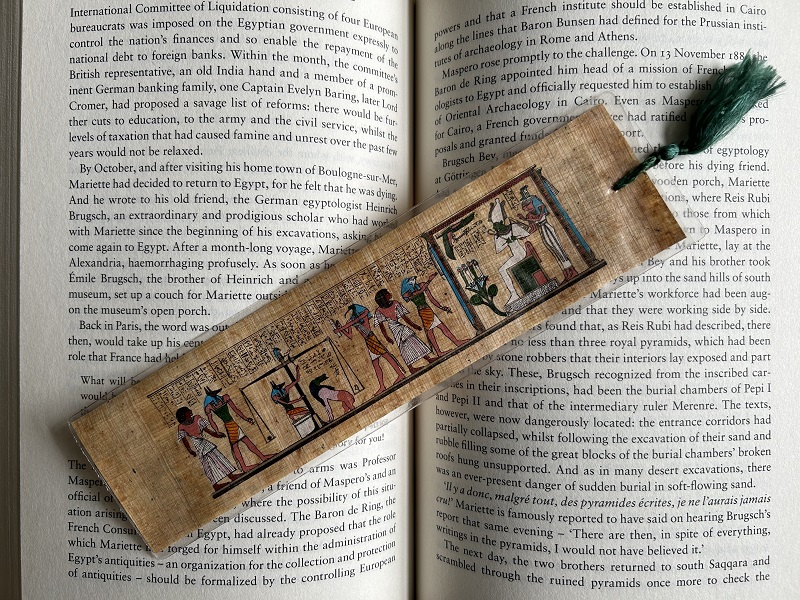
I must have got this papyrus bookmark from the same place as the one I had in an earlier post. I’m just not sure where that was, only I don’t think it was Egypt. Oh well.
Book: A History of Ancient Egypt: From the Great Pyramid to the Fall of the Middle Kingdom by John Romer
 Alex Good