Gideon Falls Volume 3: Stations of the Cross

Gideon Falls Volume 3:  Stations of the Cross

I really shouldn’t have liked this at all. We’re now deep into the free-fall of crazy and splintering of timelines into various universes that I usually can’t stand. All too often this strikes me as just being lazy storytelling, a way of giving up on creating a coherent plot and pulling the rug out from the reader whenever you want to introduce some new element.

But I thought this volume of Gideon Falls the best yet. Yes, our heroes are skipping around in time and space, but instead of everything breaking apart the sense that’s given is of things coming together, and doing so in interesting and visually striking ways. It seems Andrea Sorrentino was being given more freedom to open things up as things went along, and he’s using that freedom in a fiercely creative way.

The first few issues collected here introduce us to a slightly new character: Father, then Bishop, Burke. I say slightly new because he’d been previously glimpsed in the background. Here he gets a lot more development as he’s shown to be on the trail of Norton Sinclair, who is possessed or being controlled by the Laughing Man/Bug God. And it’s a trail that’s so crooked, branching through different dimensions and timelines, that Burke even has to grab a pen and paper at one point to draw a map. Though I had to wonder what use that might be.

As Bishop Burke he also has a team of priests to help him out. This was the only part of the story where I still felt out of the loop. If the Bug God is some alien force of evil, what is its hang-up with Christian symbolism? Why does he crucify people, and why are the people who are fighting him so fixated on having God on their side? Maybe this will all be explained, but for now it left me scratching my head.

What we do know, now, is that the Bug God needs a human body to function as a master key to unlock a gateway to other dimensions, including our own. He figured Danny would fill this role but as things leave off here he’s found a substitute in Danny’s dad. Creepy stuff! I’m enjoying this series quite a bit and looking forward to what’s next.

Graphicalex

The unparty

We live in political times, which is an observation that isn’t diminished by the fact that in many democracies a lot of people don’t care about politics at all. We know this because  of voter turnout numbers, a measure of what is the most minimal level of political involvement.

This is a point I first started thinking seriously about twenty years ago while reviewing the pollster Michael Adams’s book American Backlash. “Non-voters are the majority non-party in American politics,” I said in my review. At the time, the most recent presidential election had been in 2004, which felt like another very political time, what with George W. Bush running for a second term after the Iraq War. As a percentage of the voting-age population though the turnout was only 56.7%. In 2024 it was 59%, which was actually down 3.8% from the 2020 presidential election.

In the U.K. general elections in 2024 the voter turnout was nearly the same at 60%, which was the lowest turnout since 2001, when it was 59.4%.

Canada does a little better federally, averaging in the mid-60s in the last couple of decades. But again, these numbers are all national. At the state and provincial level the numbers drop considerably. In Ontario’s just finished provincial election the voter turnout was 45.4% of eligible voters. This was one percent higher than the last provincial election, which was the lowest voter turnout in the history of our provincial elections.

Drill down to the municipal level and the numbers drop even further. In my hometown’s last municipal election in 2022 only 28% of eligible voters voted. A number that was down 8% from 2018! The 2023 mayoral election in Toronto had a turnout of 38%. To take a random municipal election from the U.K., the turnout for the Sunderland City Council election in 2024 was 30.8%. The 2024 mayoral election for London hit 40.5%.

What this seems to underline is the fact that, to invert the famous adage often associated with the American politician Tip O’Neill that all politics is local, today all politics is national. Just as local news media have been dying, leaving no one covering city hall, the public’s attention has been focused more and more exclusively on politics at the national level. And with the importance of the Internet to fundraising this has only become more pronounced.

This is something I find very concerning, for reasons that I’ve talked about before. Chief among these is the fact that a lot of national political debate is of less direct consequence to citizens than what is going on at the local level, and that if no one is paying attention to what’s happening locally you’re opening the door to a level of corruption that (I think) would shock people if they were aware of it. I know I’ve been shocked by it when I’ve had dealings with local government in both rural and urban areas. You know things are bad when a single family has half-a-dozen members filling different jobs on council. But it’s rare to get reporting on this in places that have become “news deserts.”

But to go back to where I started, it’s been locked in for decades now that slightly more than a third of all eligible voters in Canada, the U.S. and the U.K. do not vote and will never vote. If non-voters were a party they would win every election. And that’s at the federal level. On the provincial or municipal level the non-voter party would win landslide majorities. Does this constitute a functional democracy?

If so, I think it’s one that could be improved. In the lead-up to Ontario’s recent provincial election. the Toronto.com website had a poll asking people who seldom or never vote why they don’t vote. 62.5% said their vote wouldn’t make any difference. They are right to be so disillusioned. The three English-speaking jurisdictions I’ve been talking about all use a first-past-the-post electoral system rather than one based on proportional representation. In Germany, which has a proportional representation system, the 2025 general election had a voter turnout of 82.5%, which is the highest since German reunification.

I think proportional representation is a better system, but there’s no chance the political parties will allow it to happen here, as public apathy to it as an issue means there’s no call for change. That non-voting party seems to want to keep their official status of invisibility.

Hailstone

Hailstone

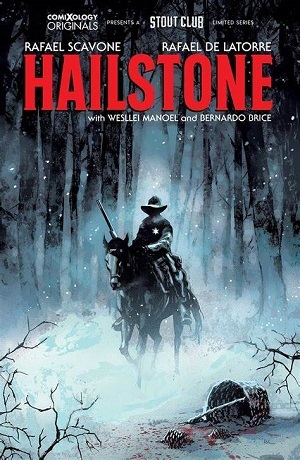
A neat little idea. We’re in the town of Hailstone, Montana sometime during the American Civil War. This was before there was a state of Montana, and possibly even before it was a territory, but we’ll let that slide. In any event, Hailstone is a company town, with the company in this case being the U.S. Army, which runs a giant munitions factory. Meanwhile, the good citizens of Hailstone are starving and living off of grudgingly bestowed government handouts.

Then people start disappearing from the woods around Hailstone, and there are sightings of a strange beast. Sheriff Denton Ross and his half-native deputy Tobias investigate and uncover a dastardly plot engineered by the commanding officer of the army factory, who turns out to be a mechanically-inclined Doctor Moreau. I won’t give too much more away, as they leave off revealing the monster until fairly late in the day and if I tried to explain it I’m afraid it wouldn’t make much sense anyway. It’s all steampunk science mixed with bits of fantasy, as steampunk often is.

It’s a pretty good comic though. It builds a bit slowly and I thought the native stuff was superfluous. But on the plus side there’s a stirring climax and the monster was quite an original invention. Also the twist at the end was unexpected, and not just for being so dark and downbeat. Like a lot of comics in this genre you can’t help thinking of the movie they could make out of it, but setting that aside I think it stands on its own as a thrilling read.

Graphicalex

Holmes: The Five Orange Pips

Does anyone use the word “pip” for “seed” anymore? Perhaps it’s still current in the UK, but I’ve never heard the seed of a fruit referred to as a pip in my life. Outside of this story, I don’t recall encountering it in a book either, though probably at some point I have.

Anyway, the five orange pips in question are death threats from the “KKK,” which Sherlock Holmes (having recourse to the American Encyclopedia) identifies as the Ku Klux Klan. I guess that wasn’t so obvious in 1890s London. Once again the plot revolves around a crime in a foreign country being avenged back in England, resulting in a series of murders. That was also what happened in both A Study in Scarlet and The Sign of the Four. The difference here, perhaps due to space constraints, is that it’s a mystery that’s not fully resolved, not to mention one that Holmes flubs.

The introduction tells us up front that Holmes did have cases that “baffled his analytical skill, and would be, as narratives, beginnings without an ending, while others have been but partially cleared up, and have their explanations founded rather upon conjecture and surmise than on that absolute logical proof which was so dear to him.” Watson puts “The Five Orange Pips” into the latter category, and Holmes admits at the end that that the murder of the young man who initially had sought his help offends his pride. But even during that initial intake interview he had cautioned that he had only ever been “generally successful” at solving crimes. Even a proud man can possess genuine humility.

Doyle considered this one of his favourite stories, and it has found a lot of popular favour, but to me it feels rushed. The deductions that lead to Holmes discovering the identity of the killer are pedestrian, and it may be that the reason it ends the way it does is because Doyle couldn’t think of any other way for justice to be done. What was sending five orange pips to Captain Calhoun supposed to do? Holmes says he’s cabled the police in Savannah, but what evidence does he have against the killers?

That said, I didn’t mind being left with no explanation for the killings. That goes with Holmes’s earlier musings about “the ideal reasoner”: someone possessed of perfect knowledge who would, “when he had once been shown a single fact in all its bearings, deduce from it not only all the chain of events which led up to it but also all the results which would follow from it.” This is a vision of a mechanical, deterministic universe, one where if one could but know all the forces at play one would be able to predict every outcome. I don’t know if Holmes (or Doyle) actually subscribed to this point of view, but it’s nicely undercut by the outcome here, which checks the hubris of such a philosophy. Today I think we’re even further from it, accepting that the best that even the most godlike knowledge can aspire to is a calculation of the probability of different results.

Holmes index

Wallpaper paste

A few weeks ago I found a post on another site where someone had asked an AI to write a film review. The results were what I think you might expect: a bland, clichéd summary of opinion such as you’d get from a review aggregator.

The reason this is what you’d expect is because the way these programs work (and I’m aware that people who understand this field better don’t even consider it to be AI) is to just take all the data there is on a subject and melt it down to something that sounds like a general consensus. So of course it’s going to be clichéd and derivative. Cliché is, by definition, the most common form of expression in the datasets from which it draws on.

What we’re left with is the hive mind, which is where we were heading anyway what with review aggregators and the like. The “wisdom of crowds” is a distillation not of the best that has been thought and said but of everything that’s been thought and said. And I think for a lot of people, and for different purposes, that may be good enough. For people who read genre fiction by the bale, those looking for executive summaries of generally held views, or students looking for a precis.

In the field of aesthetic response or opinion writing, however, is this the best we can expect? I started thinking about this because of an article I read online at the Yahoo! Sports page covering NFL football. I originally pulled a blank on the byline “Castmagic.” Was that a person? People have lots of strange names these days so I thought it possible. But when I clicked on the link to read it I found this:

(This article was written with the assistance of AI and reviewed by our editorial team to ensure accuracy. Please reach out to us if you notice any mistakes.)

I immediately had some questions. It was just a short opinion piece, so what did it mean that it was written “with the assistance of AI and reviewed by our editorial team”? My own sense was that it was written entirely by AI and just proofread and copyedited for factual errors or anything that might get Yahoo! in trouble. I also wondered if this was a direction more news organizations, and not just Internet ones, were going to be heading in.

The subject of the piece was the New York Giants football team. The Giants were a very bad team last year, resulting in their having a high pick in the upcoming draft. They don’t have a clear starting quarterback on their roster and it’s usually assumed that a team in such a situation will pick the best QB on their draft board as this is the most important position to have filled. So the question posed to “Castmagic” was “Is it time for the Giants to draft a quarterback?”

Things didn’t get off to a good start: “As the dust settles from the 2024 NFL season, it’s evident that some teams face more pivotal offseasons than others.”

Well, duh. We’re hit in the face with a cliché right off the bat, followed up by an obvious truism. I didn’t need an AI to tell me this.

As “Castmagic” went along it mostly borrowed from an earlier column on the same subject written by one of Yahoo!’s (human) sports writers. But if I’d been that particular writer I don’t think I’d look at this as being the sincerest form of flattery. I’d probably be worried for my job.

Did “Chatmagic” have any original insights to offer on the question of whether the Giants should draft a QB? No. Here’s the conclusion:

In the end, the Giants’ path forward hinges on navigating the delicate balance between short-term success and long-term strategic planning. Whether through drafting a quarterback or trading down to solidify the entire roster, the Giants face decisions that could define the franchise for years to come. Only time will reveal if they choose wisely.

Really? That’s the takeaway? The Giants have options and “only time will tell” if they make the right choice?

Will “Chatmagic” get better? I think it will, if only because I don’t see how it can get any worse. Or less useful. But I think these early, baby steps give some indication of the issues going forward, at least when it comes to this form of writing. How can an opinion of any value on any subject be fashioned out of a dataset that is just a collection of everybody else’s opinion? These programs aren’t interested in original insights or finding out the truth. Are they even capable of that? Only time will tell . In the meanwhile, what we have now reads like a page of Google search results, just the repackaging of random information, some of which is no doubt total garbage, into a paste of content that you can skim your eyes over before clicking onto what’s next.

There were some 50 comments on the article the last time I checked. Most of them piling on the “dummies” who write sports opinions for Yahoo! Only one of them registered that it had been written by an AI.

Batman: Justice Buster Vol. 3

Batman: Justice Buster Vol. 3

Since Volume 2 of this series ended with Batman facing off against his rogue AI-controlled battlesuit (named the Justice Buster) you’d be forgiven for thinking that we’d be kicking things off here with a no-holds-barred showdown.

Not so. Instead Batman just wakes up after being knocked out with some sleeping gas to find that the Justice Buster has disappeared (which is kind of remarkable, even the police admit, given how large a unit it is). And that’s it for the Justice Buster in this volume! It isn’t mentioned again in the rest of the book, and indeed I think it’s only seen later brooding over the city on a couple of pages that are just filler.

So instead of that, what do we get? More on the unlikely partnership between Batman and Joker (who is Jason Todd, and a good guy, in this Batman universe). More on Dick Grayson and his relationship with Joe Chill, or Uncle Sam, or whoever this guy is. It seems he’s been hypnotizing young Dick and been orchestrating scenes of violence around Gotham while wearing a bucket on his head.

Interesting stuff, with a dark “death in the family” ending that still leaves a lot of loose ends. I’m still impressed with this series as it goes places I haven’t been expecting and these swerves are usually pretty interesting. So on we go!

Graphicalex

TCF: Guilty Creatures

Guilty Creatures: Sex, God, and Murder in Tallahassee, Florida
By Mikita Brottman

The crime:

Mike and Denise Williams were a Florida couple who were good friends with Brian and Kathy Winchester. Mike went missing while duck hunting one day in December 2000 and was thought to have fallen out of his boat and been eaten by alligators. It later turned out that Brian Winchester had been carrying on an affair with Denise. He had killed Mike and, five years later, after divorcing Kathy, married her. He and Denise had a messy falling out, leading to their divorce and Brian being charged with kidnapping her. Brian then confessed to the murder of Mike Williams in a plea deal that gave him immunity. In 2018 Denise was tried, convicted of first degree murder and sentenced to life for killing Mike, but a later appeal overturned this because there was no evidence she’d actually been involved in the murder. Her conviction for accessory to murder remained, however, for which she was given a 30-year sentence.

The book:

It’s interesting how the title emphasizes guilt. That’s not something you hear a lot about in true crime stories. We’ve become so used to the psychopath: someone unable to feel empathy who just kills and goes on with his or her life without feeling any pangs of conscience. Conscience is more of a literary trope, belonging in classic works like Crime and Punishment. It’s not something you encounter as much in real life. At least I don’t see much of it. People don’t even say they’re sorry anymore. An apology means taking responsibility, which might lead to being sued.

Introducing the notion of guilt – not guilt in a legal sense but as a moral reckoning – helps foreground the question that lies at the heart of Mikita Brottman’s telling of this tawdry tale. Were Brian and Denise tortured souls, either before or after the murder, or were they just thoughtless, sleazy people? Was Brian’s confession a genuine come-to-Jesus moment, a way of expiating a sense of guilt that had weighed on him for years? Or was it just a way of getting back at Denise? Did Denise not want to divorce Mike because it went against the Bible’s teachings? Or because she didn’t want to take the financial hit? (“Better to be a rich widow than a poor divorcée,” as Brian put it.) And how did Denise feel about marrying the man who killed her husband? Guilty? Complicit? Or did she think about it at all?

These are the questions that Brottman worries away at, and in doing so I think she takes the more literary route I mentioned, giving the protagonists a moral or spiritual depth relating to their faith that I thought they didn’t fully deserve. But I’ll admit to not being sure about that, as I never want to judge people, even murderers, so harshly that I don’t give them the benefit of a doubt.

In order to explore this question of guilt Brottman has to imagine what might have been going on in their heads. Here’s how that goes. First, Denise’s adultery:

They’d both been taught that abstaining from sex before marriage would lead to spiritual, physical, and emotional satisfaction. All their lives, they’d struggled to follow the Bible, and when the time came for them to reap their reward, it wasn’t there. They felt cheated.

Now a door had opened. Forbidden sex, it turned out, was a lot more exciting than anything that happened at home. At the same time, they couldn’t set aside what they’d learned in church – that adultery was a terrible sin. They could go to hell for what they were doing – which made it even hotter.

On the one hand, this is plausible. Forbidden fruit and all that. And a lot of people who go down this road don’t know in advance that they’re going to end up feeling cheated either way: following the rules or breaking them. We’re talking about sex here, and that’s all just hormones. I don’t think we need to invoke “the complications and paradoxes of desire.”

Then, after Brian kills Mike, he achieves a kind of post-coital clarity:

There was no feeling of exhilaration, no relief, no sense of achievement in pulling off the plan, no excitement about the prospect of finally having Denise all to himself. None of it was how he’d imagined it would be. All he could think about was the shock and horror of what he’d done. He regretted the murder right away. It weighed on him every day of his life.

Did it? And how much?

Their own way of making sense of or even justifying what they were up to led, of course, to rationalizations. Only here those rationalizations were tinged, I think in a way many would consider heretical, with faith: that God wanted them to be led astray as part of some mysterious plan he had for their salvation. That if the murder was arranged as an accident it would be a kind of “test” that God had prepared, both for Mike and for the two of them. Then, after the murder, they recommitted to doing more church work:

In terms of profit and loss, their biblical credit balance was in negative figures; they had to build it back up through religious devotion, as well as monetary tithes. Their recommitment to the church was also a symbolic attempt at moral cleanliness, a desire to sanitize themselves, to rewrite their story. It was a kind of hand washing or exorcism, a cleaning of the self after encountering a contagious force of evil. Never mind that the force was their own.

How much of this should we credit? “To the faithful, transgression has a special force and valency that’s absent from secular life.” Does it? I don’t think so. I don’t think you need to have any kind of faith to have a moral compass. And this leaves aside the question of how faithful Brian and Denise ever were.

I just don’t like this kind of thinking, where being a person of faith somehow puts you above the common run of sinners, the people who don’t even know that they’re sinning. You find this in writers like T. S. Eliot and Graham Greene and it puts my back up. Perhaps it isn’t always humbug, but in this case it sure feels like it. For Brian, Brottman tells us, “Guilt, the invader, pushed apart the cracked barriers of his conscience.” He was “not as well defended as his wife [Denise]. His armor was thinner, his capacity for repression less profound.” Really? Or was he just practicing a sort of strategic blame-shifting after it was clear that the “mutually assured destruction” of the guilty secret he shared with Denise was a token in play after their divorce? “Their pledge [to each other] was unbreakable because there was no way out. Their prenup was a murder.” But unbreakable pledges can be broken, and you can always argue over a prenup in court.

I think Brottman pitches the spiritual drama too high. She often has chapter epigraphs drawn from the Bible or Shakespeare, and even at one point describes Mike’s mother entering the courtroom at Denise’s trial “like Cleopatra sailing by on her barge,” an allusion to Anthony and Cleopatra which I thought ridiculous in context. What the story more closely resembled, and it’s a connection Brottman also makes, is the world of film noir and movies like Double Indemnity (yes, there was a big life insurance policy involved here too). In this view Denise became the femme fatale or Black Widow, which is the lens the media took to seeing her through. I found this perspective on the story reminiscent of American Fire, another tale of a criminal couple who shared a “kind of love that is vaguely crazy and then completely crazy and then collapses in on itself.” The only “essential truth” being that when they (Charlie and Tonya, Brian and Denise) started off they were in love and “by the time they finished, they weren’t.”

Sticking with American Fire, we might also note how in both cases it was the man who pled guilty and his partner (both in life and in crime) who maintained her innocence and subsequently attracted the lion’s share of media opprobrium. Denise’s attorney describes this as the “Eve Factor”: the way that when a man and a woman are part of a crime together it is generally the woman who is thought to be the mastermind, the Eve who tempts Adam. There’s the Bible again, but it’s also the standard noir plot:

When lovers plot to kill the wife’s husband, or the husband’s wife, although the woman might help plan the murder, it’s almost always the man who carries it out. But the woman is punished equally, if not more so, and unlike her co-conspirator, she’s publicly sex shamed. She’s scorned, ridiculed, and condemned, described as a Black Widow, a Jezebel, or a Delilah. Examples are easy to find.

Then, dialing things down even lower, we get to a final layer: the public (now mostly online) finding Brian and Denise to be “trashy and ugly; their story . . . lurid and tawdry, a cheap tabloid scandal.” But, naturally, a “guilty pleasure.”

Noted in passing:

I mentioned how police originally suspected that they couldn’t find Mike Williams’s body because it had been eaten by alligators. But he had disappeared on a particularly chilly day in December and it turns out that alligators do not generally feed during the winter months due to the colder temperatures. Specifically:

Most herpetologists agree that between November and late February, alligators, even in Florida, go into a state called brumation – a kind of semi-hibernation in which their metabolism slows down to conserve body temperature, and they no longer need to eat.

Search parties did encounter active alligators at the time in question so the police felt this was still at least a possible explanation for not being able to find a body, but apparently it is very unlikely alligators would be active at all in the existing conditions. They only look to maintain their body temperature and aren’t interested in food.

In 2008, with the investigation into Mike’s disappearance ongoing, authorities contacted a forensic psychologist with a Ph.D. “who used her intuitive powers to envisage what might have happened to Mike.” She said he had been shot in a bedroom by a woman with a revolver. In fact he was shot out on a lake by a man with a shotgun.

If you read enough true crime you’ll find this happens a lot. When the police are at a dead end they’ll talk to psychics. But it always surprises me. This is the twenty-first century. Why do this?

Takeaways:

I’ll throw out a couple of quotes here, both relating to the theme of “us and them” we experience when reading true crime:

It’s easy to assume that familiarity robs a story of its intrinsic interest, but the contrary is true – events are uniquely engrossing when they’re closer to home. The more alike we are, the more hypersensitive we become to tiny differences. . . . We don’t want to accept how similar we are to someone who’s done something reprehensible, so we exaggerate minor distinctions to separate ourselves from them. We try to find an otherness to disguise our sameness.

And:

People are murdered because they are loved, because they were once loved, or because they stand in the way of love. When a person kills another out of the blue, if they’re not mentally ill, we assume they must be in the grip of some great passion: rage, desire, jealousy, greed, or lust for revenge.

Most of us don’t commit murder, even though we might sometimes want to, because our fear of the consequences outweighs the impulse or the desire of the moment. It seems impossible to believe that two otherwise rational, God-fearing people would decide to kill someone rather than contemplate divorce. But it happens all the time. People aren’t reasonable. God-fearing people sometimes least of all.

True Crime Files

Old Man Logan

Old Man Logan

I’ve dumped on the Marvel multiverse concept quite a lot over the years, so I think it’s only right to give them credit when it works. And if you wanted perhaps the best example of that you need look no further than this storyline by writer Mark Millar and artist Steve McNiven.

The world-building here is exceptional. The world in question is (checks notes) Earth-807128, which is about as rotten a hellscape as you could imagine. There’s been a battle between superheroes and villains and the bad guys won. America has been divided up among various boss-level villains and Old Man Logan, no longer Wolverine because of a tragic incident in his past that we only find out about later, is living as a rancher with his wife and kids in a burnt-out version of Sacramento. It looks like the Wild West.

This part of the U.S. is run by the Hulk Gang: the original Hulk/Bruce Banner, who has gone insane, and his degenerate and bullying green descendants. They even beat Logan up. Anyway, in need of money, Logan agrees to accompany a blinded Clint Barton/Hawkeye on a cross-country trip to deliver some secret contraband to D.C.

This is where the hellscape and world-building I mentioned really kicks in. As the two former superheroes pass through parts of the U.S. run by Kingpin, Doctor Doom, and finally the Red Skull (now the president of the United States) they are witness to scenes of incredible violence and desolation. They see the Punisher and Daredevil fed to a pair of dinosaurs in an arena. They meet up with Barton’s daughter, but she’s gone full Spider-Bitch and tries to kill him after overthrowing Kingpin. They’re chased by a T-Rex that has bonded with the Venom symbiote. They meet up with a sort-of resistance underground headed by the White Queen. And finally they get to D.C. where Barton gets killed and Logan is captured by the Red Skull. He escapes after decapitating the Skull with Captain America’s shield and returns to Hulkland only to find that the Hulk Gang has killed his family. He takes a spectacularly bloody revenge before riding off into the sunset with Baby Hulk, on their way to more adventures.

This is all hard, hard, hardcore stuff, especially with all the heroes and villains being cruelly tortured and destroyed. Logan himself takes several severe beatings, but of course he’s immortal so no matter how badly he gets disassembled or destroyed he’s always going to come back. But with that warning for the faint of heart, I came away impressed with what Millar and McNiven managed to accomplish. This is a fast-paced, wild ride that keeps upping the ante with every turn in the road (a road that I was grateful to follow with the map provided of Logan’s and Barton’s route across the no longer United States).

The road trip framework isn’t open-ended but makes this a self-contained story, with a beginning, middle and end, or departure, journey, and return. I’ve read few series with such a satisfying sense of completion, even if Marvel (as always) decided to keep the Old Man Logan storyline going. The way it all works is mainly through a kind of narrative edging: we keep waiting for Logan to snap and “pop his claws,” and Millar keeps denying us, even finding ingenious workarounds for Logan’s fight with the Red Skull. But when he gets back to Sacramento and finds what’s happened we finally get it, an orgasmic double-page spread of SNIKT! and then, claws finally extended “The name isn’t Logan, Bub . . . It’s Wolverine.”

Old Man Logan isn’t a deconstruction of the superhero mythos any more than the spaghetti western blew up the traditional Hollywood oater (and that’s a connection that’s very much in play here). But, like the spaghetti western, it’s a more violent and dirtier rendering of that mythology. So not for everyone, but in its own way a contemporary classic.

Graphicalex