Bookmarked! #118: Panda Poo!

I’ve posted panda bookmarks before (see here and here), but this is a special one. Not because it comes from the Toronto Zoo but because it’s made, as the back of it proudly proclaims, “with real poo!” Or, at more length, it’s a “recycled and odorless paper product made from panda poo!” The company that does this says “We take the ‘oo” out of ‘poo’!”

Book: Crossroads by Jonathan Franzen

Bookmarked Bookmarks

Archer: Find the Woman

Not cherchez la femme, because that means something different: find the mysterious woman who is the complicating factor at the root of a crime. Private detective Lew Archer would drop this tag in a later novel, The Chill, so he was well aware of it. No, finding the woman here just refers to Archer being hired to locate a missing person.

Specifically, he’s hired by a damsel in distress, a woman of a certain age who shows up at his “brand-new office” (this was the first Archer story) wanting him to find her daughter. He heads out to the woman’s big house (“huge and fashionably grotesque”) and then drives around L.A. asking questions. Some of the people he meets don’t like being asked questions, and at one point he gets knocked out. This comes with the territory in hard-boiled detective fiction; you have to be able to take your lumps. But ut all turns out to be a red herring because, as will so often be the case in Ross Macdonald’s fiction, the real rot turns out to be closer to home.

There’s a lot here that Macdonald would return to, again and again. “Find the Woman” feels a bit like a trial run, at speed. Archer jumps from place to place so quickly there’s almost no connecting tissue between the different scenes, as though he’s using a transporter to get around. And what actually happened to the woman is a bit far-fetched. But the family nastiness, also a Macdonald trademark, is on point and gives an indication of where he wasn’t going to be afraid to go as he settled in with Archer for the long haul.

Archer index

DNF files: Manhunters

Manhunters: How We Took Down Pablo Escobar

By Steven Murphy and Javier F. Peña

Page I bailed on: 104

Verdict: The title was a bad sign. This is a book about a couple of Drug Enforcement Administration agents who were part of the international effort to “take down” the Colombian cocaine kingpin Pablo Escobar in the early 1990s. By the time I quit, a hundred pages in, I don’t think they’d even mentioned Escobar yet. It was all about the two agents telling their life stories and how they got into law enforcement.

I’m not a fan, to put it mildly, of the true-crime/memoir hybrid so this really wasn’t my sort of book. I didn’t care for El Jefe: The Stalking of Chapo Guzmán by Alan Feuerbook for much the same reason: the focus on the work of the agents rather than their target. Now for some readers that’s what they want, and to be fair neither book advertises itself as being anything else. But it wasn’t for me.

The DNF files

Bookmarked! #117: Remembrance Day

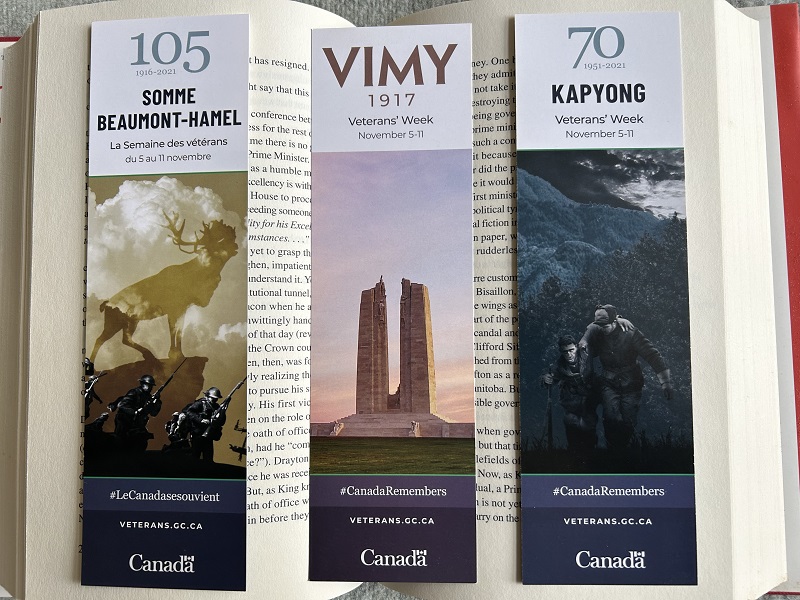
I have a lot of Remembrance Day bookmarks but couldn’t get them all in one picture. So here are a few from 2021, put out by Veterans Affairs Canada, marking the anniversaries of battles that Canadians played a major role in: Beaumont-Hamel (on the opening day of the Somme offensive), Vimy, and Kapyong in Korea.

I’ve looked in bookstores this past couple of weeks and haven’t seen any new ones. I don’t think anyone does bookmarks anymore.

Book: Marching As to War: Canada’s Turbulent Years 1899-1953 by Pierre Berton

Bookmarked Bookmarks

DCeased

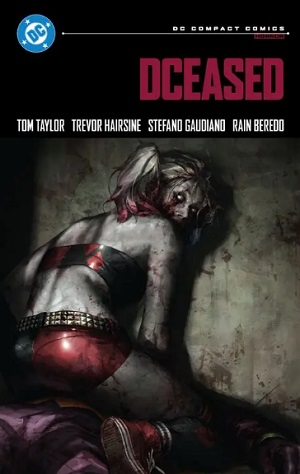
Dceased

The first thing to note about this series is that it was late to the party. When Marvel Zombies started in 2005-2006 they were hitting the market at what I’ve called the moment of peak zombie. I was actually a bit surprised to see that DCeased (or DC Zombies) didn’t come out until 2019, long after the point when zombies had gone out of fashion. Though that didn’t stop the series from becoming a huge bestseller and spawning several sequels.

OK, technically these aren’t zombies. They’ve been infected with the Anti-Life Equation, which arrives on Earth as a sort of computer virus and starts turning people into undead creatures who go around biting chunks out of the living and so infecting them and turning them into . . . zombies. Apparently the equation spreads just as well by digital imagery as it does by infected blood. “I always suspected we’d have to destroy the Internet to save the world,” Green Arrow says. “I just didn’t know it would be like this.”

Batman figures all this out, and just to clear up any confusion gives us this quick fact check: “They’re not zombies. They’re not consumed by hunger. They’re not feeding. They’re spreading death. They’re stealing life. These are the anti-living.”

Oh, just stop already. This is DC Zombies. The zombie pathogen is a hybrid, both being a blood infection and spread through our phones like in the Pulse films or Stephen King’s Cell. We might almost say the virus is undergoing a cultural mutation, evolving from gene to meme.

Batman himself only figures all this out after he’s been infected, and later he’ll turn into one of the (ahem) “anti-living.” As will most of the rest of the DC pantheon. Yep, Batman, Green Lantern, Superman, the Flash, Wonder Woman. It’s up to the B-listers and a bunch of successors and superkids to save the day, which they do by loading the Earth’s uninfected onto space arks and heading out to Earth 2. Where the adventure will continue . . .

While I’ve called this DC Zombies, it’s actually hard to compare to Marvel Zombies. They’re both quite dark, obviously, but they feel different. Tom Taylor’s writing has less of Kirkman’s black humour, but I thought the storyline was more coherent. Which means that taken as whole I enjoyed the series a bit more. Though that isn’t a full endorsement, as I thought Marvel Zombies disappointing. I should also say that I read this in a “compact comic” edition. These are smaller format reprints (like the Marvel Masterworks volumes) so the art doesn’t have the same pop or impact and I sometimes had to strain to read the text. Even so, I liked the dark palette and Trevor Hairsine’s penciling.

Graphicalex

Holmes: The Army of Dr. Moreau

This is a follow-up to Guy Adams’s first Holmes pastiche The Breath of God. It takes a very similar approach, drawing in a grab-bag of fictional characters from the pulp fiction of the time while telling a slam-bang, highly cinematic (sometimes even cartoonish) action story that climaxes in subterranean London (in The Breath of God the subway system, here the sewers).

As the title indicates, the jumping-off point is H. G. Wells’s The Island of Doctor Moreau. It seems the not-so-good doctor might still be alive and practicing his dark arts somewhere in London, as a string of grisly deaths have been occurring, with the victims appearing to have been mauled by animals. Things are complicated somewhat because it turns out that the British government had been funding Moreau, and his experiments had progressed to the point where he was no longer just putting together his creatures through vivisection but had invented a serum that triggered rapid evolution from the human form to various other species. “Darwinism haunts our steps in these matters,” Holmes opines.

One can’t call this new process much of an improvement, or less cruel, or even more plausible, but it is something different anyway. It also leads Watson to a humorous reflection: “What manner of creature would Holmes become if exposed to such a concoction – a swollen brain hovering over a pair of massive, tobacco-hardened lungs? The thought of such a beast, despite the serious context, could not help but make me smile.” I got a chuckle out of it too.

Among the team assembled to fight the new Moreau and his mongrel army are Professor Challenger from Conan Doyle’s The Lost World, Professor Lindenbrook from Jules Verne’s A Journey to the Centre of the Earth, Abner Perry from Edgar Rice Burroughs’s At the Earth’s Core, and Professor Cavor from Wells’s The First Men in the Moon. When you throw in all the nods to the plot of The Island of Doctor Moreau and a lot of fan service commentary on the Holmes canon (Watson even kicks things off by answering some readers’ FAQs), you have a book that should feel a lot more meta. That it plays so well as what Adams describes as “a bit of pulp fun” is testament to his sure hand with the material. It’s thrilling and comical by turns, and while never taking itself too seriously also never makes fun of our heroes. For a while Holmes takes over narrative duties and he speaks with just the sort of arrogant, superior voice you’d expect, though without slipping into parody.

So it’s wilder and woollier than anything in the canon, but I thought it a successful blend of a contemporary storytelling style with an affection for the nineteenth-century sources. Adams likes to do his own thing with these characters and I’m happy to let him.

Holmes index

Indestructible Hulk: Agent of S.H.I.E.L.D.

Indestructible Hulk: Agent of S.H.I.E.L.D.

The Hulk is perhaps the most basic, meat-and-potatoes superhero you can imagine, and the Indestructible Hulk series is, in terms of its narrative structure, as basic and meat-and-potatoes a contemporary comic as you’re likely to see.

The frame story has it that Bruce Banner is tired of working in the shadow of such genius benefactors of humanity as Reed Richards and Tony Stark. As he complains to Maria Hill, Director of S.H.I.E.L.D.:

Tony Stark and Reed Richards use their genius to save the world every other week. That’s how they’ll be remembered in history. Meanwhile, I . . . I who, forgive me, have just as much to contribute – will be lucky if my tombstone doesn’t simply say “Hulk smash!”

So here’s his pitch to Hill: if S.H.I.E.L.D. will fund him and set him up in a lab with a team of scientists to work under Bruce Banner, then they can have the use of the Hulk whenever they need him. And it’s a deal.

What follows is a series of comics where Hulk is let loose on baddies like the Mad Thinker, the Quintronic Man (both of these guys are basically evil geniuses operating battlebot suits), and Attuma the Lemurian. There’s nothing subtle about how the Hulk goes about these missions. The bad guys just blast him with everything they’ve got, which they reckon should be more than enough to destroy him, but guess what? He’s the Indestructible Hulk. So he ends up smashing them.

Like I say, meat and potatoes. But what made this a winner for me was the art by Leinil Francis Yu. This guy can really draw, delivering the goods whether it’s two people talking in a diner or a bunch of sea monsters taking out a fleet. And with great art you can never go wrong.

Graphicalex