There are some subjects that I always click on a news story about. Like anything to do with the decline of reading. A couple of years ago I posted on some of the findings at the time, including the fact that the number of young American teens who read for fun daily had, in 2024, been cut in half in only a decade. That’s not so much a historical trend line as it is a total collapse. Then, just last year, there was a story out of the UK about how over a quarter of 4-5-year-old kids didn’t even know what a book was or how to properly “use” it. That’s bad.
Well, last week another story dropped with still more concerning findings. The Organization for Economic Cooperation and Development dropped its Program for International Student Assessment, or PISA, report, assessing reading, math, and science skills. This study measures logic and reasoning skills and it is huge, testing more than 760,000 students across 91 countries.
You can probably guess the results.
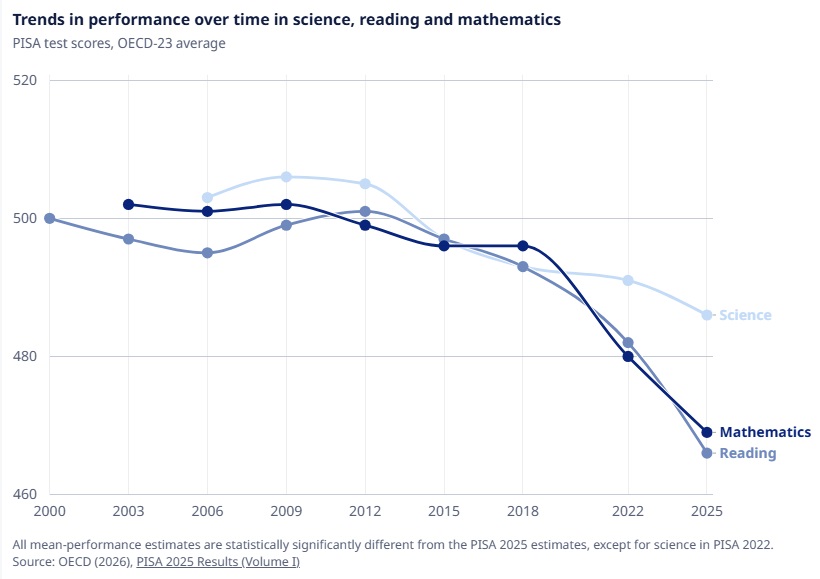
Now apparently Canada still rate above the OECD average, but the rate of decline (at least as I’ve read the report) has been steeper. Apparently students are on average two years behind where they were a decade ago.
Are we even surprised at results like this anymore? Or the fact that China and Singapore were the highest performers? Should we be learning something from them?
Most of the blame for what’s happening is directed at phone usage among young people and the pernicious effects of social media. But it made me think of a post I did of my “final thoughts” on the pandemic and its aftereffects. One of the groups I thought would be most affected by the lockdown was going to be kids. Here’s what I said five years ago:
The second affected group [by the COVID shutdown, after people with medical conditions whose treatment had been delayed] are schoolkids and what UNESCO has dubbed the “shadow pandemic” of “education disruption” (you can read more about this in an excellent article in the July 2021 issue of Maclean’s by Sarmishta Subramanian). I didn’t think the educational system was ready to switch to online learning, and it wasn’t. From what I’ve seen just over the course of the last couple of months, it never really got up to speed. Top students, those most, privileged, disciplined and motivated, have managed. They usually do, and there’s no need to worry about them. But for everyone else (which is to say, the overwhelming majority of students) it’s been nearly two years down the drain. I don’t blame the teachers. I met some new teachers who had just graduated before COVID struck and I can’t imagine how at sea they felt being thrust into such a situation. But based on the online classes I saw, and the students I spoke to, “school” this past year was a total waste.
That these kids lost a couple of years out of their education would go some way to explaining why they are two years behind today.
You do have to look at the charts and wonder where the bottom is in all this. And if we’re looking at assigning blame we have to be clear about one thing: the “kids these days” didn’t do this to themselves. It’s the adults in the room that let them down.


Yep, the whole point is that teachers are “teaching” the children. The kids aren’t teaching themselves, otherwise they’d not need school.
But parents allow behavior that feeds into that downward spiral and I blame them. I mean, parents are responsible for their kids, period. So if something is going wrong with the kids, the parents are the first place to see why.
LikeLike
Yeah, if you don’t like kids today I really don’t blame them. They were raised, educated, shaped by people who didn’t do their job.
That said, the kids today really are in rough shape.
LikeLiked by 1 person
Well, of course, I saw it up close and personal 20-25 years ago and I can tell you blaming parents is much too simplistic. I had to deal with schools that decided to teach subjects in ways that made no sense to people like me from an earlier generation, then decided books weren’t necessary, then decided homework wasn’t either, leaving us effectively out of the loop. It’s one thing to tell parents to teach their kids in a rational, consistent way at home, but quite another to tell them to do that *in competition with* a school system that has its own ideas entirely. When people say parents are to blame, they’re projecting their own school experience on today’s situation and that simply is not the way it works. And of course all that is to say nothing of changes in society itself. So, yeah, “adults” is correct. And I agree with that 100%.
LikeLike
Yep, that’s what I meant by saying the adults in the room. The kids didn’t create smartphones or social media platforms. They didn’t oversee problems with their schools. They didn’t cause a pandemic. And, while not all parents are to blame, kids didn’t choose their parents or create the domestic situations that may have set them back. If kids are falling behind it’s not because of things they did wrong but the result of things that happened to them.
LikeLike
I am not surprised considering the massive “hiccup” the education system experienced during Covid. It really created a reset of sorts for students and teachers and parents alike, and I don’t know if any of those parties looks at education the same way after all of that at-home schooling. I think one thing is for sure. If parents don’t emphasize the importance of getting an education, kids won’t excel.
LikeLike
Yes, kids take their cues from adults. They don’t see adults reading, for example, so they don’t see why it’s important for them.
LikeLiked by 1 person