
Empire of Orgasm: Sex, Power, and the Downfall of a Wellness Cult
By Ellen Huet
The crime:
Nicole Daedone, a Californian entrepreneur, began a movement in the early 2000s that centered on a practice she called Orgasmic Meditation (OM) and that eventually became a business known as OneTaste. Members of OneTaste took courses and workshops on OM and often lived communally in a manner that observers likened to a sex cult. What OM mainly consisted of was women having their genitals “stroked” to orgasm, most often by a man. In 2023 Daedone and OneTaste head of sales Rachel Cherwitz were indicted and after a lengthy trial both women were found guilty of federal forced labour charges, with Daedone being sentenced to nine years in prison.
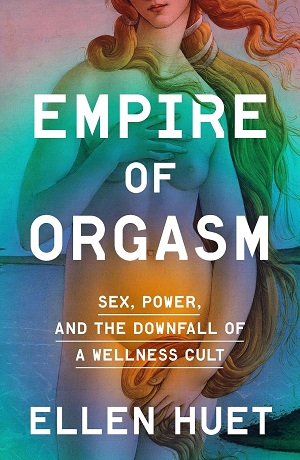 The book:
At first this book seemed like it might be a near clone of Blazing Eye Sees All, as both were stories of female-led cults based out of northern California that emphasized lifestyle makeovers, with Love Has Won being more New Age while OneTaste tapped into the wellness market. And, needless to say given that I’m talking about them in the True Crime Files, they both ended badly. They even came with similar political footnotes, with a shift to the right and the convicted women here complaining to “right-wing media outlets” about “prosecutorial overreach” (the “witch hunt” defence) and courting individuals with access to Donald Trump to see if they could swing a pardon.
The differences, however, are instructive. As the famous line from Eric Hoffer put it, “Every great cause begins as a movement, becomes a business, and eventually degenerates into a racket.” We may well ask though if OM and OneTaste didn’t begin as a racket. This isn’t to say that Daedone was wholly cynical, just that she went into it with a business plan. Her earliest discussions with an older fellow sex communard and mentor took the form of “long, meandering conversations about advanced clitoral stroking and how to build a commercially viable following around it.” The sales pitch would have to get with the times: “Since we are not selling the god hustle,” she was told, “what do we do? What we have to sell is an organically healthy lifestyle with sensuality and intimacy. . . . Sell sensuality, sex, good communication, hot ass, any ass, etc.” Since Daedone had a background in the sex industry she had an edge. She’d also had previous experience in similar sex movements whose followers were frankly described as “marks.” I don’t think she was ever under any illusions about what the point of all this was.
But the wellness angle wasn’t the only thing that made OM a timely project. This was San Francisco and Silicon Valley at the dawn of the tech boom, and Daedone
was surrounded by bright-eyed tech founders who believed that the most effective way to change the world and to improve people’s lives was to build a company. By the mid-2000s, even being a guru was a professional pursuit, something that required branding and business savvy.
Now as those bright-eyed tech founders turned into the current oligarchy of tech bros we have all begun to wonder just how idealistic they were about creating a better world, and the point I want to make is that Daedone should be judged by the same standard. In the environment of the time, faith and gold weren’t just hard to tease apart, they were seen as being the same thing. There was a new law of physics contained in Daedone’s philosophy that “money is just energy.” “The universe is made of love,” Deadone would tell her sales staff. “Sales is love. Therefore the universe is made of sales.”
“One look at her face,” Huet adds, “told you she really believed it.”
Was this attitude “uniquely Silicon Valley,” as one reporter covering the OM movement averred? I wouldn’t go quite that far, but OneTaste really was of its time.
A key quality of a cult is its ability to adapt with the times. Just as cults in the 1960s reflected the era’s countercultural movement, today’s cults don’t look like they did in the past. Now, they look like mission-driven startups and Fortune 500 companies with demanding schedules and rigid corporate practices. They look like fitness fads, YouTube celebrities, altruistic nonprofits, therapeutic psychedelic guides, and executive leadership training seminars.
Wellness is an industry; spirituality is a commercial product. There will always be people with a hole in their heart – and someone willing to sell them a cure. Those cures will be constantly evolving, and the characteristics of cult leaders will modernize as well.
This leads me to a second point that I saw as setting OneTaste apart as a cult.
Devotees of OM weren’t suffering from a hole in their hearts so much as a lack of meaning and purpose in their lives. Meaning, purpose . . . and excitement. Were they seekers of enlightenment, or just bored? Boredom is like a refrain in the lives of OneTaste’s members, their main point of vulnerability. Daedone’s first husband is described as being drawn to her because “he wanted to avoid a boring, off-the-rack life.” The “best marks,” Daedone had learned, “were eager to hand over cash in exchange for the promise of more sex, vigor, and fun in their lives.” Her earliest followers were “the perfect marks” because they “had money to burn and yearned for a more thrilling life.” Even after quitting OneTaste one former follower confessed to fantasizing with another ex-member about going back, only because they both felt “bored and lonely.” It’s all kind of sad. One 29-year-old member was drawn to OneTaste because she’d never experienced an orgasm. We are also told that this same woman had been on antidepressants for fifteen years. So since she was 14? And from some of the other pocket bios Huet provides it’s clear this woman was far from the most messed up person to join the movement.
Ironically, even Daedone herself wasn’t having a lot of fun. As OneTaste expanded she grew tired of the responsibility of running the company. Her cultivated detachment led to feelings of loneliness, and people in the organization at the end “noted how she seemed to get impatient and bored, even when OneTaste was thriving.”
It seems that even becoming a god was no cure for this emotional brownout. “Against boredom,” Nietzsche wrote, “even gods struggle in vain.”
The cure for boredom, however, turned out to be worse than the disease. (Much worse, if, like me, you don’t consider boredom a bad thing in the first place.) Looking at it from the outside, OneTaste had the appearance of a gathering of sex addicts, only it was a movement that sought to deepen rather than diminish the effects of addiction. Participants were engaging in four or five “stroke sessions” per day, which I would have thought wearing after a while, even given the canonical time limit of 15 minutes per session (which I’m sure was rarely strictly adhered to). But then that’s the way most addictions work. Huet makes the link to edging, but I think the even more recent coinage “gooning” better applies. One woman explicitly compared the experience “to a drug-induced high,” while another never wanted it to stop. “When the fifteen-minute bell rang, she didn’t want to get up and go about her day, she said: ‘I just kept wanting to do it again, and again, and again.’” What is this if not a form of addiction? As every cult leader knows, sexuality is “the most intimate way you can control someone,” and who could resist a communion that made women’s genitals feel “like warm, buttery liquid caramel”?
Needless to say, there’s something depressing in all this. OM practitioners, who often did their thing publicly at training sessions, seem like the sex positives in the dystopian blue movie Café Flesh: putting on massage-table performances for the repressed or impotent. And everything about the movement fits with today’s porn culture, which is (to state the obvious) a mass masturbation cult. I’m not a prude, but I found the OneTaste commune to be a bit disgusting, like some kind of perpetual, onanistic orgy in a bawdy house hopping with bed bugs. There are people whose kink is exhibitionism though, so whatever turns you on . . .
And I think it’s the exhibitionist angle that made OneTaste as typical of its time as the Silicon Valley start-up ethos. One strong connection between Daedone and Carlson of Love Has Won is that both were extreme narcissists, obsessed not so much with attaining wealth and power as simply always being the center of attention. And in an attention economy, narcissists have a clear competitive advantage.
The attention economy at OneTaste was always in effect: “In OneTaste, attention was a powerful currency. Receiving someone else’s undivided attention felt amazing, and giving it to someone else could make them melt in your hands.” Literally melt, like warm, buttery liquid caramel.
It seems both weird and strangely familiar. A woman on a massage table, her legs spread and being stroked while a crowd of approving onlookers gaze in rapt attention, offering up their own commentary on how this makes them feel, is only a more sexually explicit form of the attention seeking of any Internet personality or podcaster chasing views, likes, and dopamine hits. That attention then being highly monetized. Today we’re all members of this broad church of engagement.
Noted in passing:
When OneTaste was starting out and they were looking for a San Francisco headquarters/communal residence, Daedone found “a dingy, newly vacant warehouse” that was available.
It was full of construction debris. Upstairs, there was some office space, and on the main floor, concrete floors and high ceilings. It looked like an industrial cave, and it was hard to imagine people living there.
Of course some renovations were necessary, but while a group shower area seemed to pass muster people were so unimpressed with there being only two toilets, side by side without stalls around them, that they went elsewhere. Most residents slept in a large main space that had beds packed in rows with thin curtains between them.
It sounds grim to me, like an urban summer camp for horny grown-ups, but the question I had was how it was legal. I could see setting up some apartments, maybe, but turning a warehouse into a commune housing fifty people would seem to involve some significant zoning and safety code issues. I don’t think anything like this would fly in my hometown. At the very least there’d be a year or more of public hearings. But maybe things are more relaxed in SF.
“To lead her defense, Nicole had hired an aggressive advocate: Jennifer Bonjean, a high-profile attorney who had represented Harvey Weinstein, Bill Cosby, R. Kelly, and the NXIVM leader Keith Raniere.” I think a client list like that establishes that you’re the go-to lawyer for cases involving sexual exploitation that come with a lot of media exposure, but didn’t all of those guys go to prison? Though I don’t know what role Bonjean played, at what stage, in their defenses. Apparently in Cosby’s case she got the initial sexual assault convictions overturned, but then she lost a later case where Cosby was sued for sexual assault so that might be considered a wash. In any event, it’s a line-up that speaks to Bonjean’s experience and I guess by the time these people were calling her things had already come to a desperate pass.
Takeaways:
If you have trouble getting yourself off you may need help, but you should first ask if maybe you’re just being lazy.


Blimey O’ Reilly! 😳 bored people are strange.
LikeLike
I think boredom accounts for a lot more weird behaviour than people realize.
LikeLiked by 1 person
They haven’t heard of hobbies I suppose.
LikeLike
This was their hobby! 😊
LikeLike
Not sure joining a cult for masturbation can be classed as a hobby! 🤦🏼♀️
LikeLike
Maybe more relaxing than stamp collecting. Or less relaxing. Depends how you do it. Different strokes, as they say.
LikeLike
That is a very disturbing account.
LikeLike
Most cults are pretty disturbing. I thought this was a weird one, even though it didn’t have any crazy mythology, just women getting off.
LikeLiked by 1 person
It didn’t sound like they had a religious element though, which moves it away from an actual cult. Or was there the religious and it just got glossed over by everything else?
LikeLike
A cult can be different things and the author acknowledges they’re complex and hard to define. She says the main elements are a charismatic leader with unique or divine gifts who members surrender to, and an overarching belief system. Orgasmic meditation was marketed as a form of enlightenment and empowerment and Daedone was a charismatic leader who basically controlled people’s lives.
LikeLiked by 1 person
So closer to Apple then, hahahahah….
LikeLike
At least back when Steve Jobs was in charge. You could argue that he had a cult. Or Elon Musk today. I mean, they’re both prophets of the way new technology is going to change all our lives and the destiny of the human race etc.
LikeLiked by 1 person
I know you haven’t watched it, but one of the great Everybody Loves Raymond episodes has Ray’s brother joining a cult. I laughed because some pictures of Daedone look a lot like the goofy cult leader in that episode (though the episode aired in 2002, before this group was created).
Anyway, I’m glad this chick was convicted and I hope she serves her full term.
LikeLike
As I understand it, female cult leaders are actually quite rare. But both Daedone and Carlson of Love Has Won worked that crossover into “influencer” territory. Which makes me wonder if we’re going to see a lot more of this sort of thing, given how important (and lucrative a business) being an influencer now is.
You’re right, I haven’t seen a single episode of Everybody Loves Raymond. Pretty good bet if it’s network TV post-1990 I haven’t seen it. I think I watched a bit of Seinfeld but that’s it.
LikeLike
Never liked Seinfeld; in fact, it was the beginning of the end for me as it introduced all the new narrative formats, none of which appealed to me (The Office and all that crap). Now you might have seen It’s Gary Shandling’s Show (86-90) and some of that was hilarious.
LikeLike
I did watch the Gary Shandling Show. I think I even have it on DVD. I liked The Office too though! Seinfeld I thought had some great moments.
LikeLike
Some of the stories that have come out on various cults over the years have often been bizarre, and even horrific on occasion. It always makes me wonder how some folks sign up for these various lifestyles. I suspect these are often people simply looking for some sense of belonging, of a purpose, and being within a “community.”
LikeLike
This is always the fascination with cults. Intelligent people who go all-in for something that any objective bystander would see as completely bonkers. Like you say, I think it mostly comes down to a search for meaning and purpose.
LikeLiked by 1 person