
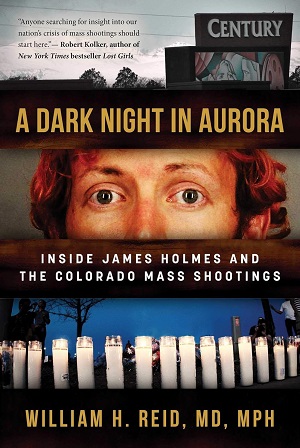
A Dark Night in Aurora: Inside James Holmes and the Colorado Mass Shootings
By William H. Reid
The crime:
During a midnight showing of the film The Dark Knight Rises at a cinema in Aurora, Colorado on July 20, 2012 James Holmes went on a shooting rampage, killing twelve people and injuring some seventy others. In 2015 Holmes was convicted on 24 counts of first-degree murder, 140 counts of attempted first-degree murder. He was sentenced to twelve consecutive life sentences without possibility of parole for the murders and an additional 3, 318 years for the lesser included offenses. This was the longest sentence ever handed down in U.S. history at the time.
 The book:
I think William H. Reid introduces the story well by pointing out how special a case this was, offering “a rare opportunity to study a mentally ill but very intelligent, highly organized murderer, the extraordinary events that led to his crimes, the shootings, the trial, and its sequelae.”
A Dark Night in Aurora exists because James Holmes survived. He wasn’t killed by the police; he didn’t commit suicide. The elements of the shootings, a web of important precursors, and Holmes himself received extraordinary scrutiny during the three years in which the prosecution and defense prepared for a trial that would last for months.
Reid himself was a part of that extraordinary scrutiny, being appointed by the judge presiding over Holmes’s trial to offer a non-partisan psychiatric assessment of Holmes. To do this he received access to tens of thousands of pages of evidence as well as to Holmes himself, whom he interviewed on several occasions for many hours. Interviews that can now be watched, in full, on YouTube, if you’re interested in that sort of thing. I watched some of them and found it all very dull. But Reid’s point stands: it’s not very often that we have such an amount of material, both first and second hand, to draw on.
I also think Reid winds things up as he should with a discussion of “The Search for Why?” The “why?” of crime is a big part of why we read books like these, and it looms especially large in a case as extreme as this.
Not resolving the why can be very unsettling. We want our world to be orderly, predictable, and safe, not frightening. We don’t want the person next door to be able to turn homicidal all of a sudden, especially without some good reason. We don’t want danger to lurk in theaters or nightclubs or schools or workplaces, but if it occasionally does, we want that danger to be somehow logical, not to be so random that we get nervous every time we sit down in an auditorium and feel the lights dim. More broadly, we want to feel settled, comfortable with some explanation that fits the way we go through life.
This very human need makes it all the more confounding that there’s no obvious answer to the question of why James Holmes blew up in the way he did. While Reid asks the question, and on one level (that of an expert in forensic psychiatry) is well positioned to supply an answer, his ultimate diagnosis of “schizotypal personality” is dry and unrevealing. I also found it to be inadequate as an explanation of what went wrong with Holmes, though that may be asking too much. I think Reid might say that it is, but as a true-crime reader I’ll happily dive in.
Holmes came from a comfortably well-off family and his childhood doesn’t seem to have raised any particular red flags. He was bright and did well at school. Well enough to eventually get accepted into a graduate program studying neuroscience at the University of Colorado. While people who knew him found him a bit odd, the fact is he had friends, including girlfriends, one of whom briefly became a sexual partner. He wasn’t an incel and while he spent time on dating sites seems not to have obsessed over romantic partnerships. His relationship with his girlfriend is described by Reid as “fairly superficial,” and there’s no evidence their break-up caused him any heartache. In none of his writings or interviews did he express a hatred of women.
He had no criminal record or history of violence, and until he began preparation for his “mission” seems not to have had the slightest interest in guns. He spent a couple of months prior to July 20 at firing ranges getting used to the weapons he’d bought, but on the fatal night had to give up shooting people as the result of a simple jam that he couldn’t clear. In other ways he was a caricature of the nerd who overthinks practical points. The explosive booby-traps he rigged in his apartment were ingenious in a Rube Goldberg sort of way, but none of them worked.
He doesn’t seem to have had any desire for fame and notoriety or in leaving a legacy. He had no political agenda and didn’t want his actions characterized as terrorism because “Terrorism isn’t the message. The message is, there is no message.” He received no satisfaction, sexual or otherwise, in killing people. When he was done he just left the cinema and sat quietly in his car until he was arrested. He wasn’t responding to a history of bullying and his attack wasn’t an example of someone “going postal” and shooting up their workplace. He didn’t kill anyone he knew, and chose as his killing zone a location where it would be hard for him to even identify any of his victims. It was dark, he had thrown in a smoke bomb, and he was wearing a gas mask while listening to techno music on headphones so he wouldn’t be able to hear anything from people in the theatre (Reid doesn’t mention it, but apparently the song was “Becoming Insane” by Infected Mushroom). Just as he was leaving he noticed a man sitting in the front row who seemed to be smiling, and this unnerved him. Holmes wouldn’t shoot him because, as he put it, “it would have been really personal to shoot a person who’s smiling at me.” And there was nothing personal about any of this. He had actually considered becoming a serial killer, but one of the reasons he rejected this as a criminal career was because it was “too personal.”
Without any personal motivation one naturally wonders if there was some kind of delusion motivating Holmes, but here too there’s not much to point to. He didn’t hear voices commanding him to kill. Apparently he only had a vague theory of “human capital” that said that every life was somehow worth a point, and that when you killed someone you got their human capital. But Holmes’s explanation of how this worked was shifting, and never made much sense in any reading. The accumulation of human capital didn’t do him any good. He tried to explain to a girlfriend that taking the human capital of others would make his “life more meaningful” but even she couldn’t follow (“i don’t understand the concept of human capital. I don’t see how it is useful.”). That he was expressing the idea to others in the days leading up to his rampage means it probably counts for something, but it still strikes me as a very weak sort of after-the-fact rationalization. Reid even characterizes one of the expert psychiatrists testifying in Holmes’s defence, in what amounts to a professional drive-by, as saying that their “opinion of insanity rested to some extent simply on his [the doctor’s] not being able to think of a rational reason for Holmes to kill the people in the Century 16 theater.”
What we’re left with is a general misanthropy. “Most fools will misinterpret correlation for causation,” Holmes would write in his notebook, “namely relationship and work failure as causes. Both were expediting catalysts [but] not the reason. The causation being my state of mind for the past fifteen years.”
As a bit of self-analysis, that’s not bad, even if it begs the question of what that “state of mind” was. Holmes was depressed and suicidal and his mission gave him a purpose. For whatever reason he’d given up on life. And he just didn’t like people. It’s hard to say he hated people since his own way of putting it was that he only disliked them as some people dislike broccoli. It was not “a fiery, angry, passionate hate.” Which is another explanation that takes away more than it gives. The psychiatrist he was seeing at university only “sensed that he had some level of hatred of mankind, but, she testified, ‘he didn’t state that in so many words.’” It was just a vibe.
Holmes thought life was worthless and meaningless. His life philosophy, shorn of decorative elements and doodles like his self-designed “Ultraception” symbol, was reductive and nihilistic. “I suffer. Other people suffer. We’d all be better off if everybody on earth dies.” “Life came into being,” he would text a friend, “and ever since has been a cancer upon death.” So perhaps in asking the question “Why?” we’re coming at it from the wrong end, assuming that such a horrific crime had some correspondingly big or clear explanation. For Holmes the question may have been “Why not?”
Part of the charges of first-degree murder he was convicted on was that the killings were committed “with extreme indifference.” In legal terms this is defined as knowingly showing an attitude of “universal malice manifesting extreme indifference to the value of human life.” That’s not insanity but a part of many people’s mental make-up. Where it comes from I can’t say.
Noted in passing:
Holmes’s defence team offered to plead guilty in return for a sentence of life without parole in order to avoid the death penalty, but this was turned down by the prosecutors. I think they should have taken the deal. The trial process went on for two years and cost millions of dollars and Holmes ended up avoiding the death penalty anyway. And as Reid points out, even if the jury had voted for Holmes’s execution it probably would never have happened and would have taken years if not decades to work its way through appeals. This is not a problem with the system, which should be very cautious in such matters. And I’m not saying Holmes didn’t deserve the death penalty, though the question of whether he was criminally responsible should be considered in conjunction with the fact that he obviously wasn’t well. But the prosecution’s decision seems to have been mostly political rather than practical or smart.
Takeaways:
There may be warning signs, but it’s hard to tell when someone is going to snap, or know what it is that pushes them over the edge. In some cases there may be no explanation at all.
 Alex Good
Not to have a ‘why?’ Answered must’ve been hard on both the relatives of the dead people and his own.
LikeLiked by 1 person
For sure. But most victims of crime are just people who were in the wrong place at the wrong time. You can’t make sense of life.
LikeLiked by 1 person
True.
LikeLike
Calling the decision to seek the death penalty “political” ignores the victims, which include the hundreds of people affected by their murder. As a society, we are way too fond of ignoring the victims.
LikeLiked by 1 person
I don’t know how much a trial helped them though. For some victims it just makes things worse. And even if they’d got a conviction here the process would likely still be going on (and Reid thinks Holmes would never end up being executed). I think the practical thing to do would have been to take the guilty plea. The political decision though is always guided by the imperative to appear tough on crime.
LikeLike
It’s called the “justice” system for a reason. If it is occasionally impractical that’s reason to change the system, not to cave to economic expediency. In the meantime, we should seek justice as best we can. And so long as we have the death penalty, we ought to pursue it when it’s appropriate. This guy was antisocial, but hardly a loon.
And you know what? I can’t think of anything wrong with being “tough on crime.” The alternative is how we get so many repeat offenders let back onto the streets to kill and rape and rob again and again. Tell me I’m crazy, but *that’s* what I call impractical.
LikeLike
I agree with most of what you’re saying. Where I think we might diverge is on where thinking of the victims comes in to play and what the results of that are. “Victims’ rights” became a really big movement over the last thirty years or more, with the introduction of victim impact statements and the like. My own feeling though is that victims don’t or shouldn’t have much of a role in criminal trials. It’s the state that is prosecuting criminals and the administration of justice shouldn’t be coloured by any desire for vengeance or bringing closure to those who have suffered loss.
This is where politics unfortunately gets involved, as that sort of emotional appeal only goes one way. Prosecutors should be impartial in the sense that they aren’t out to nail anyone but just to see justice is done. I know from the legal battles that I’ve been in that the process can drive you into a crazy rage (and I’ve never been involved in criminal proceedings). A good lawyer though will talk their client down. They know how the system works and what’s going to happen. They may be totally on your side and support the justice of your cause, but they can tell you what you’re going to get and what you should be satisfied with (which is always less than what you want or what you think is fair). In this case there was a huge public outcry given it was such a high profile trial, but if you had the guilty party agreeing to a life sentence without parole it seems to me the practical thing to do would be to say OK, we’re not likely to get more than that at trial and even if we did this would end up dragging out forever so let’s do that deal. It’s not going to make everybody happy, but given the sentence that was being agree to I wouldn’t have a problem with it. It wasn’t a sweetheart deal. And this is where politics often comes in to play. Epstein got a ridiculously soft deal. On the flipside, Trump probably wouldn’t have been put to trial for his fraud and Hunter Biden would have had his initial plea accepted and been done with it if not for politics. When people want “justice” it can be pretty subjective.
I’ll add that I’m not absolutely against the death penalty, and I wouldn’t have been upset at Holmes receiving it, but I wouldn’t want the system changed so that it’s easier to sentence people to death. I think it should be hard.
LikeLike
Well then just some food for thought.
1. Victim impact statements are a modern phenomenon. But would you agree that by and large our modern society is increasingly disconnected and desensitized? In the more distant past such statements would have been unnecessary because any jury would readily understand the impact. Nowadays a reminder can be helpful. (Juries should never forget the victims. If there’s a problem, that’s what deliberation is for.)
2. You have to be careful about making the death penalty harder. The harder it is, the more impractical it becomes. Before long you’ll be sayng in effect, I’m not opposed to the death penalty, I just want it to be impossible to achieve.
LikeLike
(1) That’s an interesting defence of the victim impact statements I hadn’t heard. Usually they’re pitched as giving those affected by crime their day in court. I think modern society is definitely disconnected and desensitized but I still take the (what is, I know, unpopular) view that they don’t belong in a criminal trial.
(2) Agree that this can become a problem, especially in a system so thick with rules already. But I wouldn’t relax the standard.
LikeLike