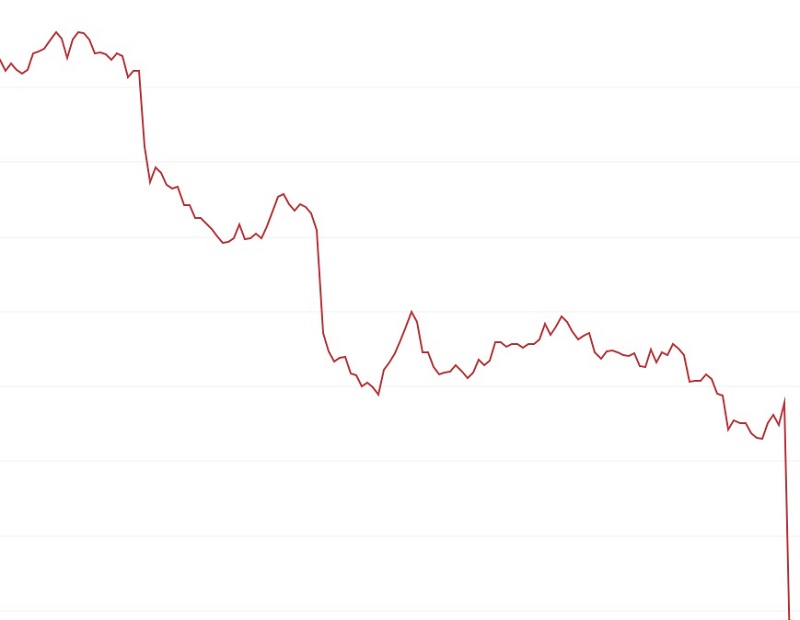
Actual screenshot of goeasy’s stock price taken at the end of last week.
Last week shares in the Canadian subprime lender goeasy (they don’t capitalize the “g”) crashed 70% and it’s an open question whether the company, which at the start of the week had a market cap of over $5 billion, will survive. For the last several years goeasy has been a champion dividend stock, paying investors big returns. But one of their divisions specializing in loans for autos and “powersports” (ATVs and snowmobiles) recently had to report a much higher than expected amount of charge-offs (loans that were not going to be collected). All dividends have been cancelled. The bloom is off the rose.
Suspicion has now been raised that management knew about the trouble the company was in and was concealing this information from investors. Comparisons have been made to the kind of thing that happened in the mortgage meltdown in 2008, and what is happening with private credit markets now (I should point out that goeasy is not a mortgage lender, nor is it a private credit company, being publicly-traded.) Some class action suits are in preparation, and as of this writing it’s still unclear how this will all play out.
I have some goeasy stock, but not a lot, and at this point I’m assuming it’s a write-off. Easy come, goeasy. Overall I’ve done well as an amateur investor the last thirty years so I’m not jumping out of any windows. You win some, you lose some. Still, the news did make me want to “think in ink” a bit here about what’s going on. What other shoes are waiting to drop?
I think you should always assume the worst in life, as it means you’ll have fewer bad surprises. So where are markets at and where are they heading?
If you listen to voices on the Internet, and there are a lot to listen to, you might have picked up on the increasing note of panic. Does this reflect something real, or is it just that these are the sort of voices that get magnified by the algorithm? I’d be inclined to attribute most of it to clickbait, but there are some prominent voices joining the chorus of doom, with much talk of a “reckoning” that’s on its way. Which leads me to a preliminary observation: if there is some kind of collapse coming it will be, if not the biggest, the most widely predicted in history.
I think there are some real grounds for concern, and I’ll arrange them under four headings. The four horsemen, if you want to pump things up, of the market apocalypse. And just to underline a point in advance: these are all interconnected. Each one affects all the others.
(1) Credit crisis:
In his book MegaThreats the economist Nouriel Roubini uses the concept of debt as a master metaphor for the various faces of the polycrisis the modern world faces, from economics to politics to environmental collapse. He has a point, especially when looking at the big picture. A bill is coming due for the way we’ve been living beyond our means, both as states and as households and individuals. Since 2008 the national debt in the U.S. has gone from $7 trillion to $38 trillion. And it’s set to explode even further, given the massive tax cuts handed out by Trump. The “debt death spiral,” where a government must borrow just to pay interest on the debt, is in sight.
More specifically, however, what we seem to be entering into now is the tight-money part of the credit cycle. This is partly what happened in 2008 with the financial crisis. A lot of bad debt had to be written off, leaving lenders feeling gun-shy. This is the same signal being sent up by what happened to goeasy. And, on a much larger scale, it seems to be what’s behind the headlines regarding the private credit market, whose full exposure to bad loans we can’t determine as it’s not publicly reported. But for sure some lenders are now going to have to take a haircut or go under (again, as in 2008). This will of course have knock-on effects throughout the rest of the economy. Someone is lending lenders that money, after all.
(2) Economic stagnation:
Unemployment numbers in both Canada and the United States have slipped into the red, with Canada losing a remarkable 84,000 jobs just last month (the U.S. lost 92,000). The only sectors that can still be seen as holding their own are health care and some government work. Last year was also a record year for corporate bankruptcies in the U.S. And even the stock market (“the DOW is at 50,000!”) has been kept afloat by questionable means. As I understand it, take away the investment in building A.I. infrastructure and the U.S. economy shrank this past year.
(3) Incoming inflation shock:
In the tight-money phase of the credit cycle prices usually go down. This is what we see already happening in many housing markets, and it comes with its own set of problems. But that doesn’t mean inflation isn’t a bigger threat, and what Trump has done with his scattershot imposition of tariffs and beginning a war in Iran makes it hard not to see prices on essentials (food, energy) going up. Also, given Trump’s resistance to raising interest rates, it isn’t clear to me what his plan would be to address that situation. This may lead to quite a whipsaw effect, and if consumers choose (or are forced) to cut back on their spending that could lead to a greater slowdown in the economy, more unemployment, and market collapse.
(4) AI bubble:
Is all the investment going into AI the sign of a bubble? The current valuations don’t make sense to many analysts. Still, maybe it isn’t a bubble, at least to the extent that crypto is (though I don’t know if I’d characterize crypto as a bubble so much as call it gambling app, which makes it the perfect investment vehicle for our casino/betting economy). As with crypto, or a casino, there may be winners in AI. But there will be more losers, and they now stand to lose a lot, with (again) major knock-on effects throughout the rest of the economy. We’ve already been getting reports of this in connection with rising energy costs due to how much power AI data centers use and predictions of massive job losses. And that’s just the start.
So these are the four big areas of concern I have moving forward. To be honest, the only reason I’m not more full of doom and gloom is that nobody knows anything. We could ride this long bull market for another ten years. But it’s good to keep the potential downside in mind. You’ll often hear it stated how the market, in the long run, always goes up and that all you have to do is invest in index funds and you’ll be fine. Timing the market never beats time in the market, as the conventional wisdom has it. And this is good advice. But I’d want to register two caveats.
In the first place, when the market goes down it can stay down or be flat for ten years or more. It’s done that twice in my lifetime, in the 1970s and the 2000s. You could easily see the last 125 years as consisting of just two or three big booms. So the wealth elevator may be out of order for a while, and the “long run” might need to be longer than most people will want or be able to manage.
The second point is that while it’s true the history of the market is one of growth, there’s no reason to believe in that as some kind of natural law. The market doesn’t have to go up, even in the long run. Because Canada and the U.S. have never suffered a total collapse of their monetary system, with money becoming worthless and “blood in the streets,” doesn’t mean it’s impossible. Just something to keep in mind.
 Alex Good
My biggest concern is the debt, personal and governmental (at all levels). That bill is going to come due at some point and it is really looking like it will be sooner rather than later.
LikeLike
I keep thinking that at some point you run out of road to keep kicking the can down, but I’ve been saying that for a while. I do think there comes a point though where some kind of reset button is going to have to be pushed. The numbers don’t make sense anymore.
LikeLiked by 1 person
What gets me is that the whole world is in the same situation.
LikeLike
Yep. Everything is connected.
LikeLiked by 1 person
World economies are way over my head, other than knowing wars & governments mess them up, and there’s a lot of that happening. Never done investing, that seems like gambling to me, but have been in dire financial circumstances in my younger years, when in the 1980’s recession, I lost my home, a horrible time.
LikeLike
I don’t see all investing as gambling since technically you are buying shares in an actual company that has, at least in most cases, actual assets. But when valuations go sky high you’re obviously in a situation where there’s no connection there anymore. And some stocks are pure speculation, yeah. I don’t invest any money that I can’t afford to lose.
Most market stuff is way over my head too. I just follow things as an amateur. One of the things that scares me the most though is when all the experts are so completely wrong. I just keep telling myself that I don’t actually know anything, but that nobody else does either.
Sorry to hear about the house! I can see how that would be something that would keep you a bit paranoid about financial stuff.
LikeLiked by 1 person
It did! Sorted now and have a shed load of savings as a buffer, but it had a long term effect, in that I won’t spend any of it just-in-case! 🙄 I’ll be annoyed if I die and someone else gets it! 🤣
LikeLike
You can’t take it with you! But then you can’t schedule your checkout time in advance either. So the kids and grandkids get to go on a trip someplace nice.
LikeLiked by 1 person