
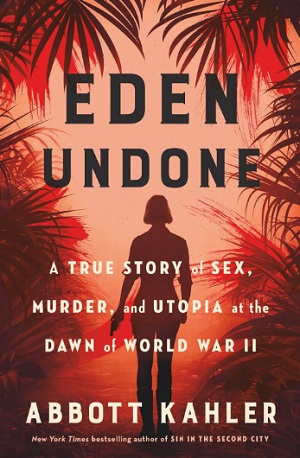
Eden Undone: A True Story of Sex, Murder, and Utopia at the Dawn of World War II
By Abbott Kahler
The crime:
In the late 1920s-early 1930s a bunch of German drifters took up homesteading on the then deserted Galápagos island of Floreana. First to arrive were Friedrich Ritter and Dore Strauch. They became minor celebrities back home and were soon followed by another German couple: Heinz and Margret Wittmer. Then an eccentric Austrian, the Baroness Eloise Wehrborn de Wagner-Bosquet, showed up, along with two lovers: Rudolf Lorenz and Robert Phillipson. The Baroness declared herself the Empress of Floreana and talked of plans of building a hotel there.
The islanders had trouble getting along, and in 1934 the Baroness and Phillipson both disappeared, never to be heard from or seen again. Shortly after, Lorenz hitched a ride on a boat off the island but he and the boat’s captain shipwrecked on another island, where they both starved. And a little later Friedrich Ritter died of food poisoning.
 The book:
I got this one out of the library after having seen the 2013 documentary film called The Galapagos Affair: Satan Came to Eden. As an unsolved crime story with a surprising amount of evidence in the form of letters, memoirs, and even home movies, there’s plenty of meat on these bones to pick over, and a dramatic version of the same events was even released in 2025, directed by Ron Howard and starring Jude Law as Friedrich Ritter.
Eden Undone came out in 2024, and while it presents a fuller accounting of what happened there still aren’t a lot of answers. To the point where it’s fair to ask if this is really a “true crime” book. Murder is in the subtitle, though technically we don’t know if the charge fits. A couple of people disappeared. Another got sick and died from food poisoning. Was there a murder, or murders? It’s widely assumed, I think fairly, that the Baroness and Phillipson were murdered. But their bodies were never found, and while the idea that they left the island by ship is far-fetched (no ship had been seen visiting Floreana at the time, and neither missing person was ever seen or heard from again), it’s just possible there was some kind of accident. We really don’t know.
That uncertainty is part of what makes the story so interesting. But the stuff we do know is just as intriguing. Life on Floreana was a sort of petri dish, very much like one of today’s reality-TV shows, a real-life Survivor or Big Brother. As such, what it provides is a fascinating study in small-group dynamics, one with lots of psychosexual overlays.
The smell of sex permeated Floreana. One visitor referred to the Baroness’s “hotel” as a “festering sex complex.” Lorenz and Phillipson were her toy boys, with Lorenz being the odd man out in their messy ménage. Apparently all three slept in the same bed together, and the Baroness still wasn’t satisfied, as she tried to seduce both Ritter and Heinz Wittmer as well. If Floreana was an Eden, I think it’s fair to say that she was the serpent in the garden, or the apple of discord, to switch metaphors. She wasn’t any great beauty, but she flaunted what she had and there was little competition. Freidrich and Heinz were probably hungry for something different. Another visitor, upon leaving the island, observed how “man seems to need the conquest of his mate. To be too sure is to become stale. It apparently is more interesting to live with your neighbour’s wife than with your own. There is a real basis in psychology here which can be critically analyzed.” Indeed there is, as even the Bible had something to say about coveting your neighbour’s wife. It’s forbidden fruit, and there we are back in the garden. The fact that both the other couples had adulterous origins probably only made things easier for them to stray.
That said, the Baroness seems to have squandered her competitive advantage by being a royal pain in the ass who rubbed everyone the wrong way, at least eventually. Lorenz was clearly a man past his breaking point by the end of his stay on the island. Dore noticed the gradual development of his “deadly hatred” toward the Baroness and I don’t think she was making that up (though I wouldn’t trust her on much else). Phillipson, probably because there’s less of a written record, remains a cipher to me. Friedrich was a crank, tyrant, and hypocrite, in no particular order. Isolation is the only practical option for such a personality. His plan for being a settler was to have no plan but to “be driven by our id – our inner demon – and its whims.” That’s not always the best idea. Dore, who I would have thought far too ill to have managed under such circumstances, was a self-dramatizing type who had some weird kind of codependency going on, with love-hate feelings rhythmically flaring up. The Wittmers were at least a semi-stable family unit, which probably explains their continued residence on the island. Their descendants still live there today.
Sorting through all of this is difficult, in part because the pile of documentary evidence I mentioned tends to point in different directions. In their letters and memoirs the different players tried to spin the story their own way, and often misrepresented or lied about what happened. As I’ve said, I think there’s a most likely scenario that is understandable, but if the true explanation was something a lot weirder I can’t say I’d be surprised.
Noted in passing:
Whatever you think of the personalities involved, and I think they were a mixed-up bunch, I have to confess to being impressed at how well they made a shift of it. Life on Floreana was a hardscrabble existence, isolated and with few amenities. Ritter was a doctor, but a bit of a quack and medical care was limited anyway. Add to this the fact that Dore had multiple sclerosis, that Margret Wittmer arrived on the island in an advanced state of pregnancy and that the Wittmers’ son was a sickly child, and it’s truly remarkable what they accomplished. I don’t think you could take many people today and plunk them down in such a situation and expect as much. As previously noted, this is the stuff of reality TV now, shows that (however they’re billed) are carefully controlled experiments.
A hundred years ago the islanders were celebrities, and for some reason popular among American millionaires who liked to visit Floreana on their yachts, but in terms of their capabilities I think they were probably pretty average urban citizens of the time. The average was just a higher level of general competence back then.
Takeaways:
If someone indicates that they want to be left alone, you should respect their wishes and leave them be.
 Alex Good
How did they build houses for themselves and a hotel?
LikeLike
Ships dropped off some supplies. Otherwise they just put together shacks. The “hotel” was a shack. Some of the time they lived in caves.
These weren’t fancy living accommodations, but considering they were homemade they looked pretty impressive to me. Better than I could do.
LikeLike
I had a little google about the Island, which looks beautiful, and apparently Fred Ritter removed all his teeth and had metal dentures fitted so he wouldn’t get dental problems when he was living on the Island, now that’s prevention rather than cure in extremis!
LikeLike
Yep the book talks about the teeth. Probably a good idea if going to live on an island. But Roald Dahl had his teeth smashed out in an airplane crash and he would go around recommending everyone simply have theirs removed so as not to have any problems with them later.
LikeLiked by 1 person
Great idea! We could all have gurning competitions!
LikeLike
Gotta keep those great British traditions alive somehow.
LikeLiked by 1 person
I think I’ll stick to my current living situation, thank you very much!
LikeLike
I consider myself to be a recluse, but I like the comforts of modern living too.
LikeLiked by 1 person
especially bootleg maple syrup!
LikeLike
Yeah, don’t think they have any maple trees on the Galapagos. That would be a real privation.
LikeLiked by 1 person
On the other hand, you could have the distinct pleasure of knowing you were having the last bowl of galapagos turtle soup in existence! That has to be worth something, right?
LikeLike
I’m not sure they have any of those left on Floreana. So you’re out of soup too.
LikeLiked by 1 person
Wow. No bootleg maple syrup, no almost extinct turtle soup. Makes me wonder what is the point of living there. Maybe they get good internet rates?
LikeLike
They had a highspeed mailbox on the beach for mail to get dropped off and picked up by any passing ships.
LikeLiked by 1 person
Now THAT is living the dream!
Of course, my dream is to get no mail at all, specifically bills.
LikeLike
There are still places off the grid. I know a couple of people who did it. I respect it, but couldn’t do it myself.
LikeLiked by 1 person
What does “the dawn of World War II” have to do with this? (Which is a fatalistic stretch anyway if all the excitement takes place around 1934.)
LikeLike
It has absolutely nothing to do with the book. I was wondering why they put that in the subtitle too. Marketing I guess.
LikeLike
Helter Skelter: The True Story of the Manson Murders at the Dawn of the Internet Age.
LikeLike
Could work for a new edition.
I should re-read that sometime. I remember how much it scared me the first time I read it.
LikeLike
Same. It’s one I’m always considering re-reading.
LikeLike