
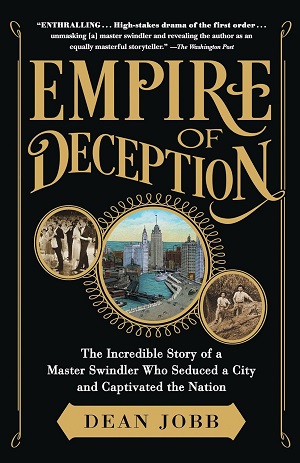
Empire of Deception: The Incredible Story of a Master Swindler Who Seduced a City and Captivated the Nation
By Dean Jobb
The crime:
In 1920s Chicago a lawyer named Leo Koretz who had a taste for the finer things in life – married women, nice clothes, big houses, expensive dinners – went into the financial scam business. What this involved was selling shares in a non-existent company called the Bayano River Syndicate that he said had discovered oil in a remote part of Panama. The scam operated as a Ponzi scheme, paying rich dividends out of the money pumped into the stock by new investors. Just before being exposed, Koretz fled Chicago, abandoning his wife and family, and opened a hunting lodge in Nova Scotia under a new identity. He was eventually discovered and returned to the U.S., where he pled guilty to charges of fraud and was sent to prison. He died shortly thereafter, some say from suicide after eating a box of chocolates that put him into a diabetic coma.
 The book:
The psychology of the Ponzi scheme has always puzzled me. Not the psychology of those who invest in them; they’re only in it to make a quick buck. Are they suckers? Some of them. But ignorance, if not bliss, is still advisable in such situations, and Koretz didn’t appreciate doubters. So either way, that part is easy to understand.
What I have trouble understanding is what the person operating the scheme is thinking.
As anyone who considers the matter even for a moment knows, a Ponzi scheme always carries within it the seeds of its own destruction. The music has to stop. Scams where new money is paid out as supposed returns on investment are “doomed to collapse” because of an inherent flaw: “There is never enough money for all . . . and the inflow of new money must ultimately dry up.”
Knowing all that, what is the end game? Do the fraudsters who run such schemes just find themselves stuck on a treadmill they can’t get off? Do they think there’s some way they’re going to be able to defer the inevitable crash, if not indefinitely at least until something else comes up? I don’t know.
Koretz seems to have been a particularly complicated case. After his arrest he would claim that he almost came to believe in the oil fields himself:
“I talked Bayano, and planned Bayano, and dreamed Bayano, so that I actually believed the stuff. The idea grew and grew. Every day I spoke more of it until, finally, I was confident. It almost seemed that I had those thousands of acres and that oil down there in Panama.”
Ah, yes. It “almost seemed.” I think in the case of Charles Ponzi this might be close to the truth. But Koretz wasn’t as high on his own supply of bunko. “I knew the bubble would burst,” he also later confessed. And he did have a plan for getting away with it. Not that well thought out a plan, to be sure, but still a plan.
It began by sending a team of his most prominent investors on a trip to Panama to inspect the oil fields for themselves. He told them they would be surprised by what they found, and sent a final cable to them saying only BON VOYAGE, signed by THE BOSS. (In turn, the investors’ cable home would summarize their findings: “NO OIL, NO WELLS, NO PIPELINES, NO ORGANIZATION.”) I had trouble figuring this trip out, and the cruel mockery in that “BON VOYAGE.” The investors felt that being sent to Panama “had been a ploy to get them out of the way while Leo planned his escape,” but I think he must have already made his plans to get away by then and I don’t see where it helped him much to have them out of the country. When later asked about why he’d arranged this wild goose chase when he knew what the investors would find, he replied that he “was disgusted at myself and disgusted at the people who had wealth and demanded something for nothing. . . . And I was indifferent as to how the matter ended.”
There may be some truth in this. I don’t think he was indifferent to his likely fate, as he tried hard to avoid it. I’m also not sure how disgusted he was with himself. But his disgust at the people he conned rings true, in part because he must have seen a bit of himself in their wanting something for nothing.
This is a really good book, but I found it hard to be sympathetic toward Koretz. For example, he restricted his list of investors to friends and family. These were the people he took advantage of? He did give family members large gifts of cash just before he disappeared (money that they, miraculously, returned to the authorities), but targeting those closest to him instead of random strangers reveals a certain degree of heartlessness. It came as no surprise to me that he ditched his wife and children when he pulled a runner, not even bothering to get in touch with them while living a life of pleasure in Nova Scotia.
Women made up a big part of that life of pleasure. And here too one finds it hard to warm to Koretz. Canadian observers referred to his “fickle and insatiable appetite for women,” that saw him “passing from one woman to another like a hummingbird in a flower bed.” He was a good dancer, but aside from that the only source of attraction would have been his ostentatious wealth. That, and what later pick-up artists would describe as “negging”: “I am always indifferent to them,” he’d explain about his way with women, “and sometimes I am downright rude, but it just seems to make them want me more than ever. I don’t know what I do to make them behave so foolishly.” But of course he did know. Jobb notes how it’s “the same reverse psychology he had had used so effectively to sell millions of dollars’ worth of bogus stocks.” A con man is always playing a con.
Did he have any good qualities? Jobb thinks so. “Leo, whose ambition and self-confidence knew no bounds, could have been a top-flight lawyer, a business leader, or perhaps a powerful politician. He chose, instead, to become a master of promoting phony stocks.” Is this true? This is one of the abiding mysteries I find about the criminal mind: why people who could make money honestly choose to instead take up a life of crime, which they work every bit as hard at. This leads me to think that they probably couldn’t be successful with a legitimate job. The Illinois state’s attorney, for one, expressed surprise at the success of Koretz’s con: “people seemed to throw their money at him. . . . Koretz is not what one might call a brilliant man. . . . He is not fascinating or particularly impressive. But people threw their money at him! That’s what astounds me.” Yes, this is judging Koretz after the fact, but I don’t think Koretz was “particularly impressive” in any regard. As so often in such cases, his status and power was a gift bestowed upon him by people who should have known better.
I’ll confess I don’t recall ever having heard of Koretz before reading this book. Jobb argues that this is unfair. We still talk about Koretz’s Chicago contemporaries Leopold and Loeb, and Al Capone. And while another financial scammer operating at the same time, Charles Ponzi, became more famous,
Leo had devised his more elaborate and more brazen schemes more than a decade before Ponzi came along; he was a marathoner who was running long after Ponzi’s hundred-yard-dash ended in a prison cell. Fame and notoriety, however, went to the fraudster who stumbled first and died last. It is fitting, perhaps, that a man who spent much of his life cheating others was cheated out of his rightful place in the history of financial scams.
“In terms of the scale of their frauds, staying power, and sheer audacity, Leo Koretz and Bernie Madoff stand apart in the pantheon of pyramid-building swindlers.” At least grant the man a bad reputation.
If Koretz has been forgotten in the mists of time, the Bayano River remains equally hidden from view, “almost as remote and little known as it was when Leo made it the talk of Chicago.” A lot of Panama is still pretty wild, including the nearby Darién Gap, an area so called because it’s the only break in the longest road on the planet: the Pan-American Highway, running from Prudhoe Bay, Alaska to Ushuaia, Argentina. According to Wikipedia the Gap is considered to be “one of the most inhospitable regions in the world.”
But even though the location of the Syndicate’s oil fields was well off any beaten track, Jobb says that a bit of research in one of Chicago’s public libraries would have turned up the fact that Panama wasn’t a major oil producer. Nor did anyone bother to talk to players in the oil industry – people likely to know about a pipeline spanning the Isthmus of Panama and oil fields producing 150,000 barrels a day. Of course today you could go on the Internet and call up satellite images of the Syndicate’s oil fields to see what was going on for yourself. But while in the 1920s willful blindness was easier to maintain, it still took some effort. This is the bitter truth underlying most cons: They’re rarely victimless crimes.
Noted in passing:
The state prison at Joliet that Koretz was sent to was a grim place, with dark, tiny cells where inmates had to use a bucket instead of a toilet. And apparently they didn’t like con men:
How well he [Koretz] would hold up in prison, and for how long, was an open question. Con men were among the lowest of the low in Joliet’s hierarchy, shunned and almost as detested as sexual offenders. They tended to be older and better educated than the men locked up with them, and had betrayed the only things that mattered inside – loyalty and trust.
This surprised me. I would have thought that being a con man would be seen as having some cachet: using your brains instead of violence to take advantage of people who were just greedy anyway. So I was curious enough about this to check Jobb’s source, which turned out to be Nathan Leopold’s prison memoir Life Plus 99 Years. I guess he’d know.
Takeaways:
Cons today are both easier and harder to pull off than they were a hundred years ago. Easier because scammers can use the Internet and social media to infinitely expand their reach. But harder because the same technology makes it quick and easy to check things out. In a time when so much information is literally at investors’ fingertips there’s no excuse for not taking advantage of the tools you have and doing some basic research into claims that would seem to ask for it.


The finer things in life – married women?? Made me laugh, being one. Suicide by chocolates is a new one for me, who the heck gave him a box of chocolates – seems odd when the prison sounds like a hell-hole. Still, a yummy way to go.
LikeLike
Well, he had an eye for married women . . . not his own long-suffering spouse but other people’s wives. Actually seems as though he moved through a pretty sleazy milieu.
I can’t remember now who sent him the chocolates. I think they were smuggled into the prison and the theory is that it was meant as a way for him to commit suicide. He was in very poor health anyway and likely figured it was a nice way to go.
LikeLiked by 1 person
Oh, I thought this was going to be a book about ME. I’m pretty captivating after all. Oh well.
Ugh, death by diabetic coma is a really bad way to go. You basically starve to death while pissing every hour as your body simultaneously can’t process any of the food you do eat without the insulin and tries to get rid of the extra glucose in your system. Probably better than being raped to death though.
LikeLike
Probably . . .
Do you run an empire of deception? Is there a real Bookstooge? Or is this the AI Bookstoogebot?
LikeLiked by 1 person
My entire blog is an Empire of Deception.
Bookstooge left years ago and I, Botstooge 5.0 have been running things flawlessly since.
Bow down and kiss my metal chromed toes!
LikeLike
Botstooge 6.0 might want to have a word with you.
LikeLiked by 1 person
He Who Shall Not Be Numbered has not yet come into his full glory.
LikeLike
That Bon Voyage note instantly brought to mind good old “Mr. Webster.” If you’ve got 2 minutes, check it out: https://www.youtube.com/watch?v=OZPro5Rc8w0
I can sympathize with Webster; wouldn’t occur to me to try in Koretz’s case. I detest con men. But that’s interesting about the prison hierarchy. Definitely did not know that.
LikeLike
Thanks for the song! Guess Mr. W got the last laugh.
I have trouble figuring out where Koretz’s head was at with that telegram. He must have had some mental or emotional issues that Jobb, not unreasonably, doesn’t go chasing after.
LikeLike