
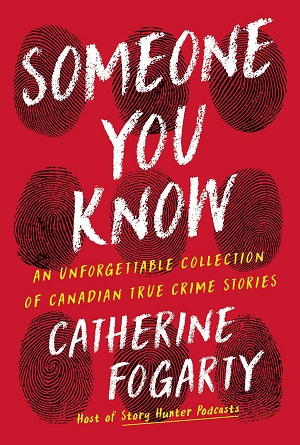
Someone You Know: An Unforgettable Collection of Canadian True Crime Stories
By Catherine Fogarty
The crimes:
“Murder in the Morgue: The Two Faces of Steven Toussaint”: the supervisor of the morgue at the University of Toronto Medical School kills his co-worker, burns down some churches, and then disappears. His body is found a year and a half later.
“Deadly Secrets: The Murder of Gladys Wakabayashi”: a jealous wife kills a woman she suspects her husband is romantically involved with. Years later, she is tricked into confessing as part of an elaborate police sting.
“Lost Boy: The Murder of Nancy Eaton”: a descendant of the wealthy Eaton family befriends a troubled teen who ends up killing her.
“Sins of the Son: The Disappearance of Minnie Ford”: a woman is killed by her brutish son and her body thrown in a lake.
“A Mother’s Love: The Ma Duncan Case”: a mentally disturbed mother gets upset at her son’s marriage and arranges for the pregnant bride to be murdered.
“Enemy Within: The Murder of Glen Davis”: a wealthy philanthropist is murdered by a grasping heir. It turns out the killer was left nothing in his victim’s will.
“Behind the Laughter: The Phil Hartman Story”: a popular comedian is shot in bed by his wife. She later kills herself.
“Back to Reality: The Murder of Jasmine Fiore”: a contestant on a crass dating show kills his wife and throws her body in a dumpster.
“Hollywood Horror Story: The Murder of Iana Kasian”: a rich fellow trying to make it in the entertainment business kills his fiancée in a horrific manner.
“Murder in the Suburbs: The Case of Lucille Miller”: classic case from the 1960s about a woman killing her husband by drugging him and putting him in a car that she torches.
“Black Widow: The Many Lies of Evelyn Dick”: notorious Canadian case of a woman who killed her infant son and then seemed to have some role in the killing of her husband. She was found not guilty of the latter murder at trial and subsequently disappeared.
“No Way Out: The Jane Stafford Story”: a woman kills her abusive spouse, and her trial sets a major legal precedent for “battered wife” cases.
 The book:
I wonder what makes a crime story “Canadian.” If it takes place in Canada? If it involves Canadian criminals, or Canadian victims?
I raise the question of labeling just to introduce what you get in this book. The subtitle refers to “Canadian True Crime Stories” but we could be more precise and say that it’s a collection of murder cases. And specifically they are cases that illustrate the point that most homicides are indeed committed by someone the victim knew. “Interpersonal and intimate partner violence accounts for most murders in our country. While we are all taught about ‘stranger danger’ as young kids, the reality is that we are more likely to be sleeping with, socializing with, related to or married to our killer. And that is deeply disturbing.”
The twelve cases are divided into four sections relating to killers who are the friends, kids, lovers, and spouses of their victims. But again the classification scheme doesn’t seem totally on point. You could argue that each of the three murders in the third section were cases where someone killed their spouse, so they could just as easily have been included in the fourth section. Instead, what distinguishes the stories in the third section is the strange coincidence that they all deal with murders involving ex-pat Canadians living in California. All that sunshine does things to us.
(I should expand on a point here. When I say that the cases in the third section were arguably spousal killings I mean that Jasmin Fiore apparently had just had her marriage to Ryan Jenkins annulled (though there are no records of this) and that Iana Kasian was only Blake Leibel’s fiancée. What I also want to add here is that both these women were killed after their relationships had fallen apart but when they agreed to meet with their exes in a gesture of conciliation. As I’ve said before, this is not advisable. If you’re splitting up, you should make a clean break and never get together with your (violent and abusive) ex again. And you definitely should avoid meeting with them alone.)
As far as the writing and research goes I thought Catherine Fogarty did a good job relating the facts and not dragging things out unnecessarily. There were places though where I wished she’d done a bit more digging, especially with regard to cases that are now decades old. The first case here, for example, left me with a lot of questions. Starting with whether the killer’s name was Steven or Stephen Toussaint. Both spellings are used. Meanwhile, all of the sources are news reports from 1998-99 and they don’t offer any resolution on a number of points. Did Toussaint kill himself? How? We’re only told that his body was badly decomposed, but it still seems odd to me that they couldn’t determine any cause of death. And why did it take so long to find his body? Fogarty wonders about this herself, as the body was discovered (18 months later) only 500 meters from where Toussaint’s car had been abandoned and there’d been a supposedly extensive search of the area. We’re only told the body was in an overgrown, wooded area. Were the search parties just too lazy to get into the weeds?
With increased hindsight you might expect some of these questions to be more fully explored. Another point that came up in the next case, also from the 1990s, bothered me. Just how did Jean Ann James dispose of so much physical evidence when she killed Gladys Wakabayashi? There must have been a lot, and James had been the “number one suspect” of the police. She said she’d burned her bloody clothes in the incinerator at her son’s school, but this was an explanation that was later proved false because there was no incinerator at the school and anyway the amount of blood there must have been would have gotten everywhere. To have cleaned up so well is remarkable. Fogarty assumes James threw her clothes in a dumpster, but there must have been more to it than that. I guess we’ll never know.
Aside from being Canadian true crime stories dealing with cases of murder committed by people close to the victim, another theme I found popping up was that of the double life. This made me wonder how much the notion of a double life is something real and how much of it is a myth. To be sure, we all have public and private selves. Or personalities that are different at work and at home. Dickens noticed that a couple of hundred years ago. So do we all lead double lives?
Not in the sense that I think most people use the term, and certainly not as you find it employed in true crime writing. In that latter context what it usually means is the good neighbour/family man who is a serial killer or homicidal psychopath on the side. But it could also mean something more innocuous. Was there anything exceptional in the marriage of Phil and Brynn Hartman? “Behind their perfect-looking family façade, there was trouble – tension, jealousy and addiction.” Indeed their marriage was on the rocks. But this is common if not more the rule than the exception in any marriage. Or take this description of Stephen Toussaint:
He was a hard-working family man with an effervescent personality and a great sense of humour. But beyond Sunday school and bowling nights, there was another side to Stephen Toussaint that neither his family nor church were aware of. He was a man of dark secrets.
What were these dark secrets? All we seem to know is that he was an alcoholic, which had in turn affected his work at the morgue. Which in turn led to his murdering a co-worker. Toussaint had a drinking problem, but a double life? Was he two different people, at work, at home, or at the bar?
To some extent everything about us is always a façade. The point a collection like this drives home is that we all have secrets and that nobody, not even those closest to us – children, spouses – knows us fully. And even if such perfect knowledge existed, there’d always be a random element impossible to predict.
Noted in passing:
Glen Davis was shot in the stairwell of an underground parking garage. Yes, it was around 1:45 in the afternoon, but does this count as being “gunned down in broad daylight in a busy area of the city”?
Ryan Jenkins mutilated Jasmin Fiore’s body, specifically removing her teeth and finger joints post-mortem, to prevent recognition. He did not reckon on the fact that breast implants have serial numbers printed on them that could be used to confirm her identity.
Takeaways:
Given that you can never really know someone, you should observe their behaviour and assume that this will remain consistent over time. In the most notorious case here Jane Hurshman fell for Billy Stafford because she was impressed that he was “kind, gentle and listened to Jane talk about her marital troubles.” In fact he was notorious for being a violent and abusive drunk. Jane knew about his “less than stellar reputation” but . . . “love is blind.” It cannot afford to be.
 Alex Good
That sounds like a fun read! I don’t suppose Canadian murders are much different from any other countries murders in the end.
LikeLike
No they really aren’t. People are all pretty much the same.
LikeLiked by 1 person
I remember Hartman from his stint on “New Radio” tv show. He was a funny guy indeed. Was that case expounded on, or is the wiki entry on him enough now?
LikeLike
I don’t know how much has been written on it. It’s well known because he was a celeb, but to be honest it wasn’t a very intriguing case in any other way.
LikeLiked by 1 person
Bummer. I was hoping for a longer entry than what I read on wikipedia. He impressed me as an actor, and that is hard to do.
LikeLike