
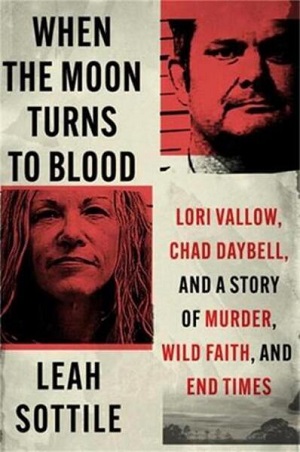
When the Moon Turns to Blood: Lori Vallow, Chad Daybell, and a Story of Murder, Wild Faith, and End Times
By Leah Sottile
The crime:
Lori Vallow, her lover (and soon-to-be fifth husband) Chad Daybell, and Lori’s brother Alex Cox conspired to kill Lori’s then-husband Charles, Chad’s then-wife Tammy, and Lori’s two children, Tylee and J.J. Alex later died of natural causes, while Chad was sentenced to be executed and Lori to life in prison.
 The book:
I’ve already gone over a lot of the facts in this case in my notes on John Glatt’s The Doomsday Mother. Both books came out before either Lori or Chad went to trial, but I don’t think they miss a lot. There are pros and cons with being timely. All too often true crime books spend far too much time on trial coverage, but trials do add information previously unknown to the public and it would have been nice to read an account of this case that took us to closure. In any event, I don’t expect more books about these events anytime soon so it looks like Glatt and Sottile are the last word. Public attention has moved on.
What makes this book different from Glatt’s is the focus Sottile places on the religious and cultural milieu that Lori and Chad were a part of. Here’s how she sets it up:
In one interview with a podcast about the Vallow/Daybell case, the managing editor at East Idaho News said people had made the case out to be a story of religion, when it in fact had everything to do with sex and greed. And to an extent, that became an early theory of the case, the reason two children were found dead in the yard of Chad Daybell was actually quite simple: two people wanted to be together and killed the people in their way. Even Lori’s own father seemed to imply that was his theory in his email to me.
But the more I sunk into the world of Lori Vallow and Chad Daybell, the more clear it became that their story could only have happened inside a culture that festers in the LDS Church: a cancer that even men of God cannot seem to cut out.
Does Sottile make good on this claim? Well, she does her best. Personally, I think this was, mainly, a case of sex and greed. But those motives were mixed with religious views that take some time to unpack.
While they were both part of the LDS (Mormon) Church, Chad and Lori’s personal belief system was more a kind of pop-culture amalgam of stuff ranging from the Bible and the Book of Mormon to the Left Behind and Harry Potter series of novels. I don’t know if Chad wanted to be the head of an end-times cult or a bestselling author, or if there’s a distinction to be made there. There’s really no sorting any of it out, what with the possession by light and dark spirits, people being transformed into zombies, and a magic crystal on a pendant used to do readings.
Two things stand out however as key ingredients in Chad and Lori’s peculiar personal religion, and both are pretty familiar to cult watchers. In the first place there’s the idea that the members of the cult are among the saved. Chad took his lead from the Book of Revelation in figuring that only 144,000 individuals were going to be counted among the elect, which in a global population now of 8 billion is around 0.01 percent of us. Considering that all the immediate members of Chad’s circle were among this elite, that’s a serious sense of exceptionalism.
That exceptionalism is also seen in the way that in their past lives cult members enjoyed a lot of upward social mobility. Throughout all of human history, the vast majority of humanity have been peasant farmers or labourers who have left behind no material or historical record of their ever having existed. But if you’ve ever listened to anyone talk about their past lives all you’ll hear is of how they were Napoleon or Cleopatra. And so Chad, according to his own testimony, had previously lived as James the Just (the brother of Jesus), while Lori had been James’s wife Elena. Nor did it end there. “Almost everyone but Chad and Lori was a granddaughter or a spouse of a saint – some peripheral biblical character. But Chad and Lori were special, more important. Lori, in yet another life, had been married to Moroni, the Nephite warrior who appeared as an angel in a blinding holy light at the bedside of Joseph Smith.” That’s Mormon royalty for the rest of us.
As always when reading about the operation of a cult one is left wondering just how much of this anyone really believed. Tragically, I think in this case they believed a lot. But one can understand a lot of the psychological and cultural factors at play. Everyone has the need to feel they’re special, if not one of the elect. Having been a king or a saint in a previous life fills the same need to think that we’re somehow destined for greater things, that we have some biological marker that makes us better than the herd.
Take the matter of Chad’s “zombies.” These were imagined to be people whose souls were dead and who were inhabited by evil demons. But zombies are a big part of contemporary media culture (books, movies, videogames), fitting especially well with our sense of living at or near the end times. As I’ve argued at greater length elsewhere (see my review of Glenn Kay’s book Zombie Movies), what the zombie represents is simply other people, the apocalypse is only the revelation that all these creatures that look like human beings that we encounter every day aren’t even truly alive, or at least not as alive as we are. And so it’s no surprise that in addition to Chad’s theory of evil possession, Lori’s father also argued that anyone who paid taxes was a zombie. “Like hypnotized zombies the general population systematically and begrudgingly allow the IRS operations to steal their hard-earned money,” he wrote in a book. General population = zombies. Which means the elect, those 0.01 percent, are like the gang of survivors in The Walking Dead. And from here, how big a step is it to just getting rid of (that is, killing) other people? I mean, they’re already dead anyway.
The impression I had is that Lori was a hot mess from the get-go. Her family was likened to a psychological “hornet’s nest” that may have involved some form of sexual abuse. As early as 2007, more than ten years before the killing started, a court-appointed mental health examiner assessed her during custody proceedings as being someone whose “belief system is riddled with ghosts and seemingly fanatical religious dogma.” Once she fell in with Chad’s end-times cult she was casting witchy hexes and curses on her enemies by way of texts and seeing all kinds of bizarre spiritual phenomena operating in her daily life. It should go without saying that none of this had anything to do with Mormonism. I’m no apologist for the LDS, but you can find wingnuts in every religion, and at the end of the day I was left unconvinced by Sottile’s argument that there was something peculiar to the Mormon Church that gave rise to a case like this. Lori and Chad “had grown up with some elements of the far-right fringes of Mormon culture in their lives.” But while she mentions the Rafferty brothers (whose story was told by Jon Krakauer in Under the Banner of Heaven) and Warren Jeffs, and it’s true they based their crimes on what they took to be divine direction, there have always been people of every faith you can think of who have justified bad behaviour in such a way.
At first, the story of Chad and Lori and their missing children looked like a complicated version of a stock true-crime trope: a love affair gone wrong, a story of sexual desire so intense it drove two people to kill. They collected the insurance money from former loved ones and ran away together. But the story is so much more complicated than that. This is a story of faith, and of all the things we allow ourselves to believe.
I just can’t get totally on board with this. Yes, faith played a role in what happened, but it wasn’t “so much more complicated” than the stock true-crime trope. This was a case, primarily, of sex and greed. And failure. Lori and Chad were a pair of not very bright losers who wanted more out of life but felt they’d come to the end of the line. I found it most telling that neither of them invited any friends or family to attend their beach wedding in Hawaii. That just seemed sad. Then, recognizing that they’d come to their own, personal end of the line they projected this onto the rest of the world, seeing this as the end times. It’s the narcissistic apocalypse, and speaks very much to the spirit of the age.
Noted in passing:
It’s not clear what happened the morning Charles Vallow was shot and killed by Alex Cox (Lori’s brother). Charles and Alex are both now dead, as is Tylee, who may also have been present. And the only other possible witness is Lori, who says she wasn’t there. The story that Lori and Alex came up with, and that Tylee went along with when questioned by the police, is that Tylee had grabbed a baseball bat and tried to come between Charles and Lori when Charles was threatening his wife. Charles then wrenched the bat away from her and she ran out of the house. Alex then shot Charles after, he said, Charles started swinging the bat at him.
I don’t think this is what happened. It doesn’t seem to fit at all the kind of guy Charles was, or the frame of mind he was in. But Sottile takes it as established that Tylee “hadn’t flinched to stand between Lori and Charles Vallow with a baseball bat, ready to protect her mother.”
I was really surprised to read this. As I’ve said, I don’t think there’s any way now we can be sure of exactly what happened, but I really doubt it went down like this. I think it more likely Lori coached Tylee what to say, and even then their stories didn’t agree with each other anyway. There were plenty of reasons to be sceptical about it then, which is something Sottile should have registered.
Takeaways:
If you think everyone else is a zombie, perhaps you are the zombie.
 Alex Good
But doesn’t everyone think that everyone else is a zombie? Does that mean that we are all zombies? How dare you! You’re the zombie!
Having spent some time in court, there’s usually quite a bit that can’t be reported on until the trial is over, so I nomally find the courtoom part of a retold true-crime story quite compelling, because there’s often information which wasn’t shared at the time.
What did Gandhi say, why do we feel elevated by the degradation of others? Don’t a lot of belief systems work on that premise, YOU are right, everyone else is wrong?
LikeLiked by 1 person
Trials usually throw up a lot more information. The problem is that true crime books written after a trial often get taken over by the trial in their back half and just take to copy-and-pasting big chunks of it. They’re like reading a transcript.
Of course I know everyone else is a zombie, and that I am always right and everyone else is wrong. But still I have to get by living in this fallen world.
LikeLiked by 1 person
Always find it incomprehensible that people can do this stuff, especially killing the kids.
LikeLiked by 1 person
There are people who just don’t have any feeling for other people at all. Even their own kids. They just see them as assets or liabilities.
LikeLiked by 2 people
I got nothing, that’s for sure…
LikeLiked by 1 person
That’s OK. You get a pass.
LikeLiked by 2 people
But, I did put up your favorite picture on my post, so you’re welcome 😀
LikeLiked by 1 person
Have you ever taken Mr. Zippy to the gun range and just accidentally put a target on his bib?
LikeLiked by 2 people
Awww, that’s NOT awesome AA.
LikeLiked by 1 person
Well you know if you gave him a gun he’d be coming after you. And anyone else within range.
LikeLiked by 2 people
He’s a good monkey. He only shoots commies…
LikeLiked by 1 person