Phoenix
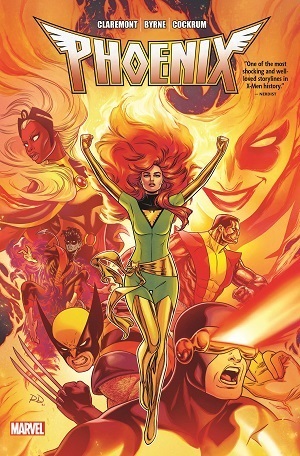 This is where I came in.
What I mean is that it was the story arc that had the X-Men taking on the Hellfire Club, with “Jason Wyngarde”/Mastermind seducing Jean Grey/Phoenix and turning her into Dark Phoenix in the process, that made me an X-Men fanboy. These were issues I bought when I was a teenager and I think I still have them in storage somewhere — but they’re in pretty bad shape because I re-read them dozens of times. This was simply one of the best superhero stories I’d ever read, and Wolverine rising from the dead, claws extended, snarling “Now it’s my turn!” (at the end of issue #132) is the greatest comic panel ever. It looms so large in my memory that I was sure it was a full-page spread. It isn’t, but it works even better with the build-up to the hand reaching out of the water and grabbing the sewer pipe first.
So when this deluxe edition of the full Phoenix saga came out I figured I’d splurge on it, albeit at a discount price. I mean, $125 in Canada is steep. I paid $40, which I thought was fair. You get 34 comics basically covering Phoenix’s origin through her evolution into a God-like cosmic power and then her eventual death. Bonuses include interviews with the creative talent behind the saga, like writer Chris Claremont and penciler John Byrne. It took me quite a while to get through the whole book, but I enjoyed most of it very much. I especially liked seeing how the X-Men managed to deal with Proteus, “The Deadliest Mutant Alive.” I had issue #127, you see, but not #128, so I never saw what they did to take him down. For forty years I’ve lived in suspense. And I have to say I was not disappointed.
As far as the larger story arc we follow here, I wasn’t as thrilled at the cosmic Phoenix “goddess on a mountaintop” as I was by the Hellfire Club plot. This is a complaint I make with a lot of superhero comics. As heroes and villains keep leveling up, to the point where they’re single-handedly destroying galaxies and universes, it’s hard to care anymore. And everyone knew that was a problem here, as it’s something they talk about in the roundtable at the end. Phoenix was going to be an analog to Thor in being a “female cosmic hero,” but when she turned into a god “she was so powerful that she . . . made the rest of the group kind of redundant.” That’s a feeling I shared. I mean Phoenix is a force that can’t be stopped by anyone, and when she dies at the end she’s really committing suicide.
Meanwhile, what Claremont does so well is present the story on a human level. First and foremost this means setting up the fights. Of course, most superhero comics follow a conventional format where the story is all about building up to climactic fights between heroes and their rivals. What Claremont did was to infuse these battles with a shot of emotional intensity that you rarely found in other comics. You always get the sense that the heroes fighting in these comics are angry, that they really hate each other. Wolverine pulling himself out of the storm drain is just the best example. He’s pissed off now and someone’s going to pay!
Speaking of making someone pay, I laughed out loud at the scene in the diner/grocery store where Wolverine/Logan is flipping through a Penthouse magazine and the store owner tells him “This ain’t no library, fella. You want to read the magazine, buy the magazine.” This triggers Logan, who “don’t like bein’ tapped, bub. Or ordered around.” The owner holds his ground, saying “I don’t like people readin’ without payin’. Wanna make something of it?” Wolverine is about to tear into him before the bad guys arrive. Our heroes can be such squalid types. But something about Wolvering perving out to a dirty mag seemed so right. If you were a teenage boy at the time, you could relate.
Getting back to Claremont’s ability to humanize these figures, I also really liked the way the seduction of Jean Grey played out. That’s genuinely erotic, even without the crazy fetish outfit she dresses up in as the Black Queen. And the thing is, Jean is a hot lady. When she’s going through her transformation into Dark Phoenix Storm senses “pain, great sadness – and an awful, all-consuming lust” within her. Then, when Phoenix summons the lightning she laughs “as the awesome bolts of energy caress her body like a lover.” All this power is turning her on in more ways than one.
The X-Men comics are great. The Classic X-Men titles also included here are not. I just had the sense that Phoenix was a character Claremont couldn’t leave alone, though he really should have. Still, if you want as much Phoenix as you can get in a single volume this is the place to find her. And the central part of the book, meaning the X-Men vs. Hellfire Club storyline remains a classic in every dimension of comic art. I haven’t mentioned Tom Orzechowski’s lettering, but it’s always impressed me as setting a certain standard too. Though rigorously standardized, it has a thickness to it that carries a human timbre. It’s the way I thought all comic dialogue should be written, and has a distinctive character to this day.
So I’m still a fan. And if you want to know why the X-Men (and Wolverine) became the franchise figures they did, it’s all right here. They’d go on to have a pretty good run in comics after this, but more recently they’ve lost the plot in the chaos of the Marvel multiverse meltdown that’s pretty much wrecked everything, even while harkening back to the characters, plotlines, and even tag lines from these glory days.
 Alex Good
The X-men were where I came in too, not the comics, but the animated series on TV which used to be on the TV at silly o’clock in the wee hours when I was up feeding my kid. I really liked Gambit but he didn’t seem to be in at as much as the others.
LikeLiked by 1 person
Yeah Gambit came in a bit later than this. Him and the uber-sexy Psylocke. Don’t know if she was in the TV show, which I confess I never saw.
LikeLiked by 2 people
No Psylocke that I remember. Maybe too uber sexy for kids TV?
LikeLiked by 1 person
Psylocke took the sexy superheroine about as far as it could go. At least at the time. Not surprised she wasn’t in the show.
LikeLiked by 1 person
Does Guelph public library even stock Penthouse?
Is that why they’ve told you the public toilets were not accessible?
You spent forty bucks on comics?
LikeLike
I spend $40 a day on comics. Do you have a problem with that? Can’t get Penthouse at the newsstand anymore so have to spend my money on something.
LikeLiked by 1 person
what’s a newsstand?
LikeLike
Where you run down from your office to when you want to pick up the latest news, hot off the press.
LikeLike
I was never into the X-men. Didn’t know it at the time, but I was just not a team player and needed a solo hero to read about.
Glad this collection didn’t destroy your old memories…
LikeLike
I was surprised at how well it held up. Even saw things in it that I didn’t when I was a kid.
LikeLiked by 1 person