The Object-Lesson
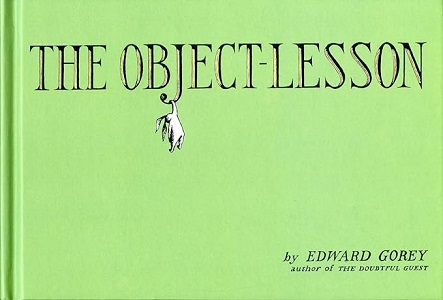 I love the work of Edward Gorey but you have to take it in small doses. As I go along (if I keep going along) I’ll be revisiting his various Amphigorey collections, but until I get to them this little book will do as an entry point to his dark universe.
Dark because danger and death and loss and mutilation are always lurking around the corner. Some monster is no doubt waiting behind that thick network of wallpaper we’re faced with on the first page. A beast hiding in the mists on the moors. In the trees . . . “a bat, or possibly an umbrella.” You can’t even tell what it is when it flies away. “Something happened to the vicar,” and from the looks of it nothing good. Perhaps a bicycle accident.
The horizontal nature of the book leads you to believe there’s some sort of continuity at work in the way landscapes seem to run from page to page. Your eyes are moving at speed across a sweep of space. But is there a thread that holds it all together? Not an obvious one, but that just means we have to fill in the gaps and make the links ourselves. The text may suggests temporal relations. “Meanwhile, on the tower . . .” And we seem to be moving from morning through day to night. But are there also traps? When the people in the dinghy cry “Heavens, how dashing!” are they talking about the “erstwhile cousin” stepping backwards into the water? They seem to be looking at him, but is that just a coincidence? And is that water the same lake the lordship meets the Throbblefoot Spectre by? And are odd figures who are never identified recurring, or different people? Take the lady in mourning by the edge of the lake (she appears again from a distance, walking either away from or towards the tower), or the lady with the flowerpot.
Surrealism? Yes, or at least the absurd. It’s in the dreamlike symbolism of the landscape mostly. That tower in the middle of nowhere. The ornate gates to the asylum with no adjoining walls. The lonely kiosk. Detached structures that again might be understood as in the same neighbourhood, or be located on different continents and in different eras.
A haunted world, and by what? “The miseries of childhood.” That kid on the second page has seen too much that can never be forgotten. He (or she) will lose much that will never be found.
 Alex Good
The Doubtful Guest s the one remember. had forgotten all about ths partcular rabbt hole…oh, now can’t use that mssng lett on your ste, what s gong on! See the comments got yesterday from Bookstooge and Bran!
LikeLike
Wt?
LikeLiked by 1 person
Oh, now it’s working.
LikeLike
I can write “i”s just fine here.
LikeLike
It’s weird. It conked out for me temporarily. But I’m not going to worry about it.
LikeLiked by 2 people
I’d take it as a personal judgment if I was you.
LikeLike
FFS eye can’t use the letter eye on yours, Dx’s or Bookstooges blogs eyether, just get nutheng when typeng the letter eye, most maddeneng, usng an e enstead.
LikeLiked by 1 person
I don’t know what’s going on. I had one comment on Dix’s site that wouldn’t let me use the i but that’s it.
LikeLiked by 2 people
It’s quite annoying, but I don’t think it’s any of our faults, must be something in the WP universe, but not on the app. Odd…
LikeLiked by 1 person
It seems to be sorted at least for now, aye!
LikeLiked by 1 person
I’m still in the reader and the I is back.
LikeLiked by 1 person
Commenting on the book now. I assume it is a visual book, as you have the Graphicalex link at the bottom, and the shape of the book is more inline with a picture book than a straight novel.
LikeLiked by 1 person
Yes, it’s a picture book. And the format does add to it, more so than the way it’s presented in the Amphigorey collection.
LikeLiked by 1 person