
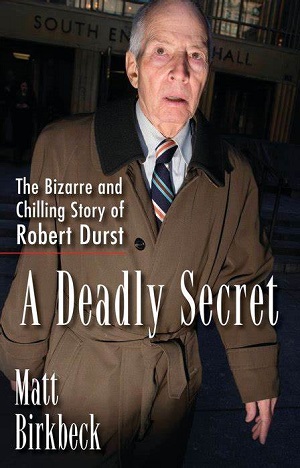
A Deadly Secret: The Bizarre and Chilling Story of Robert Durst
By Matt Birkbeck
The crime:
Robert Durst was heir to a New York City real estate fortune whose wife Kathleen disappeared in 1982. For years there were suspicions that Durst had murdered her, and as the investigation ramped up Durst went into hiding. In 2000 a long-time friend of Durst’s, Susan Berman, was found murdered in Los Angeles. In 2003, while staying in Galveston, Texas, Durst killed a man named Morris Black, chopped Black’s body up, and threw the remains (minus Black’s head) into the bay. Claiming self-defence at trial, Durst was found not guilty of murder. But in 2021 he was found guilty of killing Berman. Durst died in 2022.
 The book:
If you know the name Robert Durst it’s probably because you were either following the tabloids closely back in the early 2000s or you saw the six-part HBO documentary on him by Andrew Jarecki called The Jinx: The Life and Deaths of Robert Dust. The Jinx aired in 2015, making it one of a trio of docuseries that all came out around the same time, signaling an explosion of interest in true crime – the others being Making a Murderer (also 2015) and the podcast Serial (which began in 2014).
The first thing to say about A Deadly Secret then is that it was first published in 2002, with later updates in the form of very brief notes that take us up to the point of Durst’s arrest for the murder of Berman (which followed immediately upon the airing of the final episode of The Jinx). So while it does a good job covering the initial investigations into the disappearance of Durst’s first wife, it only skims over the later parts of the story, which are also the ones that you’re probably more familiar with. While Durst died in 2022, Jarecki made a sequel, The Jinx Part 2 that came out in 2024 and brought the story even more up to date. For true crime addicts the Durst saga was the gift that just kept on giving.
I think everyone at the time realized the story was gold. Multiple murders. An unsolved mystery. And at the heart of it a superrich eccentric. And because it was such a great story, everyone involved in its telling wanted a piece of it, to claim some degree of ownership over it. This was a criticism leveled at Jarecki, whose The Jinx Part 2 was seen as being a little too self-congratulatory about having bagged Durst in the first docuseries. But it was the same with Jeanine Pirro, the New York DA who saw the case as her meal ticket for greater things. In addition to forbidding anyone in New York from talking to the media, Pirro would jet about the country (Texas, California), insinuating herself into all the different Durst investigations even when her presence was neither welcome nor necessary. Other jurisdictions came to dislike her, feeling she was just playing to the camera and “talked too much.” They hadn’t seen anything yet.
Another figure who tried to take ownership of the story was a friend of Kathleen’s named Gilberte Najamy. She would play the media with the same skill as Pirro, and it wouldn’t take long before the two would be working together. Both Pirro and Najamy come off looking pretty bad in Birkbeck’s book, and I don’t think he was being unfair to either.
But the figure who did the most damage to Durst’s case by talking too much was Durst himself. This was his undoing at the end of The Jinx, when a hot mic caught him confessing that he “killed them all.” But that’s a moment foreshadowed here after Durst is caught shoplifting a chicken-salad sandwich from a Wegman’s when he had $500 in his pocket. Sitting in the back of the police cruiser taking him to his booking he was overheard muttering to himself about how stupid he’d been.
His biggest mistake, however, wasn’t the hot mic moment so much as his agreeing to sit down and be interviewed for The Jinx in the first place. This surprised Birkbeck, as up until then Durst hadn’t talked to anyone. But as Shakespeare knew, people are no good at keeping secrets. Murder, in particular, will out. This is the logic behind Hamlet’s staging of The Mousetrap:
I have heard
That guilty creatures sitting at a play
Have, by the very cunning of the scene,
Been struck so to the soul that presently
They have proclaimed their malefactions;
For murder, though it have no tongue, will speak
With most miraculous organ.
Dostoyevsky and Freud both said something similar. The way people give themselves away, even if through a process of subconscious compulsion, has long been recognized.
As long as you keep in mind that this was a very early take on the story and so leaves a lot out, I think people with an interest in the Durst case will find it worthwhile. It offers a fuller perspective than you get in The Jinx, especially from the point of view of some of the police investigators. But I have to confess that I started off really digging my heels in against the way Birkbeck was presenting things. What I mean is that he goes for a novelistic style that often had me shaking my head at how he could possibly be recounting events in such detail. Here, for example, is how things kick off:
It was late November 1999, and a misty haze enveloped the northern New York City suburbs, soaking the landscape. [New York State Police investigator Joe] Becerra, who ran his usual four miles on the muddy trails, never once had to call out to his dogs to keep up, and worked up a good sweat in the unusually warm, late-fall-morning air. Becerra was drenched, beads of sweat and rain falling from his brow. At the end of the run, which took him in a full circle back to his cottage, he stood bent over, breathing heavily, his palms down on his knees.
The dogs were right with him, their paws, lower legs, and underbellies muddied. They barked and reached up to Becerra on their hind legs.
Becerra pushed them off, then wiped the mud from his sweatpants.
“C’mon, you guys. You’re filthy,” he said, still taking deep breaths.
The dogs still continued to bark.
“Okay, I know,” he said.
Is this exactly what Becerra said? An approximation? Did he stand bent over, hands on knees? Did he wipe mud from his sweatpants? This is very cinematic, and made me think of the opening of The Silence of the Lambs. But it seemed too perfectly visualised to be an exact recollection.
Then a few pages later we have this scene:
Becerra thought for a moment, then looked over to Luttman, who was still reading his paper. . . . Becerra walked over to Luttman’s desk.
“Henry, did you ever hear of a woman named Kathie Durst?”
Luttman quickly took his eyes off the paper.
Really? And later, as part of the same episode: “Luttman folded his newspaper, took a last sip of coffee, and stood up.” How does Birkbeck know that’s what Luttman did on that particular day? How would Luttman have remembered? It’s impossible to recreate moments like these at this level of detail. It does make for an easy read, but these are dramatic reconstructions and can’t be taken as entirely factual.
As a final point relating to when this book was written, there’s a lot of time spent considering whether or not a case could have brought against Durst either for the murder of his wife or Susan Berman. Because we know he was later convicted of killing Berman and almost certainly at least had a hand in killing his wife, it’s easy to be critical of the police and prosecutors in this regard. But what were the prosecutors in particular supposed to do? They might have got to Berman quicker, but it’s unlikely she was going to talk. And if Durst was acquitted in the murder of Morris Black in Texas, a case where he was caught dead to rights, what were the chances of getting convictions in New York or L.A., where they had far less evidence? In fact, as the one detective puts it, they had “nothing.” I’m usually all for criticizing the police, but in this case it doesn’t seem fair. Unless you want to call out the two-tier justice system that makes it so hard to convict rich clients like Durst of anything in the first place.
Noted in passing:
The New Jersey Pine Barrens are huge: just over a million acres of forest and wetlands. I’d recently read a magazine piece on the Jersey Devil, a resident evil spirit, so I should have been more up on it, but I was still surprised at how a big chunk of Jersey the Barrens constitutes. For various reasons – ease of digging, a reputation as a favourite place for mobsters to hide bodies, the phone record of a call from the area – it’s thought that Durst might have disposed of Kathleen’s body there, and there were some preliminary efforts made to search parts of it. Which would have been a tall task indeed if we’re talking about having to cover the entire Barrens. But I wonder if it would have been possible to narrow things down quite a bit. Durst wasn’t a big guy, so you’d figure a burial site would have to be somewhere near a road. And on the evidence of what he did with Morris Black’s remains, Durst was no genius at getting rid of bodies.
Takeaways:
Guilty or innocent, it doesn’t pay to talk to anyone about possible crimes you’re being investigated for. As one of the detectives working Durst’s case remarked before The Jinx interview, the only way of pinning anything on him would be “if Bobby Durst himself would tell the world what happened to his long-lost wife.” That seemed a long-shot at the time. But maintaining silence requires a lot of discipline. Most people want to tell their story, in their own words. Robert Durst certainly did. And you can see where it got him.
 Alex Good
I reviewed The Jinx 2, will post a link at some point. In a way, I wondered what Durst really had to lose by doing this. He was not long for this world anyway, and he certainly livened things up by taking part in this doc. He seems to have enjoyed the fame, and the notion that he outsmarted everyone.It seemed more like a lap of honour. The tv show did have some remarkable access, and I think I’d prefer that unfiltered angle to this book, which sounds way overwritten. Pirro is just one of these awful rent-a-gob parrots who follow Murdoch’s exploitative line, barely worth laughing at; you wonder how these people get anywhere at all, but I guess willingness to sell your soul gets you somewhere for a bit…
LikeLike
Pirro is a horror show now, but one of the interesting things about this book is seeing her before her turn to Fox and how she was always a horror show. Basically there’s a type of personality that needs attention/a camera in front of them all the time and in our current media dispensation these people have been let run wild.
I can’t figure Durst out. Maybe so much money insulated him from reality and he really thought he was smarter than everyone else and could play them along endlessly. I know that happens. Or maybe like you say he thought he was near the end of the line anyway and didn’t care anymore. Could have had a self-destructive streak too. Getting caught stealing a lousy sandwich suggests that.
LikeLiked by 1 person
Well, he’s going to burn in hell, that’s all I know.
And if you aren’t disciplined enough to keep your mouth shut, you should just confess after the fact and take your lumps.
LikeLike
Silence is a virtue that’s harder to come by in this fallen age.
LikeLiked by 1 person
Well, if I ever murder someone to death, my confession will be just like one of my book reviews. Short and to the point.
Officer, I confess. I murdered to death the crimelord Alex Goodinoff with this rusty spoon. And I’d do it again in a heart beat.
~signed Bookstooge
LikeLike
That should stand up in court. No need for jury deliberations. Court can recess early for pancakes and there’s no conflict of interest.
LikeLiked by 1 person
can I get a snapple?
LikeLike
Any flavour you want.
LikeLiked by 1 person
How about an Eddie Goat with BBQ sauce? That’s the flavor of snapple I’m requesting…
LikeLike
May take a minute, but the staff say they can do that for you.
LikeLiked by 1 person
Excellent. Well trained staff I must say! Couldn’t ask for more from the police….
LikeLike
Well that ended up not being a deadly secret at all!
LikeLike
He couldn’t keep it!
LikeLiked by 1 person