Torso
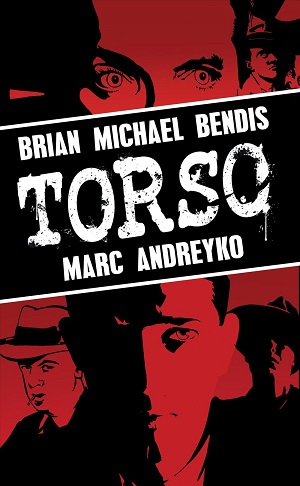 Torso is a six-part series based on the Cleveland Torso Murderer investigation. Though the killer was never apprehended, it’s assumed that he killed and then dismembered some 12 victims in the 1930s, leaving their body parts scattered around Cleveland (for fuller accounts of what happened, see here and here). So we’re definitely in true-crime noir territory here, as if you couldn’t tell from the stark black-and-white art inking every face half in shadow.
There’s also a documentary feel to the proceedings, underscored by cityscapes backlit with vintage photos. And for the most part, at least in the early going, creators Brian Michael Bendis and Marc Andreyko stick fairly close to the record, even including a gallery of newspaper archive clippings and pictures with this edition (though there’s no bibliography or suggested further reading; even 300 had suggestions for further reading!). On the other hand, some names have changed and made-up characters have been introduced. The drama is heightened and compressed. And at the end a climactic shootout in a burning human abattoir that is very Hollywood is wholly invented. But overall it’s not bad on that front. Just remember that it is a fictionalization, a historical graphic novel.
The presentation plays off different tensions. The separate chapters begin by taking us in and out of focus and commercial stippling. As with the shadow – and there is a lot of shadow in this book! – it seems the harder we look the less we see. Another tension is between static and dynamic. Stencil-like figures are repeated identically throughout the book, sometimes throughout entire scenes of dialogue and sometimes reappearing in different scenes in different chapters. But this stationary feeling is given a spin by a layout that zigs and zags around the page, or that requires you to turn the book on its side to read. One scene, Eliot Ness’s interview with the killer “Gaylord Sundheim,” even forces you to turn it all the way around as it’s written in a spiral.
That spiral page (or double-page spread) will annoy some people, but I thought it had a thematic point and worked well playing off the circling movement with the way figures are repeated over and over. Plus, it’s a one-off.
This is a stylish but not artificially artsy book that I rated very highly, though I’ll concede that it’s probably not for everyone. Don’t get hung up on it being an accurate account of the Cleveland torso murders and just enjoy it for the dark entertainment that it is.
 Alex Good
I can’t help imagining waht a figure you must cut in the local coffee shop with a copy of Torso and your cuddly lion bookmark.
It’s maybe a style thing, but do you need a full-stop after using a exclamation mark? I thought the exclamation mark doubles up, but I’m often wrong about these things, as you you.
LikeLike
The cuddly lion lures the unwary in. Then by morning all that’s left are torsos.
I don’t mind using an exclamation mark at the end of a parenthetical statement, as here. But people can argue endlessly over that I guess.
LikeLiked by 1 person
So, a “true crime, not true crime” comic. My goodness, the things you kids read these days. Somebody should do something!
~waves cane
LikeLiked by 1 person
Everything has gone to the bad. I need to review some Archie comics.
LikeLiked by 2 people
Archie vs Predator is a good comic 🙂
I enjoyed the heck out of it….
LikeLiked by 1 person
Looking forward to that. I just finished Afterlife with Archie and thought it was great.
LikeLiked by 2 people
I read it back in ’16:
LikeLiked by 1 person
That does sound like fun! I’m going to look for it. I did like the zombie Archie and (a little less) the werewolf Jughead.
LikeLiked by 2 people
I’d offer to let you borrow it, but I don’t have access any more. It was a netgalley thing, before I quit them too.
LikeLiked by 1 person
Library has it in so no problem.
Isn’t NetGalley for reviewers? So the publisher sent you a copy for the review?
LikeLiked by 2 people
Oh good!
Netgalley IS for reviewers. But reviewers request a book there and then the publisher decides if that request is given out or not (95% of the time it is. Most of the rejected requests are because of stupid geo-location rights. I was never able to review any Neal Asher’s polity books from there because it was restricted to the UK for his stuff).
LikeLiked by 1 person
stupid enter.
So kind of like a semi-exclusive library where it matters if you rate and leave a review.
I stopped using them when they used part of my review on a book cover. I loved the book and the author, but didn’t want that publicity, no matter how tiny.
LikeLiked by 1 person
You’re so shy!
LikeLiked by 2 people
Something like that.
I think it’s more about controlling my own data…
LikeLiked by 1 person
The twirly bits do sound annoying, but I’d never read this anyway so will stay serene.
LikeLike
Normally I’d agree wholeheartedly. But here there’s only the one double-page spread, and it does sort of fit with the story. If they’d done it twice though I would have been angry.
LikeLiked by 1 person