
Under the Bridge: The True Story of the Murder of Reena Virk
By Rebecca Godfrey
The crime:
On the night of November 14, 1996 14-year-old Reena Virk was attacked by a group of six teenage girls and one boy under the Craigflower Bridge in the town of View Royal on Victoria Island. Virk managed to walk away from the initial beating but was followed across the bridge by two of the gang – 15-year-old Kelly Ellard and 16-year-old Warren Glowatski – who then proceeded to further assault and then drown her.
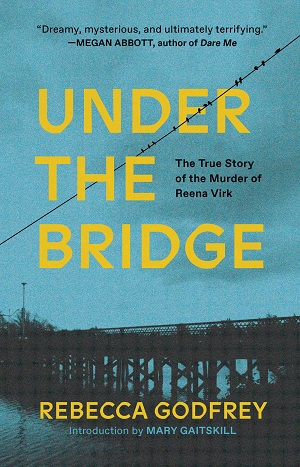 The book:
Rebecca Godfrey came to this book with solid credentials for the job, being raised in Victoria and having previously published a novel called The Torn Skirt about teenage girls in Vancouver who are involved in drugs, gangs, and prostitution. Under the Bridge isn’t what I’d call “novelistic” though, and its main literary flourishes are relatively subtle ones like the use of repetition for rhythmic effect. It’s a good read, and as a work of true crime it also indulges a more subjective point of view than you’d expect from say a journalist. But at the end of the day I wasn’t sure if this was a plus, or even if Godfrey really understood these kids all that well.
Moral judgment comes with the territory when writing true crime. One expects condemnation of the wicked and sympathy for their victims. And in what I have to say here I don’t want to be mistaken as saying that the wicked here weren’t truly wicked, and Virk not a tragic victim. But I felt that Godfrey was telling the story slant or leaving things out. Virk herself, for example, was a very troubled kid, but Godfrey doesn’t go into any of her history at all.
Obviously Godfrey despises the two main “bad girls”: Ellard and Nicole Cook (whose name is changed to “Josephine Bell” for legal reasons here). But Cook’s explanation of her initial motive for attacking Virk wasn’t “embarrassing and petty.” Apparently Virk had stolen an address book that belong to Cook and was phoning up Cook’s friends and spreading rumours about her, including that she had AIDS. “Her anger at Reena’s transgression,” Godfrey writes, “seemed to Josephine a perfectly normal response.” I think it was. Obviously things went much too far, but I can’t find fault with Cook being very angry at Virk. These things don’t just matter to high-school girls.
Then, much later, a big deal is made out of the low-cut red top Ellard wore to court the day she was granted a new trial. Most of the shock and outrage over this comes from the report of a journalist who attended the court that day, but Godfrey quotes it approvingly. And I wasn’t sure why. I see girls wearing more revealing outfits at the mall or walking around downtown all the time. Isn’t this just slut-shaming?
Godfrey’s loathing of Ellard and Cook is justifiable, though in examples like these I found her oddly out of touch with the lives of the people she was writing about. But what makes her telling of the story even more slant is that her attitude toward the girls is in marked contrast with the way she treats Warren Glowatski. She seems charmed by Glowatski, which is in keeping with the effect he is said to have had on many women, both girls his own age as well as teachers and parents. Was Godfrey another of his conquests? I can’t see why he gets off so easy here otherwise, as he seems to have been just as culpable as Ellard in Virk’s death. The main difference is that he appeared to be remorseful after the fact, but one can question how big a difference that should make or how sincere it was. Certainly Ellard didn’t do herself any favours with her long denial of any responsibility, but what are we to make of this description of Glowatski leaving the courtroom after the announcement of the verdict against him: “When he looked at the little boy [Virk’s brother], it was then that Warren knew, as if for the first time, what it was that he had really done.” How does Godfrey know this? Is it something Glowatski told her? It seems a sneaky way to enlist our sympathy and I wasn’t buying it.
That said, Godfrey does an exemplary job getting us through the many trials of Ellard quickly and efficiently, though the various police interviews come across as just pages of transcripts and the description of the high-school milieu and the personalities involved in the case struck me as missing something. Or a couple of things in particular . . .
Noted in passing:
Among the things Godfrey doesn’t talk about, I found it very odd that she didn’t explore the issues of race and sex more. Indeed, they’re both avoided entirely. I didn’t have any prurient interest, and wasn’t looking for salacious details, but I was wondering how sexually active these kids were. The suggestion is certainly made that boyfriends and girlfriends were having sex, but it’s just left at that.
Then the race of the various actors is also left largely unmentioned. The police would later declare that Virk’s murder wasn’t racially motivated (she was of Indian ethnicity), but this was later called into question. Meanwhile, the various high school gangs modeled a lot of their behaviour after American “gangsta” or rap culture, with one group even calling themselves the Crips. This all seems ridiculous now but probably really did mean something at the time to the kids in question. But what? Were these mostly white high schools? Was the girl (Godfrey names her “Dusty”) who wrote “Niggers rule” on the group-home wall in strawberry jam even Black? Or was this just the kind of thing white suburban kids said in the 1990s?
I don’t think Godfrey needed to go into these matters very deeply, but leaving race and sex totally out of the book seemed like quite an omission. I’m sure they both played a part in what happened.
A more minor point I flagged came when the school guidance counselor asked Glowatski if he’d come in with his girlfriend and talk to some of her other students about “being a couple. A nonviolent couple.” She wanted them to present as role models that “worked out their problems non-violently.”
Really? They were 15 years old. It reminded me of Anissa Weier, one of the girls involved in the Slenderman assault, being part of a program in her high school “helping younger students . . . make good decisions and stay out of trouble.” Would Glowatski be a better role model than her? But I guess the guidance counselor adored Warren, so thought it would be a good idea.
In any event, I understand kids listen to their peers more than they listen to adults, but this still struck me as weird. Were there that many “violent couples” among these adolescents that this was an issue needing to be addressed? Again I have to think that Godfrey might have gone into more detail about the nature of these relationships in order to provide some context.
Takeaways:
It’s easy for adults to forget, or just not appreciate, how truly hellish an experience high school is for many kids.
 Alex Good
Glowatski must have been a right piece of work, as the girl’s parent apparently forgave him and he was rehabilitated and released from his life sentence in 2010. I looked up a newspaper report after reading your post, there was a TV programme called Under The Bridge about it, but I missed that.
I wonder how the other 6 involved but not prosecuted got on with their lives. Do you just grow up and be kind of normal after being involved in something like this.
LikeLike
I think Glowatski got a lot of credit for accepting some responsibility and being repentant, which contrasted with Ellard’s stance. But as far as actual culpability went in the murder, they were both in it together.
Young people do tend to put these things behind them. You sort of build a wall around it and move on.
LikeLiked by 1 person
We’ve had one recently in the news where a girl and boy killed another teen who was first a boy but then a girl, not sure that was the reason but it was pretty awful what they did. Both jailed now and blamed each other. It’s hard to understand.
LikeLike
It’s true that young people do a lot of stupid stuff. Less impulse control, hormones, etc. I know I did some bad things when I was young. Murder is really going off the rails though. But I don’t think it’s a sign of the times as there have always been child killers.
LikeLiked by 1 person
Yes, we’ve had a few over the years here.
LikeLike
What kind of finishing school did you go to? Cold showers, rugger and tiffin with Nana in the evening?
LikeLike
It made me the man I am today. I probably should have gone somewhere else.
LikeLike
Homeschooling. That won’t solve all the problems but it sure will prevent a lot.
LikeLike
It would have some benefits, especially over really bad schools.
LikeLiked by 1 person
It’s more about forcing the parents to take some responsibility in their kids’ lives. It’s just easier for parents to evade that when there is a state paid baby sitting service….
LikeLike