
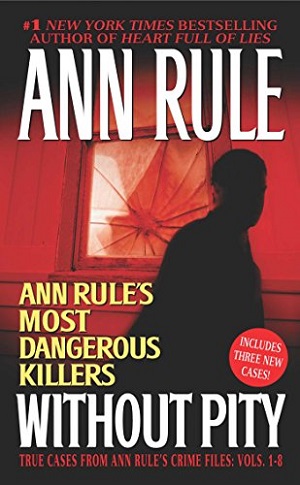
Without Pity: Ann Rule’s Most Dangerous Killers
By Ann Rule
The crimes:
“The Tumbledown Shack”: the still unsolved case of two young women found murdered in a remote shack in 1975. A man confessed, but he was mentally unstable and the police were never sure if he was telling the truth.
“Dead and on Tape”: a paranoid petty criminal records his own murder at the hands of a dirty cop.
“Fatal Obsession”: a bank manager (well, vice president of personnel) has a breakdown and kills his wife and son.
“Campbell’s Revenge”: a giant brute goes to prison for raping a woman. He gets early work release and returns to kill her and her child along with a neighbour.
“One Trick Pony”: a man decides to kill his wife rather than bother with a costly divorce. He tries to make it look like one of her horses kicked her in the head, a story that the police buy but that her sister doesn’t.
“The Last Letter”: an Alaskan businessman falls in love with a younger woman, who he eventually divorces his wife to marry. He becomes an alcoholic, loses all his money, and kills her, but not before mailing out a dozen or more copies of a long letter he’d written blaming her for everything that happened.
“I’ll Love You Forever”: A con man marries a wealthy widow, takes out an expensive life insurance policy on her, then throws her off a cliff.
“Murder and the Proper Housewife”: a woman hires the grown-up version of a kid she used to know to kill her friend’s estranged husband. Because that’s what friends are for, I guess. “To this day, I’m not sure why they did what they did,” Rule says in her introduction.
“The Most Dangerous Game”: a pair of naïve Seattle teens run away from home to rough it in the Cascades. In winter. The cold turns out to be the least of their worries though when they meet up with a weirdo who tries to kill them.
“The Killer Who Never Forgot . . . or Forgave”: race car-driver husband kills his wife and baby after taking out a double indemnity policy on their lives. Just a stupid and sad story.
“The Lost Lady”: Marcia Moore, a wealthy New Age/spiritualist, disappears while experimenting heavily with ketamine. Her remains are later discovered but there are no messages sent back from the other side and it’s never determined what actually happened to her.
“The Stockholm Syndrome”: a young couple go camping in the woods and a psycho drifter kills the husband and gets the wife to go along with his story of it being an accident. Later, she recants.
 The book:
This is a collection of stories previously published in volumes 1-8 of Ann Rule’s Case Files. Things kick off with three new cases, and there are brief introductions and even briefer updates to a few of the reprints to basically just let us know if the perps have died in the meantime. In other words, the book itself feels very much like a cash grab, with the publisher banking on Rule’s name to repackage some old material.
There doesn’t even seem to be any thematic cohesion. Look over the case summaries and see if you can find any connecting threads. In a very brief introductory Author’s Note Rule tells us that “Some [of the perpetrators] are wealthy and some are drifters, but they all have a special gift with words, a rather negative talent that lets them hide what they really think from friends, enemies, victims, and even detectives – for a while.” Was that the case with Charles Rodman Campbell? Or the bank manager in “Fatal Obsession”?
Nor does the title help much. I doubt very much if these were Ann Rule’s “most dangerous killers.” Some of them weren’t even killers, but just attempted murder. Then there are the comic pair in “Murder and the Proper Housewife.” They were nearly as big a danger to themselves. And why Without Pity? I suppose anyone who plans murder is missing some degree of empathy, but even here it feels like this was generic verbiage and just part of the packaging, in no way a reflection of the book’s contents.
You’ll have guessed I wasn’t thrilled by this one. Even the photo section is terrible, with pictures so blurry I honestly had no idea what some of them were supposed to be of, despite being labeled. But sticking with the text, if these were the greatest hits from Ann Rule’s Case Files I don’t feel inspired to go back and read any more (though I probably will). I also trust Rule’s judgment in determining which cases were worth full book-length treatment and which weren’t. None of these did (though her one novel, Possession, was based on the case related in “The Stockholm Syndrome”). I think part of what turned her away from exploring these particular cases in more depth is that there just wasn’t enough in the way of character and motive to go on. I found myself particularly mystified by the events of “Dead and on Tape.” What was going on there? Did anyone ever find out?
If there’s no common thread there are at least some recurring themes. The most interesting of these I found to be the American urbanite’s nightmare vision of the backwoods, the lost traveler landing up in Deliverance or Texas Chain Saw Massacre country. The girls who went to orchard country at harvest time and ended up dead in “The Tumbledown Shack.” The even younger girls who went roughing it in the bush in “The Most Dangerous Game.” The young couple who were ambushed when led off the beaten path in “The Stockholm Syndrome.” If true crime caters to our curiosity with horror it’s no surprise that there’s a strain of it that’s shared with one of the most popular tropes in horror films: the sinister cabin in the woods, the wrong turn off the highway, nature not as a source of spiritual renewal but as destroyer.
Noted in passing:
In the first story, “The Tumbledown Shack,” Washington’s Lake Chelan is called “the second largest inland lake in America.” When I read that I didn’t understand what it meant. I’d never heard of Lake Chelan and when I went to look for it in a compact atlas I keep handy I couldn’t even see it marked.
It’s a long, thin body of water but is nowhere near the second largest lake in the U.S. In fact, when I went to check on Wikipedia it ranked 97th in size. Even if you discount binational lakes, like four of the five Great Lakes and Lakes Champlain and St. Clair, it’s still way down the list. This made me wonder where Rule was getting her information. Does “inland lake” have a special meaning? Aren’t all lakes inland by definition? I did find one website that said that the designation “inland lake” excludes the Great Lakes, but I wasn’t sure why. Because they have an outlet to the ocean? Even if that is part of the definition I still don’t think Lake Chelan ranks so high.
Takeaways:
When a wife or husband is murdered, the surviving spouse is usually the prime suspect, and for good reason. That being the case, taking out an insurance policy on one’s wife only a month or so before killing her is being a little too obvious.
 Alex Good
Most Scottish lochs have an outlet; Loch Ness has one that allows Nessie to escape to the North Sea and evade detection. FacT!
LikeLiked by 1 person
Isn’t there some big thingy going on to find her? Think I saw it advertised somewhere.
LikeLiked by 1 person
I took a picture of her when I visited back in ’76. Have to look for it.
LikeLiked by 2 people
That was lucky! I only got a stuffed fluffy version.
LikeLiked by 1 person
Yes, there is a big Nessie hunt planned.
LikeLiked by 1 person
Are you attending?
LikeLike
But are they “inland lakes”? I just can’t figure how this pond I’d never heard of was ranked second largest in the U.S.
LikeLiked by 1 person
So it’s a kind of ‘best of’ from Rule’s other books, sounds like a cash cow to me.
LikeLiked by 1 person
Rule wrote a lot of books, and there are a lot of these “best of” books drawn from them. They probably could have started a series of the best of the best of collections. She really did become a brand.
LikeLiked by 2 people
Is she dead now?
LikeLiked by 1 person
I think so. (Quick check.) Yep, died in 2015.
LikeLiked by 2 people
Would be cool if she was murdered, they make a movie for that!
LikeLiked by 1 person
Lived to a ripe old age. Odd story though about that on her Wikipedia page. Apparently her two sons had been charged with theft against her just before she died (of heart failure), and when she died the charges were dropped. Actually sounds pretty awful.
https://www.huffpost.com/entry/ann-rule-sons-theft_n_7111854
LikeLiked by 2 people
That is sad.
LikeLike